Release Sign-Off
Release Sign-Off is the formal approval that confirms a software release is ready to move to production. Software delivery involves many stages: requirement analysis, design, development, testing, defect fixing, regression, user acceptance, release planning, deployment preparation, and post-release validation. Even when all major testing activities are complete, a product should not be released only because the planned date has arrived. The team needs a clear, documented decision that the release is acceptable from quality, business, and operational perspectives. That decision is captured through release sign-off.
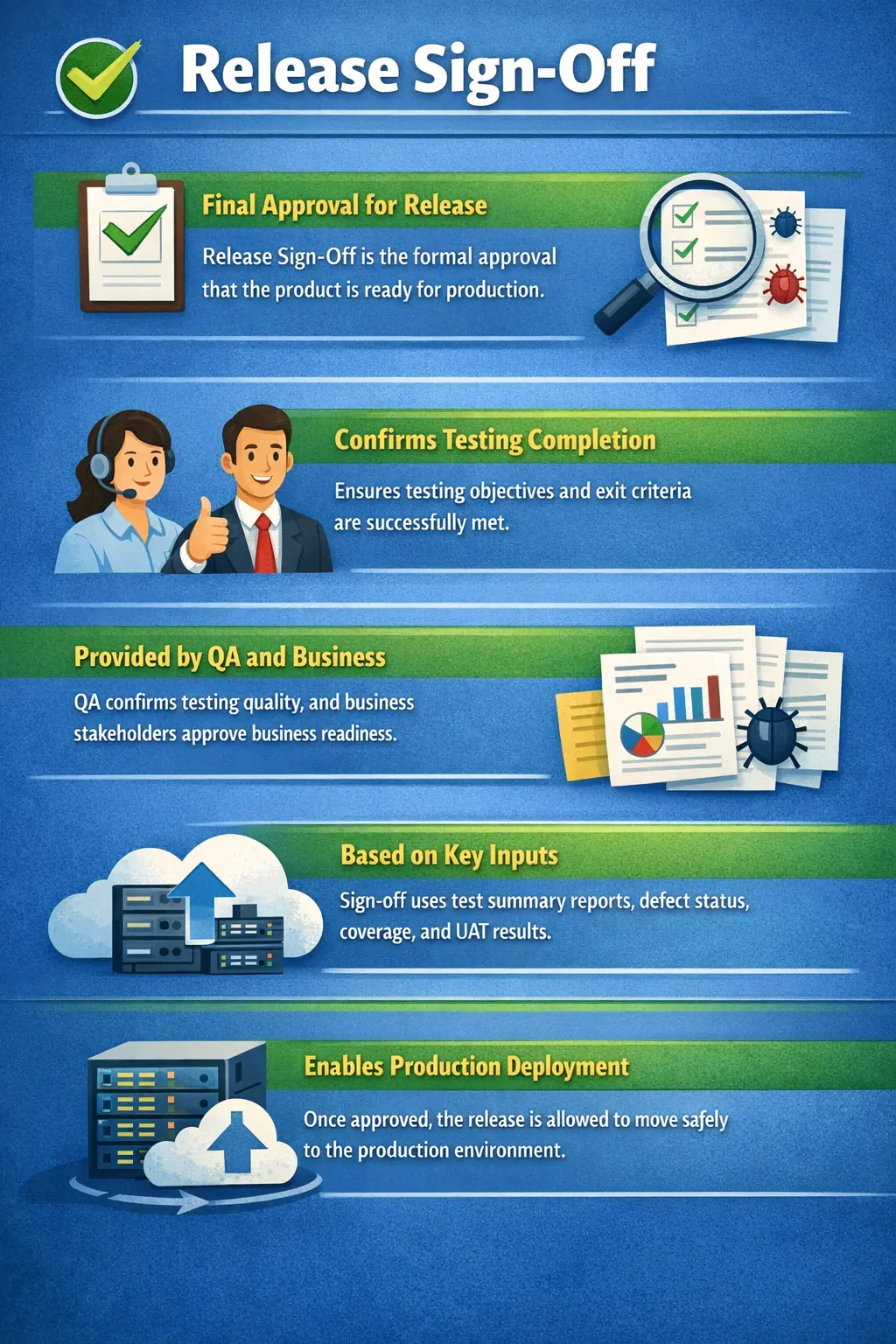
Release sign-off answers a crucial question: are we confident enough to release this system to production? This question is not as simple as asking whether all test cases passed or whether every defect is fixed. In real projects, some low-risk defects may remain open, some change requests may be deferred, and some limitations may be accepted by the business. Release sign-off ensures that these decisions are visible, documented, reviewed, and agreed upon by the right stakeholders before deployment.
A release sign-off is both a quality checkpoint and a governance activity. From a quality perspective, it confirms that testing objectives have been met, critical risks have been addressed, and the product has reached an acceptable level of stability. From a governance perspective, it records who reviewed the release, what evidence was considered, what risks remain, and who approved moving forward. This documentation is important for accountability, audits, compliance, and future reference.
Release sign-off does not mean the software is perfect. No serious testing professional should claim that a release is defect-free. Instead, sign-off means the known quality status is acceptable for release. It means stakeholders understand the test results, open issues, residual risks, deployment readiness, and business impact, and still agree that the release can proceed. This distinction is important because release decisions are about risk management, not absolute certainty.
Understanding Release Sign-Off
Release sign-off is the formal process through which responsible stakeholders approve a software release for production deployment. It usually happens after planned testing is complete, defects are reviewed, exit criteria are evaluated, and business readiness is confirmed. The process may be lightweight in small Agile teams or formal in regulated enterprise environments, but the purpose remains the same: make the release decision explicit and accountable.
In many organizations, release sign-off is supported by documents such as a test summary report, defect status report, release readiness checklist, deployment checklist, UAT completion note, risk assessment, and rollback plan. These documents help stakeholders make a decision based on evidence rather than pressure or assumption. The sign-off may be captured through an email approval, a ticket workflow, a release management tool, a signed document, or minutes from a Go/No-Go meeting.
A good sign-off process does not hide uncertainty. It clearly shows what was tested, what was not tested, which defects remain open, what workarounds exist, which risks are accepted, and which teams are ready for deployment. This transparency protects the organization. If an issue appears in production later, stakeholders can trace what was known at release time and why the decision was made.
Release sign-off is especially important when multiple teams are involved. Development may confirm code readiness, QA may confirm testing status, business users may confirm acceptance, operations may confirm deployment readiness, and support teams may confirm readiness to handle user issues. Sign-off brings these perspectives together into one final release decision.
Purpose of Release Sign-Off
The first purpose of release sign-off is to confirm that testing exit criteria have been met. Exit criteria define the conditions required to conclude testing. These may include completion of planned test execution, acceptable pass percentage, no open critical defects, completion of regression testing, completion of UAT, and review of known issues. Sign-off ensures these conditions are not ignored when release pressure increases.
Another purpose is risk transparency. Every release carries some risk. A new feature may affect existing workflows. A defect may be deferred. A configuration change may depend on external systems. A data migration may carry operational risk. Release sign-off ensures that these risks are not hidden. They are reviewed, documented, and consciously accepted or mitigated.
Sign-off also establishes accountability. When stakeholders approve a release, they acknowledge the current quality status and accept the decision to proceed. This does not mean blame is assigned if a production issue occurs. It means the decision was made responsibly using available information. Accountability improves discipline and prevents informal, uncontrolled deployments.
Release sign-off also helps create an audit trail. In regulated industries such as banking, healthcare, insurance, telecom, and government systems, organizations may need evidence that releases were reviewed and approved before deployment. Sign-off records can show that testing was performed, defects were assessed, risks were reviewed, and authorized stakeholders approved the release.
Stakeholders Involved in Release Sign-Off
Release sign-off usually involves both technical and business stakeholders. The QA lead or test lead plays a major role by presenting the testing status, test execution summary, defect status, coverage, residual risks, and recommendation from a quality perspective. QA does not always own the final release decision, but QA provides some of the most important evidence behind that decision.
Business stakeholders or product owners provide business acceptance. They evaluate whether the application meets operational needs and whether any remaining issues are acceptable from a business standpoint. A low-severity defect may be technically minor but business-sensitive. Conversely, a visible UI issue may be acceptable if it does not affect critical operations. Business judgment is essential.
Project managers or delivery managers may participate to confirm project scope, schedule, dependencies, and communication readiness. Development leads may confirm code readiness, fix status, technical constraints, and deployment package readiness. DevOps or operations teams may confirm environment readiness, deployment steps, monitoring, access, backups, and rollback capability.
Support or customer service teams may also be involved for customer-facing releases. They need to know what is changing, what known issues exist, and how to respond if users report problems. In mature release processes, sign-off is not only a QA checkpoint; it is a cross-functional readiness agreement.
Inputs Reviewed Before Release Sign-Off
A release sign-off decision should be based on concrete inputs. One of the most important inputs is the Test Summary Report. This report summarizes what testing was performed, how many test cases were planned and executed, pass and fail status, defect summary, coverage, unresolved issues, and the QA recommendation. It gives stakeholders a consolidated quality view.
Defect status is another critical input. Stakeholders review open defects by severity, priority, module, business impact, and fix plan. The key concern is not merely the number of open defects, but their risk. One unresolved critical defect may block release, while several minor cosmetic defects may be accepted if documented and scheduled for later.
Test coverage metrics are also reviewed. Requirement coverage, scenario coverage, regression coverage, risk coverage, and automation coverage may all contribute to confidence. If important areas were not tested, stakeholders must understand why and decide whether the release risk is acceptable. Untested scope should never be silently ignored.
UAT results are often part of sign-off. If business users completed User Acceptance Testing successfully, that strengthens release confidence. If UAT was skipped, incomplete, or waived, the reason should be documented. Production readiness inputs are also important, including deployment plan, environment readiness, monitoring readiness, rollback plan, data migration status, and communication plan.
Release Sign-Off Criteria
Release sign-off criteria define what must be true before the release can be approved. These criteria vary by organization, but common examples include completion of planned testing, closure of all critical defects, review of high-severity defects, completion of regression testing, successful smoke testing in the release candidate environment, and completion of UAT or formal UAT waiver.
A common criterion is that no critical or blocker defects remain open. Critical defects are issues that prevent essential business operations, cause severe data loss, create security exposure, or make the system unusable. Releasing with such defects usually requires exceptional approval and strong mitigation, if it is allowed at all.
High and medium severity defects may remain open in some releases, but they must be reviewed. Stakeholders should understand the affected area, business impact, workaround, fix timeline, and risk owner. A deferred defect should not disappear from attention. It should be tracked after release and planned for a future fix.
Another important criterion is rollback readiness. Even a well-tested release can encounter production issues. A rollback or mitigation plan gives the team a controlled response if deployment fails. Sign-off should confirm that the team knows how to restore service, disable a risky feature, or route traffic back to a stable version if needed.
Manual Tester’s Role in Release Sign-Off
Manual testers contribute to release sign-off by providing accurate testing evidence. They execute test cases, update results, log defects, verify fixes, perform regression checks, validate critical workflows, and communicate risks. The quality of sign-off depends heavily on the accuracy of this information. If test results are not updated properly, stakeholders may make decisions based on unreliable data.
Testers often support preparation of the test summary report. They may provide execution counts, pass/fail status, blocked scenarios, defect details, retest status, regression results, and known limitations. Testers also help identify residual risks, such as areas tested with limited data, scenarios blocked by environment issues, or modules affected by late changes.
Another important responsibility is defect disposition validation. Before sign-off, testers help confirm whether defects are fixed, retested, closed, deferred, duplicate, rejected, or accepted as known issues. Incorrect defect status can mislead stakeholders. A defect marked closed without proper retesting can create production risk.
Testers also support honest communication. Release pressure can make teams overly optimistic, but QA must present quality status clearly. A tester should not exaggerate risks, but should not hide them either. Professional release sign-off depends on factual, balanced reporting.
Release Sign-Off vs Go/No-Go Decision
Release sign-off and Go/No-Go decisions are closely related, but they are not the same. A Go/No-Go decision is usually made in a release readiness meeting where stakeholders discuss whether the release should proceed. The meeting may review testing status, defects, deployment readiness, business approval, operational readiness, and support readiness.
Release sign-off is the formal record of approval that follows or captures that decision. The Go/No-Go discussion is the decision-making activity. The sign-off is the documented confirmation. In some organizations, they happen together. In others, the Go decision is made in a meeting and then recorded through a sign-off email, ticket, workflow approval, or document.
Understanding this distinction helps testers communicate correctly. During Go/No-Go, QA may present a recommendation such as “QA recommends Go with known low-risk issues” or “QA recommends No-Go due to open critical defects.” Release sign-off records the final approved outcome and the stakeholders who accepted it.
Common Risks Reviewed Before Sign-Off
One common risk is untested scope. This may happen when requirements change late, environments are unavailable, test data is missing, or timelines are compressed. Untested scope should be explicitly listed in sign-off materials. Stakeholders must decide whether to delay release, test further, or accept the risk.
Open defects are another major risk. Even non-critical defects can matter if they affect important customers, compliance, revenue, or brand perception. The sign-off process should review defect impact, not just severity labels. A defect with a medium severity label may still be unacceptable if it affects a high-value workflow.
Environment and deployment readiness are also reviewed. Production must be prepared with correct configuration, infrastructure capacity, monitoring, alerts, access, backups, certificates, integrations, and deployment scripts. A technically good release can fail if production readiness is weak.
Data migration risk is important when releases involve moving, transforming, or backfilling data. Teams should confirm migration testing, validation approach, backup plan, and rollback strategy. Performance, security, integration, and compatibility risks may also be reviewed depending on release scope.
Common Mistakes in Release Sign-Off
A common mistake is treating sign-off as a formality. If sign-off is reduced to a routine email with no real review, it loses value. The process should involve meaningful evaluation of test results, defects, risks, and readiness. A rushed sign-off can lead to production issues that could have been prevented.
Another mistake is hiding or softening known risks. Teams sometimes avoid highlighting issues because they fear delaying release. This is dangerous. Sign-off is not about making the report look good; it is about making an informed decision. A known risk that is documented and accepted can be managed. A hidden risk can surprise everyone later.
Missing business acceptance is also a serious problem. QA may confirm that testing passed, but the business must confirm that the release supports operational needs. If business stakeholders are not involved, the release may be technically stable but still unacceptable to users.
Another mistake is approving release without rollback readiness. Even strong testing cannot guarantee production success. A rollback or mitigation plan is part of responsible release management. Sign-off should confirm that the team is prepared if deployment does not go as expected.
Real-Time Example
Consider a banking application release that includes changes to account statements, transaction search, and notification preferences. QA completes functional testing, regression testing, and integration testing. UAT is completed by business users. The test summary report shows 98 percent execution completion, 95 percent pass rate, no open critical defects, two medium defects related to statement formatting, and one low defect related to UI alignment.
During the release readiness meeting, QA explains that all critical money movement flows were regression tested and passed. The business reviews the two medium defects and confirms that they do not affect statement accuracy, only formatting under a rare condition. The product owner accepts the risk and agrees that the fixes can be included in the next maintenance release. DevOps confirms deployment steps, monitoring, and rollback plan.
Based on this evidence, stakeholders approve release sign-off. The sign-off document records test status, accepted defects, business approval, deployment readiness, and rollback availability. If a question arises later, the organization has a clear record of why the release was approved and what risks were accepted.
Interview-Ready Explanation
In interviews, release sign-off can be explained as the formal approval given before production deployment after reviewing testing status, defect status, coverage, UAT results, risks, and release readiness. It confirms that testing objectives have been met and that stakeholders accept the remaining risks.
A strong answer should clarify that release sign-off does not mean the application is defect-free. It means the known quality status is acceptable for release. Mentioning test summary reports, exit criteria, open defect review, UAT completion, rollback plans, and stakeholder approval demonstrates practical understanding.
A concise interview answer could be: Release sign-off is the formal approval from QA and business stakeholders that a release is ready for production. It is based on test completion, defect status, coverage, UAT results, and risk assessment. It documents that stakeholders understand and accept the remaining risks before deployment.
Key Takeaway
Release sign-off is the final formal approval that confirms a software release is ready for production deployment. It brings together testing evidence, business acceptance, defect status, risk assessment, deployment readiness, and stakeholder accountability. Its purpose is not to claim perfection, but to ensure a transparent and responsible release decision.
Effective sign-off protects both the product and the organization. It prevents uncontrolled deployments, exposes known risks, documents acceptance, and confirms readiness across QA, business, development, operations, and support teams. When performed seriously, it strengthens release governance and production confidence.
Ultimately, release sign-off provides the final assurance that the system is ready to be used by real users and that responsible stakeholders understand the quality status before production deployment begins.