Release Readiness Assessment (RRA)
In modern software development, releasing an application is not just the final step in a project plan. It is a business decision that affects users, operations, support teams, revenue, reputation, and future confidence in the product. Even when development is complete and testing has been performed, a release should not move to production automatically. The team must understand whether the build is stable, whether critical workflows are tested, whether open defects are acceptable, whether stakeholders know the remaining risks, and whether deployment teams are prepared. Release Readiness Assessment, commonly called RRA, provides this structured evaluation before the application goes live.
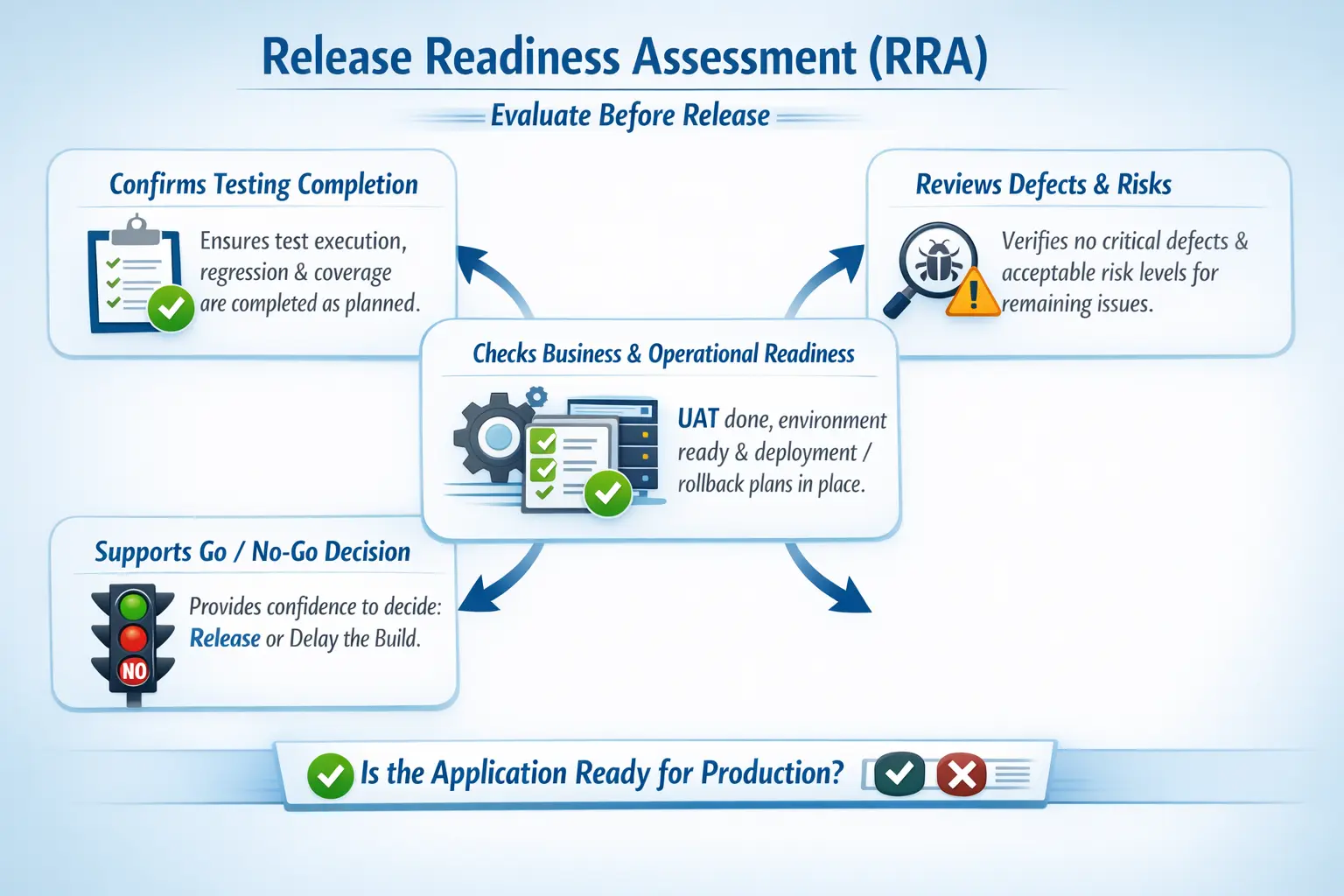
Release Readiness Assessment transforms release decisions from guesswork into evidence-based discussion. Instead of saying "testing is mostly done" or "the build looks fine," the team reviews test execution status, defect status, requirement coverage, UAT outcome, environment readiness, operational preparation, and residual risks. This creates a clear picture of quality and helps stakeholders make a conscious go or no-go decision.
RRA is not about proving that the application has zero defects. No realistic testing process can guarantee that. The purpose is to determine whether the known quality level is acceptable for release. It helps the team avoid blind launches, hidden risks, last-minute confusion, and avoidable production failures. In manual testing, RRA is especially important because testers often provide the clearest view of what was tested, what failed, what remains open, and what risks still exist.
What is Release Readiness Assessment?
Release Readiness Assessment is a formal evaluation performed before production deployment to decide whether a build is functionally stable, sufficiently tested, operationally prepared, and acceptable for release. It answers a direct and important question: are we truly ready to release this build? The answer should be based on facts, not pressure, assumptions, or optimism.
In practical terms, RRA reviews whether testing is complete, whether exit criteria are met, whether critical defects are closed, whether open defects are understood, whether regression testing is completed, whether UAT sign-off is available if required, and whether deployment and rollback plans are ready. It brings QA, development, business, product, release management, and operations together around the same release-quality view.
A good way to explain RRA in an interview is this: Release Readiness Assessment is a structured review of testing results, defect status, coverage, business acceptance, environment stability, and operational preparedness before production deployment. It helps stakeholders make informed go/no-go decisions by making quality and risk visible.
Why Release Readiness Assessment Is Important
Release Readiness Assessment is important because modern releases are frequent, fast, and interconnected. A small production issue can affect many users if the application is integrated with payments, reports, authentication, notifications, external services, or customer-facing workflows. Without a readiness assessment, teams may release a build that has incomplete testing, unresolved critical risk, unstable configuration, or poor operational preparation.
One of the main purposes of RRA is to validate whether planned testing activities have actually been completed. During a busy release, teams may skip some test cases, reduce regression scope, delay retesting, or leave blocked scenarios unresolved. RRA forces the team to review these gaps explicitly. If something was not tested, it should be known and discussed before release, not discovered after users are affected.
RRA also helps assess residual risk. Every release carries some risk. There may be low-priority defects, known limitations, environment dependencies, untested edge cases, or deferred enhancements. The problem is not always the existence of risk; the bigger problem is hidden risk. Release Readiness Assessment ensures that remaining risks are documented, communicated, and accepted by the right stakeholders.
Another important value of RRA is that it checks business and operational readiness, not only technical readiness. A build may pass functional testing but still be risky if UAT is incomplete, support teams are not informed, monitoring is not configured, rollback is not planned, or deployment instructions are unclear. A good readiness assessment looks at the release as a complete business event.
When Release Readiness Assessment Is Performed
Release Readiness Assessment is usually performed at key milestones before production deployment. In a traditional project, it may happen after system testing and UAT are completed. In Agile teams, it may happen near the end of a sprint, before a planned release train, before an incremental deployment, or before enabling a feature flag for users. The frequency depends on how often the organization releases and how much business risk is involved.
RRA is commonly performed after system testing, after UAT, before production deployment, before hotfix releases, before emergency patches, and before major feature rollouts. Even for hotfixes, readiness assessment matters because emergency changes can introduce side effects if they are pushed without validation.
In Agile or DevOps environments, readiness assessment may be lighter and more frequent, but it should not disappear. Continuous delivery does not mean careless delivery. It means teams need faster and clearer readiness signals. A lightweight checklist, automated test results, QA recommendation, defect review, and deployment readiness confirmation can still provide strong release control.
Key Dimensions of Release Readiness
Release readiness cannot be judged by one number. A test pass percentage alone does not prove readiness. A build with 98 percent passed test cases may still be unsafe if the failed cases belong to payment, login, data privacy, or critical reporting. A release must be evaluated across multiple dimensions: testing readiness, defect readiness, requirement and scope readiness, UAT readiness, environment readiness, configuration readiness, and operational readiness.
Testing readiness focuses on whether planned testing activities are complete. The team checks whether test cases were executed, whether planned smoke, sanity, functional, regression, integration, and exploratory testing were performed, whether blocked cases were resolved, and whether test coverage is acceptable. The depth of testing matters as much as the execution percentage. If only simple happy paths were executed, readiness may still be weak.
Defect readiness focuses on the status and impact of defects. A release is generally not considered ready if critical defects remain open. High and medium defects must be reviewed carefully. Some defects may be accepted by the business if their impact is low, workaround exists, or the affected feature is not part of the release. However, this acceptance must be explicit. Unreviewed defects are dangerous because stakeholders may not understand the real risk.
Requirement and scope readiness ensures that committed requirements have been tested and that deferred scope is documented. A Requirement Traceability Matrix or similar coverage mapping helps confirm that requirements are linked to test cases and execution results. Untested requirements create unknown risk, which is often more dangerous than known defects.
UAT readiness focuses on whether business users have validated the product. QA confirms that the system works according to requirements, but UAT confirms that the system supports business expectations. If UAT defects remain open, they must be reviewed and accepted before release. Business sign-off is important when the release affects real users, operations, financial workflows, or customer commitments.
Environment and configuration readiness ensures that the release is validated in a production-like setup. Many production issues happen not because the code is wrong, but because configuration, feature flags, endpoints, roles, certificates, or environment variables differ from test environments. Readiness assessment should confirm that deployment configuration is reviewed and that important production-like settings are validated.
Operational readiness focuses on deployment and support. A release may be functionally stable but still risky if the deployment plan is unclear, rollback steps are missing, monitoring is not configured, support teams are not ready, or incident contacts are unknown. RRA should confirm that the team can deploy, monitor, support, and recover if something goes wrong.
Manual Tester’s Role in Release Readiness
Manual testers play an important role in Release Readiness Assessment because they understand the practical testing status of the product. They know which flows were executed, which defects were found, which fixes were retested, which areas received regression coverage, which cases were blocked, and which risks still remain. Their input helps stakeholders make a decision based on real evidence.
A tester’s responsibility is to provide an honest and accurate quality assessment. This includes test execution status, defect distribution by severity, coverage details, regression results, blocked scenarios, known issues, and untested areas. Testers should also explain the business impact of risks rather than only sharing numbers. For example, saying "two high defects are open" is useful, but saying "two high defects are open in payment retry and invoice generation" is much more meaningful.
Testers should participate in readiness review meetings and explain the QA recommendation clearly. If the release is ready, they should state the basis for that recommendation. If risks remain, they should explain those risks without hiding them. One of the most important responsibilities is avoiding green washing. Green washing means presenting everything as healthy just to make the status look good. A professional tester gives transparent information, even when it is uncomfortable.
Release Readiness Checklist from QA View
A structured checklist helps make Release Readiness Assessment consistent. From a QA perspective, the checklist should confirm whether exit criteria are met, planned test cases are executed, regression testing is completed, smoke and sanity testing are passed, no critical defects remain open, high and medium defects are reviewed, blocked cases are resolved or accepted, and the test summary report is prepared.
The checklist should also include requirement coverage, RTM status if applicable, UAT completion, known risks, deferred defects, environment issues, production smoke plan, rollback awareness, and QA recommendation. The purpose of the checklist is not to create paperwork. It ensures that important readiness factors are not forgotten during release pressure.
A practical QA readiness statement may say: "Regression testing is completed for critical business flows. No critical defects are open. Two medium defects remain open and are accepted by business. UAT sign-off is received. Known risks are documented. QA recommends release with monitoring." This kind of statement gives stakeholders enough context to decide responsibly.
Release Readiness vs Release Sign-Off
Release Readiness Assessment and Release Sign-Off are closely connected, but they are not the same. Release Readiness Assessment evaluates whether the build appears ready for release based on quality, coverage, risk, and operational factors. It provides the information needed for decision-making. Release Sign-Off is the formal approval to proceed with the release.
In simple terms, RRA answers, "Should we release?" Release sign-off answers, "We approve the release." QA may provide a recommendation during RRA, but the final release approval may involve product owners, business stakeholders, release managers, operations, or leadership depending on the organization.
This distinction is useful in interviews. A tester should not claim that QA alone always approves production release. QA provides quality evidence and risk analysis. Business and release stakeholders usually make the final go/no-go decision based on that evidence.
Common Risks Identified During RRA
Release Readiness Assessment often reveals risks that might otherwise be hidden. One common risk is incomplete testing due to time constraints. When deadlines are tight, teams may skip low-priority cases, reduce regression scope, or leave edge cases untested. RRA makes these gaps visible so stakeholders can decide whether the remaining risk is acceptable.
Environment-related risk is another frequent finding. A feature may work in QA but fail in production because configuration values, endpoints, feature flags, roles, or external integrations are different. RRA should highlight any environment mismatch or unvalidated production-like configuration.
Untested edge cases and boundary conditions are also common release risks. The happy path may be stable, but rare scenarios such as expired sessions, maximum limits, retry flows, failed payments, or unusual role combinations may still be weak. Depending on business impact, these gaps may require additional testing or risk acceptance.
Another risk is defect concentration in one module. If many defects were found in a specific area, that module may be unstable even if the latest build has fewer open defects. Defect trends, reopened defects, and repeated failures provide deeper insight than current defect count alone.
Common Mistakes in Release Readiness
One common mistake is treating RRA as a formality. If the team conducts a readiness meeting only to approve a release that has already been decided, the process loses value. RRA should be a real evaluation where risks can be discussed and decisions can still be influenced by quality evidence.
Another mistake is relying only on metrics. A high pass percentage, low defect count, or completed test cycle does not automatically mean the product is ready. Metrics must be interpreted in context. Which tests passed? Which areas failed? Are open defects business-critical? Were important scenarios skipped? What trends are visible? These questions matter more than isolated numbers.
Hiding known issues is a serious readiness mistake. If a tester or team hides risks to show a green status, production surprises become more likely. Transparency is essential. Stakeholders can accept risk only if they know it exists. Rushing the readiness assessment due to deadlines is also risky because release pressure is exactly when structured evaluation becomes most important.
Real-Time Example
Consider an e-commerce application preparing for release. Test execution is 95 percent complete, no critical defects are open, UAT is completed, and most regression cases have passed. At first glance, the release may appear ready. However, during RRA, the QA team highlights two high-severity defects in the payment module. One defect affects payment retry logic, and another affects the display of payment failure messages.
The team reviews the impact. If payment retry is unstable, some customers may face issues after failed payment attempts. The business checks transaction volume, available workaround, support readiness, and monitoring options. The release team confirms that rollback is possible if payment errors increase. Based on this information, stakeholders may decide to proceed with caution, delay the release, disable the risky feature, or deploy with enhanced monitoring.
This example shows that RRA is not about making a perfect decision. It is about making an informed decision. The same build can be released or held depending on business impact, risk tolerance, workaround, monitoring, and stakeholder acceptance.
Interview-Ready Answers
A short interview answer can be: "Release Readiness Assessment is a structured evaluation performed before production release to confirm whether testing is complete, defects are controlled, risks are known, and the build is ready for deployment." This answer is concise and covers the purpose clearly.
A detailed answer can be: "Release Readiness Assessment evaluates test execution status, defect status, regression completion, requirement coverage, UAT sign-off, environment readiness, operational readiness, and residual risks. It helps stakeholders make an informed go/no-go decision by showing whether the release is functionally stable and whether remaining risks are acceptable." This answer is stronger because it explains the practical dimensions of readiness.
If the interviewer asks about the tester’s role, you can say: "As a tester, I provide accurate test metrics, defect status, coverage information, known risks, blocked areas, and QA recommendation. I also make sure risks are not hidden and that stakeholders understand the actual quality status before sign-off." This shows professional responsibility and release awareness.
Key Takeaway
Release Readiness Assessment is not about ensuring zero defects. It is about ensuring clarity, transparency, and control before production deployment. It confirms that testing is complete enough, risks are visible, stakeholders are aligned, and release decisions are made consciously rather than blindly.
A strong RRA process protects users and the business by making quality evidence visible at the right time. It helps teams release with confidence, delay when necessary, or proceed with known risk and proper support. In professional software testing, release readiness is one of the most important bridges between test execution and real-world delivery.