Agile Model: An Iterative and Value-Driven SDLC Approach
Introduction to the Agile Model
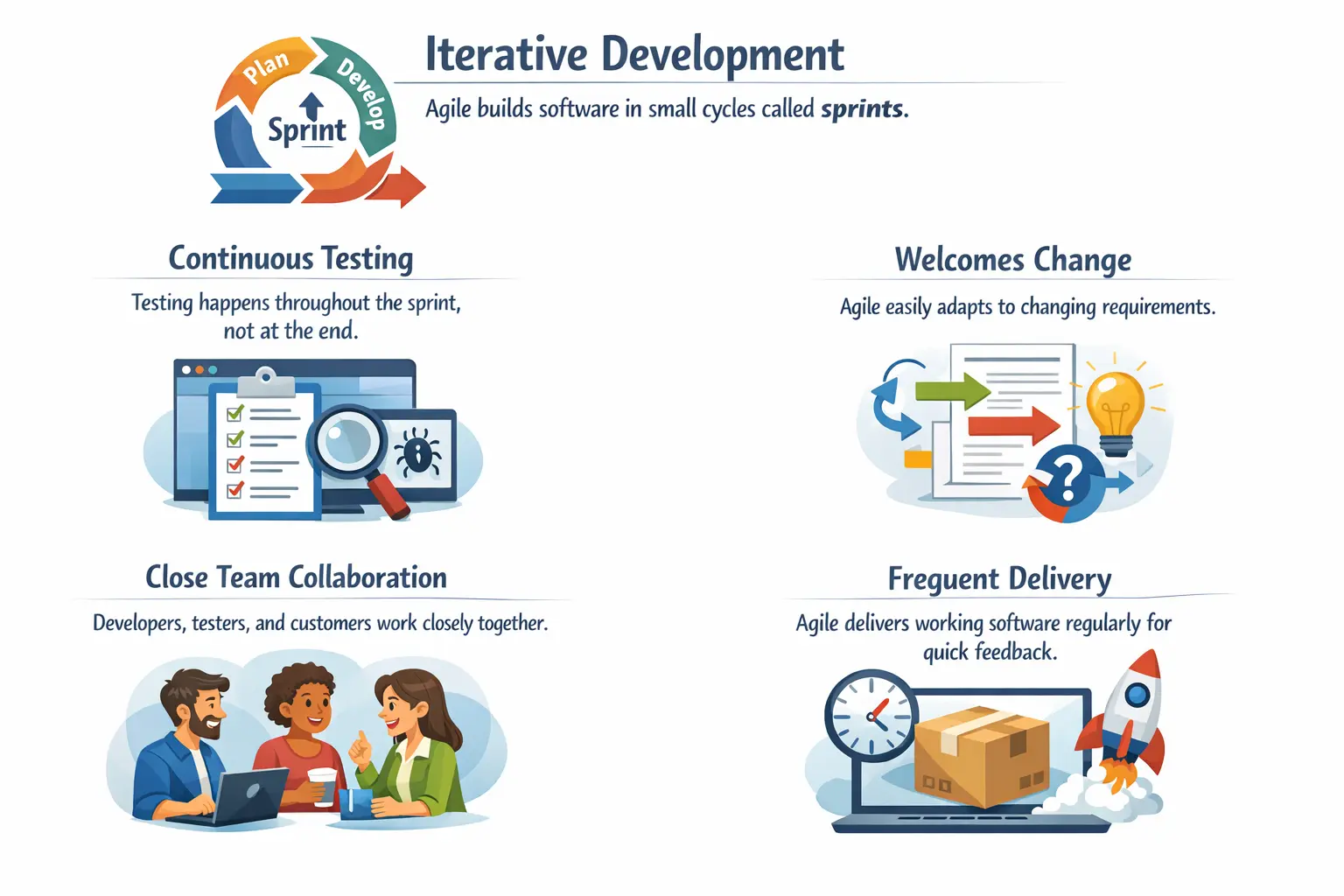
The Agile model is an iterative and incremental approach to the Software Development Life Cycle where software is built and tested in small cycles called iterations or sprints. Instead of delivering everything at the end, Agile focuses on delivering usable software frequently. This allows teams to gather feedback early, adapt to change, and continuously improve the product.
Why the Agile Model Matters
The Agile model matters because modern software rarely stays unchanged from the first requirement discussion to the final release. Business priorities shift, users discover new needs, competitors introduce new features, regulations change, and technical constraints become clearer only after teams begin building. A rigid development approach often struggles in this environment because it assumes that the team can know everything upfront. Agile accepts a more realistic view: teams learn as they build, and the process should support that learning instead of resisting it.
In traditional sequential models, a team may spend a long time gathering requirements, designing the entire solution, building the full system, and then testing it near the end. This can work when requirements are stable and the domain is predictable, but it becomes risky when uncertainty is high. If the team discovers late that a requirement was misunderstood, the cost of correction can be high. Agile reduces this risk by breaking work into smaller pieces and delivering usable increments frequently.
Agile also changes the relationship between the development team and stakeholders. Instead of showing the product only at the end, the team demonstrates progress repeatedly. Stakeholders can see working software, provide feedback, clarify expectations, and adjust priorities. This makes the final product more likely to match real business needs. Agile is not only about speed; it is about delivering the right value at the right time with continuous feedback.
Agile as an Iterative and Incremental Approach
Agile is both iterative and incremental. Iterative means the team works in repeated cycles. Each sprint or iteration includes planning, development, testing, review, and improvement. The team does not expect the first version of every idea to be perfect. Instead, it learns from each cycle and improves both the product and the process. This repeated rhythm gives Agile its ability to adapt.
Incremental means the product grows in small usable parts. Rather than waiting months to deliver a complete system, the team delivers valuable features step by step. A user management module may be delivered first, then login, then profile update, then password reset, then role-based permissions. Each increment adds business value and increases the working product. This is important because users and stakeholders can evaluate real functionality instead of reviewing only documents or assumptions.
For testers, this creates a very different working style. Testing is not limited to one large phase. Testers must understand the scope of each sprint, validate the increment, protect existing functionality through regression testing, and provide fast feedback. The tester's work becomes continuous and closely connected with development.
Agile Values in Practical Terms
Agile is often associated with the Agile Manifesto, but in real projects the values must be interpreted practically. When Agile values individuals and interactions over processes and tools, it does not mean process and tools are useless. It means communication should not be replaced by heavy procedure. A defect can often be resolved faster when a tester and developer discuss it immediately rather than waiting for a long chain of formal communication.
Working software over comprehensive documentation does not mean no documentation. It means documentation should help the team build and use the product, not become the product itself. A useful acceptance criterion, a clear API contract, a meaningful test case, or a short decision record can be valuable. Excessive documents that no one reads may create an illusion of control while slowing delivery.
Customer collaboration over contract negotiation means the team should stay connected to business reality. Requirements should not be treated as frozen words when better understanding emerges. Responding to change over following a plan means planning still matters, but the plan must be adjustable. Agile teams plan frequently because they know conditions change.
How Agile Changes Testing
Agile changes testing from a phase into an ongoing activity. In a traditional model, testers may receive a completed build and begin execution after most development decisions are already made. In Agile, testers are involved before coding starts. They review user stories, question acceptance criteria, identify missing scenarios, prepare test data, and clarify expected behavior with developers and product owners.
This early involvement helps prevent defects. For example, if a user story says that a customer can apply a coupon during checkout, a tester can ask whether the coupon is case-sensitive, whether expired coupons show a specific error, whether one customer can reuse the same coupon, whether coupons can be combined, and what happens when the discount is greater than the order value. These questions improve the story before development begins.
During the sprint, testers validate features as soon as they become testable. They do not wait until the final day if a smaller part is ready earlier. This reduces feedback delay. If a defect is found while the developer still has the context fresh, it is usually faster to fix. Agile testing therefore supports both speed and quality when practiced with discipline.
The Sprint as a Quality Cycle
A sprint is not only a development timebox; it is also a quality cycle. The sprint begins with planning, where the team selects stories and confirms the sprint goal. Testers contribute by reviewing whether stories are clear, testable, and realistic for the sprint. If a story has vague acceptance criteria, hidden dependencies, or unclear test data needs, the tester should raise the concern early.
During development, the team builds and tests continuously. Developers may write unit tests, testers may design and execute functional scenarios, and the team may run automated regression checks. Product owners clarify business rules as questions appear. Defects are logged, discussed, fixed, and retested within the sprint whenever possible.
The sprint review gives stakeholders a chance to inspect working software. This is important because actual software often reveals things that documents do not. A workflow may be technically correct but awkward for users. A screen may meet requirements but require too many steps. Feedback from the review can shape the next sprint. The retrospective then focuses on the team's process. Testers can raise issues such as unclear stories, late builds, unstable environments, insufficient regression time, or recurring defect patterns.
User Stories as the Center of Agile Work
User stories are central to Agile because they express work from a user's perspective. A good user story usually explains who needs something, what they need, and why it matters. This keeps the team focused on value rather than only technical tasks. For example, "As a registered customer, I want to reset my password so that I can regain access to my account" is clearer than simply saying "Build password reset."
Acceptance criteria make the user story testable. They define the conditions that must be true for the story to be considered complete. For the password reset story, acceptance criteria may include valid email submission, reset link generation, link expiry, password rule validation, successful login with the new password, and appropriate error messages. Testers use these criteria as a foundation for test scenarios.
Weak user stories create weak testing. If acceptance criteria are missing or unclear, testers may make assumptions, developers may implement different behavior, and product owners may reject the result during review. Agile teams avoid this by refining stories before sprint execution. Refinement is where testers can add significant value.
Definition of Done in Agile
The Definition of Done is one of the most important quality tools in Agile. It defines what must be true before a story or increment can be considered complete. Without a clear Definition of Done, teams may call a story complete even when testing is incomplete, defects are unresolved, documentation is missing, or acceptance criteria are only partially met.
A practical Definition of Done may include completed development, code review, unit tests passed, functional testing completed, acceptance criteria satisfied, regression impact checked, critical defects fixed, necessary documentation updated, and product owner acceptance. The exact checklist depends on the project, but the purpose is the same: prevent unfinished work from being treated as done.
For manual testers, the Definition of Done provides a shared quality agreement. It helps them avoid being pressured to approve incomplete work. It also makes testing visible as part of completion, not an optional activity after development. A strong Definition of Done improves sprint predictability and reduces hidden quality debt.
Regression Testing in Agile
Regression testing is one of the biggest challenges in Agile. Because the product grows every sprint, every new change can affect existing functionality. A login change may affect checkout, account settings, admin access, and session handling. If regression testing is ignored, defects may escape even when the new story itself appears to work correctly.
Agile teams manage regression through a combination of risk-based manual testing and automation. Not every test can be manually repeated in every sprint, especially as the product grows. Testers identify high-risk flows, business-critical paths, and areas impacted by recent changes. Automated regression suites are useful for stable and repetitive scenarios, while manual testing remains valuable for exploratory checks, usability, complex business flows, and new features.
The key is to treat regression as a continuous concern. Waiting until the end of a release to run regression defeats the Agile purpose. Regression testing should be planned within sprint capacity, supported by automation where possible, and adjusted based on risk.
Agile Requires Discipline, Not Chaos
A common misunderstanding is that Agile means teams can work without structure. In reality, Agile requires strong discipline. Short cycles expose problems quickly. If stories are unclear, builds are late, testing is delayed, environments are unstable, or defects are ignored, the sprint will show it. Agile does not hide weak practices; it makes them visible.
Discipline in Agile includes regular refinement, realistic sprint planning, clear acceptance criteria, frequent communication, continuous testing, proper defect management, and honest retrospectives. Teams must also avoid overcommitting. If too many stories are pulled into a sprint, testing becomes rushed and quality suffers. A sustainable pace is part of Agile quality.
This is why good Agile teams measure progress through completed, tested, valuable work rather than only development output. A story that is coded but not tested is not truly done. A sprint that produces many unfinished stories creates carryover and weak predictability. Agile rewards small, complete, high-quality increments.
Manual Tester Skills Needed in Agile
Manual testers in Agile need more than execution skills. They must be strong communicators because clarification happens continuously. They must understand user stories, acceptance criteria, business rules, and risk. They must be comfortable asking questions early and challenging unclear requirements in a constructive way.
They also need prioritization skills. Agile timelines are short, so testers must know which scenarios are critical, which are high risk, and which can be deferred if necessary. They should understand exploratory testing because not every issue is found through predefined test cases. They should also understand regression strategy, defect reporting, and collaboration with automation testers where automation exists.
The best Agile testers act as quality partners. They do not wait for instructions; they help shape stories, identify risks, improve acceptance criteria, validate increments, and contribute to process improvement. Their role becomes broader and more influential than in teams where testing is isolated at the end.
When Agile Works Best
Agile works best when the product benefits from frequent feedback and incremental delivery. It is useful for web applications, mobile applications, SaaS products, internal business tools, and customer-facing platforms where user needs evolve. It is also helpful when stakeholders can regularly participate in reviews and prioritization.
Agile is especially strong when the team has cross-functional skills. Developers, testers, product owners, UX designers, analysts, and operations members collaborate closely. The team can decide, build, test, and learn without waiting for large handoffs. This reduces delays and improves shared ownership.
However, Agile does not automatically solve problems. It needs engaged stakeholders, disciplined backlog management, clear priorities, reliable environments, and a team culture that values transparency. Without these, Agile ceremonies may exist but real agility may be missing.
When Agile Can Struggle
Agile can struggle when stakeholders are unavailable, priorities change without control, or the team treats flexibility as an excuse for poor planning. If user stories are constantly added during the sprint, the team may lose focus. If acceptance criteria are vague, testers and developers may build different interpretations of the same story. If the team skips retrospectives or ignores improvement actions, the same problems repeat.
Agile can also be difficult in environments where strict documentation, approvals, or regulatory controls are mandatory. This does not mean Agile cannot be used in regulated domains, but it must be adapted carefully. Documentation, traceability, validation evidence, and release controls still matter. Agile should not be used as a reason to avoid compliance responsibilities.
Large programs may also need coordination across multiple Agile teams. Dependencies, shared components, integrated releases, and common environments require planning beyond a single sprint. Agile at scale needs thoughtful governance so that flexibility at the team level does not create confusion at the product level.
Practical Example: Agile Login Feature
Consider a team building a login feature. In sprint planning, the product owner explains the user story and acceptance criteria. The tester asks about invalid credentials, locked accounts, empty fields, password masking, remember-me behavior, security messages, and session timeout. The developer asks about API behavior and database checks. The team clarifies scope before work begins.
During the sprint, the developer implements the login form and backend validation. The tester begins testing as soon as a usable build is available. Functional scenarios confirm successful login and expected error handling. Negative scenarios check invalid username, wrong password, blank inputs, and inactive users. Regression checks confirm that navigation, account access, and logout still work.
At the sprint review, the feature is demonstrated to stakeholders. If they request improved error wording or an additional security rule, the team can add it to the backlog and prioritize it. The value is delivered sooner, feedback is gathered earlier, and improvements are handled through future increments. This is Agile in practice: small delivery, fast feedback, and continuous refinement.
Interview-Ready Understanding of Agile
In interviews, Agile should be explained as an iterative and incremental SDLC model that delivers working software in small cycles and uses continuous feedback to adapt. A strong answer should mention sprints, user stories, acceptance criteria, sprint planning, sprint review, retrospective, continuous testing, and shared ownership of quality. It should also explain that Agile welcomes change but still requires discipline.
From a testing perspective, it is important to say that testers are involved throughout the sprint. They participate in story refinement, review acceptance criteria, identify scenarios, test features early, run regression checks, report defects quickly, and contribute to retrospectives. Agile testing is not late testing compressed into a shorter timeline; it is continuous quality involvement across the sprint.
At its core, Agile answers a simple question: how can we deliver value continuously and adapt to change? This mindset makes Agile especially suitable for dynamic projects where requirements evolve.
Core Philosophy of Agile
Agile is guided by a set of values that prioritize people, collaboration, and working software. It values individuals and interactions more than rigid processes, and working software more than excessive documentation. Customer collaboration is preferred over strict contracts, and responding to change is valued over blindly following a plan.
These values do not reject planning or documentation; they emphasize that these should support value delivery rather than slow it down.
Key Characteristics of Agile
Agile development is iterative, meaning work is done in repeated cycles. Each cycle produces a small but usable increment of the product. Releases are frequent, allowing stakeholders to see progress and provide feedback.
Testing is continuous rather than a separate phase. Collaboration between developers, testers, product owners, and stakeholders is close and regular. Agile teams accept that change is natural and design their process to handle it. Documentation exists, but it is kept minimal and meaningful instead of excessive.
Typical Agile Flow
An Agile lifecycle usually begins with requirement discussions captured as user stories. These stories are prioritized and selected during sprint planning. Development and testing then happen in parallel within the sprint.
At the end of the sprint, the team conducts a sprint review to demonstrate what was built and gather feedback. A retrospective follows, where the team reflects on what went well and what can improve. Each sprint ideally results in a potentially shippable increment.
This cycle repeats, allowing continuous refinement of both product and process.
Role of a Manual Tester in Agile
Manual testers play an active and continuous role in Agile teams. During sprint planning, they study user stories, review acceptance criteria, identify scenarios, and highlight risks. Their input helps ensure stories are testable and clear.
During sprint execution, testers validate stories as they are developed. They perform functional checks, run regression tests where needed, and log defects early. Close collaboration with developers allows quick clarification and faster fixes.
In sprint reviews, testers help validate that completed stories meet expectations. During retrospectives, they share insights about quality issues and suggest process improvements. Their influence extends beyond testing into overall quality advocacy.
Agile Testing Mindset
Agile testing treats quality as a shared responsibility. Testing does not belong only to testers; the whole team owns quality. Feedback is expected early and frequently. Customer involvement is also important so that the product stays aligned with real needs.
Testing in Agile is proactive rather than reactive. The goal is to prevent defects and detect them quickly when they occur.
User Stories and Acceptance Criteria
User stories describe what a user wants to achieve, usually from a business perspective. Acceptance criteria define when a story is considered complete. For testers, acceptance criteria are a primary reference for designing tests.
Clear acceptance criteria reduce ambiguity and help ensure that development and testing are aligned.
Agile Compared to Traditional Models
Agile differs from traditional models mainly in flexibility and timing. Change in Agile is expected and welcomed, while in traditional models it is often costly. Testing in Agile is continuous instead of late. Delivery is incremental rather than a single big release. Documentation is lighter but still purposeful.
These differences make Agile more adaptable but also demand strong communication and discipline.
Benefits of Agile
Agile provides faster feedback because working software is shown regularly. This improves alignment with business needs. Defects are often detected earlier due to continuous testing. Customer satisfaction tends to be higher because users see progress and influence direction.
Challenges for Testers in Agile
Agile is not without challenges. Requirements may be incomplete at first. Timelines are tight, and changes are frequent. Regression testing can become heavy as the product grows. Testers must be adaptable, organized, and proactive to succeed in Agile environments.
A Simple Real-World Example
Consider a login feature. In Agile, this feature can be designed, developed, tested, and reviewed within a single sprint. Feedback from that sprint can immediately influence improvements in the next one. Value is delivered sooner rather than waiting for a full system release.
Common Misunderstandings
Some people think Agile means no documentation, which is incorrect. Agile promotes useful documentation, not zero documentation. Others skip regression testing due to time pressure or delay testing within the sprint, which reduces quality. Agile still requires discipline; it is not an excuse for chaos.
Interview Perspective
In interviews, Agile is often described as an iterative model that delivers software in small increments with continuous feedback. A strong explanation highlights collaboration, flexibility, and continuous testing. Mentioning the tester’s active role across the sprint shows practical understanding.
Key Takeaway
Agile empowers testers to test early, test continuously, and influence quality throughout development. It shifts testing from a phase to an ongoing activity. When practiced well, Agile helps teams deliver valuable, high-quality software while staying responsive to change.