Definition of Ready (DoR)
Definition of Ready (DoR) is an important concept in Agile and Scrum that helps teams ensure work is properly prepared before it enters a sprint. Agile teams work in short iterations, and there is limited time to clarify requirements once a sprint begins. The Definition of Ready establishes a shared understanding of what conditions must be satisfied before a User Story can be accepted into a sprint.
Definition of Ready answers a fundamental Agile question: “Is this story ready to be worked on?” If a story is not ready, it is likely to cause confusion, delays, and defects during the sprint. DoR ensures that stories are clear, testable, and feasible before development and testing start.
Definition of Ready improves sprint predictability by reducing unexpected problems. It ensures that development teams, testers, and product owners have a common understanding of the work before committing to it. For manual testers, Definition of Ready is especially important because it ensures that testing activities can be planned in advance.
A well-defined DoR helps teams move from reactive problem-solving to proactive planning. Instead of discovering missing requirements during testing, teams identify gaps early during backlog refinement.
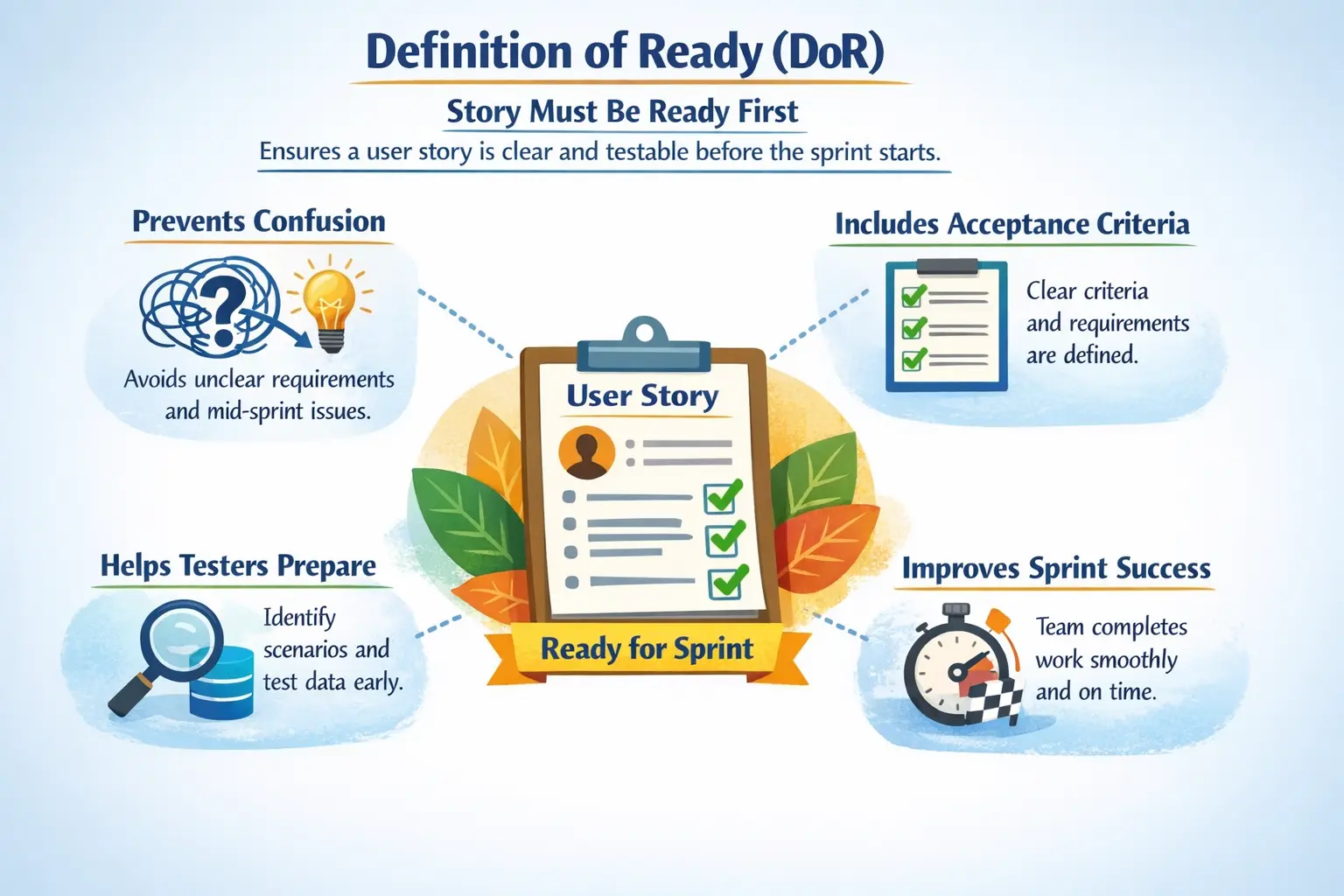
Definition of Definition of Ready
Definition of Ready is a set of criteria that a User Story must satisfy before it can be selected for a sprint. It ensures that the story is sufficiently understood, well-defined, and testable.
Definition of Ready establishes minimum standards for backlog items so that the team can work efficiently. It prevents incomplete or unclear requirements from entering the sprint.
DoR ensures that stories are small enough to be completed within a sprint and that all necessary information is available. It also confirms that dependencies and risks have been identified.
Definition of Ready does not guarantee that a story will be completed successfully, but it significantly increases the chances of success by ensuring that the team starts with clear and complete requirements.
DoR acts as a quality gate before sprint planning. Only stories that meet the Definition of Ready should be selected for development.
Purpose of Definition of Ready
Definition of Ready serves several important purposes in Agile development.
One of the main purposes is preventing poorly defined stories from entering sprints. Stories that lack clarity or acceptance criteria often cause confusion and delays.
Definition of Ready reduces mid-sprint rework. When requirements are unclear, developers and testers must spend time seeking clarification during the sprint. This disrupts planned work.
Definition of Ready improves sprint predictability. When stories are ready, teams can estimate effort more accurately and deliver consistent results.
Definition of Ready enables early and effective testing. Testers can prepare test scenarios and test data before development begins.
Definition of Ready also supports collaboration. Product owners, developers, and testers discuss stories before committing to them.
Definition of Ready ensures that the team starts each sprint with confidence and clarity.
Importance of Definition of Ready in Agile Projects
Definition of Ready is especially important in Agile environments where teams work in short iterations.
Without Definition of Ready, teams often experience mid-sprint confusion. Developers may need additional clarification, and testers may struggle to design test scenarios.
Poorly defined stories often lead to incomplete implementations. Developers may implement only part of the requirement or interpret requirements incorrectly.
Definition of Ready improves communication between team members. It encourages discussion and clarification before development begins.
Definition of Ready also helps prevent sprint failure. When stories are not ready, teams often miss sprint goals.
Definition of Ready helps teams maintain a sustainable development pace. Work becomes predictable and manageable.
Typical Definition of Ready Criteria
A story is considered ready when certain conditions are satisfied. These conditions vary by organization but usually include common elements.
Business value should be clearly defined. The team must understand why the story is important.
Acceptance criteria should be written and testable. Acceptance Criteria define how the story will be validated.
Requirements should be clear and unambiguous. All team members should have the same understanding of the story.
Dependencies should be identified. External systems, APIs, or teams may affect the story.
Test scenarios should be derivable. Testers should be able to determine how the story will be validated.
Test data requirements should be known. Required input data must be identified before testing begins.
UI designs or references should be available if the story involves user interface changes.
Story size should be small enough to complete within a sprint. Large stories should be broken into smaller pieces.
These conditions ensure that the story can be implemented and tested efficiently.
Definition of Ready and Backlog Refinement
Definition of Ready is closely connected to backlog refinement.
Backlog refinement is the process where stories are reviewed and prepared before sprint planning. During refinement, the team ensures stories meet DoR criteria.
Product owners explain business requirements during refinement sessions.
Developers evaluate technical feasibility.
Testers review testability and identify scenarios.
If a story does not meet DoR criteria, it is returned to the backlog for further refinement.
Backlog refinement ensures that sprint planning is efficient and focused.
Definition of Ready provides a structured way to evaluate story readiness during refinement.
Manual Tester’s Role in Definition of Ready
Manual testers play a crucial role in ensuring stories meet the Definition of Ready.
Testers review User Stories during backlog refinement sessions. They ensure that stories are clear and testable.
Testers identify missing Acceptance Criteria. Missing validation rules often lead to defects.
Testers analyze edge cases and negative scenarios. These scenarios help uncover hidden requirements.
Testers verify that test scenarios can be created from the story.
Testers identify test data requirements. Data availability is critical for testing.
Testers raise environment concerns such as missing test servers or tools.
Testers also identify dependencies that may block testing.
If a story is not test-ready, testers should recommend delaying it until requirements are clarified.
Early tester involvement significantly improves story quality.
Definition of Ready vs Definition of Done
Definition of Ready and Definition of Done are often confused, but they serve different purposes.
Definition of Ready focuses on starting work. It ensures that stories are prepared before development begins.
Definition of Done focuses on finishing work. It defines conditions that must be satisfied before a story is considered complete.
Definition of Ready applies before sprint planning.
Definition of Done applies before sprint completion.
Definition of Ready ensures clarity.
Definition of Done ensures quality.
Both are owned by the team and work together to ensure successful delivery.
Definition of Ready ensures the team starts correctly.
Definition of Done ensures the team finishes correctly.
Real-Time Example of Definition of Ready
Consider a User Story:
As a user, I want to reset my password so that I can regain access to my account.
This story may not be ready if important details are missing.
If Acceptance Criteria are not defined, testers cannot design validation scenarios.
If business rules are unclear, developers may implement incorrect behavior.
If the email service integration is not ready, testing cannot proceed.
If the story is too large, it may not be completed within a sprint.
Such a story should not be selected during sprint planning.
After refinement, the story may include clear Acceptance Criteria, defined dependencies, and test scenarios. At that point, the story becomes ready.
Benefits of a Strong Definition of Ready
A strong Definition of Ready provides many advantages.
It reduces sprint blockers because dependencies are identified early.
It improves test planning because testers know what to validate.
It improves development efficiency because developers understand requirements clearly.
It improves sprint success rates because teams commit only to ready stories.
It reduces defect rates because requirements are clarified early.
It improves collaboration because teams discuss stories before development.
It improves estimation accuracy because work is clearly defined.
Teams with strong DoR practices usually deliver more consistent results.
Definition of Ready and Testing Quality
Definition of Ready improves testing quality significantly.
Testers can prepare test scenarios before development starts.
Testers can identify missing requirements early.
Testers can prepare test data in advance.
Testers can estimate testing effort accurately.
Testing becomes more structured and predictable.
Without Definition of Ready, testing often becomes reactive instead of proactive.
Testers spend time clarifying requirements instead of validating functionality.
Definition of Ready allows testers to focus on quality instead of requirement discovery.
Common Mistakes in Definition of Ready
Some teams treat Definition of Ready as optional. This often leads to poorly prepared stories entering sprints.
Another common mistake is making Definition of Ready too rigid. Excessively strict criteria slow down development.
Definition of Ready should provide guidance without becoming a bureaucratic process.
Some teams create vague DoR criteria that do not provide meaningful checks.
Ignoring tester input is another common mistake. Testers often identify important gaps.
Some teams assume that Product Owners alone are responsible for story readiness.
Definition of Ready is a team responsibility.
Stories should not be accepted into sprints if they do not meet DoR criteria.
Definition of Ready in Real Agile Environments
In real Agile projects, Definition of Ready evolves over time.
Teams adjust DoR criteria based on past experiences.
If teams experience repeated blockers, they may strengthen DoR requirements.
If DoR becomes too strict, teams may simplify criteria.
Definition of Ready should reflect team needs and project complexity.
Mature Agile teams use Definition of Ready as a practical tool rather than a formal document.
Definition of Ready works best when teams use it consistently.
Why Definition of Ready Matters Before Sprint Planning
Definition of Ready matters because sprint planning should not be the first time the team discovers what a story means. Sprint planning is meant to select and plan work that is understood well enough to start. If the team spends most of planning clarifying basic requirements, identifying unknown dependencies, or debating what the story includes, the backlog item is probably not ready.
In short iterations, unclear work creates immediate pressure. A two-week sprint does not provide much time to discover missing business rules, redesign the solution, wait for environment access, and still complete development and testing. When unclear stories enter a sprint, the team often loses the first few days in clarification and the last few days in rushed testing. Definition of Ready reduces this pattern by moving clarification earlier.
DoR also protects the sprint goal. A sprint goal depends on the team selecting work that is realistically achievable. If several selected stories are not ready, the sprint goal becomes unstable. The team may still stay busy, but the planned outcome becomes uncertain. Ready stories improve the team’s ability to forecast, commit, and deliver with confidence.
From a testing perspective, readiness before sprint planning is critical. Testers need time to understand behavior, identify scenarios, prepare test data, and think about regression impact. If testers discover missing acceptance criteria only after development is complete, validation becomes reactive. DoR helps testers shift quality left by ensuring that testability is considered before the sprint starts.
A practical Definition of Ready does not make the team slow. It makes the team deliberate. The goal is not to create a heavy approval process, but to ensure that the team does not knowingly pull unclear, oversized, or blocked work into a sprint and then struggle with avoidable problems.
Readiness Is a Team Responsibility
One of the biggest misunderstandings about Definition of Ready is that it belongs only to the Product Owner. The Product Owner plays an important role because the Product Owner owns backlog ordering and business clarity. However, readiness is not created by one person alone. Developers, testers, designers, architects, and sometimes business stakeholders all contribute to making a story ready.
The Product Owner clarifies business value, user expectations, priority, and acceptance needs. Developers evaluate technical feasibility, dependencies, implementation risks, and possible breakdown of the work. Testers evaluate testability, negative scenarios, edge cases, data needs, and validation approach. Designers may contribute UI flows or interaction rules. Together, these perspectives create a complete picture of readiness.
If only the Product Owner defines readiness, stories may be clear from a business point of view but still difficult to build or test. If only developers define readiness, stories may be technically feasible but missing user-centered criteria. If testers are not involved, test data, edge cases, and validation rules may be discovered too late. DoR works best when the whole team uses it as a shared checklist.
Team responsibility also means the team has permission to challenge readiness. If a story lacks acceptance criteria, has unknown dependencies, or is too large, the team should discuss it openly. Pushing an unready story into a sprint to appear busy usually creates more delay later. A mature Agile team protects delivery quality by saying, “this needs more refinement before we commit.”
This does not mean every detail must be known before sprint start. Agile accepts that some learning happens during development. But the story should be clear enough for the team to estimate, start, test, and complete within the sprint. Definition of Ready defines that minimum level of shared understanding.
Definition of Ready and Backlog Quality
Backlog quality directly affects sprint quality. A backlog full of vague, oversized, and poorly prioritized items produces unstable sprints. A backlog with clear, small, valuable, and testable stories supports predictable delivery. Definition of Ready improves backlog quality by setting expectations for what a well-prepared story looks like.
A ready backlog item usually has a clear user goal. The team should understand who needs the feature and why it matters. If the business value is unclear, the story may be difficult to prioritize and difficult to test meaningfully. A story without clear value may still describe activity, but it does not clearly describe the outcome the team should create.
A ready story also has clear boundaries. The team should know what is included and what is not included. Without boundaries, scope can expand during the sprint. A story about exporting reports may suddenly include filters, scheduling, email delivery, and multiple file formats unless scope is clarified. DoR helps prevent hidden scope from entering the sprint unnoticed.
Backlog quality also depends on story size. A story may be understandable but still too large. Large stories create risk because they hide multiple workflows and testing paths. Definition of Ready should encourage teams to split large stories before sprint planning. Smaller stories make work easier to estimate, develop, test, and review.
When DoR is applied consistently, backlog refinement becomes more productive. The team does not refine stories randomly. It evaluates each upcoming item against readiness expectations and improves it until it can be selected with confidence.
Practical DoR Checklist for Testers
A tester’s Definition of Ready checklist should begin with clarity. The tester should be able to explain what the story does, who uses it, what value it provides, and what behavior is expected. If the tester cannot explain the story clearly, test design will be weak. Clarity is the first condition for testability.
The next checkpoint is acceptance criteria. The criteria should be specific enough to validate. A criterion such as “system should show proper error” is not ready because “proper” is subjective. A better criterion describes the condition, expected message, and system behavior after the error. Testers should challenge vague criteria before the sprint begins.
Testers should also check whether positive, negative, and edge scenarios can be derived. A story that describes only successful behavior may not be ready if failure handling is important. For example, a payment story should clarify invalid card, insufficient funds, timeout, duplicate submission, and confirmation behavior where relevant. These scenarios affect quality and user trust.
Test data readiness is another important checkpoint. If testing requires special accounts, specific roles, existing records, large files, expired links, or external service responses, those needs should be identified early. Missing test data can block validation even when development is complete. DoR helps surface this before the sprint starts.
Environment readiness also matters. If a story depends on an integration environment, third-party API, email service, payment sandbox, or test server configuration, the team should know whether it is available. A story may be functionally clear but still not ready if the team cannot test it in the sprint.
Examples of Ready and Not Ready Stories
Consider a story that says, “As a user, I want to reset my password so that I can regain access to my account.” By itself, this story is understandable but not necessarily ready. It lacks acceptance criteria, expiration rules, email behavior, password rules, invalid email handling, and dependency information. A tester would not yet know enough to design complete validation scenarios.
The same story becomes more ready when it includes clear criteria: a registered email triggers a reset link, an unregistered email receives a safe generic response, the reset link expires after fifteen minutes, the new password must follow security rules, and the user can log in with the new password after reset. Dependencies such as email service availability and test accounts are also identified. Now the team can estimate, build, and test the story more confidently.
Another not-ready story might say, “Improve dashboard performance.” This is too vague. The team does not know which dashboard, what performance target is expected, what user role is affected, or how success will be measured. A ready version would define the dashboard, current issue, target load time, expected data volume, affected browsers or devices, and validation approach.
A UI story may not be ready if design references are missing. If the story says, “As a customer, I want a redesigned checkout page,” the team needs layout, fields, validation behavior, responsive expectations, and error message rules. Without those details, developers may build one interpretation and testers may validate another.
These examples show that readiness is not about making stories long. It is about making them clear enough to act on. A ready story can still be concise, but it must contain the information needed for development and testing to begin responsibly.
Balancing DoR Without Creating Bureaucracy
Definition of Ready is useful only when it supports delivery rather than blocking it unnecessarily. Some teams make DoR too strict and require every possible detail before a story can enter a sprint. This can slow learning and make the backlog feel like a formal approval system. Agile teams should avoid turning DoR into heavy documentation.
A practical DoR defines minimum readiness, not perfect certainty. The team needs enough clarity to start, not every possible answer. For example, the team may not know the final wording of a message during refinement, but it should know the message purpose and expected behavior. The exact wording can be finalized during implementation if it does not create major risk.
The right level of readiness depends on risk. A low-risk UI text change may require fewer details. A payment, security, compliance, or data migration story requires stronger readiness because mistakes can have serious impact. DoR should be flexible enough to reflect risk while still maintaining quality discipline.
Teams should review their DoR periodically. If stories often enter sprints with missing information, the DoR may be too weak or inconsistently applied. If stories wait too long because the team demands excessive detail, the DoR may be too rigid. The best DoR is practical, lightweight, and continuously improved.
The purpose of DoR is not to say no to work. The purpose is to help the team say yes responsibly. When used well, it improves flow, reduces blockers, and creates better sprint outcomes.
Definition of Ready in Sprint Planning
During sprint planning, Definition of Ready helps the team decide which stories can be selected. The team should not simply pull the highest-priority items without checking readiness. Priority matters, but readiness determines whether the team can realistically complete the work in the sprint.
If a high-priority story is not ready, the Product Owner and team must decide what to do. They may refine it quickly if the missing information is small. They may split it if it is too large. They may defer it if dependencies are unresolved. They may select another ready story that supports the sprint goal. The decision should be explicit rather than accidental.
DoR also supports better estimation during planning. Teams estimate more accurately when requirements, acceptance criteria, and dependencies are clear. If a story has many unknowns, the estimate becomes guesswork. A readiness check helps expose those unknowns before the team commits.
For testers, sprint planning with DoR creates a better starting point. Testers can identify which stories need test data, which require environment setup, which affect regression scope, and which may need early collaboration with developers. This allows testing to be planned as part of the sprint, not squeezed in at the end.
A team that uses DoR in sprint planning usually has fewer surprise blockers. The sprint may still face challenges, but those challenges are less likely to come from basic requirement gaps that could have been identified earlier.
Definition of Ready and Risk Management
Definition of Ready is also a risk management tool. Every unclear story carries risk. The risk may be rework, missed acceptance expectations, delayed testing, blocked development, dependency failure, or production defect leakage. DoR helps identify these risks before the sprint begins.
Risk becomes especially important for stories involving integrations, payments, security, compliance, or complex business rules. Such stories should not enter a sprint with vague criteria or unknown dependencies. The cost of misunderstanding can be high. DoR encourages the team to clarify risky areas early.
Testers contribute strongly to risk identification. They may ask whether the story affects existing workflows, whether regression coverage is needed, whether data setup is difficult, whether negative scenarios are defined, or whether external services are available. These questions improve readiness and reduce delivery risk.
DoR does not remove all risk. Agile development always includes uncertainty. But it helps the team separate acceptable uncertainty from avoidable confusion. Unknowns that can be clarified before the sprint should be clarified. Unknowns that remain should be visible and managed intentionally.
When DoR is treated as risk prevention, teams understand its value better. It is not a paperwork step. It is a way to protect sprint success, testing quality, and business confidence.
Improving Definition of Ready Over Time
Definition of Ready should evolve based on the team’s real experience. If the team repeatedly faces missing test data, then test data identification should become part of DoR. If stories are often too large, story size or splitting guidance should be strengthened. If unclear acceptance criteria cause defects, criteria review should become mandatory before planning.
Sprint Retrospectives are a useful place to improve DoR. The team can ask whether any sprint problems were caused by unready work. If the answer is yes, the DoR should be updated or applied more consistently. This connects retrospectives with practical process improvement.
Teams should also remove criteria that no longer help. If a DoR item creates delay but does not improve clarity, quality, or predictability, it may need adjustment. The Definition of Ready should be a living agreement, not a fixed document that no one questions.
As teams mature, their DoR often becomes simpler but more meaningful. New teams may need explicit checklists. Experienced teams may internalize many readiness habits and use a shorter checklist. The goal is not the size of the checklist; the goal is the quality of the shared understanding before work begins.
A continuously improved DoR helps teams learn from delivery problems. Instead of repeating the same blockers, the team updates its readiness expectations and prevents similar issues in future sprints.
Interview Perspective
Definition of Ready is a common Agile interview topic.
A short answer defines Definition of Ready as criteria that must be satisfied before a story enters a sprint.
A detailed answer explains how DoR improves sprint predictability and testing readiness.
Interviewers often ask how testers contribute to Definition of Ready.
Strong answers emphasize early involvement and testability checks.
Understanding Definition of Ready demonstrates Agile experience.
Key Takeaway
Definition of Ready ensures that quality starts before development begins.
It ensures that User Stories are clear, testable, and feasible before entering a sprint.
For manual testers, Definition of Ready enables early test planning and reduces mid-sprint confusion.
A strong Definition of Ready improves collaboration, predictability, and product quality by ensuring that teams start each sprint with well-prepared work.