Cost of Defects in Software Testing: Why Early Detection Matters
Understanding Cost of Defects
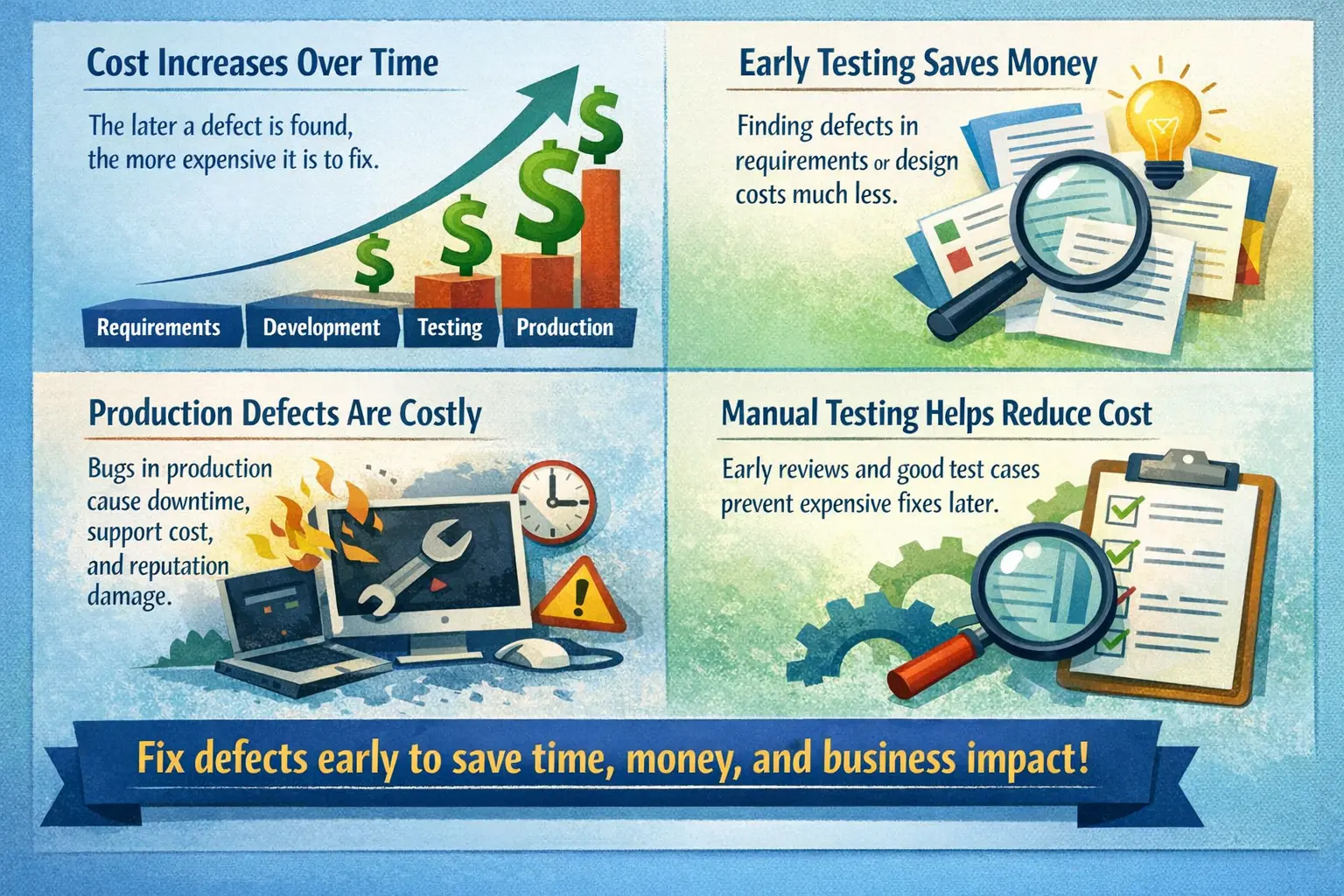
Cost of Defects refers to the increase in time, effort, money, and business impact required to fix a defect based on when it is discovered in the software development lifecycle. A defect found early is usually inexpensive to fix, while the same defect found later can become costly and disruptive. The simple principle is that the later a defect is detected, the higher the cost to resolve it.
This concept is fundamental in software testing because it connects quality practices directly to business value. Testing is not only about finding bugs; it is about finding them at the right time.
Cost of Defects as a Business Concept
Cost of defects is often discussed in testing, but it is not only a testing concept. It is a business concept that explains how quality problems consume time, money, effort, and trust. A defect can start as a small misunderstanding in a requirement, but if it travels through design, development, testing, release, and production, the cost grows at every stage. The cost includes not only the technical fix but also the communication, analysis, retesting, deployment, customer handling, and reputation impact that follow.
This is why early detection matters so much. When a defect is found during requirement review, the team may only need to clarify a sentence, update an acceptance criterion, or adjust a workflow diagram. When the same issue is found after release, the organization may need emergency meetings, hotfix planning, production deployment, customer communication, data correction, and support team involvement. The defect itself may be the same, but the surrounding cost becomes much larger because the product has already moved forward.
Why Defects Become More Expensive Over Time
Defects become more expensive over time because more work is built on top of earlier decisions. A requirement mistake influences design. A design mistake influences code. A code mistake influences test cases, documentation, user training, and release planning. When the defect is discovered late, the team must not only fix the original problem but also inspect everything that depended on it. This dependency chain is what makes late defects costly.
Late defects also create interruption cost. Developers may be working on new features when they are pulled back to fix an old issue. Testers may need to stop planned testing and retest urgent fixes. Project managers may need to revise schedules. Business users may need to revalidate workflows. Support teams may need to respond to complaints. Every interruption reduces productivity and increases pressure. The later the defect is found, the more people and activities it can disturb.
Cost of Defects Across the SDLC
During the requirements phase, defect cost is usually low because the product has not yet been built. If a missing rule, unclear condition, or conflicting expectation is identified at this stage, the team can correct the requirement before design and development begin. Requirement reviews, walkthroughs, clarification sessions, and acceptance criteria discussions are therefore powerful cost-control practices. They prevent wrong assumptions from becoming expensive code.
During the design phase, defect cost increases because design decisions may already depend on the requirement. A design defect may require changes to architecture, data flow, API structure, UI layout, integration approach, or security handling. The cost is still usually manageable because implementation may not be complete, but it is higher than requirement correction. Good design reviews help catch issues before they become embedded in code.
During development, a defect requires code changes, unit testing, code review, and sometimes changes to related modules. If the defect affects multiple areas, developers must analyze dependencies and update logic carefully. The cost rises because actual implementation work must be changed. Still, finding defects during development is usually cheaper than finding them during formal testing or production because the code is fresh and the team can respond before release commitments are affected.
During the testing phase, defect cost grows further. A tester must identify the issue, reproduce it, document it, assign severity, and report it. Developers must investigate and fix it. Testers must retest the fix and perform regression testing to ensure that related areas are not broken. If the defect is severe, release planning may change. Testing-phase defects are expected, but a large number of serious defects at this stage may indicate weak upstream review or unclear requirements.
In production, defect cost is highest because real users are affected. A production defect can cause downtime, incorrect transactions, user complaints, customer support workload, emergency patches, rollback planning, data repair, legal exposure, or reputational damage. Production defects also create urgency, which increases stress and the chance of secondary mistakes. Preventing defects from reaching production is one of the strongest economic arguments for disciplined testing and quality practices.
Direct and Indirect Cost of Defects
Direct cost is the visible effort required to fix a defect. It includes developer analysis, code correction, build creation, test execution, retesting, regression testing, and deployment. These costs are easier to track because they appear in task updates, defect logs, timesheets, sprint capacity, or release plans. When teams discuss the cost of defects, they often focus on these direct activities.
Indirect cost is often larger and harder to measure. It includes delayed releases, missed business opportunities, customer dissatisfaction, support calls, reduced team morale, loss of stakeholder confidence, and brand damage. A defect that causes a payment failure may require only a small code fix, but the indirect cost can include abandoned purchases and loss of customer trust. A defect that exposes private data may trigger legal review and public communication. Indirect cost shows why defect impact should not be judged only by the number of lines changed.
Requirement Defects and Their Cost
Requirement defects are among the most expensive when they are discovered late. If a requirement is missing, ambiguous, contradictory, or misunderstood, the team may build the wrong behavior even though the code is technically correct. This type of defect is dangerous because testing may initially pass if test cases were created from the same incorrect understanding. The product may satisfy the written requirement but fail the business need.
Early requirement review reduces this risk. Testers can ask practical questions before development begins. What should happen if the user enters invalid data? Are there role-based rules? What is the expected message? Are there boundary values? Is the workflow different for existing users and new users? These questions reveal hidden assumptions. A tester who prevents a requirement defect before coding has saved far more cost than a tester who finds the same issue after release.
Design Defects and Their Cost
Design defects occur when the planned solution cannot properly support the requirement or quality expectation. For example, a design may not support expected user volume, may ignore accessibility, may create weak security boundaries, or may make future changes difficult. These defects are more costly than requirement edits because they affect the structure of the solution. If discovered late, design defects can require major rework.
Design reviews, architecture discussions, prototype reviews, and early technical validation help reduce design-related cost. Testers can contribute by raising quality attribute questions. Will this design support regression testing? Is the workflow testable? Are error states visible? Can user roles be validated clearly? Are logs available for troubleshooting? Thinking about testability and quality during design can prevent costly downstream issues.
Development Defects and Their Cost
Development defects occur when code does not implement the intended behavior correctly. These may be logic errors, missing validations, incorrect calculations, integration mistakes, configuration problems, or poor error handling. The cost depends on how quickly the defect is discovered and how many areas are affected. A simple code defect found during unit testing may be inexpensive. The same defect found after integration can require broader investigation and regression testing.
Good development practices reduce development defect cost. Unit testing, code review, static analysis, pair review, local validation, and clear coding standards help catch issues before they reach formal testing. When developers verify their own changes carefully, testers can focus more on business flows, edge cases, integration behavior, and user experience rather than repeatedly finding basic implementation mistakes.
Testing-Phase Defects and Their Cost
Defects found during testing are less expensive than production defects but still carry meaningful cost. Every defect requires documentation, triage, assignment, investigation, fixing, retesting, and status tracking. If the defect affects a critical workflow, it may block further testing. If it affects shared logic, it may require broad regression. If the fix is risky, the team must spend additional effort verifying that no new issues were introduced.
Testing-phase defects are also affected by build quality. If builds are unstable, testers may waste time distinguishing real defects from environment issues. If requirements are unclear, defects may be debated instead of resolved. If defect reports lack clear steps, developers may spend extra time reproducing the problem. Good testing discipline reduces cost by making defects easier to understand and fix.
Production Defects and Their Cost
Production defects are the most expensive because the product has already reached users. Once users are affected, the organization must manage both the technical issue and the business consequences. A production defect can generate support tickets, social media complaints, lost transactions, incorrect records, compliance concerns, refunds, service credits, emergency releases, and management escalation. The technical fix may be only one part of the total cost.
Production defects also reduce trust. Users may forgive a minor inconvenience, but repeated failures create doubt. Business stakeholders may lose confidence in the delivery process. Development and testing teams may lose capacity because urgent production fixes interrupt planned work. This is why reducing defect leakage to production is a major goal of quality management.
Defect Leakage and Escaped Defects
Defect leakage happens when a defect is not caught in the phase where it should have been detected. If a requirement ambiguity passes into development, that is leakage from requirement review. If a coding error passes into system testing, that is leakage from development checks. If a defect passes from testing into production, it becomes an escaped defect. Leakage indicates that an earlier quality activity missed something important.
Tracking leakage helps teams improve. If many production defects come from unclear requirements, the team should strengthen requirement reviews and acceptance criteria. If many defects come from integration failures, integration testing and contract validation may need improvement. If many defects come from browser differences, compatibility coverage may be weak. Leakage analysis turns defects into process learning.
Severity, Priority, and Defect Cost
Severity and priority influence defect cost. A high-severity defect, such as data loss or system crash, can create large technical and business cost. A high-priority defect may require urgent attention because it affects release, customer commitments, or business operations. However, cost is not determined only by severity. A low-severity issue on a public home page may have high business visibility. A medium defect in a financial calculation may create serious trust concerns.
Testers help control cost by describing impact clearly. A defect report should explain what failed, how to reproduce it, what the expected result is, what the actual result is, and why it matters. Clear severity and impact information helps teams prioritize fixes correctly. Poor classification can waste effort on minor issues while serious risks remain unresolved.
Role of Reviews in Reducing Defect Cost
Reviews are one of the cheapest ways to prevent defects. Requirement reviews, test case reviews, design reviews, code reviews, and document walkthroughs can catch problems before execution begins. A reviewer may notice missing validation rules, conflicting business logic, unclear acceptance criteria, or incomplete scenarios. Fixing these issues during review is usually faster than fixing them after coding.
Reviews are especially powerful because they prevent defects rather than only detect them. When a tester reviews a requirement and asks about boundary conditions, the team can clarify behavior before development. When a developer reviews code and catches a logic mistake, the defect never reaches testing. When a test lead reviews test cases and finds missing negative scenarios, coverage improves before execution. Each review reduces the chance of expensive late discovery.
Manual Testing and Early Defect Detection
Manual testing contributes strongly to cost control because human testers can identify gaps that automated checks may not see. During requirement analysis, manual testers can question unclear workflows. During test design, they can include positive, negative, boundary, and edge scenarios. During execution, they can observe confusing behavior, inconsistent messages, and business flow problems. During exploratory testing, they can investigate risks that were not captured in scripted cases.
Manual testers also support user acceptance testing, where business-level defects can be caught before release. A business user may identify that a workflow is technically correct but operationally impractical. Finding that issue before production is far cheaper than discovering it after users struggle. Manual testing helps connect technical behavior with real business use, which is essential for controlling defect cost.
Automation and Cost of Defects
Test automation can reduce defect cost by catching regression issues quickly and repeatedly. Automated tests are useful for stable, high-value workflows that must be checked often. If a code change breaks login, checkout, search, report generation, or role-based access, automation can provide fast feedback before the defect moves further. This reduces the cost of late discovery.
However, automation is not free and does not replace thoughtful testing. Poorly designed automation can become expensive to maintain, especially if locators are unstable or test data is unreliable. Automation should be used strategically where repeated checking saves effort and reduces risk. The best cost control comes from combining early reviews, developer checks, manual testing, exploratory testing, and useful automation.
Risk-Based Testing and Defect Cost
Risk-based testing helps teams reduce defect cost by focusing effort where failure would hurt most. Not all defects have equal impact. A typo in an internal label is different from an incorrect payment calculation. A layout issue in a rarely used admin screen is different from a login failure affecting all users. Risk-based testing helps prioritize critical workflows, high-usage features, complex logic, integrations, security-sensitive areas, and areas with frequent change.
This approach is practical because testing time is always limited. Teams cannot test everything equally. By identifying risk early, testers can spend more time where defects would be most expensive. This improves release confidence and reduces the chance that costly defects escape into production.
The Fix Later Trap
The phrase fix later often sounds harmless during a busy project, but it can hide real cost. When teams knowingly defer defects or skip testing to meet a deadline, they may only move the cost into the future. The future cost is usually higher because the team may need to revisit old code, re-understand context, handle customer impact, and interrupt new work. A short-term schedule gain can become a long-term quality burden.
This does not mean every defect must be fixed immediately. Some low-risk issues can be deferred intentionally. The problem occurs when deferral happens without understanding impact. A mature team evaluates severity, priority, business risk, workaround availability, user impact, and release goals before deciding. Smart deferral is risk management. Blind deferral is cost transfer.
How Good Defect Reports Reduce Cost
A clear defect report reduces the cost of fixing because it helps developers understand and reproduce the issue quickly. Good reports include a concise summary, environment details, test data, steps to reproduce, expected result, actual result, screenshots or logs, severity, and relevant notes. When this information is missing, developers spend extra time asking questions or trying to reproduce the problem. That extra time is part of defect cost.
Good reports also reduce communication friction. A well-written defect report helps triage teams decide priority, helps testers retest accurately, and helps future team members understand what happened. In complex projects, defect reports become historical evidence. Clear reporting is a practical skill that directly saves time and improves quality flow.
Cost of Defects in Agile Projects
In Agile projects, defect cost is controlled through short feedback loops. Requirements are discussed as user stories, acceptance criteria are clarified, developers and testers collaborate during the sprint, and working software is validated quickly. When issues are found within the same sprint, the team can fix them while the context is fresh. This reduces delay and rework.
However, Agile does not automatically eliminate defect cost. If user stories are unclear, testing is rushed, regression is weak, or defects are carried sprint after sprint, cost still grows. Agile teams need disciplined refinement, clear acceptance criteria, definition of done, continuous testing, regression coverage, and honest defect tracking. Short iterations help only when the team uses them to detect and correct problems early.
Cost of Defects in Production Support
Production support reveals the real cost of escaped defects. Once a defect reaches users, support teams must understand the issue, collect evidence, respond to customers, escalate to technical teams, and track resolution. If data is affected, operations teams may need correction scripts or manual recovery. If the defect is public, communication teams may need to prepare status updates. These activities are not part of simple code fixing, but they are part of the total cost.
Production defects also create opportunity cost. While teams handle urgent incidents, planned feature work slows down. Roadmap commitments may be delayed. Team morale may suffer if production emergencies become frequent. Reducing production defects therefore protects both current users and future delivery capacity.
Measuring Cost of Defects
Measuring the exact cost of every defect can be difficult, but teams can track useful indicators. Defect leakage rate, escaped defects, production incidents, reopen rate, average fix time, average retest time, severity distribution, and customer-reported defects all provide insight. Teams can also review how many defects originated from requirements, design, coding, environment, or data issues.
These metrics should be used for improvement, not blame. The goal is to understand where cost is being created and how to reduce it. If many defects are reopened, fix verification or root cause analysis may be weak. If many severe defects appear late, review and early testing practices may need improvement. If many defects are environment-related, test environment management may need attention.
Cost Prevention Through Quality Practices
Cost prevention is more effective than cost recovery. Strong quality practices reduce the number of defects created and catch remaining defects earlier. Useful practices include requirement reviews, acceptance criteria clarification, design review, code review, unit testing, static analysis, test case review, exploratory testing, regression testing, user acceptance testing, automation for stable workflows, and production monitoring.
The purpose of these practices is not to create process overhead. The purpose is to avoid expensive failures. A small investment in review and thoughtful testing can prevent much larger production cost. This is the business value of quality. Testing should be understood as a cost-control activity because it reduces uncertainty before release.
Interview-Ready Understanding of Cost of Defects
In interviews, cost of defects can be explained as the time, effort, money, and business impact required to fix a defect depending on when it is found in the software development lifecycle. A strong answer should mention that defects found early are cheaper because fewer artifacts and users are affected. Defects found late are more expensive because they may require code changes, retesting, regression testing, emergency releases, customer support, data correction, and reputation management.
A practical example is a missing password rule. If the rule is clarified during requirement review, the cost is low. If discovered during testing, code and test cases must be updated. If discovered by users in production, the team may need a hotfix, customer communication, security review, and support handling. This example clearly shows why early detection matters and why testing has business value.
Why Cost of Defects Is Important
Understanding the cost of defects helps organizations appreciate the value of early quality activities. It explains why requirement reviews, design discussions, and early testing are worth the effort. It also supports risk-based testing decisions by showing where early detection can save significant resources.
From a management perspective, this concept demonstrates that testing is not merely a technical activity but a business safeguard. Preventing expensive late-stage fixes protects schedules, budgets, and customer satisfaction.
How Defect Cost Changes Across the SDLC
The cost of fixing a defect grows as the project progresses. During the requirements phase, a defect may only require clarification or a small correction in documentation. In the design phase, it may require modest redesign. During development, code changes and unit rework are needed. When discovered in testing, the fix requires code changes plus retesting and possible regression impact. In production, the same defect can trigger hotfixes, emergency releases, downtime, and reputational damage.
This increasing curve is why early verification and testing activities are so valuable.
What Contributes to Defect Cost
A defect rarely costs only the time needed to fix the code. It can involve developer rework, tester rework, and delays in release schedules. There may be customer support involvement, investigation time, and coordination across teams. In severe cases, production outages and service disruption occur. Beyond direct costs, there is also brand damage and loss of customer trust, which are harder to measure but highly impactful.
A Practical Example
Imagine a password rule that was never clearly defined in the requirements. If this gap is noticed during a requirement review, the fix is quick and inexpensive. If it is discovered during testing, code and test updates are needed. If users discover it in production, the organization must handle complaints, prepare a hotfix, and possibly deal with security concerns. The same issue becomes more expensive simply because it was found later.
Defect Leakage and Its Impact
Defect leakage occurs when defects escape from one phase to the next or reach production. High leakage rates usually indicate weak review or testing practices. The more defects leak forward, the higher the eventual cost. One of the primary goals of testing is to reduce leakage by catching issues as early as possible.
Role of Manual Testing in Cost Control
Manual testing plays a strong role in controlling defect cost. Testers who review requirements, ask questions, and clarify ambiguities help prevent issues before development begins. Thoughtful test design that includes negative and edge scenarios uncovers hidden problems. Supporting user acceptance testing also helps catch business-level gaps before release.
These activities reduce the chance of expensive late-stage surprises.
Time Pressure and the “Fix Later” Trap
Teams sometimes reduce testing under time pressure to meet deadlines. While this may appear to save time initially, it often shifts the cost to later phases. Fixing issues after release is almost always more expensive and stressful than fixing them earlier. The idea of “fixing later” typically leads to higher total cost and risk.
Common Misunderstandings
Some assume that having fewer reported defects always means lower cost, but this is not necessarily true. A single minor-looking defect in production can have major business impact. Another misconception is that testing is a cost center. In reality, effective testing is cost prevention because it avoids expensive failures later.
Interview Perspective
In interviews, cost of defects is commonly explained as the increasing effort, time, and money required to fix issues when they are found late in the lifecycle. A stronger explanation includes the business impact, such as downtime and reputation loss, which make late defects far more expensive than early ones.
Key Takeaway
The most effective way to control defect cost is early detection through reviews, verification, and thoughtful testing. Finding defects sooner saves time, money, and reputation. Cost of defects clearly shows that quality is not just a technical concern—it is a business priority.