Business Rule Testing: Validating Core Business Logic
Introduction to Business Rule Testing
Business Rule Testing is the process of verifying that an application correctly enforces business logic, policies, and decision rules defined by stakeholders. It ensures that the system behaves according to agreed business expectations rather than just technical functionality.
Business rule testing answers a critical question: does the system behave according to business rules?
Purpose of Business Rule Testing
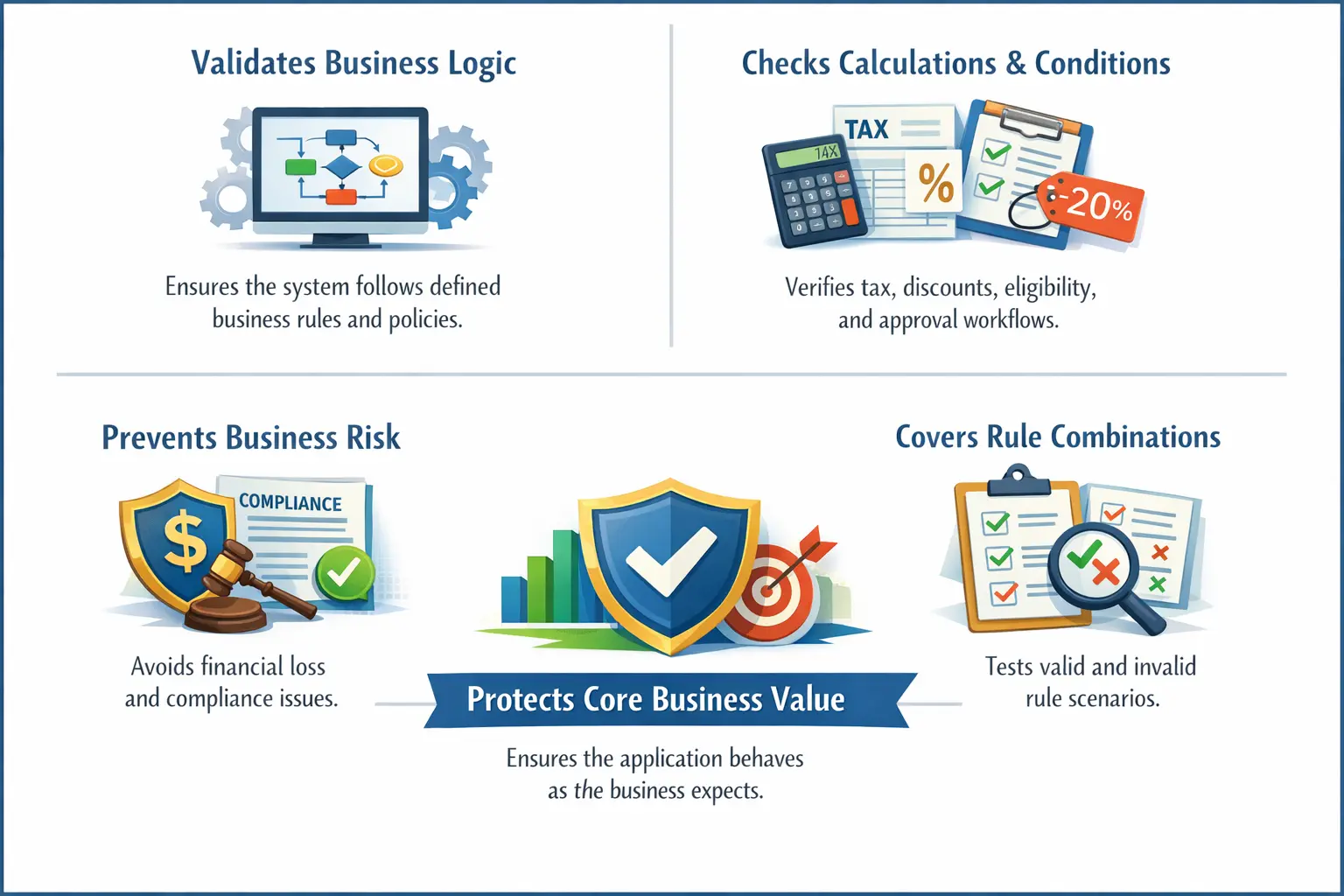
The primary objective of business rule testing is to confirm that business logic is implemented accurately and consistently. Business rules are the decisions that make the application meaningful to the business. A screen may load correctly, a button may submit successfully, and data may be saved in the database, but if the system makes the wrong business decision, the application has still failed in a serious way.
Business rules often drive financial transactions, approvals, eligibility checks, compliance requirements, pricing, discounts, tax calculations, credit limits, access decisions, and workflow routing. Errors in these areas can lead to financial loss, legal exposure, customer dissatisfaction, operational disruption, or reputational damage. That is why business rule testing usually carries high importance even when the visible feature seems simple.
This form of testing ensures alignment between business expectations and system behavior. It verifies that the application follows the policies agreed by stakeholders, not merely that the technical feature executes. For example, a loan application form may submit successfully, but the real question is whether the approval decision follows the bank's eligibility rules.
Business rule testing also protects trust in the system. Users and business teams rely on software to make correct decisions repeatedly. If the system applies a discount incorrectly, approves an ineligible customer, rejects a valid claim, or calculates tax wrongly, business users may lose confidence in the application. Careful rule validation prevents these failures from reaching production.
Understanding Business Rules
Business rules define how the system should make decisions. They describe the logic that connects business policy with system behavior. These rules may involve calculation formulas, eligibility conditions, workflow approvals, conditional branching, regulatory constraints, priority handling, threshold values, or exception conditions.
For example, tax calculations, discount percentages, approval hierarchies, renewal eligibility, insurance claim rules, loan interest computations, shipping charges, late payment penalties, and user access rights are all governed by business logic. If these rules are implemented incorrectly, the system may function technically but fail from a business standpoint.
Business rules may be simple or complex. A simple rule may say that a password must contain at least eight characters. A complex rule may say that a loan is approved only if the applicant meets age, income, credit score, employment, existing debt, and document verification conditions. The more conditions involved, the more carefully the rule must be tested.
Some business rules are explicit in requirement documents. Others are hidden in conversations, legacy systems, regulatory guidelines, spreadsheets, or business team assumptions. A tester must be alert to both written and implied rules. If a rule is unclear, it should be clarified before testing begins.
Business rules can also interact with each other. One rule may override another, or two rules may apply at the same time. For example, a customer may qualify for a discount but not if the product is already on clearance. Rule precedence and conflict handling are important parts of business rule testing.
Role of the Manual Tester
A manual tester must thoroughly understand the business domain and interpret the logic behind each rule. This requires analyzing requirement documents, user stories, acceptance criteria, decision tables, business process flows, regulatory notes, and stakeholder explanations. The tester must understand not only what the screen does, but why the rule exists and what business outcome it should produce.
The tester identifies all conditions and decision paths, then validates outputs against expected business outcomes. If a rule depends on age, income, and credit score, the tester must identify valid values, invalid values, boundary values, and combinations. Testing only one approved case and one rejected case is usually not enough.
Effective business rule testing requires designing scenarios that cover multiple combinations of conditions rather than testing only straightforward use cases. Manual testers must think analytically and ask what happens when one condition passes and another fails, when values sit exactly at a threshold, when exception rules apply, and when two rules conflict.
The tester also plays a communication role. Business rule defects often require discussion with business analysts, product owners, developers, and subject matter experts. If the expected result is unclear, the tester should not guess. Clarifying the rule early prevents wrong testing and wrong implementation.
Good testers maintain traceability between business rules and test scenarios. This makes it possible to prove which rules have been validated and which remain untested. Traceability is especially important in financial, healthcare, insurance, government, and compliance-heavy domains.
Techniques Used in Business Rule Testing
Structured test design techniques are essential for validating business logic thoroughly. Decision table testing helps validate combinations of conditions and actions. Boundary value analysis ensures limits and thresholds are handled correctly. Equivalence partitioning verifies representative input categories. Scenario-based testing validates real-world workflows influenced by business decisions.
Decision table testing is one of the most useful techniques for business rules. It lists conditions and expected actions in a structured format. For example, a loan rule may depend on age, income, credit score, and employment status. A decision table helps testers verify each meaningful combination without missing important paths.
Boundary value analysis is important because business rules often depend on thresholds. If a discount applies when order value is above 1000, testers should validate values just below, exactly at, and just above the threshold. If eligibility begins at age 18, testing 17, 18, and 19 helps confirm the rule is implemented correctly.
Equivalence partitioning helps reduce unnecessary test cases by grouping inputs into meaningful categories. For example, income values may be divided into low, eligible, and high categories. Instead of testing every possible income, testers choose representative values from each category.
Scenario-based testing validates how rules behave inside real workflows. A rule may work correctly when tested alone but fail when combined with user actions, approvals, documents, or system states. Scenario-based testing confirms that business decisions work in context, not only as isolated calculations.
These techniques prevent gaps in rule validation. They also make business rule testing more explainable to stakeholders because the coverage is based on visible logic rather than random case selection.
Real-Time Example
Consider a loan approval process. Business rules may define minimum age, minimum income threshold, and minimum credit score requirements. Business rule testing validates every possible combination of these inputs to ensure correct approval or rejection decisions.
Suppose the rule says an applicant must be at least 21 years old, have a monthly income of at least 30,000, and have a credit score above 700. A simple happy path test may use age 30, income 50,000, and score 760. That confirms one valid case, but it does not prove the rule is complete.
Business rule testing checks multiple combinations. What happens if the age is 20 but income and score are valid? What happens if age and income are valid but credit score is 699? What happens if the credit score is exactly 700 or exactly 701? What happens if income is exactly 30,000? These cases reveal whether thresholds and rejection conditions are implemented correctly.
The tester should also check rule precedence. If a customer is below the minimum age, should the system reject immediately, or should it show all failed conditions? If the applicant has a special employee status, does a different rule apply? If manual approval is allowed for borderline cases, when should the application route the request for review?
Testing must confirm that valid combinations are accepted and invalid combinations are rejected consistently. It must also confirm that the reason for rejection or approval is clear enough for business users to trust the decision.
Entry and Exit Criteria
Business rule testing begins when business rules are clearly documented and test cases are prepared. Testing concludes when all defined rules have been validated and no critical business logic defects remain unresolved.
Entry criteria should include approved business rules, clarified acceptance criteria, available test data, access to the correct environment, and agreement on expected outcomes. If business rules are vague, testing can become opinion-based. A tester may think a result is wrong while a business analyst considers it correct. Clear rules prevent this confusion.
Exit criteria should include execution of planned rule scenarios, validation of boundary and exception cases, closure or accepted deferral of critical rule defects, and stakeholder agreement where needed. In high-risk domains, business users may need to review test results or approve rule behavior before release.
Clear traceability between business rules and test cases is essential for completeness. Every important rule should map to one or more test scenarios. If a rule changes, traceability helps testers identify which cases must be updated and rerun.
Common Defects Identified
Business rule testing often uncovers incorrect calculations, missing conditional branches, improper rule precedence, and inconsistent enforcement of policies. In complex systems, multiple rules may conflict, and priority handling errors can emerge.
Incorrect calculations are common in finance, billing, tax, insurance, discounts, and interest-related systems. A small rounding error or percentage mistake can create major business impact when repeated across thousands of transactions.
Missing conditional branches occur when the system handles common cases but fails for special situations. For example, a discount may apply correctly for regular customers but fail for premium customers, employees, or customers using multiple offers.
Rule precedence defects occur when multiple rules apply but the system chooses the wrong one. For example, a product may be eligible for a seasonal discount and a clearance restriction at the same time. The system must know which rule wins.
Inconsistent enforcement is another serious defect. A rule may be enforced on the web application but not in the mobile app, API, admin panel, or batch process. Business rules must be consistent across all channels that affect the same decision.
These defects typically carry high business impact because they affect decisions, money, compliance, or customer eligibility. They are often more serious than simple display defects.
Business Rule Testing Compared to Functional Testing
Functional testing verifies whether features work as specified, while business rule testing validates whether business decisions and policies are implemented correctly. Functional defects may affect usability or behavior, but business rule defects can directly impact revenue, compliance, or operational accuracy.
A functional test may verify that a user can submit an insurance claim form. A business rule test verifies whether the claim is approved, rejected, routed, or flagged according to policy rules. The form submission may work perfectly, but if the claim decision is wrong, the business has a serious problem.
Business rule testing often sits inside functional testing, but it deserves separate attention because the risk is different. A broken button may block a user. A wrong rule may approve an ineligible loan, calculate incorrect tax, violate a compliance requirement, or deny service to a valid customer. Because of this, business rule testing carries extremely high priority.
| Aspect | Business Rule Testing | Functional Testing |
|---|---|---|
| Focus | Business logic | Feature behavior |
| Impact | High business risk | Functional correctness |
| Priority | Very high | High |
Common Mistakes
One common mistake is validating only happy paths while ignoring alternate rule combinations. Another is insufficient domain understanding, which leads to incomplete test coverage. Failing to validate rule precedence in complex decision flows can also introduce critical production issues.
Another mistake is relying only on examples provided in requirements. Examples are useful, but they may not cover every condition. Testers must analyze the rule and derive additional scenarios, especially boundary, negative, and exception cases.
Poor test data preparation is also a frequent problem. Business rule testing often needs specific data states: eligible users, ineligible users, premium customers, expired accounts, borderline values, conflicting rules, and different approval roles. Without controlled data, important rule paths may not be tested.
Some teams fail to test rule changes across channels. A rule may be updated in the UI but not in an API, report, batch job, or admin tool. If the same business decision appears in multiple places, all relevant paths must be considered.
Business rule testing demands analytical thinking and domain awareness. The tester must understand the rule, challenge it with combinations, and verify outcomes from a business point of view.
Best Practices for Business Rule Testing
The first best practice is to clarify rules before testing begins. If a rule is vague, contradictory, or missing exception handling, testers should raise questions early. Testing unclear logic leads to unreliable results.
The second best practice is to use decision tables for complex conditions. Decision tables make combinations visible and reduce the chance of missing important paths. They also help business stakeholders review the expected outcomes.
The third best practice is to include boundary values. Many business rules depend on thresholds, limits, ranges, dates, scores, amounts, and counts. Values just below, exactly at, and just above these limits should be tested carefully.
The fourth best practice is to maintain traceability. Each business rule should be linked to test scenarios, test data, and results. Traceability helps during audits, rule changes, regression planning, and release decisions.
The fifth best practice is to involve business stakeholders. Testers can design strong scenarios, but business users or domain experts should confirm whether the expected decisions are correct. This is especially important for finance, insurance, healthcare, legal, and compliance-heavy systems.
Business Rule Testing in Agile Projects
In Agile projects, business rule testing should begin during backlog refinement. Testers should ask about conditions, exceptions, thresholds, rule priority, and expected outcomes before development starts. These questions improve the quality of user stories and acceptance criteria.
During sprint testing, business rule scenarios help confirm that the implemented story delivers the expected business behavior. If a story contains complex logic, testers may create decision tables or example-based scenarios before execution. This gives developers and business stakeholders a shared understanding of the rule.
Rule changes should also influence regression testing. When a business rule changes, existing workflows, reports, calculations, APIs, and downstream processes may be affected. Agile teams should treat rule changes as high-impact changes even when the UI change looks small.
Documentation and Traceability
Business rule testing depends heavily on documentation and traceability. The tester should know where the rule is defined, which scenarios validate it, which data was used, and what result was observed. This is important because business rules often change over time.
Good documentation makes future maintenance easier. If a tax rule changes, the tester can quickly identify the affected test cases. If a production issue occurs, the team can check whether that rule was covered and whether a new regression case should be added.
Traceability also supports audits and stakeholder confidence. In regulated domains, teams may need to prove that specific policies were tested. Clear mapping between rules and test evidence makes this possible.
Interview Perspective
In interviews, business rule testing is typically explained as the validation of business logic, calculations, and decision-making rules within an application. A strong explanation emphasizes that it protects business value and prevents financial or compliance risks.
A stronger interview answer explains that business rule testing uses techniques such as decision tables, boundary value analysis, equivalence partitioning, and scenario-based testing. It should mention that testers must validate combinations of conditions, not only happy paths.
If asked for an example, a loan approval system is effective. The tester can explain age, income, credit score, and employment conditions, then describe testing approved and rejected combinations, boundary values, and rule precedence.
If asked how business rule testing differs from functional testing, the answer should clarify that functional testing checks feature behavior, while business rule testing checks whether business decisions are correct. A feature can work technically but still fail if the business rule is wrong.
Key Takeaway
Business Rule Testing safeguards the core business functionality of an application. Even if features appear to work correctly, failure in business logic can cause severe impact. Validating business rules thoroughly ensures that the system not only functions but also operates in alignment with real-world business expectations.
The practical value of business rule testing is business protection. It prevents wrong approvals, wrong calculations, wrong eligibility decisions, wrong discounts, wrong charges, and wrong compliance behavior. These are not minor defects; they can directly affect money, trust, operations, and legal responsibility.
Good business rule testing combines domain understanding, structured test design, realistic data, boundary thinking, traceability, and stakeholder collaboration. When done well, it ensures that the application does more than process screens. It makes correct business decisions.