Principles of Software Testing: A Practical Guide for Real-World Testing
Introduction
The principles of software testing are foundational guidelines that shape how testing is planned, designed, and executed. They are not rules to memorize but realities to understand. These principles explain the limits of testing, the need for prioritization, and the importance of aligning testing with business value. In real projects, testers who understand these principles make smarter decisions about where to focus effort and how to reduce risk.
Why Testing Principles Matter in Real Projects
Software testing principles matter because testing is always performed under limits. Testers rarely have unlimited time, unlimited environments, perfect requirements, complete data, or full access to every possible user behavior. A tester must make decisions every day about what to test, how deeply to test, what risk to communicate, and when the evidence is strong enough to support release decisions. The principles of software testing provide a practical foundation for making those decisions with maturity.
These principles also help stakeholders understand what testing can and cannot promise. Testing is powerful, but it is not magic. It can reveal defects, reduce uncertainty, and improve confidence, but it cannot prove that software is perfect. When teams misunderstand this, they may expect testers to guarantee that no bugs remain. A mature testing culture understands that testing reduces risk through evidence, prioritization, and learning. This realistic view prevents false confidence and encourages better quality decisions.
Principle 1: Testing Shows Defects, Not Their Absence
The first principle states that testing can show that defects are present, but it cannot prove that defects are absent. This is one of the most important ideas for any tester to understand. If a test fails, the defect is visible. If a test passes, it only means that the specific condition tested behaved as expected. It does not mean that every possible condition has been tested or that the software is completely defect-free.
In real projects, this principle shapes communication. A tester should avoid saying that a product has no bugs. A better statement is that the tested scenarios passed and no defects were found in the covered areas. This wording is more accurate because it acknowledges the limits of testing. A system may pass all planned test cases and still fail when a user enters unusual data, follows a rare workflow, uses a different browser, or triggers an integration timing issue.
This principle does not weaken the value of testing. Instead, it makes testing more honest. Testing provides evidence about product behavior. The more relevant and risk-focused the tests are, the stronger the evidence becomes. But evidence is not the same as absolute proof. Good testers help teams understand the difference.
Practical Meaning of Passed Test Cases
Passed test cases are useful because they confirm that known expectations are met under specific conditions. For example, if login succeeds with valid credentials and fails with invalid credentials, that gives confidence in the basic login flow. But the same login feature may still have problems with expired accounts, locked users, special characters, session timeout, browser autofill, slow network conditions, or role-based redirection. A passing result is meaningful only within the scope of what was actually tested.
This is why test reporting should include coverage and risk, not only pass counts. A test execution summary that says 100 test cases passed is less useful if it does not explain what those tests covered. Stakeholders need to know whether critical business flows, negative scenarios, boundary values, integrations, and regression areas were included. Testing principles encourage testers to communicate intelligently rather than relying on raw numbers alone.
Principle 2: Exhaustive Testing Is Impossible
Exhaustive testing means testing every possible input, path, condition, configuration, and combination. In practical software systems, this is impossible. Even a small form can create many combinations. A registration form may include name, email, phone number, password, date of birth, country, gender, terms checkbox, referral code, and optional profile fields. Each field can contain valid values, invalid values, empty values, boundary values, special characters, and different formats. The number of combinations grows very quickly.
Because exhaustive testing is impossible, testing must be selective. Selective testing does not mean careless testing. It means thoughtful testing based on risk, business value, usage frequency, complexity, defect history, and impact. A tester must choose scenarios that are most likely to reveal important defects. This is why test design techniques such as equivalence partitioning, boundary value analysis, decision table testing, state transition testing, and risk-based testing are important. They help testers reduce an impossible space into a meaningful set of tests.
This principle also prevents waste. If a team tries to test everything equally, it may spend too much time on low-risk areas while critical flows receive insufficient attention. Smart testing focuses depth where failure would hurt most. Testing everything is impossible; testing wisely is essential.
Risk-Based Thinking in Place of Exhaustive Testing
Risk-based testing is the practical response to the impossibility of exhaustive testing. Risk is usually a combination of probability and impact. A feature that is complex, frequently changed, heavily used, integrated with other systems, or business-critical has higher risk. A defect in such an area can cause serious damage. For example, payment processing, authentication, order placement, data import, report generation, and role-based access usually deserve careful testing because the impact of failure is high.
Lower-risk areas may still need testing, but they may not need the same depth. A spelling change on an internal tooltip is not the same as a change to tax calculation. Risk-based testing helps the team spend effort where it produces the most value. This approach aligns testing with business priorities and makes better use of limited time.
Principle 3: Early Testing Saves Time and Money
Early testing means starting quality activities as soon as possible, not waiting until code is complete. Testing begins when testers review requirements, ask questions, identify ambiguities, examine user stories, review acceptance criteria, and think about possible scenarios. Many defects can be found before a single line of code is written. A missing validation rule, unclear workflow, incomplete error condition, or conflicting requirement can be corrected early with far less effort.
The cost difference is significant. If a requirement says that users can reset passwords but does not specify link expiry, password complexity, old password invalidation, or security messaging, a tester can raise these questions during requirement review. If the team clarifies them immediately, the cost is small. If the gap is discovered during system testing, developers must update code and testers must retest. If discovered after release, users may face security issues, support teams may receive complaints, and the organization may need an urgent hotfix.
Early testing is therefore a cost-control practice. It reduces rework, improves understanding, and prevents defects from moving forward into later phases. It also helps testers design better test cases because they understand the requirement intent before execution begins.
Early Testing in Agile and Waterfall Projects
In Agile projects, early testing happens during backlog refinement, sprint planning, story discussion, acceptance criteria review, and continuous collaboration with developers and product owners. Testers ask questions before implementation, identify missing scenarios, and help define what done means. This prevents misunderstandings within the sprint and reduces late surprises.
In Waterfall or sequential projects, early testing happens through requirement reviews, design reviews, test planning, and test case preparation before execution. Even though testing execution may happen later, test thinking should begin early. When testers participate early, they can identify gaps before those gaps become code. The principle applies across project models because early feedback is always cheaper than late correction.
Principle 4: Defects Cluster Together
The defect clustering principle states that defects are often concentrated in a small number of modules or areas. In many systems, a few components produce a large percentage of defects. These may be complex modules, frequently changed modules, poorly understood areas, integrations, legacy code, or business-critical workflows. Defects are rarely spread evenly across the whole application.
This principle helps testers focus effort. If historical data shows that payment, authentication, and reporting repeatedly produce defects, those areas deserve deeper testing. If a new release modifies a complex pricing engine, testers should treat it as high risk. If a module has many reopened defects, unclear ownership, or frequent hotfixes, it may be a defect cluster. Recognizing these patterns helps teams improve quality more efficiently.
Defect clustering also supports continuous improvement. If the same module repeatedly fails, the team should not only test it more; they should investigate why it is fragile. The root cause may be poor design, unclear requirements, lack of unit tests, weak code ownership, unstable dependencies, or insufficient regression coverage. Testing identifies the cluster, but quality improvement requires addressing the cause.
How Testers Identify Defect Hotspots
Testers identify defect hotspots through observation and data. Defect reports show which modules fail most often. Production incidents reveal areas that escape testing. Reopened defects indicate fixes that do not fully resolve issues. Complex workflows, frequent code changes, unclear requirements, and integration-heavy features often signal higher risk. Testers should use this information when planning regression and exploratory testing.
A practical example is an e-commerce checkout flow. It may involve cart calculation, discounts, tax, address validation, payment gateway, inventory update, order creation, notification, and user history. Because many parts interact, the checkout flow is more likely to produce defects than a static information page. Defect clustering tells testers to spend more time where complexity and impact combine.
Principle 5: Pesticide Paradox
The pesticide paradox says that if the same tests are repeated again and again without change, they eventually stop finding new defects. The application becomes well-covered only for those familiar paths, while new risks remain hidden. Repeating the same regression suite is useful for confirming that existing behavior still works, but it is not enough to discover new types of defects.
Test cases must evolve as the application evolves. When new features are added, workflows change, data rules expand, user roles are introduced, or integrations are modified, test suites should be reviewed and improved. Testers should add new scenarios, update old ones, include negative cases, vary test data, test different paths, and perform exploratory testing. A test suite that never changes becomes less effective over time.
This principle is especially important in automation. Automated tests are excellent for repeated checks, but automation can create false confidence if it covers only old paths. A green automation report does not mean new risks have been explored. Automation should be maintained, reviewed, and expanded based on product changes and defect history.
Keeping Test Suites Effective
To avoid the pesticide paradox, teams should periodically review test cases. Outdated tests should be updated or removed. Missing scenarios should be added. Defect history should influence new test design. If a defect was found in production, a regression test should be considered so that the same issue does not return. If user behavior changes, test data and scenarios should reflect that change.
Exploratory testing is also useful because it introduces fresh thinking. A tester can take a feature and explore it from a different angle: unusual data, interrupted workflows, role changes, browser differences, boundary conditions, or integration delays. This helps uncover defects that scripted tests may miss. Mature testing balances stable regression checks with continuous test improvement.
Principle 6: Testing Is Context-Dependent
Testing is context-dependent because different applications have different risks, users, regulations, technologies, and business goals. There is no single testing approach that fits every product. A banking application requires strong security, accuracy, auditability, and reliability testing. A healthcare system requires safety, privacy, compliance, and workflow validation. A gaming application may focus more on usability, performance, device compatibility, and visual behavior. A learning website may focus on content accuracy, navigation, mobile readability, and accessibility.
Context affects test strategy, test design, test data, environment selection, tool choice, and release criteria. A low-risk internal admin page may not require the same depth of performance testing as a public high-traffic payment system. A prototype may need fast feedback rather than formal documentation. A regulated system may require evidence, traceability, approvals, and audit-ready test records. Good testers adapt instead of applying the same checklist blindly.
Understanding Product Context Before Testing
Before testing deeply, testers should understand the product context. Who are the users? What are the critical workflows? What business risks exist? What happens if the system fails? Which data is sensitive? What environments are supported? Which legal or compliance requirements apply? Which areas changed recently? Which areas have a history of defects? These questions help testers design relevant testing.
Context also helps testers communicate better. Instead of reporting only that a defect exists, a tester can explain why it matters in this product. A minor alignment issue may be low risk in an internal tool but high visibility on a public landing page. A slow report may be acceptable for an occasional admin export but unacceptable for a dashboard used during live operations. Context turns testing into informed risk assessment.
Principle 7: Absence-of-Errors Fallacy
The absence-of-errors fallacy says that finding and fixing defects does not help if the system does not meet user needs. A product may have very few known defects and still fail because it solves the wrong problem, supports the wrong workflow, omits a critical feature, or creates a poor user experience. Quality is not only about correctness. It is also about usefulness and value.
This principle reminds testers to validate business value. If the requirement itself is wrong or incomplete, testing only against that requirement may not be enough. Testers should understand the user goal and business process. They should ask whether the workflow makes sense, whether the output is useful, whether users can complete their task, and whether the product supports real-world needs. Validation is as important as verification.
A simple example is a report that generates without error but does not include the data users need for decision-making. Technically, the report feature works. Practically, it fails. The absence-of-errors fallacy explains why defect-free does not always mean high quality.
Applying the Principles Together
These principles are most useful when applied together. Testing shows defects but cannot prove perfection, so testers communicate risk clearly. Exhaustive testing is impossible, so testers use risk-based prioritization. Early testing reduces cost, so testers participate in requirement and design discussions. Defects cluster together, so testers focus on hotspots. The pesticide paradox warns testers to refresh test suites. Context-dependent testing reminds teams to adapt to product risk. The absence-of-errors fallacy keeps everyone focused on user value.
Together, these principles create a realistic testing mindset. Testing is not about blindly executing the maximum number of test cases. It is about learning the product, identifying risk, designing meaningful coverage, communicating evidence, and supporting better release decisions. A tester who understands these principles becomes more effective because they know why they are testing, not only what they are testing.
Common Mistakes When Principles Are Ignored
When testers ignore these principles, testing becomes inefficient. Some testers try to test everything and become overwhelmed. Some repeat the same test cases without updating them and miss new defects. Some wait until the end of development and discover issues late. Some focus only on defect count and forget business value. Some use the same testing approach for every project, regardless of context. These mistakes reduce the impact of testing.
Another common mistake is treating a passed test cycle as proof that the system is perfect. This creates dangerous confidence. A better approach is to explain what was tested, what was not tested, which risks remain, which defects are open, and how confident the team should be. Testing principles help testers become better communicators and risk advisors.
Role of Manual Testers in Applying Testing Principles
Manual testers apply these principles throughout the project. During requirement review, they practice early testing by asking questions and finding ambiguities. During test design, they accept that exhaustive testing is impossible and choose meaningful scenarios. During execution, they look for defect clusters and explore risky areas. During regression, they avoid the pesticide paradox by updating test cases. During reporting, they communicate that testing reduces risk but does not prove total absence of defects.
Manual testers also apply context-dependent thinking. They test a payment flow differently from a content page. They test a medical workflow differently from an entertainment feature. They test a public user registration form differently from an internal admin setup page. This judgment is what makes manual testing valuable. Tools can execute checks, but testers decide what matters.
Principles in Test Planning
A test plan should reflect these principles. Since exhaustive testing is impossible, the plan should identify scope, priorities, risks, and exclusions. Since defects cluster, the plan should pay extra attention to complex or historically problematic areas. Since testing is context-dependent, the plan should match the product domain and business goals. Since early testing saves cost, the plan should include review activities and early involvement.
A good test plan does not promise perfection. It explains how testing will reduce risk and provide confidence. It identifies the test levels, test types, environments, data needs, responsibilities, entry criteria, exit criteria, and reporting approach. Testing principles turn planning from a formality into a practical quality strategy.
Interview-Ready Explanation of Testing Principles
In interviews, the principles of software testing should be explained with practical meaning, not just listed. A strong answer says that testing shows the presence of defects but cannot prove their absence, exhaustive testing is impossible, early testing saves time and money, defects cluster together, repeated tests become less effective over time, testing depends on context, and defect-free software can still fail if it does not meet user needs.
A practical example strengthens the answer. For a login feature, testers cannot test every possible input and environment combination, so they choose valid login, invalid login, locked account, password rules, session handling, role redirection, browser compatibility, and security-related checks based on risk. They also update tests when new login behavior is added. This example demonstrates several principles at once and shows real testing maturity.
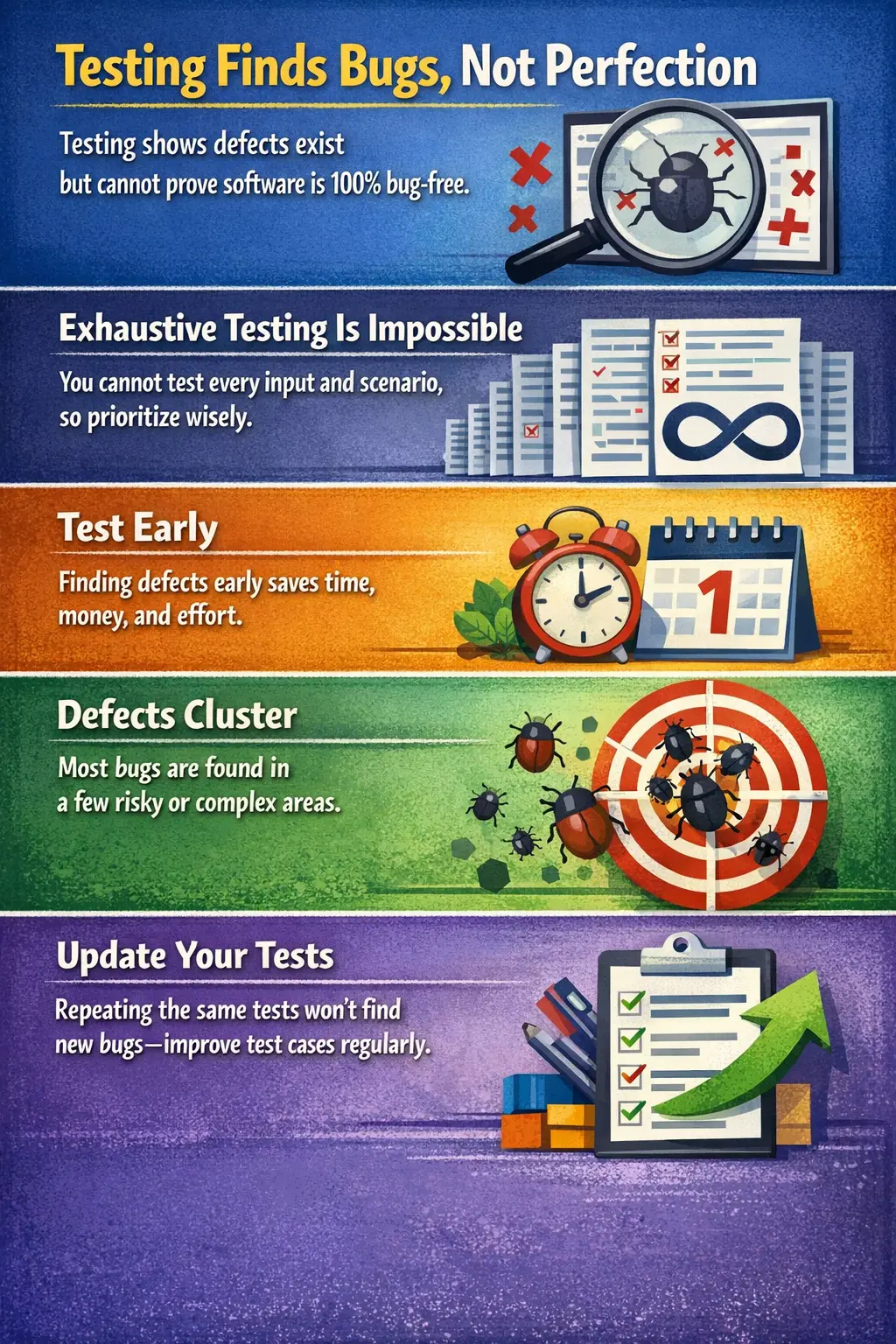
Testing Shows the Presence of Defects
Testing can demonstrate that defects exist, but it can never prove that a system is completely defect-free. No matter how many tests are executed, there is always a possibility that undiscovered issues remain.
This matters because teams must avoid a false sense of security. Passing tests indicate that known scenarios work, not that every scenario works. A system can pass all test cases and still fail in a rare real-world condition. Good testers communicate this limitation clearly to stakeholders.
Exhaustive Testing Is Impossible
It is impossible to test all combinations of inputs, paths, and conditions in any non-trivial system. Even a simple form with a few fields can produce thousands of combinations.
Because of this reality, testing must be selective and risk-based. Testers prioritize critical flows, high-impact areas, and common user behaviors. The goal is not to test everything, but to test what matters most.
Early Testing Saves Time and Money
Testing should begin as early as possible in the lifecycle. Reviews of requirements, designs, and user stories often reveal defects before any code exists.
Defects found early are cheaper to fix because they require less rework. A misunderstanding caught in a requirement review may take minutes to correct, while the same issue found in production may require code changes, retesting, redeployment, and customer support.
Early testing is one of the strongest cost-control practices in software projects.
Defects Cluster Together
Defects are not evenly distributed. A small number of modules usually contain the majority of defects. Complex, high-change, or critical components often become defect hotspots.
This principle encourages focused testing. Instead of spreading effort evenly, testers concentrate more on risky and complex areas such as authentication, payments, or integrations. Historical defect data often helps identify these clusters.
Pesticide Paradox
When the same tests are repeated again and again, they eventually stop finding new defects. The tests become familiar to the system, just like pests becoming resistant to the same pesticide.
To remain effective, test cases must evolve. Testers should add new scenarios, vary inputs, and explore new paths as the application changes. Regular review and enhancement of test suites keeps testing productive.
Testing Is Context-Dependent
There is no single “best” way to test. The testing approach depends on the type of application, domain, risks, and user expectations.
A banking system demands strict security and accuracy testing. A medical system requires safety-critical validation. A demo website may focus more on usability and basic functionality. Understanding context ensures testing effort matches business risk.
Absence-of-Errors Fallacy
Even if a system has very few defects, it can still fail if it does not meet user needs. Software that works perfectly but solves the wrong problem delivers little value.
Testing must therefore validate usefulness, not just correctness. Confirming business value, user workflows, and real-world relevance is as important as finding bugs.
Common Beginner Mistakes
Many new testers try to test everything, which leads to inefficiency. Others delay testing until late stages, repeat the same scenarios without improvement, or assume that “no bugs found” equals success.
Mature testing focuses on risk, learning, and continuous improvement rather than volume alone.
Interview Perspective
In interviews, these principles are often used to gauge practical understanding. A strong explanation highlights that testing finds defects but cannot prove their absence, exhaustive testing is unrealistic, early testing reduces cost, defects tend to cluster, tests must evolve, testing varies by context, and user value ultimately defines success.
Clear examples from real projects make these explanations stronger.
Key Takeaway
Effective testing is about smart testing, not more testing. The principles of software testing remind us to focus on risk, adapt to context, and prioritize user value. Testers who apply these principles deliver higher impact with their effort and help teams build better software with realistic expectations.