Heuristic Testing
In real-world software testing, not every important defect is found through predefined test cases. Some defects appear only when a tester thinks beyond the documented path, questions unusual behavior, or applies lessons learned from past projects. This is where Heuristic Testing becomes valuable. Heuristic Testing is an experience-based testing approach where testers use practical rules of thumb, mental shortcuts, patterns, and judgment to identify where defects are most likely to exist.
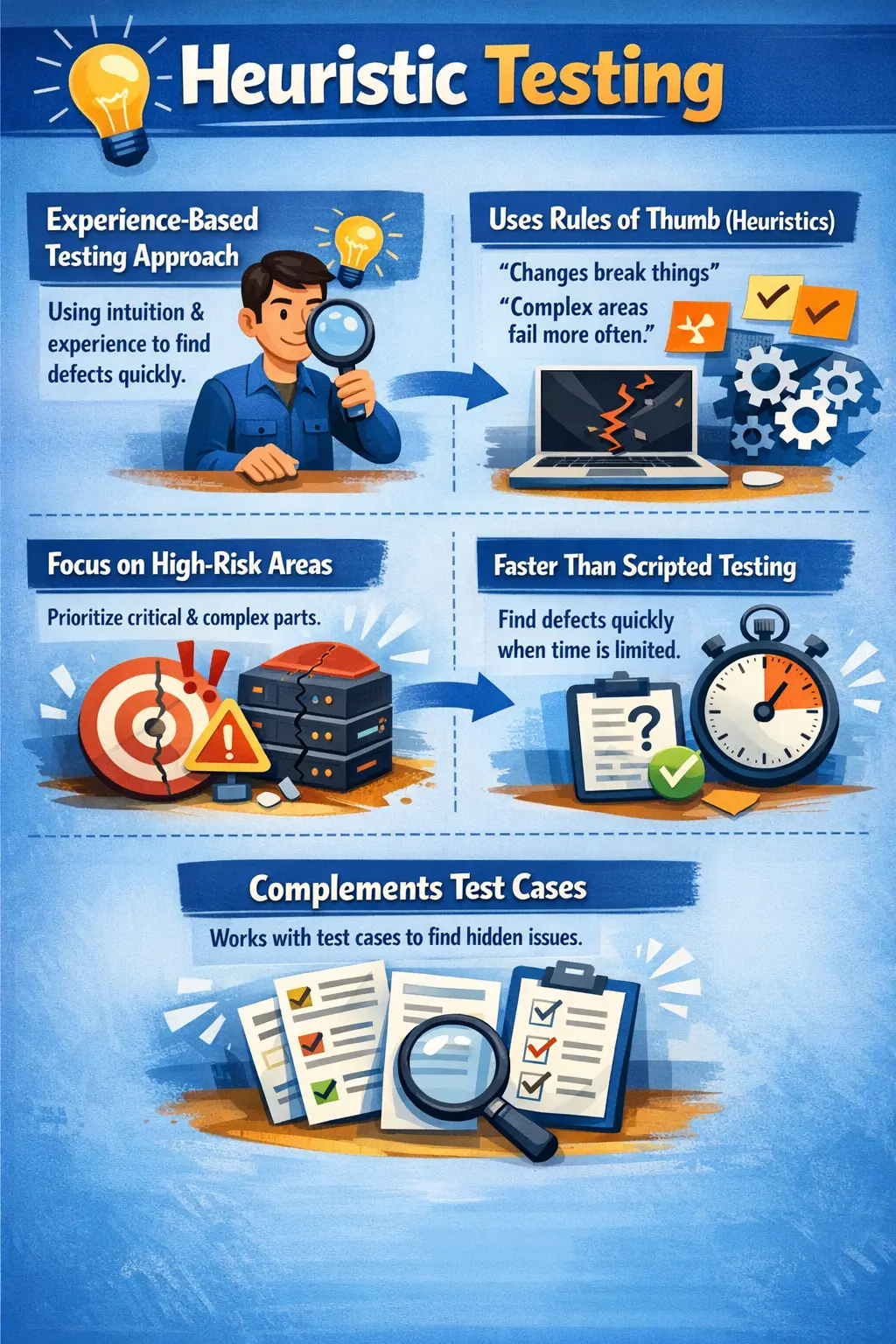
Heuristic Testing does not replace structured test cases, requirement-based testing, or regression suites. Instead, it strengthens them. Scripted testing is useful for validating known requirements, but real applications often contain hidden risks, incomplete requirements, changing workflows, configuration differences, and user behaviors that are difficult to document fully. Heuristics help testers decide where to look, what to question, and how to test intelligently when complete certainty is not available.
The key question behind Heuristic Testing is: based on experience, where are defects most likely to exist? A tester may know that recently changed modules are risky, boundary values often fail, error messages are frequently incomplete, configuration differences cause environment issues, and complex workflows tend to break at transition points. These observations guide testing effort and make defect discovery faster and more focused.
Why Heuristic Testing Is Important
Heuristic Testing is important because software projects rarely provide perfect testing conditions. Requirements may be incomplete, documentation may be outdated, timelines may be tight, and features may change during development. If testers wait only for complete test cases, important risks may remain unexplored. Heuristics allow testers to adapt quickly and make practical decisions even when information is limited.
In Agile projects, this becomes especially useful. A tester may receive a feature late in the sprint and still need to provide meaningful feedback quickly. Instead of attempting exhaustive testing, the tester can focus on high-risk areas using known patterns: recent changes, critical workflows, validations, permissions, error handling, data combinations, and integrations. This helps the team find important defects earlier.
Heuristic Testing is also valuable because not all user behavior can be predicted during test design. Users may double-click buttons, refresh pages during transactions, enter unusual data, navigate backward, interrupt workflows, or access pages directly through URLs. Experienced testers often anticipate these patterns and explore them without waiting for formal test cases. This is why heuristic thinking is closely connected to real user behavior and risk-based testing.
Most importantly, heuristics improve the tester’s ability to find hidden defects. A tester who has seen similar failures before can quickly recognize suspicious areas. For example, if a previous release had defects in role permissions, the tester may pay closer attention to authorization behavior in the next release. Experience becomes a practical tool for quality improvement.
What Are Heuristics?
Heuristics are guiding principles or rules of thumb that help testers make decisions during testing. They are not strict rules, mathematical guarantees, or formal procedures. A heuristic may not always lead to a defect, but it often points the tester toward areas that deserve attention. In testing, heuristics are based on experience, defect history, domain knowledge, technical awareness, and repeated patterns observed across projects.
For example, a tester may use the heuristic that features with recent changes are more likely to contain defects. This does not mean every changed feature is defective, but it is a useful guide for regression testing. Another heuristic is that boundaries are risky. If an input allows values from 1 to 100, values around 1 and 100 are more likely to expose issues than values in the middle. A third heuristic is that error handling is often incomplete, so invalid inputs, service failures, and interrupted workflows deserve focused testing.
Heuristics help testers think efficiently. They reduce the need to test randomly and help focus attention on meaningful risks. A skilled tester does not use heuristics blindly. They combine heuristics with requirements, business context, data, defect history, and current observations to decide what to test next.
Characteristics of Heuristic Testing
Heuristic Testing is experience-driven. Its effectiveness depends heavily on the tester’s knowledge, past exposure, domain understanding, and ability to recognize patterns. A tester who has worked on payment systems may quickly think of retry logic, duplicate transactions, failed payment handling, refunds, and reconciliation. A tester with healthcare experience may focus on patient privacy, role-based access, audit logs, and data accuracy. Experience shapes the heuristics used.
It is also adaptive. During execution, the tester may change direction based on what they observe. If one field has weak validation, the tester may explore other related fields. If one role has incorrect permission, the tester may check similar roles. This flexibility makes heuristic testing useful when the application behavior reveals clues during testing.
Heuristic Testing is fast and efficient when used correctly. It helps testers focus on areas where failure is more likely instead of spreading effort equally across low-risk and high-risk areas. It is also often combined with exploratory testing, where learning, test design, and execution happen together. The tester explores, observes, learns, adjusts, and continues testing with better insight.
Another important characteristic is that it is risk-focused. Heuristic Testing is not random clicking. It is guided by known risk patterns. The tester thinks about what can go wrong, where similar systems failed before, which areas changed recently, which workflows are complex, and which failures would hurt the business most.
Common Heuristics Used by Manual Testers
Manual testers use many heuristics in day-to-day testing, often without naming them formally. One common heuristic is CRUD: create, read, update, and delete. Any application that handles records should be tested for these basic operations. If a user can create a customer, the tester should verify whether the customer can be viewed, edited, deleted if allowed, searched, reported, and handled correctly after changes. CRUD testing helps uncover defects in data handling and consistency.
The boundary heuristic focuses on limits. Many defects occur at minimum values, maximum values, empty values, null values, and just outside allowed ranges. If a file upload limit is 10 MB, the tester should try files below 10 MB, exactly 10 MB, and above 10 MB. If a password length rule exists, the tester should test values just inside and outside the allowed length. Boundary thinking is one of the most reliable heuristics in manual testing.
Error guessing is another powerful heuristic. It uses experience to predict where mistakes may happen. The tester thinks like a careless user, a confused user, or a user attempting invalid behavior. They may submit forms with missing fields, enter special characters, perform actions in the wrong order, use expired links, repeat submissions, or attempt unauthorized access. Error guessing is especially useful when requirements do not cover every negative scenario.
The configuration heuristic focuses on settings that change behavior. Applications may behave differently based on feature flags, environments, roles, regions, languages, browsers, or user types. A feature may work when enabled but still appear when disabled. A user with one role may see data that another role should not. Configuration-related defects are common because code and settings must work together correctly.
The change impact heuristic is based on a simple but reliable idea: changes introduce risk. Whenever a feature is modified, testers should validate the changed area, connected workflows, shared components, and integration points. This heuristic is central to regression testing. A small fix in login validation may affect password reset, registration, session handling, or user profile behavior if common components are shared.
The workflow heuristic focuses on end-to-end user journeys. A feature may work in isolation but fail when used as part of a complete business process. For example, product search may work, cart may work, and payment may work separately, but the full checkout workflow may fail when discount, tax, shipping, and payment confirmation interact. Workflow heuristics help testers validate realistic user journeys from start to finish.
The data heuristic focuses on data variety and data state. Testers check large datasets, duplicate records, missing data, special formats, old records, new records, migrated data, and unusual values. Many production defects occur because test data was too clean or too simple. Data heuristics encourage testers to use realistic, messy, and varied data conditions.
Manual Tester’s Role in Heuristic Testing
Manual testers are central to Heuristic Testing because the approach depends on human observation and judgment. A tester must understand the application, the business domain, user workflows, and defect history. Based on that understanding, the tester decides which heuristics are useful for the current feature or release.
The tester’s responsibility is to identify high-risk areas and focus effort intelligently. If a module is new, complex, recently changed, or historically defect-prone, the tester may apply change impact, workflow, data, and error guessing heuristics. If the feature has many input values, boundary and data heuristics become important. If the feature depends on roles or feature flags, configuration heuristics become essential.
Even though Heuristic Testing is less scripted, documentation still matters. Testers should record what they tested, what they observed, what defects were found, and what ideas need follow-up. Without notes, useful insights may be lost and coverage may become unclear. Good documentation turns heuristic testing from informal exploration into valuable team knowledge.
Experienced testers should also share heuristics with the team. If one tester discovers that a certain module often fails after configuration changes, that insight should be shared during planning or retrospective discussions. Over time, the team builds a stronger set of shared testing heuristics.
Heuristic Testing vs Scripted Testing
Heuristic Testing and scripted testing serve different purposes. Scripted testing is based on predefined test cases and is useful for validating known requirements. It provides consistency, repeatability, and traceability. A scripted regression suite helps ensure that important existing functionality is checked across releases.
Heuristic Testing is more flexible and discovery-oriented. It is useful for finding unknown defects, exploring unclear behavior, and adapting to observations during testing. It does not require every step to be predefined before execution. Instead, the tester uses judgment to decide what to investigate next.
Scripted testing is stronger when the goal is repeatable coverage. Heuristic Testing is stronger when the goal is investigation, learning, and fast defect discovery. In real projects, the best approach is to use both. Test cases cover expected requirements, while heuristics help testers challenge the system beyond the documented path.
Real-Time Example
Consider a login feature. Scripted test cases may validate successful login, invalid password, empty username, and logout. A tester using heuristics may go further. They may try repeated failed attempts to check account lock, refresh the page during login, use browser back after logout, open the dashboard URL directly without login, test session timeout, check behavior in multiple browsers, and verify whether error messages reveal too much information.
Many of these scenarios may not be explicitly documented in the first version of test cases, but they are realistic and valuable. The tester is using experience to identify areas where login systems commonly fail: validation, session management, authorization, security messaging, and user flow interruptions. This is Heuristic Testing in action.
Another example is a file upload feature. A heuristic tester may try large files, empty files, unsupported formats, duplicate file names, files with special characters, network interruption during upload, and double-clicking the upload button. These are practical risk areas that can expose defects beyond the basic happy path.
Common Defects Found Using Heuristics
Heuristic Testing often reveals defects that scripted testing misses. These include missing or unclear error messages, incomplete validation, broken workflows, inconsistent behavior after interruption, duplicate submissions, role-permission gaps, configuration issues, data handling defects, and failures around boundary values.
It is also effective at finding usability issues. A form may technically submit, but users may not understand what went wrong when validation fails. A workflow may complete, but require too many confusing steps. A report may display data, but filters may behave inconsistently. These issues are often noticed when testers think like real users instead of only following documented steps.
Heuristics also help uncover regression defects. If a tester knows that a shared component changed, they may check several pages that use the same component. This can reveal side effects before users encounter them in production.
Advantages of Heuristic Testing
One major advantage of Heuristic Testing is faster defect discovery. Experienced testers can often identify risky areas quickly because they recognize patterns from previous projects. This is useful when timelines are short and the team needs meaningful feedback fast.
Another advantage is flexibility. Heuristic Testing can adapt to changing requirements, incomplete documentation, unstable features, and new observations during execution. It supports Agile teams because it does not depend entirely on fully written test cases before testing can begin.
Heuristic Testing also uses human intelligence in a way automation cannot fully replace. Tools can execute checks, but they do not naturally question whether a workflow is confusing, whether an error message is helpful, or whether an unusual user action might create risk. Human judgment remains a major strength of manual testing.
Limitations of Heuristic Testing
Heuristic Testing has limitations. It depends heavily on the tester’s experience, so results may vary between testers. A senior tester with strong domain knowledge may identify risks that a beginner misses. This does not make heuristic testing weak, but it means teams should support learning, mentoring, and shared heuristics.
It can also lack repeatability if not documented properly. If a tester explores an area and finds no defects but records nothing, the team may not know what was covered. Another tester may repeat the same work or miss important follow-up areas. Good notes and session summaries improve traceability.
Heuristic Testing should not replace structured testing. Requirements still need planned coverage, regression suites, traceability, and clear execution status. Heuristics enhance testing effectiveness, but they should be used alongside scripted testing, exploratory testing, risk-based testing, and test design techniques.
Common Mistakes in Heuristic Testing
A common mistake is treating Heuristic Testing as random testing. Random clicking without purpose is not heuristic testing. Heuristic Testing is guided by experience, risk patterns, and observations. The tester should be able to explain why they chose a particular area or scenario.
Another mistake is failing to document findings. Even when testing is flexible, defects, observations, assumptions, and coverage notes should be captured. Without documentation, useful learning is lost and the team cannot evaluate what was tested.
Over-reliance on heuristics is also risky. A tester may focus only on areas they personally suspect and miss requirements that need systematic validation. A balanced strategy is important: use scripted tests for known coverage and heuristics for deeper investigation.
Best Practices for Heuristic Testing
The first best practice is to build strong domain knowledge. The better testers understand the business, the better their heuristics become. Domain knowledge helps testers identify realistic workflows, critical rules, risky data, and user behavior patterns.
Teams should also share heuristics. If one tester learns that configuration changes often break a module, that insight should be added to team checklists or regression planning. Shared heuristics improve consistency and help less experienced testers learn faster.
Heuristic Testing should focus on high-risk areas and critical workflows. It should be combined with risk-based testing, exploratory testing, and structured test design. Findings should be documented clearly, including what was tested, what was observed, and what defects or risks were identified.
Interview Perspective
In interviews, a short answer can be: "Heuristic Testing is an experience-based testing approach where testers use rules of thumb and past learning to identify likely defect areas quickly." This answer gives the core meaning clearly.
A detailed answer can be: "Heuristic Testing helps testers focus on high-risk areas such as recent changes, boundaries, error handling, workflows, configurations, and data conditions. It is useful when documentation is limited, time is short, or testers need to discover unknown defects beyond predefined test cases." This answer shows practical understanding.
If asked for an example, use login, payment, file upload, or search. Explain how you would test beyond the happy path using experience. Interviewers usually want to hear how you think, not just whether you know the definition.
Key Takeaway
Heuristic Testing transforms tester experience into a practical testing tool. It helps testers think beyond test cases, focus on high-risk areas, and discover hidden defects quickly. It is especially useful in Agile environments where speed, adaptability, and judgment are important.
At the same time, Heuristic Testing should not replace structured testing. It works best when combined with planned test cases, exploratory testing, risk-based testing, and regression testing. A strong manual tester uses heuristics to test intelligently, not randomly. Ultimately, Heuristic Testing helps testers move from simply executing steps to thinking critically about product quality.