Benefits of Using Cucumber
In modern software development, one of the biggest challenges teams face is not just writing code or executing tests—it is ensuring that everyone involved truly understands what the system is supposed to do. Miscommunication between business stakeholders, developers, and testers often leads to defects, rework, and delayed releases. This is exactly the problem that Cucumber aims to solve.
Cucumber is a Behavior Driven Development (BDD) tool that enables teams to define application behavior using simple, business-readable language. Instead of writing technical test cases that only developers or testers can understand, Cucumber allows scenarios to be written in plain English using Gherkin syntax. These scenarios are not just documentation—they are executable specifications that directly drive automation.
The real power of Cucumber lies in the benefits it brings to collaboration, clarity, automation, and overall software quality. When implemented correctly, Cucumber transforms testing from a reactive activity into a proactive, collaborative process that aligns closely with business goals.
Why These Benefits Matter in Real Projects
The benefits of Cucumber become most visible in projects where requirements change often, multiple roles must collaborate, and automation needs to remain useful over time. In many software teams, the biggest quality problems are not caused by a lack of effort. Developers write code, testers execute test cases, product owners explain requirements, and automation engineers build scripts. The problem is that these activities can happen in disconnected ways. Cucumber creates value by giving the team a single behavioral language that connects these activities.
A traditional workflow may have requirements in one document, test cases in a test management tool, automation scripts in a code repository, and business understanding in meetings or emails. When any of these artifacts changes, the others may not be updated correctly. Over time, the team loses confidence in the documents and test assets. Cucumber reduces this drift by making scenarios both readable and executable. The same scenario can represent a requirement example, a test case, automation intent, and living documentation.
This does not mean Cucumber automatically solves every testing problem. It works well only when teams use it with discipline. Scenarios must be written at the right level of abstraction, business stakeholders should participate in discussions, and step definitions must be maintained carefully. When these practices are in place, Cucumber becomes more than a syntax choice. It becomes a quality collaboration layer.
Cucumber Improves Shared Understanding
Shared understanding is one of the most practical benefits of Cucumber. A requirement may look clear to one person and still be interpreted differently by another. For example, a requirement such as "user should be able to apply a discount coupon" can hide several business rules. Should expired coupons be rejected? Can two coupons be applied together? Is there a minimum order value? Does the coupon apply before or after tax? What message should appear when the coupon is invalid? These details matter.
Cucumber encourages teams to express these rules as examples. Instead of discussing only a broad statement, the team can write scenarios for valid coupon, expired coupon, duplicate coupon, minimum order mismatch, and coupon applied successfully. Each scenario creates a concrete conversation. Business stakeholders can confirm the expected outcome, developers can understand the rule, and testers can identify missing coverage.
This shared understanding reduces rework. A defect caused by misunderstanding is often more frustrating than a simple coding mistake because the developer may have built exactly what they thought was required. Cucumber helps reduce this type of defect by making expectations visible before implementation begins.
Cucumber Helps Shift Testing Left
Shift-left testing means quality activities begin earlier in the lifecycle. Cucumber supports this by encouraging scenarios to be written during requirement refinement or sprint planning, before development is complete. When the team writes scenarios early, they are not merely preparing automation scripts. They are validating whether the requirement is clear enough to build and test.
Early scenario discussion helps reveal missing rules, unclear acceptance criteria, invalid assumptions, and hidden edge cases. A tester may ask what should happen when input is empty. A developer may ask whether an API response is available. A product owner may clarify that one user role should behave differently from another. These questions are cheaper to answer before coding than after a feature is built incorrectly.
This benefit is especially valuable in Agile projects because sprint timelines are short. If requirement gaps are found late, the team may not have time to fix them cleanly. Cucumber helps move discovery earlier, making sprint execution smoother and reducing late-cycle surprises.
Cucumber Keeps Automation Business-Focused
Many automation projects fail because teams automate too many low-value checks or write scripts that are tightly coupled to implementation details. A large automation suite may exist, but stakeholders may still not know which business risks it protects. Cucumber helps by encouraging teams to automate behavior that matters from a user or business perspective.
A good Cucumber scenario describes an outcome, not a technical click path. For example, "Then the order should be placed successfully" is more meaningful than a long list of UI-specific operations in the feature file. The step definition and page object can handle the technical details. This keeps the scenario readable and stable even when the UI changes.
This business focus improves automation ROI. If automation validates critical behavior such as login, payment, search, registration, booking, account update, and reporting, it provides clear release confidence. The team can explain not only that tests passed, but which business behaviors were protected.
Cucumber Supports Better Maintenance
Maintenance is one of the biggest costs in test automation. Scripts become expensive when every small UI change requires updates across many files. Cucumber can reduce this cost when scenarios are written at the right level and step definitions are designed for reuse. The feature file remains focused on behavior, while technical details are isolated in step definitions, page objects, and helper methods.
For example, if a login button locator changes, the team should not need to update every login scenario. The change should be handled in the page object or automation layer. The scenario "When the user logs in with valid credentials" can remain unchanged because the business behavior has not changed. This separation makes the framework easier to maintain.
Reusable step definitions also reduce duplication. Common actions such as logging in, searching, adding a product to cart, submitting a form, or verifying a message can be shared across scenarios. However, reuse must be controlled carefully. If steps become too generic or ambiguous, maintenance becomes harder. Good Cucumber maintenance requires thoughtful step design.
Cucumber Builds Confidence in Releases
Release confidence comes from knowing that important behavior has been validated. Cucumber reports can show which scenarios passed, failed, or were skipped. Because scenarios are business-readable, stakeholders can understand the meaning of those results more easily than raw technical logs. This makes Cucumber useful not only for testers but also for product owners, managers, and business users.
In CI/CD pipelines, Cucumber scenarios can run automatically after code changes. If a critical behavior fails, the team receives quick feedback. This supports continuous validation and reduces the chance that a broken business flow reaches later environments. When the suite is well-designed, it acts as a safety net for important user journeys.
The confidence is strongest when scenarios are reliable, meaningful, and aligned with acceptance criteria. If scenarios are flaky or too technical, stakeholders may lose trust in the reports. Therefore, the benefit of release confidence depends on good scenario design, stable automation, clear test data, and disciplined maintenance.
Cucumber Improves the Tester Role
Cucumber also changes how testers contribute to a project. Instead of being involved only after development, testers can participate earlier by helping define scenarios, asking risk-based questions, and identifying missing examples. This makes the tester a quality partner during requirement discovery, not only a defect reporter during execution.
A tester working with Cucumber must think in terms of behavior, not only steps. They need to understand the business rule, write readable scenarios, identify positive and negative flows, and collaborate with developers on automation design. This expands the tester's contribution and makes testing more strategic.
Manual testers also benefit from Cucumber because feature files can guide manual validation before full automation exists. Teams can begin with readable scenarios, execute them manually, and later automate the most valuable ones. This makes Cucumber useful even during gradual automation adoption.
Business-Readable Test Cases
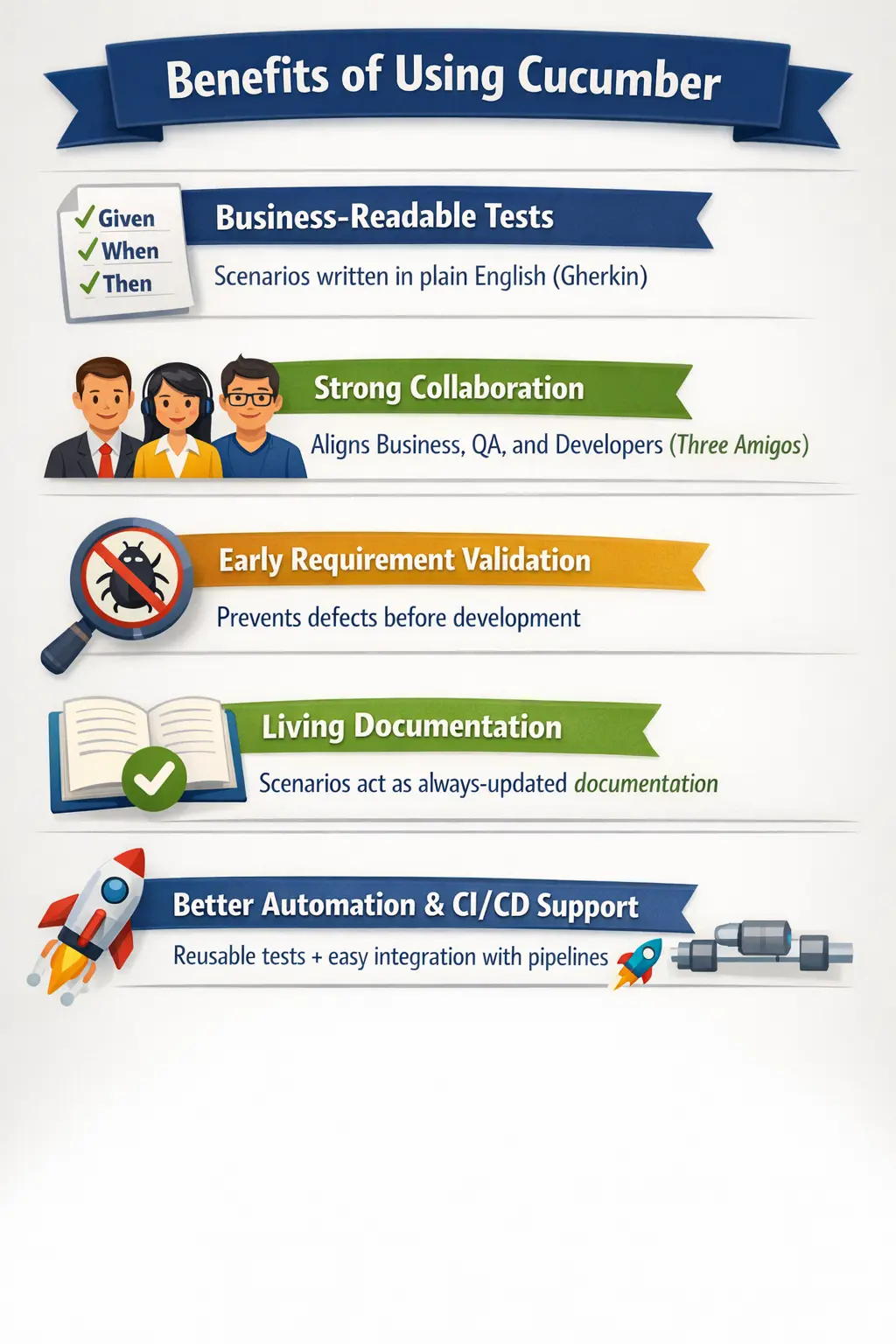
One of the most significant advantages of Cucumber is its ability to produce business-readable test cases. Traditional test cases are often written in technical language, making them difficult for non-technical stakeholders to understand. As a result, business users rarely validate test cases, leading to gaps between expectations and implementation.
Cucumber addresses this issue by using Gherkin, a structured yet simple language that reads like plain English. Scenarios are written using Given–When–Then statements, which describe behavior in a clear and intuitive manner.
This approach allows business users, product owners, and other stakeholders to read and validate test scenarios without requiring technical expertise. Test cases are no longer limited to QA teams—they become shared artifacts that everyone can understand and contribute to.
By making test cases accessible, Cucumber reduces misunderstandings and ensures that the system is being built according to actual business expectations.
Strong Collaboration Through the Three Amigos Model
Cucumber naturally promotes collaboration through what is commonly known as the “Three Amigos” model. This model brings together three key roles: business representatives (such as product owners), developers, and testers.
In traditional development, these roles often work in silos. Requirements are written by business teams, implemented by developers, and tested by QA—usually with minimal interaction. This separation leads to misinterpretation and misalignment.
With Cucumber, scenarios are discussed and agreed upon collaboratively before development begins. Everyone participates in defining the expected behavior of the system. This ensures that all perspectives are considered, and any ambiguities are resolved early.
The result is a shared understanding of requirements. Instead of discovering issues later in the cycle, teams align upfront, reducing friction and improving overall productivity.
Early Validation of Requirements
One of the most powerful benefits of Cucumber is its ability to enable early validation of requirements. In traditional testing approaches, test cases are often created after development is complete. By that time, any misunderstanding in requirements has already resulted in incorrect implementation.
Cucumber changes this timeline by encouraging teams to write scenarios before development begins. These scenarios act as a blueprint for how the system should behave.
By validating behavior early, teams can identify gaps, edge cases, and ambiguities before any code is written. This proactive approach prevents defects rather than simply detecting them later.
The impact is significant. Early validation reduces rework, lowers development costs, and ensures that the final product aligns closely with business expectations.
Living Documentation
Documentation is a critical part of any software project, but it often becomes outdated quickly. Traditional documentation requires manual updates, and as the system evolves, documents frequently fall out of sync with the actual behavior of the application.
Cucumber solves this problem by turning scenarios into living documentation. Since scenarios are executable, they are always aligned with the current state of the system. If a scenario fails, it indicates that the system behavior has changed or is incorrect.
This eliminates the need for separate documentation maintenance. The same scenarios used for testing also serve as up-to-date documentation of system behavior.
Additionally, Cucumber reports provide a clear view of which scenarios are passing and failing, giving stakeholders real-time visibility into the system’s status.
Clear Focus on Behavior
Traditional testing often focuses on implementation details such as UI elements, buttons, and fields. This approach makes tests fragile and tightly coupled to the underlying implementation.
Cucumber enforces a behavior-driven approach, where scenarios describe what the system does rather than how it does it. This abstraction allows tests to remain stable even when the UI or technical implementation changes.
By focusing on behavior, Cucumber ensures that testing aligns with business goals. Scenarios describe outcomes that matter to users, rather than technical steps that may change over time.
This leads to more robust and maintainable tests, as well as better alignment between testing and business value.
Improved Automation ROI
Automation is a significant investment, and its success depends on focusing on the right areas. Traditional automation efforts often result in large numbers of low-value test scripts that are expensive to maintain.
Cucumber improves the return on investment (ROI) of automation by prioritizing business-critical scenarios. Since scenarios are derived from business behavior, they naturally focus on high-value flows.
This approach avoids unnecessary automation of low-impact features and ensures that automation efforts are aligned with business priorities.
Additionally, behavior-driven scenarios are less fragile and easier to maintain, reducing the overall cost of automation over time.
Technology Agnostic Nature
Cucumber is not tied to a specific programming language or platform. It supports multiple ecosystems, including Java, JavaScript, Python, and .NET.
This flexibility allows teams to integrate Cucumber into their existing technology stacks without significant changes. Whether testing web applications, APIs, or databases, Cucumber can be adapted to fit the project’s needs.
Being technology agnostic also makes Cucumber a future-proof choice. Teams can evolve their technology stack while continuing to use the same behavior-driven approach.
Better Test Coverage
Cucumber encourages teams to think in terms of behavior rather than individual test cases. This naturally leads to more comprehensive coverage of scenarios.
Instead of focusing only on happy paths, teams are prompted to consider negative flows, edge cases, and alternative scenarios. This holistic approach ensures that business logic is thoroughly validated.
Better test coverage directly translates to fewer defects in production. By addressing a wide range of scenarios during testing, teams can deliver more reliable and robust applications.
Seamless CI/CD Integration
Modern development practices rely heavily on continuous integration and continuous delivery (CI/CD). Testing must be integrated into these pipelines to provide fast feedback and ensure quality at every stage.
Cucumber integrates seamlessly with popular CI/CD tools such as Jenkins, GitHub Actions, and others. Scenarios can be executed automatically as part of the build process, providing immediate feedback on changes.
This continuous validation ensures that defects are detected early and that deployments are made with confidence. Automated acceptance testing becomes a natural part of the development lifecycle.
Strong Traceability
Traceability is often a challenge in traditional testing. Maintaining links between requirements, test cases, and test results requires additional effort and tools.
Cucumber simplifies traceability by directly mapping scenarios to user stories and acceptance criteria. Each scenario represents a specific piece of functionality, making it easy to track coverage and results.
This built-in traceability eliminates the need for separate traceability matrices and simplifies auditing and compliance processes.
Reusable and Maintainable Tests
Well-designed Cucumber scenarios and step definitions promote reuse and maintainability. Instead of duplicating logic across multiple test cases, common steps can be reused across scenarios.
This reduces duplication and keeps the automation framework clean and organized. Maintenance becomes easier, as changes to a single step definition can update multiple scenarios.
Over time, this leads to a more scalable and sustainable automation framework.
Support for Both Manual and Automation Testing
Cucumber is not limited to automation. Its scenarios can be reviewed and executed manually, making it suitable for teams at different stages of automation maturity.
Teams can start by writing and validating scenarios manually, then gradually automate them as needed. This incremental approach allows for smooth adoption without forcing immediate automation.
This flexibility makes Cucumber accessible to both manual testers and automation engineers.
Improved Communication Across Teams
Cucumber acts as a common language that bridges the gap between technical and non-technical stakeholders. By using simple, structured language, it eliminates the need for lengthy requirement documents.
Communication becomes more direct and effective. Stakeholders can understand and validate scenarios easily, leading to greater confidence in the system.
This transparency improves collaboration and ensures that everyone is aligned on what the system should do.
Reduced Defect Leakage
By validating behavior early and continuously, Cucumber significantly reduces defect leakage into later stages such as UAT or production.
Since scenarios are defined upfront and executed regularly, issues are identified and resolved early in the development cycle. This prevents last-minute surprises and improves overall software quality.
Fewer defects in production mean lower costs, better user experience, and higher customer satisfaction.
Final Perspective
Cucumber is more than just a testing tool—it is a methodology enabler that transforms how teams approach software development and testing. By focusing on behavior, collaboration, and clarity, it addresses many of the limitations of traditional testing approaches.
From business-readable test cases and strong collaboration to improved automation ROI and seamless CI/CD integration, the benefits of Cucumber are both practical and strategic. It aligns testing with business goals, reduces risk, and enhances overall quality.
Key Takeaway
Cucumber improves requirement clarity, encourages collaboration, and provides living documentation. It aligns automation with business value, reduces cost and maintenance, and integrates seamlessly into Agile and CI/CD environments.
For teams aiming to build high-quality, reliable software while maintaining strong alignment with business expectations, Cucumber is not just an option—it is a powerful and proven approach.