Behavior Driven Development (BDD)
Behavior Driven Development (BDD) is a modern software development approach that emphasizes collaboration, clarity, and shared understanding among all stakeholders involved in a project. In today’s fast-paced Agile environments, where requirements evolve frequently and teams must deliver high-quality software quickly, BDD plays a crucial role in ensuring that what is built aligns perfectly with what the business expects. Rather than focusing purely on technical implementation, BDD shifts attention toward how the system should behave from a user and business perspective.
At its core, BDD is not just a testing technique or a development practice—it is a communication framework. It bridges the gap between business stakeholders, developers, and testers by expressing requirements in a language that everyone can understand. This shared language reduces ambiguity, prevents misunderstandings, and ensures that all team members are aligned before development begins.
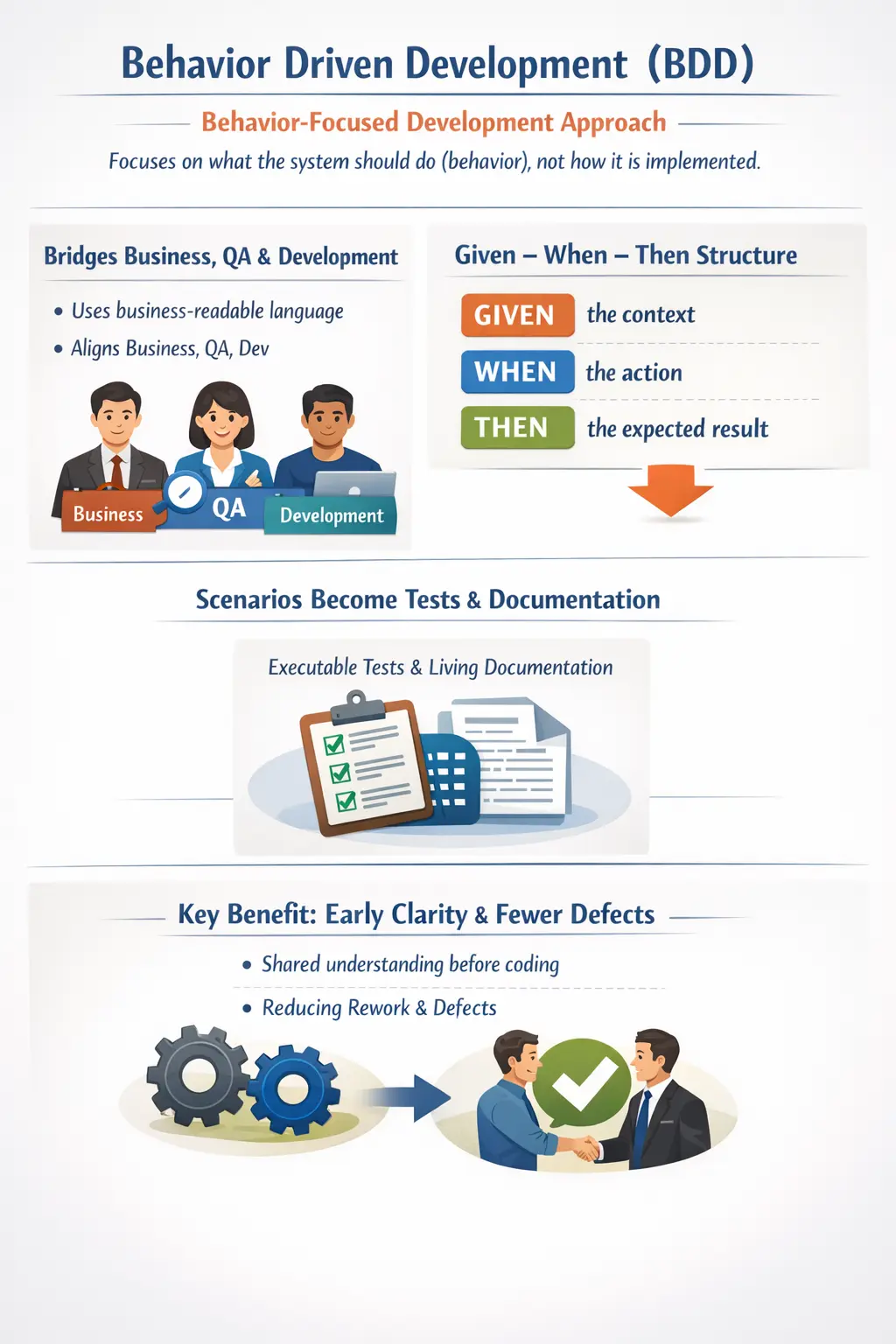
BDD as a Shared Understanding Practice
The most important value of BDD is shared understanding. Software projects often fail not because teams lack technical skill, but because people understand the requirement differently. A product owner may describe a business need in one way, a developer may interpret it technically, and a tester may discover during execution that important edge cases were never discussed. BDD reduces this gap by encouraging teams to discuss behavior through concrete examples before implementation begins.
A concrete example is easier to understand than a broad requirement statement. A requirement may say that users should be able to reset passwords, but that does not explain what happens when the email is not registered, when the reset link expires, or when the new password does not meet the security rule. BDD encourages the team to express these situations as scenarios. Once scenarios are discussed, hidden assumptions become visible. The team can then agree on the expected behavior before code is written.
This makes BDD a communication practice first and an automation practice second. Tools such as Cucumber are useful because they can execute the scenarios, but the deeper benefit comes from the conversations that produce those scenarios. If a team writes Gherkin after development is complete only to automate tests, it is using the syntax of BDD without fully using the practice. True BDD starts with collaboration.
BDD and Examples Over Assumptions
BDD encourages teams to replace assumptions with examples. Requirements written in general language can sound clear while still leaving room for different interpretations. Examples expose those differences. When the team writes a scenario using Given, When, and Then, it must decide the starting context, the action, and the expected result. This discipline forces clarity.
For example, a requirement such as "apply discount for eligible customers" raises many questions. Who is eligible? Is the discount based on customer type, order value, coupon, geography, date, or membership status? What happens if two discounts apply? What happens if the coupon is expired? BDD scenarios turn these questions into examples. Each example clarifies one rule and helps the team agree on behavior.
This examples-first mindset is one of the reasons BDD works well in complex business domains. Instead of debating abstract rules endlessly, the team discusses real situations. These situations become executable specifications. When the application behaves differently from the agreed examples, the team has a clear signal that something needs attention.
The Three Amigos Conversation
In many BDD teams, scenario discovery happens through a Three Amigos conversation. The three amigos are usually a business representative, a developer, and a tester. The business representative explains the business need and expected value. The developer thinks about implementation, technical constraints, and system behavior. The tester thinks about examples, edge cases, risks, and validation. Together, they create a more complete understanding than any one role could create alone.
This conversation is valuable because each role sees the product from a different angle. The business person may know the rule but not the technical implications. The developer may understand the architecture but may not know every business exception. The tester may identify missing scenarios and unclear acceptance criteria. BDD gives these roles a common structure for discussion.
A successful Three Amigos session should not become a long meeting where every minor detail is debated without progress. It should focus on discovering the important behaviors, clarifying uncertainty, and writing examples that guide development and testing. The output is not only a set of scenarios; it is a shared mental model of the feature.
Living Documentation in BDD
One of the strongest outcomes of BDD is living documentation. Traditional requirement documents often become outdated because they are separate from the code and tests. A document may describe how the system should behave, but if the system changes and the document is not updated, the document loses trust. BDD scenarios can remain more reliable because they are connected to executable tests. If the system changes, the scenarios must change or the tests fail.
Living documentation is useful only when scenarios are written clearly. If scenarios are too technical, too long, or too tied to UI implementation, business users may stop reading them. Good BDD documentation should describe business behavior in language that stakeholders understand. It should explain what the system does in meaningful situations, not how Selenium clicks through the screen.
When maintained well, BDD scenarios become a trusted reference. New team members can read them to understand behavior. Product owners can review them to confirm rules. Testers can use them to guide coverage. Developers can use them to understand expected outcomes. This shared documentation reduces dependency on tribal knowledge.
BDD and Automation
BDD works naturally with automation because scenarios can be mapped to step definitions. A Gherkin step such as "When the user logs in" can connect to automation code that opens the login page, enters credentials, and submits the form. This allows business-readable scenarios to become executable checks. When these checks run in a pipeline, the team receives quick feedback about whether important behavior still works.
However, automation should not dominate BDD design. A common mistake is writing scenarios based on what is easy to automate rather than what is important to the business. Another mistake is writing low-level UI steps such as "click this button" or "enter text into this field" for every detail. That style makes scenarios brittle and less readable. The better approach is to write behavior-focused steps and place technical details in step definitions and page objects.
Automation gives BDD long-term power, but only when the scenarios are well designed. Poorly written scenarios create expensive automation maintenance. Well-written scenarios create readable documentation and reliable regression checks. The goal is not to automate every sentence; the goal is to automate important behavior in a way that remains understandable and maintainable.
BDD, Acceptance Criteria, and User Stories
In Agile projects, BDD scenarios often support user stories. A user story describes a need from a user or business perspective. Acceptance criteria define the conditions that must be satisfied for the story to be accepted. BDD scenarios turn those acceptance criteria into concrete examples. This makes the story easier to develop, test, and review.
For example, a user story may say that a registered customer wants to apply a coupon so that they can receive a discount. Acceptance criteria may say that valid coupons should reduce the order total and expired coupons should be rejected. BDD scenarios can express both examples clearly. Given the customer has a valid coupon, when the coupon is applied, then the order total should be reduced. Given the coupon is expired, when the customer applies it, then the coupon should be rejected.
This connection between user stories, acceptance criteria, and scenarios improves sprint execution. Developers know what to build. Testers know what to validate. Product owners know what behavior they are approving. The scenario becomes a shared contract for the story.
BDD Quality Depends on Scenario Quality
BDD succeeds or fails based on the quality of the scenarios. A scenario should be focused, business-readable, and valuable. It should describe one behavior clearly. It should avoid unnecessary implementation details. It should use consistent language. It should be short enough to understand but complete enough to express the rule.
Bad scenarios create confusion. If a scenario contains too many actions, too many outcomes, or too many technical details, it becomes hard to maintain. If scenarios are written after the fact without collaboration, they may not represent true business understanding. If every UI action becomes a Gherkin step, the feature file becomes a procedural script rather than a behavior specification.
Good BDD teams regularly review scenarios. They remove duplication, improve wording, split large scenarios, and keep terminology aligned with the business. This discipline keeps BDD useful over time. Without maintenance, even a BDD suite can become noisy and expensive.
Common Challenges When Teams Adopt BDD
Teams often face challenges when they first adopt BDD. One common challenge is treating BDD as a tool installation rather than a practice change. Installing Cucumber and writing feature files does not automatically create collaboration. If scenarios are written only by testers after development is complete, the team may gain automation scripts but miss the deeper benefit of shared understanding.
Another challenge is writing scenarios at the wrong level. Some teams write scenarios that are too technical, with steps such as clicking buttons, entering text into fields, and checking CSS selectors. Other teams write scenarios that are too vague, with steps such as "When the user completes the process" without enough detail to understand the behavior. Good BDD requires balance. The scenario should be specific enough to verify behavior but abstract enough to remain business-readable.
Step duplication is another common issue. If teams do not agree on shared wording, they may create many step definitions that mean the same thing. One scenario may say "Given the user is logged in", another may say "Given the customer has signed in", and another may say "Given login is successful." If these mean the same state, the team should standardize the language. Consistent vocabulary reduces automation maintenance and improves documentation.
Teams may also try to automate too much at the UI level. BDD scenarios can be automated through the UI, API, service layer, or other appropriate levels. Not every behavior needs slow browser automation. A balanced framework may use UI automation for critical end-to-end workflows and API or service automation for business rules that do not require visual validation. This keeps feedback faster and more reliable.
The best way to overcome these challenges is to keep returning to the purpose of BDD: collaboration, shared understanding, and behavior-focused examples. If a scenario does not improve understanding, it should be rewritten. If an automated scenario is costly but low value, it should be reviewed. If a feature file is unreadable to business stakeholders, it is not serving its full purpose. BDD works best when teams treat it as a living practice, not a one-time setup.
Understanding Behavior Driven Development
Behavior Driven Development can be defined as a collaborative approach where application behavior is described using simple, business-readable examples. These examples are then transformed into executable tests that validate whether the system behaves as expected. In traditional development models, requirements are often documented in lengthy specifications that can be misinterpreted or outdated. BDD replaces these static documents with living specifications that evolve along with the system.
The central idea behind BDD is simple yet powerful: instead of asking “What features should we build?â€, the team asks “How should the system behave in real-world scenarios?â€. This shift in thinking ensures that development is always aligned with business goals and user expectations.
Why BDD Is Important
In many traditional development processes, teams face recurring challenges such as misunderstood requirements, late defect discovery, and poor communication between stakeholders. These issues often lead to rework, delays, and increased costs. BDD addresses these problems by introducing collaboration early in the development lifecycle.
One of the primary purposes of BDD is to ensure that everyone involved in the project has a clear understanding of the expected system behavior before any code is written. By discussing and defining behavior upfront, teams can identify gaps, edge cases, and potential risks early, significantly reducing the chances of defects later in the process.
Another key advantage of BDD is that it transforms test cases into living documentation. Unlike traditional documents that quickly become outdated, BDD scenarios remain relevant because they are directly tied to automated tests. As the system evolves, these scenarios evolve as well, ensuring that documentation is always accurate and up to date.
The Core Principle of BDD
The foundation of BDD lies in a simple principle: the system should behave as expected by the business, and this behavior should be described using examples. These examples act as a shared reference point for all stakeholders, ensuring that everyone is aligned on what needs to be built.
BDD emphasizes behavior over features, examples over assumptions, and collaboration over individual effort. This mindset encourages teams to focus on real-world usage scenarios rather than technical details. As a result, the system is designed and tested based on how users will interact with it, leading to better usability and higher customer satisfaction.
How BDD Works in Real Projects
In real-world projects, BDD follows a structured workflow that ensures continuous collaboration and validation. The process typically begins with the business or product owner describing the desired behavior in simple language. This description is then discussed in a collaborative session often referred to as the “Three Amigos†meeting, involving a business representative, a developer, and a tester.
During this discussion, the team explores different scenarios, clarifies requirements, and identifies edge cases. These scenarios are then written in a standardized format that captures the behavior clearly and concisely. Once the scenarios are defined, they are automated using tools such as Cucumber, allowing them to be executed as part of the testing process.
The final step involves integrating these automated scenarios into the CI/CD pipeline, ensuring that they are executed continuously. This continuous validation helps detect issues early and ensures that the system always behaves as expected.
The Given–When–Then Structure
One of the most recognizable aspects of BDD is the Given–When–Then structure used to describe scenarios. This structure provides a clear and consistent way of defining behavior.
The “Given†part describes the initial context or precondition. The “When†part specifies the action performed by the user or system. The “Then†part defines the expected outcome. This simple structure makes scenarios easy to read, understand, and validate.
For example, consider a login feature. A well-written BDD scenario would describe the behavior as follows: given the user has valid credentials, when the user logs in, then the user should see the dashboard. This description focuses on the outcome rather than the implementation, making it accessible to both technical and non-technical stakeholders.
BDD vs Traditional Testing
BDD differs significantly from traditional testing approaches. In traditional models, testing is often performed after development is complete, focusing on verifying whether the system works as intended. In contrast, BDD integrates testing into the development process itself, ensuring that behavior is validated continuously.
Another key difference lies in the language used. Traditional testing often relies on technical terminology, making it difficult for business stakeholders to understand. BDD, on the other hand, uses business-readable language, enabling all stakeholders to participate actively in the process.
Additionally, traditional documentation tends to become outdated over time, whereas BDD scenarios remain current because they are directly tied to automated tests. This makes BDD a more reliable and maintainable approach.
Role of a Tester in BDD
In a BDD environment, the role of a tester extends beyond executing test cases. Testers become active participants in defining system behavior and ensuring quality from the early stages of development.
Testers are responsible for analyzing requirements, identifying potential scenarios, and ensuring that all edge cases are covered. They collaborate closely with developers and business stakeholders to create clear and testable scenarios. This collaborative approach helps prevent defects rather than just detecting them.
Moreover, testers ensure that scenarios remain focused on behavior and do not include unnecessary technical details. By maintaining this focus, they help keep the scenarios simple, clear, and aligned with business goals.
Benefits of BDD
The adoption of BDD offers numerous benefits for software development teams. One of the most significant advantages is improved communication. By using a common language, BDD ensures that all stakeholders have a shared understanding of the system’s behavior.
BDD also enables early defect detection. Since scenarios are defined and validated before development begins, potential issues can be identified and addressed early, reducing the cost of fixing defects later.
Another important benefit is reduced rework. Clear and well-defined scenarios minimize misunderstandings, ensuring that the system is built correctly the first time. Additionally, BDD scenarios serve as living documentation, eliminating the need for separate documentation efforts.
BDD also aligns well with automation, making it easier to integrate testing into CI/CD pipelines. This leads to faster feedback cycles, improved efficiency, and higher confidence in releases.
Common Misconceptions About BDD
Despite its advantages, BDD is often misunderstood. One common misconception is that BDD is simply about writing test cases in plain English. In reality, BDD is a collaborative approach that focuses on defining behavior through examples.
Another misconception is that BDD replaces manual testing. While BDD enhances testing practices, it does not eliminate the need for manual testing. Instead, it complements manual testing by providing a structured way to define and validate behavior.
It is also important to understand that BDD is not just about tools. While tools like Cucumber help implement BDD, the true value lies in the mindset and collaboration it promotes.
When to Use BDD
BDD is particularly effective in projects where business rules are complex and multiple stakeholders are involved. It is well-suited for Agile and DevOps environments, where continuous collaboration and rapid feedback are essential.
However, BDD may not be necessary for small or simple projects where requirements are straightforward. In such cases, the overhead of defining and maintaining scenarios may outweigh the benefits.
BDD in Agile Teams
BDD integrates seamlessly with Agile methodologies. In Agile teams, user stories often serve as the starting point for defining behavior. These stories are then converted into BDD scenarios, which act as acceptance criteria.
During sprint planning, these scenarios help guide development and testing efforts. As development progresses, the scenarios are automated and executed continuously, ensuring that the system behaves as expected.
This alignment between requirements, development, and testing makes BDD a natural fit for Agile environments.
Interview Perspective
From an interview perspective, BDD is an important topic that demonstrates your understanding of modern development practices. A concise explanation would describe BDD as a behavior-focused approach that uses business-readable scenarios to define and validate system behavior.
A more detailed explanation would highlight its collaborative nature, its emphasis on shared understanding, and its role in improving communication and reducing defects.
Key Takeaway
Behavior Driven Development is more than just a testing approach—it is a mindset that transforms how teams build software. By focusing on behavior, encouraging collaboration, and using examples to define requirements, BDD ensures that software is built in alignment with business expectations.
It promotes early validation, reduces ambiguity, and enables continuous testing, making it an essential practice for modern software development. Ultimately, BDD helps teams deliver high-quality software with confidence, ensuring that what is built is exactly what the business needs.