Living Documentation
In traditional software development, documentation has often been treated as a secondary artifact—something created at the beginning of a project and rarely maintained thereafter. Over time, this approach has proven ineffective. Documents become outdated, teams lose trust in them, and eventually, they are ignored altogether. This disconnect between documentation and actual system behavior creates confusion, misalignment, and costly defects.
Living documentation emerges as a powerful solution to this long-standing problem. It represents a shift from static, manually maintained documents to dynamic, continuously validated artifacts that reflect the real state of the application. In the context of Behavior Driven Development (BDD), living documentation is not just an idea—it is a practical, working system where feature files and automated test results together form a reliable and always up-to-date source of truth.
Understanding living documentation is essential for modern software teams, especially those working in Agile and DevOps environments. It directly impacts collaboration, quality, transparency, and long-term maintainability.
Why Living Documentation Matters
Living documentation matters because software changes constantly. Requirements change, business rules evolve, integrations are added, old flows are redesigned, and defects lead to behavior corrections. In a static documentation model, every one of these changes requires someone to remember to update separate documents. In reality, documentation updates are often delayed, skipped, or performed inconsistently. Over time, the documentation becomes less trustworthy than the application itself.
When documentation is no longer trusted, teams lose an important source of shared understanding. New team members cannot rely on documents to learn the system. Testers cannot confidently use old test notes to design coverage. Product owners cannot quickly confirm current behavior. Developers may need to inspect code or ask senior team members to understand rules. This slows delivery and increases the risk of misunderstanding.
Living documentation solves this problem by tying documentation to executable behavior. If the documented behavior is correct and the system satisfies it, the scenario passes. If the behavior changes or breaks, the scenario fails. This feedback loop prevents documentation from silently becoming stale. It makes documentation part of the quality system rather than a forgotten side artifact.
Living Documentation Is More Than Feature Files
A common misunderstanding is that living documentation simply means having Cucumber feature files. Feature files are important, but they are not enough by themselves. A feature file that is never reviewed, never executed, or never updated is still static documentation. It may be written in Gherkin, but it is not truly living. The "living" part comes from continuous validation and active maintenance.
True living documentation includes readable scenarios, reliable automation, meaningful execution reports, team review, and alignment with current business rules. The feature file describes expected behavior. Step definitions connect that behavior to automation code. Test execution confirms whether the behavior is still valid. Reports communicate the current status. Team discipline keeps scenarios updated when requirements change.
This means living documentation is both a technical and collaborative practice. Automation keeps it verifiable, but collaboration keeps it meaningful. If scenarios are technically automated but written in a way that business stakeholders cannot understand, the documentation value is reduced. If scenarios are readable but not executed, the validation value is lost. Both sides are needed.
How Living Documentation Supports Agile Teams
Agile teams benefit from living documentation because they work with frequent change. A user story may evolve during refinement, change during sprint planning, and be adjusted after feedback. Static documents struggle in this environment because they require separate manual updates. Living documentation fits better because scenarios can evolve with the story and become part of the definition of done.
During backlog refinement, the team can discuss examples and convert them into scenarios. During development, those scenarios guide implementation. During testing, they validate behavior. During sprint review, they provide evidence of what has been completed. After release, they remain available as current documentation for future changes. This creates continuity across the Agile lifecycle.
Living documentation also helps reduce repeated clarification. If a future story modifies an existing feature, the team can review current scenarios to understand existing behavior. This is much faster than searching through old tickets, chat messages, and outdated documents. The scenarios become a practical knowledge base for the product.
How Living Documentation Improves Collaboration
Living documentation improves collaboration because it creates a shared artifact that different roles can understand. Business stakeholders care about the behavior described in the scenario. Testers care about coverage and edge cases. Developers care about implementation and automation. Product owners care about acceptance. When all these roles can look at the same scenario and discuss it, communication becomes more precise.
For example, a scenario describing successful money transfer can lead to useful discussion. The business stakeholder can confirm the expected outcome. The tester can ask about insufficient balance and daily limits. The developer can ask about account service dependencies. The product owner can decide which cases are required for the current release. This discussion improves the scenario before implementation begins.
This collaboration is often more valuable than the automation itself. A poorly understood requirement can lead to perfectly automated wrong behavior. Living documentation works best when it grows from team conversation, not when it is written silently after development. The documentation is alive because the team uses it, validates it, and improves it continuously.
Execution Reports as Proof of Current Behavior
Execution reports are a major part of living documentation. A feature file explains expected behavior, but a report shows whether the system currently satisfies that behavior. This distinction is important. A scenario without execution status is a statement of intent. A scenario with a recent passing result is stronger evidence that the behavior is working.
Good reports should be readable and accessible. Stakeholders should be able to see which features passed, which scenarios failed, what errors occurred, and when the tests were executed. For failed scenarios, screenshots, logs, request-response details, and stack traces can help teams diagnose the issue. Reports turn living documentation into a feedback system.
The value of reports depends on trust. If scenarios are flaky, reports become noisy. If failures are ignored, stakeholders stop relying on them. If reports are hidden in a technical folder that only automation engineers access, business visibility is lost. Living documentation requires reliable execution and clear communication of results.
Living Documentation and CI/CD
CI/CD pipelines make living documentation practical at scale. When scenarios run automatically after code changes, the documentation is continuously checked against the application. This creates a fast feedback loop. If a change breaks documented behavior, the team knows quickly. If all critical scenarios pass, the team gains confidence that important behavior remains intact.
In a pipeline, living documentation can be published as part of build artifacts or test reports. Teams can view the latest state without manually executing tests. This is useful for distributed teams, product owners, and release managers who need quick visibility into quality. The documentation is not a PDF stored somewhere; it is connected to the delivery process.
However, CI/CD also raises the quality bar. Tests must be stable enough for pipeline execution. Test data must be controlled. Environments must be reliable. Reports must be generated consistently. If the pipeline is unstable, living documentation loses credibility. Automation engineering discipline is therefore part of successful living documentation.
Maintaining Living Documentation
Living documentation still requires maintenance. The difference is that maintenance is driven by validated behavior rather than manual memory. When a business rule changes, related scenarios should be updated. When a feature is removed, obsolete scenarios should be removed. When an automation step becomes unreliable, the underlying implementation should be fixed. Living documentation must evolve with the product.
Teams should regularly review scenarios for clarity, relevance, duplication, and coverage. A scenario that once represented important behavior may become outdated after a redesign. Multiple scenarios may cover the same behavior unnecessarily. Some scenarios may be too technical to serve as documentation. Reviews help keep the documentation useful.
Maintenance is easier when scenarios are written at the right level of abstraction. If feature files are filled with UI locator details or implementation steps, small changes will force constant updates. If they describe stable business behavior, they remain useful longer. Good scenario design is one of the strongest foundations for sustainable living documentation.
Examples of Living Documentation in Practice
Consider a login feature. Traditional documentation may say, "Users can log in with valid credentials." That statement may remain in a document for years, even if password rules, account lockout behavior, or multi-factor authentication changes. Living documentation would express these behaviors as executable scenarios: successful login, invalid password, locked account, expired password, and MFA challenge.
When the authentication system changes, these scenarios reveal whether existing behavior still works. If the team introduces MFA and forgets to update a scenario, execution may fail. That failure is useful because it forces the team to align documentation and behavior. Either the system has a defect, or the documented expectation needs revision. In both cases, the mismatch becomes visible.
The same applies to payments, orders, approvals, subscriptions, profile updates, and reporting flows. Any business-critical feature can benefit from living documentation when examples are meaningful and execution is reliable. The goal is not to document every tiny technical detail. The goal is to document behavior that matters and keep it verified.
Ownership of Living Documentation
Living documentation should not belong only to the automation team. If only automation engineers own it, the scenarios may become too technical. If only business stakeholders own it, the scenarios may not be executable or maintainable. If only testers own it, development concerns may be missed. The strongest model is shared ownership.
Business stakeholders help ensure that scenarios reflect real business expectations. Testers help ensure coverage, edge cases, and clarity. Developers help ensure technical feasibility and automation design. Product owners help prioritize which behaviors need documentation and validation. This shared ownership keeps living documentation accurate and valuable.
Shared ownership also prevents documentation from becoming stale. When a rule changes, the team discusses which scenarios need updates. When a test fails, the team treats it as a signal rather than a nuisance. When a new feature is added, scenarios become part of the delivery workflow. This is how living documentation becomes part of team culture.
What Is Living Documentation?
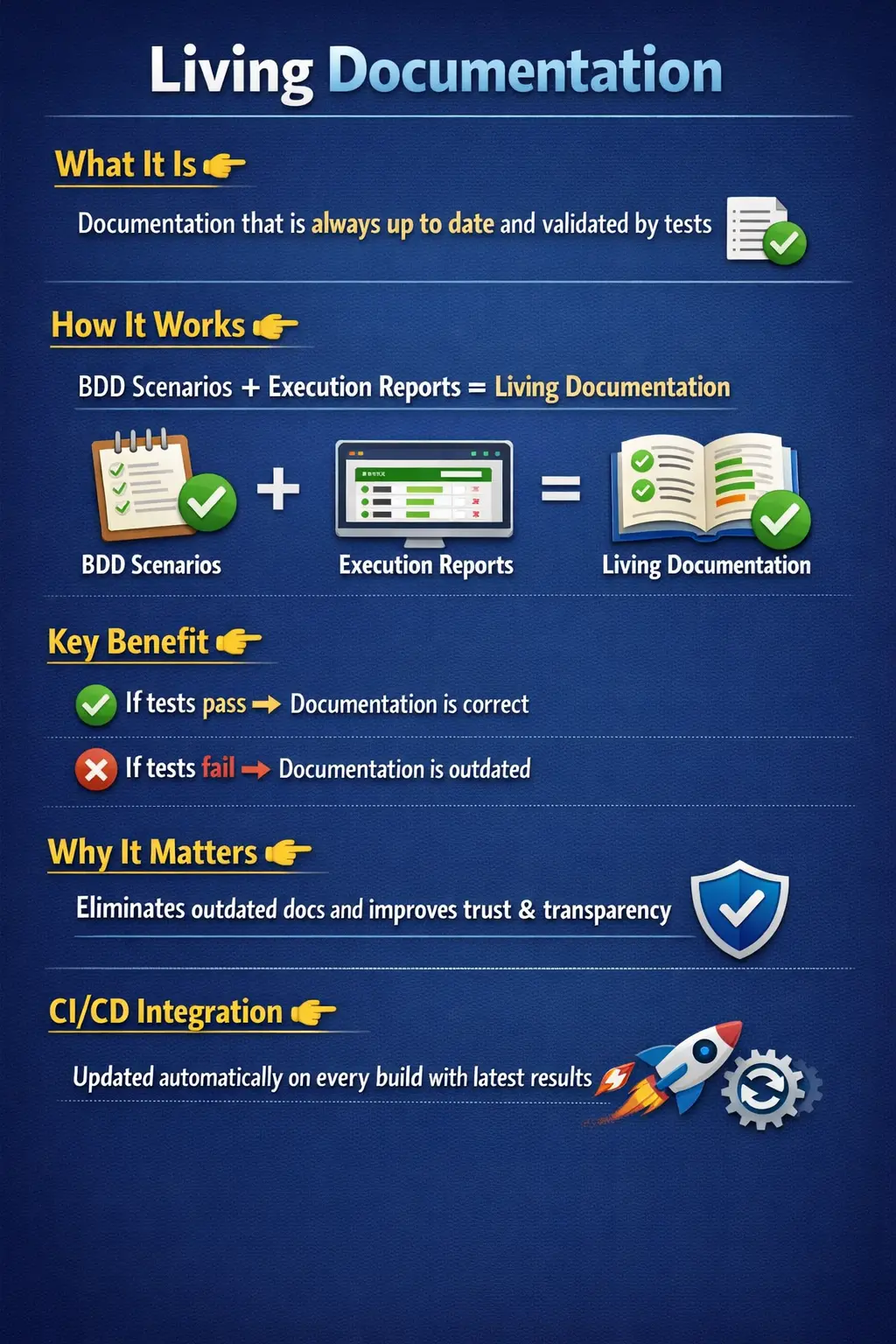
Living documentation refers to documentation that is continuously validated by automated tests and always reflects the current behavior of the system. Unlike traditional documents that exist separately from the code, living documentation is tightly integrated with the application itself.
In a BDD-driven environment, living documentation is created through the combination of Cucumber feature files and execution reports. Feature files describe the expected behavior of the system in a business-readable format, while automated test execution verifies whether that behavior is actually implemented.
The defining characteristic of living documentation is that it cannot silently become outdated. If the behavior described in the documentation no longer matches the system, automated tests will fail. This immediate feedback ensures that inconsistencies are detected early and corrected promptly.
This makes living documentation inherently trustworthy. It is not just a description of what the system should do—it is proof of what the system actually does.
The Problem with Traditional Documentation
To fully appreciate the value of living documentation, it is important to understand the limitations of traditional documentation approaches.
In many projects, documentation is created during the requirement or design phase. It may include requirement specifications, functional documents, and test case descriptions. However, once development begins, these documents often fall out of sync with the evolving system.
There are several reasons for this. First, maintaining documentation requires manual effort, which is often deprioritized in fast-paced development cycles. Second, changes in requirements are frequent, especially in Agile environments, making it difficult to keep documents updated. Third, there is usually no mechanism to validate whether the documentation is still accurate.
As a result, traditional documentation becomes unreliable. Teams stop referring to it because they cannot trust its accuracy. New team members struggle to understand the system, and stakeholders lack visibility into the current behavior of the application.
This gap between documentation and reality is one of the primary challenges that living documentation addresses.
How BDD Enables Living Documentation
Behavior Driven Development provides the foundation for living documentation by redefining how requirements are captured and validated.
In BDD, requirements are expressed as scenarios written in a business-readable language. These scenarios are not just descriptions—they are executable specifications. They define how the system should behave in specific situations using the Given–When–Then structure.
Because these scenarios are agreed upon collaboratively by business stakeholders, developers, and testers, they represent a shared understanding of system behavior. More importantly, they are automated and executed regularly.
When scenarios pass during execution, it confirms that the system behaves as documented. When scenarios fail, it indicates that either the system behavior has changed or the documentation is no longer accurate.
This continuous validation transforms static documentation into a living entity. It evolves with the system and remains aligned with actual behavior at all times.
Cucumber’s Role in Living Documentation
Cucumber plays a central role in enabling living documentation within the BDD ecosystem. It acts as the bridge between human-readable specifications and executable tests.
Feature files written in Gherkin serve as the primary documentation artifacts. They describe business capabilities and expected behaviors in a structured and readable format. Each feature contains scenarios that represent specific examples of system behavior.
Cucumber then executes these scenarios by mapping each step to corresponding automation code. During execution, it generates detailed reports that show which scenarios passed, which failed, and what the system actually did.
These reports are a critical component of living documentation. They provide real-time insights into system behavior and highlight any discrepancies between expected and actual outcomes.
Together, feature files and execution reports form a complete and continuously validated documentation system.
What Constitutes Living Documentation?
Living documentation is not limited to a single artifact. It is a combination of multiple elements that together provide a comprehensive view of system behavior.
Feature names represent business capabilities. They describe what the system is designed to achieve from a functional perspective. Scenarios within each feature define specific behaviors and use cases, often covering happy paths, edge cases, and negative flows.
Steps within scenarios act as concrete examples that illustrate how the system behaves under certain conditions. Execution status indicates whether each scenario is currently valid, while attachments such as screenshots and logs provide additional context for debugging and analysis.
This combination of descriptive and executable elements ensures that living documentation is both informative and verifiable.
Traditional Documentation vs Living Documentation
The difference between traditional documentation and living documentation becomes evident when comparing how each handles change.
In traditional documentation, a statement such as “User can log in with valid credentials” may remain unchanged even if the underlying behavior evolves. There is no mechanism to detect discrepancies, so outdated information persists.
In contrast, living documentation expresses the same requirement as an executable scenario. If the login functionality changes or breaks, the scenario will fail during execution. This failure immediately signals that the documented behavior is no longer valid.
This automatic validation eliminates the risk of outdated documentation and ensures that all stakeholders have access to accurate information.
Benefits of Living Documentation
The advantages of living documentation extend across multiple dimensions of software development.
One of the most significant benefits is accuracy. Because documentation is validated through automated tests, it always reflects the current state of the system. This builds trust among stakeholders and encourages teams to rely on documentation for decision-making.
Living documentation also eliminates the need for separate documentation efforts. Instead of maintaining multiple artifacts, teams can focus on writing and maintaining scenarios that serve both as tests and documentation.
Transparency is another key benefit. Stakeholders can view execution reports to understand what features are working and what issues exist. This visibility improves communication and alignment across teams.
Additionally, living documentation supports compliance and auditing requirements. Since it provides a verifiable record of system behavior, it can be used as evidence during audits.
Living Documentation in CI/CD Pipelines
In modern development practices, continuous integration and continuous delivery play a crucial role in ensuring software quality. Living documentation fits naturally into this workflow.
Scenarios are executed automatically as part of CI/CD pipelines. With every code change, tests run to validate system behavior. Reports are generated and published, providing immediate feedback to the team.
This continuous execution ensures that documentation is always up to date. Stakeholders can access the latest reports at any time, gaining real-time insights into system behavior.
By integrating documentation into the pipeline, teams eliminate the gap between development and documentation, making it a continuous process rather than a one-time activity.
Role of QA, Developers, and Business
Living documentation is not owned by a single role. It is a collaborative effort involving business stakeholders, testers, and developers.
Business stakeholders define the expected behavior in terms of business value. Testers ensure that scenarios are complete, covering edge cases and negative flows. Developers implement the functionality required to satisfy these scenarios.
This shared ownership ensures that documentation is accurate, relevant, and aligned with business goals. It also fosters a culture of collaboration, where all team members contribute to quality.
Common Pitfalls That Break Living Documentation
Despite its advantages, living documentation can fail if not implemented correctly. One common mistake is writing scenarios that focus on technical details or UI interactions rather than behavior. This reduces readability and makes scenarios harder to maintain.
Another issue arises when scenarios are not executed regularly. Without continuous validation, documentation loses its “living” nature and becomes outdated.
Treating feature files as mere test scripts is another pitfall. When scenarios are written without business context, they fail to serve as meaningful documentation.
Ignoring failed scenarios is equally problematic. Failures should be addressed promptly to maintain the accuracy of documentation.
Best Practices for Effective Living Documentation
To maximize the benefits of living documentation, certain best practices should be followed.
Scenarios should be concise and focused on behavior rather than implementation details. Feature and scenario names should be meaningful and clearly describe the business context.
Regular reviews during backlog refinement or sprint planning help ensure that scenarios remain relevant and accurate. Automated execution should be integrated into CI/CD pipelines to maintain continuous validation.
Finally, reports should be easily accessible to all stakeholders, ensuring transparency and collaboration.
Interview Perspective
From an interview standpoint, living documentation is often discussed in the context of BDD and Cucumber. A strong answer emphasizes that living documentation is executable documentation that remains up to date because it is validated by automated tests.
Candidates should also explain that feature files and execution reports together form living documentation and that it replaces traditional, static documents.
Understanding the practical benefits—such as improved accuracy, collaboration, and transparency—demonstrates a deeper grasp of the concept.
Key Takeaway
Living documentation represents a fundamental shift in how software documentation is created and maintained. It transforms documentation from a static artifact into a dynamic, continuously validated system.
By integrating documentation with automated testing, teams ensure that it remains accurate, relevant, and trustworthy. This not only improves communication and collaboration but also enhances overall software quality.
In a world where change is constant, living documentation provides the stability and clarity that modern software development demands.