Compliance Testing
In today’s software-driven world, applications are not evaluated only by whether features work correctly. They are also judged by whether they follow legal regulations, industry standards, security expectations, privacy requirements, and internal organizational policies. A system may pass functional testing, perform well, and look user-friendly, but still fail badly if it violates compliance requirements. Compliance Testing is the testing discipline that verifies whether an application follows the mandatory rules and controls that apply to its business domain.
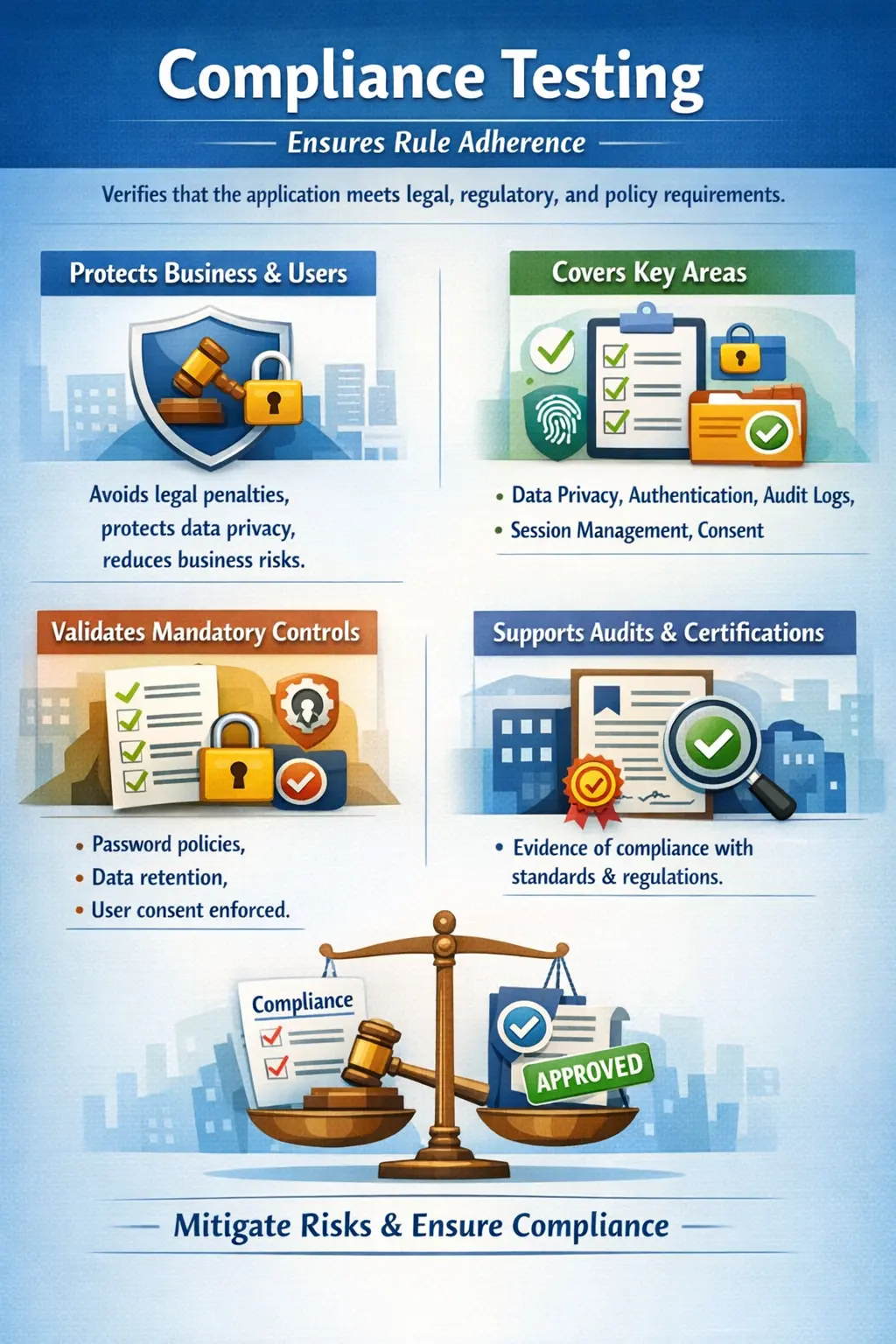
Compliance failures can be severe. They may lead to legal penalties, financial losses, audit failures, data breaches, customer complaints, reputational damage, and even restrictions on business operations. In domains such as banking, healthcare, insurance, e-commerce, education, and government systems, compliance is not an optional quality improvement. It is a business requirement. This is why Compliance Testing has become an important part of modern software testing.
Compliance Testing answers a simple but critical question: does the application meet mandatory rules and regulations? This question goes beyond checking whether a button works or a form submits successfully. It asks whether the application collects data with proper consent, protects sensitive information, enforces access control, maintains audit logs, follows data retention rules, displays required disclosures, and behaves according to applicable policies. A compliant system is not only functional; it is responsible, lawful, and trustworthy.
Why Compliance Testing Is Critical
Compliance Testing is critical because software systems often handle sensitive user data and business processes that are governed by strict rules. A healthcare application may process patient records. A banking system may handle account information and financial transactions. An e-commerce platform may store customer addresses, payment-related information, and order history. If these systems do not follow compliance rules, the impact can be much larger than a normal functional defect.
One of the main reasons compliance testing matters is legal protection. Regulatory bodies define rules to protect users, prevent misuse, maintain fairness, and ensure accountability. If an organization ignores these rules, it may face fines, legal action, audit findings, or loss of certification. Testing helps identify compliance gaps before they become public or regulatory problems.
Another important reason is data privacy and protection. Applications often collect personal information, financial details, identity documents, contact information, health records, or other confidential data. Compliance requirements define how this data should be collected, stored, processed, shared, retained, and deleted. Testers help verify whether the application respects these expectations in actual workflows.
Compliance also supports customer trust. Users may not know the technical details of a system, but they expect their data to be safe and their rights to be respected. If an application exposes private data, fails to ask consent, or allows unauthorized access, trust can be lost quickly. A compliance failure can damage brand reputation more deeply than a visible functional bug.
Compliance Testing also helps with audit readiness. Many organizations must prove that their systems follow required rules. Proper testing creates evidence: executed test cases, screenshots, logs, traceability, defect records, and sign-off documents. This evidence can support internal audits, external audits, certification reviews, and regulatory inspections.
Purpose of Compliance Testing
The purpose of Compliance Testing is to confirm that the application operates within the rules that apply to it. These rules may come from government regulations, industry standards, contractual obligations, customer commitments, or internal company policies. The tester’s job is not to interpret law independently, but to validate system behavior against documented compliance requirements.
A major objective is to avoid legal and regulatory penalties. If an application is required to obtain user consent before collecting personal data, the system must enforce that behavior. If regulations require users to access only their own data, role-based and user-based restrictions must work correctly. If audit logs are required for critical actions, the system must generate those logs reliably.
Compliance Testing also protects customer data and privacy. It verifies whether sensitive information is masked, restricted, encrypted where applicable, and hidden from unauthorized users. For manual testers, this often means checking UI visibility, role-based access, consent forms, password rules, session timeout, exported reports, and error messages that may accidentally expose sensitive details.
Another purpose is reducing operational risk. Compliance gaps can disrupt business operations. For example, if an application does not retain required transaction records, the company may fail audits. If logs are missing, incidents may be hard to investigate. If data deletion does not work correctly, the organization may violate data retention or privacy obligations. Compliance Testing helps identify these gaps before they cause larger consequences.
Ultimately, Compliance Testing ensures that software is not just usable, but also acceptable within legal, regulatory, and organizational boundaries. It adds governance to quality.
Types of Compliance
Compliance requirements vary based on industry, region, data type, and business model. From a testing perspective, it is useful to group compliance into regulatory compliance, industry standards, and organizational or policy compliance. Each category affects testing in a different way, but all of them influence product quality and risk.
Regulatory compliance refers to rules created by governments, legal authorities, or regulatory bodies. These rules are usually mandatory and legally enforceable. They may define how user data is collected, how financial transactions are controlled, how healthcare information is protected, how users are informed, or how records must be retained. Failure to follow regulatory requirements can lead to penalties, legal action, and business restrictions.
Industry standards are guidelines or controls defined by professional organizations, industry bodies, certification authorities, or security frameworks. Some standards may not be laws by themselves, but they may be required by customers, partners, contracts, certifications, or business expectations. For example, standards may define secure authentication, encryption practices, audit logging expectations, data handling rules, or accessibility guidelines.
Organizational or policy compliance refers to internal rules defined by the company. These can include password policies, data retention rules, access approval workflows, account lockout rules, user role restrictions, document retention procedures, and internal security guidelines. Even though these rules are internal, they are important because they define how the organization protects users, data, and operations.
A tester should understand which category applies to the feature being tested. For example, a password rule may come from internal policy, while consent and data deletion rules may come from privacy regulation. The source matters because it affects severity, audit importance, and business risk.
Common Compliance Areas in Manual Testing
From a manual testing perspective, Compliance Testing usually focuses on visible and behavior-based controls. Manual testers may not perform legal review or deep security audit, but they can validate whether the application enforces documented compliance rules in real user workflows.
Data privacy and protection is one of the most important areas. Testers verify whether user data is collected only after proper consent, whether privacy notices are visible, whether sensitive fields are masked, whether users can update or delete data when required, and whether unauthorized users are prevented from viewing private information. A privacy-related defect can have serious legal and reputational impact.
Authentication and authorization are also key compliance areas. Authentication confirms that the user is who they claim to be, while authorization controls what the user can access. Testers validate secure login behavior, password rules, account lockout, role-based access, direct URL restrictions, admin access limitations, and user-specific data visibility. If a normal user can access admin functionality, that is a serious compliance and security issue.
Audit trails and logging are important because many regulations require critical actions to be traceable. For example, login attempts, password changes, profile updates, payment approvals, data exports, role changes, and deletion actions may need to be logged. Testers may validate that logs are created, contain necessary information, and can be retrieved by authorized users. Missing logs can weaken audit readiness and incident investigation.
Session management is another common compliance area. Applications should enforce secure session behavior, such as automatic timeout after inactivity, session invalidation after logout, prevention of access through browser back button after logout, and secure handling of expired sessions. Poor session management can lead to unauthorized access and compliance failure.
Consent and disclosure validation is especially important for applications that collect personal data, marketing preferences, cookies, financial information, or health-related data. Testers verify whether users are clearly informed, whether consent is captured before data collection, whether optional consent is not forced incorrectly, and whether users can withdraw or update consent where required.
Data retention and deletion rules must also be tested. Some data must be retained for a required period, while other data must be deleted after a defined period or on user request. Testers validate whether deletion requests are handled correctly, whether expired data is removed, and whether retained data remains accessible only to authorized users. This area is often overlooked, but it is critical in privacy and audit-heavy systems.
Manual Tester’s Role in Compliance Testing
Manual testers play an important role in Compliance Testing because they validate how compliance requirements behave from a real user and business workflow perspective. Testers are not expected to be legal experts, but they should understand the compliance rules that are documented in requirements, policies, user stories, acceptance criteria, or test plans.
The first responsibility is to identify compliance-related requirements early. During requirement analysis, testers should look for rules related to consent, access, privacy, logging, retention, security, disclosure, approvals, and regulatory constraints. If these requirements are vague, testers should raise clarification questions with the BA, product owner, compliance team, legal team, or security team depending on the project process.
Testers must design scenarios that validate both compliant and non-compliant behavior. It is not enough to test only the happy path. If a policy says users must not access restricted data, the tester should attempt unauthorized access. If a password rule requires special characters, the tester should test valid and invalid passwords. If consent is mandatory, the tester should verify what happens when consent is not provided.
Another responsibility is collecting evidence. Compliance testing often requires proof for audits or internal review. Testers should capture screenshots, test execution results, logs, defect references, and requirement traceability where needed. The evidence should be clear, secure, and aligned with organizational policy, especially when sensitive data is involved.
Compliance gaps should be reported with proper severity. A missing consent checkbox or unauthorized data visibility may look like a small UI issue, but the business impact can be high. Testers should explain the compliance risk in the defect report so the team understands why the issue must be fixed.
Compliance Testing Activities
Compliance Testing begins with requirement review. Testers examine user stories, business rules, compliance requirements, policies, and acceptance criteria to identify what must be validated. The goal is to ensure that compliance expectations are clear and testable. If a requirement says "system should be secure" or "data should be handled properly," that is not specific enough for testing. The tester should ask what exact rules must be enforced.
During test design, testers create scenarios for valid compliance behavior, violation attempts, edge conditions, and role-based differences. For example, if password policy requires minimum length, special character, uppercase letter, and account lock after failed attempts, test cases should cover valid password creation, invalid passwords, missing special character, short password, repeated failed login, and account unlock behavior.
During execution, testers validate whether the system enforces rules correctly. They check whether non-compliant actions are blocked, whether proper messages are displayed, whether sensitive data is hidden, whether audit logs are generated, and whether access restrictions are enforced. Execution must be careful because compliance defects can be serious even when they are not visually dramatic.
After execution, testers document results and defects. If a compliance control fails, the defect should include steps, expected behavior, actual behavior, requirement reference, screenshots, logs if available, and business impact. Compliance issues should be tracked until closure and retested after fixes. Regression testing is also important because changes in security, user roles, consent, or data handling can affect many areas.
Real-Time Examples
Consider a registration flow where the application collects personal information such as name, email, phone number, and address. If compliance requires consent before data collection, the tester should verify that the consent message is shown clearly, that the user can review what data is being collected, and that the application does not proceed when required consent is missing. The tester should also verify whether consent status is stored correctly and whether the user can update or withdraw consent if required.
Another example is password policy enforcement. If the organization requires a minimum password length, special characters, uppercase letters, account lock after multiple failed attempts, and password reset security, testers must validate each rule. A system that accepts weak passwords or does not lock accounts after repeated failures may violate security policy and compliance expectations.
A third example is audit logging. Suppose an admin user changes another user’s role. Compliance may require that this action be logged with user ID, timestamp, old role, new role, and action source. The tester should verify that the action is logged correctly and that only authorized users can view the audit log. Missing or incomplete logs can create audit failure even if the role change itself works.
Data access provides another real-world example. If a customer can see another customer’s records, the issue is not merely functional. It is a security, privacy, and compliance defect. Such issues should be escalated quickly because they may expose sensitive data and create regulatory risk.
Compliance Testing vs Security Testing
Compliance Testing and Security Testing are related, but they are not the same. Compliance Testing focuses on whether the application follows required rules, regulations, standards, and policies. Security Testing focuses on identifying vulnerabilities, threats, and weaknesses that attackers could exploit. A system may pass some compliance checks but still have security vulnerabilities, and a secure system may still miss required compliance documentation or disclosure behavior.
For example, Compliance Testing may verify that password policy follows organizational rules and that account lockout is implemented. Security Testing may go deeper by attempting to identify brute-force weaknesses, session vulnerabilities, injection risks, or access control bypasses. Both are important. Compliance ensures mandatory rule adherence, while security testing evaluates resistance to misuse and attack.
From a manual testing interview perspective, it is useful to say that compliance is standards-driven, while security is threat-driven. They overlap in areas such as authentication, authorization, logging, and data protection, but their primary purpose is different.
Common Compliance Defects
Compliance defects often appear in areas where rules are not enforced consistently. A common example is missing user consent before collecting personal data. If the application stores user information before consent is given, the system may violate privacy requirements. Another common defect is weak password enforcement, such as accepting passwords that do not meet policy rules.
Missing audit logs are also frequent compliance defects. If critical actions such as role changes, data exports, approvals, or deletions are not logged, the organization may fail audits or be unable to investigate incidents. Unauthorized data access is another serious defect because users should only see data they are permitted to access.
Data retention defects can also be serious. If data is retained beyond the allowed period, deleted too early, or not deleted after user request, the application may violate policy or regulation. Incorrect disclosure text, missing terms acceptance, unmasked sensitive fields, and insecure session behavior are other examples of compliance-related defects.
Common Mistakes in Compliance Testing
One common mistake is assuming that compliance is only the responsibility of legal or audit teams. While legal and compliance teams define expectations, testers must validate whether the application implements those expectations correctly. If testers ignore compliance requirements, serious issues may escape into production.
Another mistake is testing only happy paths. Compliance testing must include violation attempts. If a user is not allowed to access admin data, the tester should try direct URLs, role changes, and restricted workflows. If consent is required, the tester should check what happens when consent is not given. Rule enforcement is proven through negative testing as much as positive testing.
Poor documentation is another issue. Compliance testing often requires evidence. If test results, screenshots, requirement references, and defect records are missing, the team may struggle during audits or release reviews. Treating compliance defects as low priority is also a serious mistake because their business impact may be legal or reputational rather than only functional.
Best Practices for Compliance Testing
A strong best practice is to involve testers early during requirement analysis. Compliance requirements should be identified before development begins because late discovery can cause expensive rework. Testers should ask clear questions about consent, access control, audit logging, retention, masking, session handling, and disclosures.
Test scenarios should be based on real-world compliance risks, not only theoretical rules. Testers should validate how users actually provide consent, access data, update records, export reports, change roles, or delete information. Both positive and negative scenarios should be included. If a rule exists, testers should verify both that allowed behavior works and prohibited behavior is blocked.
Documentation and evidence should be maintained carefully. Compliance testing results may be used in audits, release reviews, and risk assessments. Testers should capture enough evidence to show what was validated and what result was observed. Sensitive data should be masked in evidence where required.
Collaboration is also essential. Testers should work with business analysts, product owners, compliance teams, security teams, and legal stakeholders to understand expectations. Regulations and policies can change over time, so compliance test cases should be reviewed and updated regularly.
Interview Perspective
In interviews, a short answer can be: "Compliance Testing verifies whether an application follows applicable regulations, industry standards, legal requirements, and internal policies." This definition is simple and accurate.
A detailed answer can be: "Compliance Testing validates that the application enforces mandatory rules related to data privacy, consent, access control, audit logging, session management, retention, disclosures, and organizational policies. It helps prevent legal penalties, audit failures, data breaches, and reputational damage." This answer shows practical understanding.
If asked for examples, mention consent before data collection, password policy enforcement, role-based access control, audit logs for critical actions, session timeout, and data deletion rules. Interviewers usually look for awareness of compliance impact and the ability to identify real test scenarios.
Key Takeaway
Compliance Testing is a business-critical testing activity. It ensures that an application follows mandatory rules, protects user data, maintains audit readiness, and operates within legal and organizational boundaries. A system can be functionally correct but still fail if it violates compliance requirements.
Effective compliance testing requires early requirement review, clear test design, positive and negative validation, strong evidence, collaboration with stakeholders, and careful defect reporting. It protects the organization from legal, financial, operational, and reputational risk. Ultimately, Compliance Testing ensures that software is not only working, but working responsibly and lawfully.