Common Array Problems
Array problems are among the most frequently asked questions in Java interviews. Almost every problem is solved using array traversal patterns, condition checks, and basic logic. Mastering these problems builds a strong foundation for DSA, coding rounds, and real-world logic.
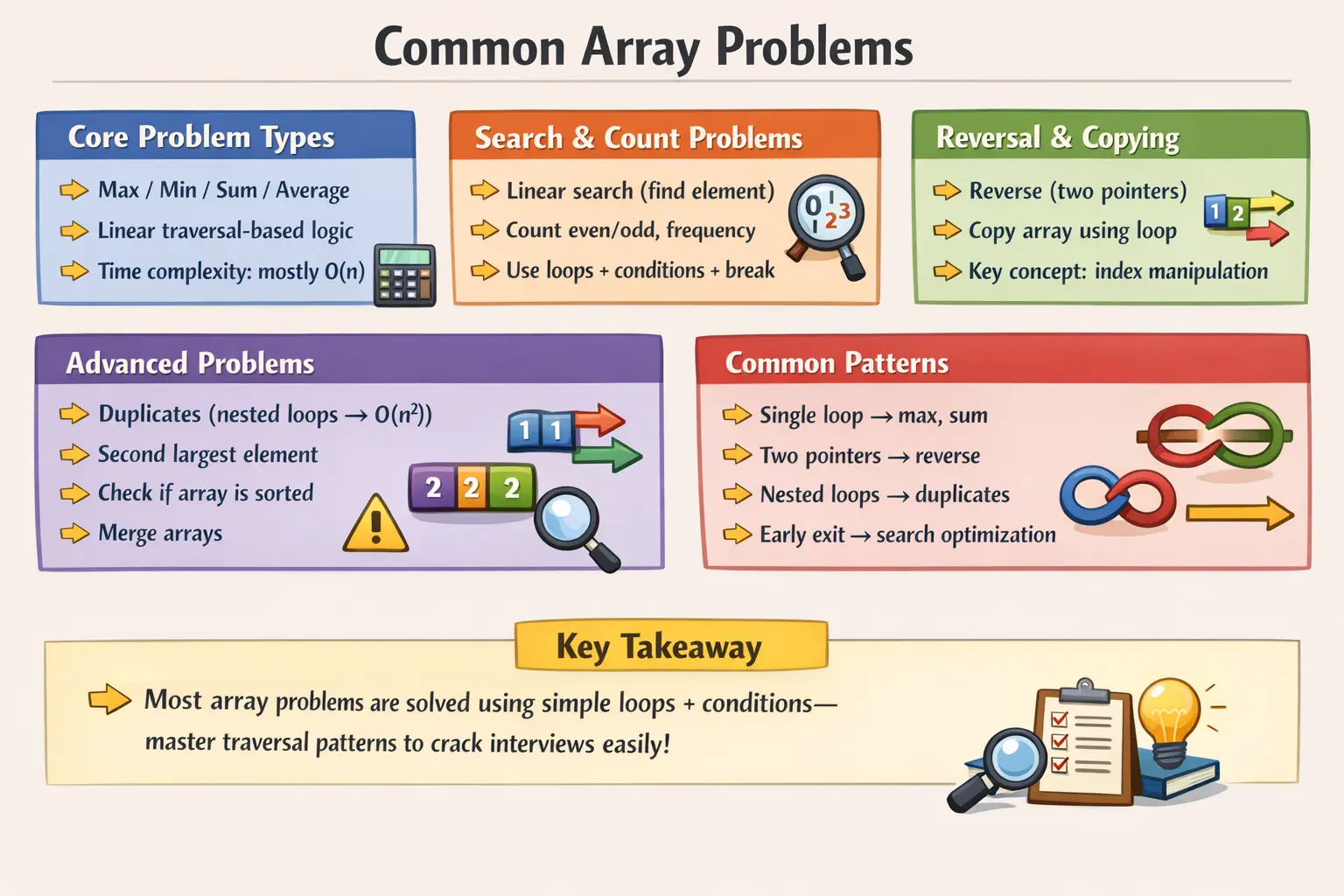
Why Array Problems Matter
Array problems matter because they test the most practical parts of Java programming at the same time. A simple question such as finding the largest element may look basic, but it checks whether the developer understands indexing, loop boundaries, initialization, comparison logic, and edge cases. These are not isolated skills. They are the foundation for writing reliable programs that process real data.
In interviews, arrays are popular because they reveal how a candidate thinks. The interviewer can quickly see whether the candidate starts with a clear approach, handles empty and single-element arrays, chooses the right loop, and explains time complexity. Even when the problem does not require advanced data structures, the solution still exposes problem-solving discipline. A candidate who can solve array problems cleanly usually has a stronger foundation for strings, collections, recursion, sorting, and algorithms.
In real-world development, array-style logic appears in many forms. A program may process marks, prices, user IDs, test data, API values, report rows, validation messages, or configuration entries. Even when the final code uses ArrayList, Set, Map, or streams, the underlying logic often begins with the same traversal patterns used in arrays. Learning common array problems therefore builds a reusable mental model for broader Java development.
The Core Idea Behind Most Array Problems
Most array problems are variations of three basic activities: visit elements, compare values, and maintain some result. The loop visits each element. Conditions decide whether the current element matters. Variables store information discovered during traversal. For example, finding the maximum uses one variable to remember the largest value found so far. Counting even numbers uses counters. Searching uses a flag or returned index. Reversing uses two indexes that move toward each other.
This is why memorizing individual solutions is less useful than understanding patterns. If you know how single traversal works, you can solve sum, count, maximum, minimum, average, and search problems. If you know how two pointers work, you can reverse an array and compare opposite ends. If you understand nested loops, you can identify duplicates and frequencies. The problem statements change, but the building blocks remain familiar.
A good way to approach any array question is to ask what information must be known at the end. If the answer is a single value, the solution probably needs an accumulator or tracker. If the answer is whether something exists, the solution probably needs search logic and early exit. If the answer involves comparing elements with one another, the solution may need pairwise traversal, nested loops, or a helper structure. This thinking makes array problems easier to classify and solve.
Understanding Traversal Before Solving
Traversal is the backbone of array problem solving. Before writing a condition or calculation, decide how the array should be visited. Should the loop move forward from the first element to the last? Should it move backward? Should it use two pointers from both ends? Should it compare each element with all later elements? The traversal pattern must match the goal of the problem.
Forward traversal is the default pattern. It is used for printing, summing, counting, searching, and many forms of validation. Backward traversal is useful when the reverse order matters or when processing from the end simplifies logic. Two-pointer traversal is useful when both ends of the array must be considered. Nested traversal is used when one element must be compared with many other elements, such as duplicate detection.
The loop boundary is just as important as the traversal direction. Many array bugs are caused by an off-by-one error. A loop that accesses arr[i + 1] must stop earlier than a loop that only accesses arr[i]. A loop that starts with arr[0] must ensure the array is not empty. A reverse loop must start at arr.length - 1, not arr.length. Careful boundary control is what turns a correct idea into correct code.
Handling Edge Cases Professionally
Edge cases are where many array solutions fail. An empty array, a single-element array, all duplicate values, all negative values, already sorted data, reverse-sorted data, and arrays with repeated maximum values can all expose weak logic. In interviews, mentioning edge cases shows maturity. In real projects, handling them prevents runtime failures and incorrect results.
For maximum and minimum problems, an empty array cannot be processed by starting with arr[0]. The program must either reject empty input, return a special value, or use a design such as Optional depending on the context. For second largest problems, an array with fewer than two distinct values may not have a valid second largest element. For average calculation, division by arr.length fails when the length is zero. These are not minor details; they define whether the program behaves safely.
Single-element arrays also deserve attention. The largest and smallest value are the same. A sorted check should return true because there is no pair that violates order. A reverse operation should leave the array unchanged. Duplicate detection should find nothing. Thinking through these cases before coding helps developers avoid patching logic later.
Single Traversal Problems
Single traversal problems are the best place to build confidence. In these problems, each element is usually visited once, and the answer is updated as the loop runs. Finding maximum, finding minimum, calculating sum, counting even and odd numbers, and searching for a value can all be solved with one pass through the array. This usually gives O(n) time complexity, which means the work grows directly with the number of elements.
The key skill in single traversal is choosing the right initial value. A sum starts at 0 because adding zero does not affect the result. A count starts at 0 because no matching values have been seen yet. A maximum can start with arr[0] when the array is known to be non-empty. Starting maximum with 0 is a common mistake because it fails when all values are negative. Correct initialization makes the loop reliable.
Single traversal also teaches how to update state carefully. Each iteration should answer a small question. Is this value larger than the current maximum? Is it even or odd? Is it the value being searched? Should it be added to the total? When the question is clear, the condition becomes simple. The loop becomes readable because every update has a purpose.
Search Problems and Early Exit
Linear search is one of the most common array problems. It checks each element until the target value is found or until the array ends. The important idea is that once the target is found, the loop does not need to continue. The break statement or an immediate return improves efficiency and makes the intention clear. This is called early exit.
Search problems may return different kinds of results. Some return a boolean value such as true or false. Some return the index of the matching element. Some return the matching object or value. The design depends on what the caller needs. If the caller only needs to know whether the value exists, a boolean is enough. If the caller needs to update or report the position, returning the index is more useful.
The not-found case must be defined clearly. If a method returns an index, -1 is commonly used to mean the target was not found. If a method returns a boolean, false means absence. If the problem asks to print a message, the message should be printed only after the search completes, not during every failed comparison. Many beginner solutions accidentally print "not found" multiple times because they place that logic inside the loop incorrectly.
Aggregation Problems
Aggregation problems combine multiple array elements into a result. Sum, average, count, maximum, minimum, and frequency are all aggregation-style tasks. The loop gathers information step by step. The final result is usually available after traversal completes. These problems are important because aggregation is common in reports, analytics, validation, and business calculations.
Average calculation is a good example of a small but important detail. If both sum and length are integers, integer division can remove decimal precision. Casting the sum or length to double before division produces a decimal result. This is why type casting is often mentioned in interview tips for average problems. The traversal may be simple, but the final calculation must still respect Java's type rules.
Frequency counting is a more advanced form of aggregation. The basic nested-loop approach counts how many times each unique element appears. It also needs a visited check to avoid printing the same element multiple times. This teaches two ideas at once: counting and duplicate avoidance. Later, the same problem can be solved more efficiently with a Map, but the array-only version helps learners understand the raw logic.
Two-Pointer Problems
Two-pointer logic is a powerful pattern for problems that involve both ends of an array. In in-place reversal, one pointer starts at the beginning and the other starts at the end. The values are swapped, the start pointer moves forward, and the end pointer moves backward. The process continues until the pointers meet or cross. This avoids creating a new array and uses constant extra space.
The two-pointer pattern is useful because it reduces unnecessary work. Instead of using a second array to reverse values, the original array is modified directly. Instead of comparing every possible pair in some problems, carefully moving two pointers may produce a more efficient solution. The key is understanding how pointer movement relates to the problem goal.
For beginners, the main risk in two-pointer logic is incorrect stopping condition. If the loop continues too long, values may be swapped back to their original positions. If it stops too early, some values may remain unchanged. The condition start < end is common because it naturally stops when the pointers meet in the middle. This pattern is simple, but it teaches disciplined index control.
Nested Loop Problems
Nested loops are often used for duplicates, frequency counting, and pairwise comparison. The outer loop selects one element, and the inner loop compares it with other elements. For duplicate detection, the inner loop often starts at i + 1 so the program compares the current element only with later elements. This avoids comparing an element with itself and reduces repeated checks.
The tradeoff is performance. A nested loop over an array may require O(n squared) time, which becomes expensive as the array grows. For small interview examples, this is usually acceptable when the question asks for a basic approach. For large data, more efficient structures such as Set or Map are often preferred. Still, understanding the nested-loop solution is valuable because it shows the logic clearly before optimization.
Nested-loop problems also require careful duplicate handling. If the goal is to print duplicate elements, the same duplicate may be printed multiple times unless the code tracks whether the value was already processed. If the goal is to remove duplicates, the expected output must be clearly defined. Should the first occurrence be kept or the last occurrence? Should order be preserved? These details affect the solution.
Second Largest and Tracker-Based Problems
The second largest problem is a classic tracker-based question. It cannot be solved by only remembering one value. The program must track the largest and second largest distinct values while traversing the array. When a new largest value appears, the old largest becomes the second largest. When a value is smaller than the largest but larger than the current second largest, the second largest is updated.
This problem teaches the importance of update order. If first is updated before second receives the old first value, the previous maximum may be lost. It also teaches distinct-value handling. If the array contains repeated largest values, the second largest should usually be a different value unless the problem states otherwise. The condition value != first prevents duplicates of the maximum from being treated as second largest.
Edge cases are especially important here. An array with one element has no second largest. An array where all elements are equal also has no distinct second largest. A robust solution should detect this instead of blindly printing Integer.MIN_VALUE. In interviews, discussing this edge case is often as important as writing the main loop.
Sorted Check and Pairwise Thinking
Checking whether an array is sorted is a pairwise traversal problem. The program compares each element with the next element. If any current element is greater than the next element in ascending-order logic, the array is not sorted. Once such a violation is found, the loop can exit early because the final answer is already known.
This problem is simple but important because it teaches correct loop boundaries. Since the logic accesses arr[i + 1], the loop must stop at arr.length - 1. The condition i < arr.length - 1 ensures that the next index remains valid. This pattern appears in many adjacent-element problems, including checking consecutive differences, detecting peaks, and validating sequences.
Sorted checks also show how business rules affect logic. Ascending order, descending order, strictly increasing order, and non-decreasing order are not the same. If equal values are allowed, the comparison should use greater-than for ascending checks. If equal values are not allowed, greater-than-or-equal may be needed. The condition must match the requirement exactly.
Copying and Merging Arrays
Copying an array means creating a new array of the same length and assigning each value from the source array to the destination array. This is different from assigning one array reference to another variable. If int[] b = a is used, both variables point to the same array. Changing one affects the other. A real copy creates a separate array object.
Merging arrays extends the copying idea. A new array is created with length equal to the combined lengths of both source arrays. A separate index tracks the current position in the merged array. Values from the first array are copied first, then values from the second array. This teaches how one index can be used to fill a result array while traversing multiple input arrays.
Copying and merging are common in data preparation, report generation, test data assembly, and algorithmic problems. They also prepare learners for understanding dynamic arrays and collection internals. Even though Java provides library methods for copying, writing the manual version helps developers understand what actually happens.
Choosing Between Basic and Optimized Solutions
Many common array problems have a basic solution and an optimized solution. Duplicate detection can be solved with nested loops, but a Set can reduce the time complexity. Frequency counting can be solved with nested loops, but a Map is more efficient. Searching in an unsorted array requires linear traversal, while searching in a sorted array can use binary search. The right answer depends on the problem constraints.
For beginner learning and interviews, it is often acceptable to start with the basic solution and then discuss optimization. This shows that the candidate understands the logic first and can improve it when needed. Jumping directly to advanced structures without explaining the base logic may hide gaps in understanding. A strong answer says what the current complexity is and how it can be improved.
Optimization should be driven by data size and requirements. If the array has ten elements, a nested loop may be perfectly fine. If the array has one million elements, the same approach may be too slow. Good developers balance clarity and efficiency. They do not optimize blindly, but they recognize when the basic approach will not scale.
Array Problems in Testing and Automation
Array problems are useful beyond coding interviews. In testing and automation, arrays help store input data, expected results, roles, browsers, URLs, messages, and combinations. Counting, searching, filtering, and comparing values are common in validation logic. For example, an automation script may verify that a list of expected menu items appears in the UI. That is essentially array traversal and comparison.
Test data often behaves like an array problem. A tester may need to count failed records, find a specific status, compare actual and expected arrays, merge datasets, or identify duplicate entries. Understanding array logic makes these tasks easier. It also helps automation testers write cleaner utilities instead of depending entirely on framework-level code.
For SDET-style learning, common array problems build the bridge between manual test thinking and programming logic. A manual tester already understands expected results, invalid data, and edge cases. Arrays provide a way to express those ideas programmatically. This makes array problem practice valuable for anyone moving toward automation or Java-based testing roles.
How to Explain Array Problems in Interviews
When explaining an array problem in an interview, start with the approach before writing code. Describe whether the solution uses single traversal, two pointers, nested loops, or early exit. Then explain the variables needed and how they change during the loop. This helps the interviewer see your reasoning and not just the final syntax.
After coding, discuss edge cases. For maximum and minimum, mention empty arrays. For second largest, mention duplicate values and arrays without a valid second largest. For average, mention type casting and division by zero. For duplicates, mention whether repeated duplicates should be printed once or multiple times. These details show practical thinking.
Finally, mention time and space complexity. A single traversal is usually O(n). Nested loops are often O(n squared). In-place reversal uses O(1) extra space. Copying and merging require additional arrays. Complexity explanations do not need to be long, but they should be accurate. This turns a basic answer into an interview-ready answer.
A Practical Strategy for Solving Any Array Question
A reliable strategy for solving array questions begins with restating the problem in simple words. Before writing code, identify the input, the expected output, and any restrictions. If the question says find the second largest element, clarify whether duplicate values should be considered. If the question says remove duplicates, clarify whether the original order must be preserved. If the question says reverse, clarify whether the array should be printed in reverse order or actually modified. Many incorrect solutions come from solving a slightly different problem than the one asked.
The second step is to choose the traversal pattern. If every element must be inspected once, single traversal is likely enough. If the problem compares elements from both ends, two pointers may fit. If the problem compares each element with every other element, nested loops may be the basic approach. If the problem needs to stop when a condition is met, early exit should be considered. Naming the pattern before coding helps keep the solution organized.
The third step is to decide what variables are needed. Most array problems need one or more trackers. A maximum problem needs max. A search problem may need found or index. A frequency problem needs count and visited logic. A merge problem needs a result array and a result index. The variables should represent the information that must survive between iterations. If a variable is reset at the wrong time, the answer becomes incorrect even when the loop itself is valid.
The fourth step is to test the logic with a small example manually. Walk through the loop using a short array such as {3, 1, 5, 2}. Track how the variables change after each iteration. This mental dry run catches many mistakes before execution. It is especially useful for second largest, reverse, duplicate, and frequency problems because their update logic can be easy to get wrong.
Time Complexity and Space Complexity in Array Problems
Time complexity explains how the running time grows as the number of array elements grows. If a solution visits every element once, it is O(n). Finding maximum, finding minimum, calculating sum, counting even and odd numbers, and linear search are common O(n) examples. Even though linear search may stop early when the value is found, the worst case is still O(n) because the value may be absent or may appear at the end.
Nested-loop duplicate detection is usually O(n squared) because each element may be compared with many other elements. This is acceptable for learning and small arrays, but it can become slow for large arrays. Frequency counting with nested loops has the same concern. When optimization is allowed, Set and Map structures can often reduce the time complexity. However, understanding the nested-loop approach first is valuable because it explains the comparison logic directly.
Space complexity explains how much extra memory the solution uses. Finding maximum, minimum, sum, average, and in-place reversal use only a few variables, so they are O(1) extra space. Copying and merging arrays require new arrays, so they use O(n) extra space. Duplicate removal may use extra space if a Set or result array is used. In interviews, discussing both time and space shows that the solution is evaluated from more than one angle.
Complexity should be explained clearly, not mechanically. A candidate should be able to say why a loop is O(n), why a nested loop is O(n squared), and why a result array increases space usage. This shows real understanding. The goal is not to use big terms, but to describe how the work and memory grow as input size grows.
Building Confidence Through Practice Order
Array practice becomes easier when problems are learned in the right order. Start with basic traversal problems such as printing elements, sum, maximum, minimum, and count. These build comfort with loops and indexes. Then move to search and early-exit problems. After that, practice reverse traversal and in-place reversal using two pointers. Once these are comfortable, move to duplicates, frequency, second largest, sorted checks, merging, and more advanced variations.
This progression matters because each group builds on earlier ideas. Second largest depends on tracking values correctly. Frequency depends on nested loops and visited checks. Sorted checks depend on pairwise traversal. Merge depends on copying logic and index tracking. If the basics are weak, advanced problems feel confusing. If the basics are strong, advanced problems become combinations of familiar pieces.
While practicing, avoid only reading solutions. Write the code, run it, test it with edge cases, and then explain it aloud. Explaining aloud is especially useful for interviews because it trains the habit of communicating thought process. A solution that works silently is good, but a solution that can be explained clearly is stronger. Interviewers value clarity because real development is collaborative.
Common Variations Interviewers May Ask
Interviewers often change a basic array problem slightly to test adaptability. After asking for the largest element, they may ask for the second largest. After asking for linear search, they may ask for the index instead of a boolean. After asking to print reverse order, they may ask for in-place reversal. After asking for duplicates, they may ask to print each duplicate only once. These variations are designed to see whether the candidate understands the pattern or only memorized one answer.
Another common variation is adding constraints. The interviewer may say the array can contain negative numbers, duplicates, or only one element. They may ask for O(n) time or O(1) extra space. They may ask whether the array is sorted and expect a more efficient approach based on that information. Paying attention to constraints is part of problem solving. The same problem can require a different solution when constraints change.
The best response is to slow down and clarify. Ask whether the input can be empty, whether duplicates matter, whether order must be preserved, and whether extra space is allowed. These questions are not signs of weakness. They show professional thinking. In real projects, unclear assumptions cause defects. In interviews, clarifying assumptions often leads to a better solution.
1. Find the Largest Element in an Array
int max = arr[0];
for (int i = 1; i < arr.length; i++) {
    if (arr[i] > max) {
        max = arr[i];
    }
}
Key Concept: Linear traversal
Time Complexity: O(n)
2. Find the Smallest Element in an Array
int min = arr[0];
for (int i = 1; i < arr.length; i++) {
    if (arr[i] < min) {
        min = arr[i];
    }
}
3. Find Sum of Array Elements
int sum = 0;
for (int value : arr) {
    sum += value;
}
4. Find Average of Elements
double avg = (double) sum / arr.length;
Interview Tip: Type casting is important.
5. Search an Element (Linear Search)
int key = 20;
boolean found = false;
for (int value : arr) {
    if (value == key) {
        found = true;
        break;
    }
}
6. Count Even and Odd Numbers
int even = 0, odd = 0;
for (int value : arr) {
    if (value % 2 == 0) {
        even++;
    } else {
        odd++;
    }
}
7. Reverse an Array
for (int i = arr.length - 1; i >= 0; i--) {
    System.out.println(arr[i]);
}
Note: This prints reverse order; not in-place reversal.
8. Reverse an Array (In-Place)
int start = 0, end = arr.length - 1;
while (start < end) {
    int temp = arr[start];
    arr[start] = arr[end];
    arr[end] = temp;
    start++;
    end--;
}
9. Copy One Array to Another
int[] copy = new int[arr.length];
for (int i = 0; i < arr.length; i++) {
    copy[i] = arr[i];
}
10. Find Duplicate Elements
for (int i = 0; i < arr.length; i++) {
    for (int j = i + 1; j < arr.length; j++) {
        if (arr[i] == arr[j]) {
            System.out.println(arr[i]);
        }
    }
}
Time Complexity: O(n²)
11. Remove Duplicate Elements (Basic Approach)
for (int i = 0; i < arr.length; i++) {
    boolean duplicate = false;
    for (int j = i + 1; j < arr.length; j++) {
        if (arr[i] == arr[j]) {
            duplicate = true;
            break;
        }
    }
    if (!duplicate) {
        System.out.println(arr[i]);
    }
}
12. Find Second Largest Element
int first = Integer.MIN_VALUE;
int second = Integer.MIN_VALUE;
for (int value : arr) {
    if (value > first) {
        second = first;
        first = value;
    } else if (value > second && value != first) {
        second = value;
    }
}
13. Check if Array Is Sorted
boolean sorted = true;
for (int i = 0; i < arr.length - 1; i++) {
    if (arr[i] > arr[i + 1]) {
        sorted = false;
        break;
    }
}
14. Merge Two Arrays
int[] merged = new int[a.length + b.length];
int index = 0;
for (int value : a) {
    merged[index++] = value;
}
for (int value : b) {
    merged[index++] = value;
}
15. Find Frequency of Each Element
for (int i = 0; i < arr.length; i++) {
    int count = 1;
    boolean visited = false;
    for (int j = i - 1; j >= 0; j--) {
        if (arr[i] == arr[j]) {
            visited = true;
            break;
        }
    }
    if (!visited) {
        for (int j = i + 1; j < arr.length; j++) {
            if (arr[i] == arr[j]) {
                count++;
            }
        }
        System.out.println(arr[i] + " -> " + count);
    }
}
Common Interview Patterns to Recognize
| Pattern | Used In |
|---|---|
| Single traversal | Max, min, sum |
| Two pointers | Reverse, comparison |
| Nested loops | Duplicates, frequency |
| Early exit (break) | Search problems |
| Index tracking | Second largest, sorted check |
Common Beginner Mistakes
- Off-by-one loop errors
- Not handling empty arrays
- Ignoring edge cases (single element)
- Incorrect variable initialization
- Missing break for optimization
Interview-Ready Summary
Short Answer
Common array problems involve searching, sorting checks, reversing, counting, and aggregation using traversal logic.
Detailed Answer
Array problems in Java typically rely on linear or nested traversal, condition checks, and basic logic. Understanding traversal patterns and edge cases allows efficient problem-solving without complex data structures.
Key Takeaway
Most array interview problems are variations of traversal and comparison. If you master loop control and array access, you can solve 90% of array-based questions confidently.