Array Traversal Patterns
Array traversal is one of the most fundamental operations in programming, yet it is also one of the most powerful. At its simplest, traversal means visiting each element of an array to perform some operation. However, in real-world applications and algorithmic problem solving, traversal is not just about iterating; it is about how you iterate. The pattern you choose directly influences readability, correctness, performance, and even scalability of your code.
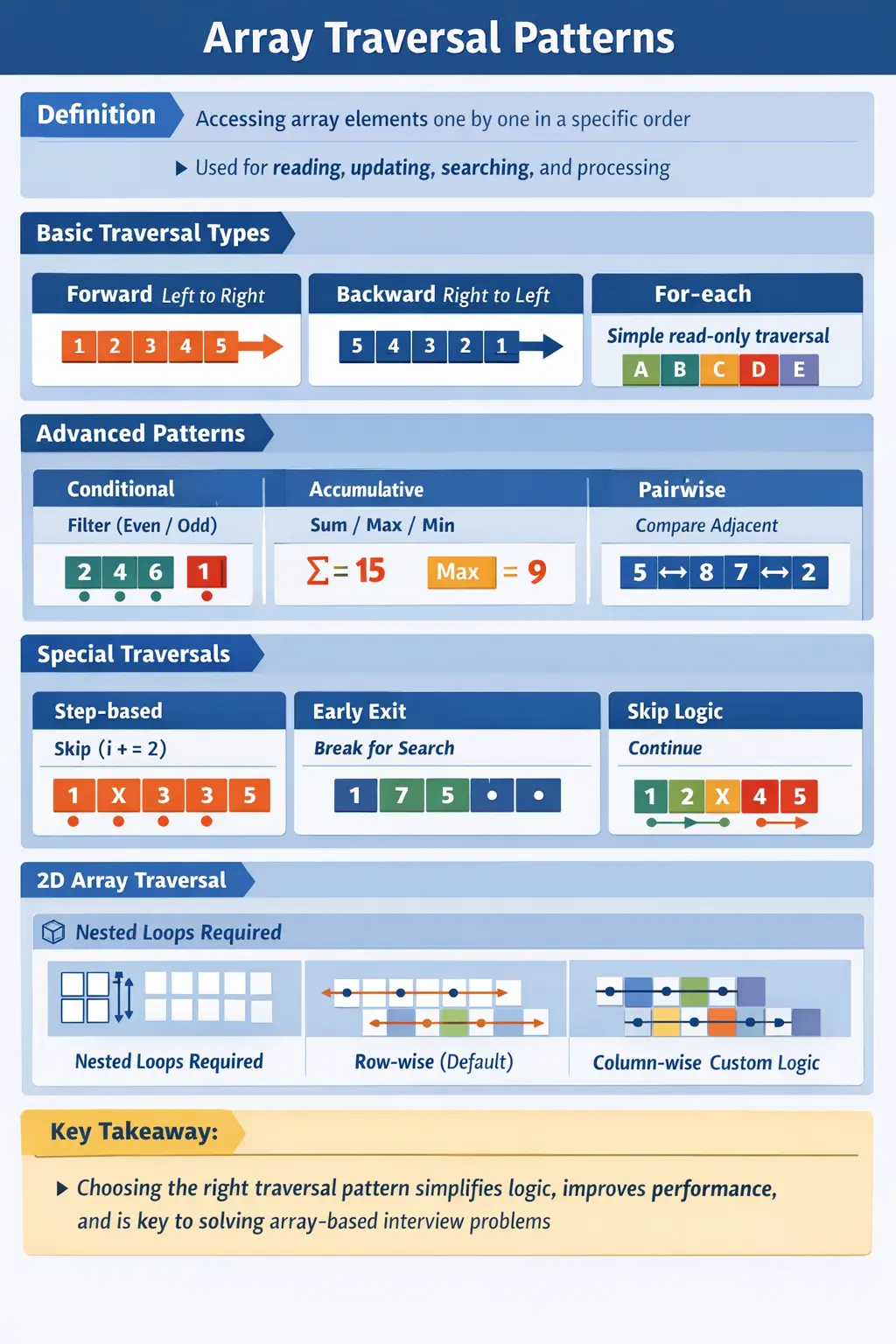
In Java, arrays are fixed-size, index-based data structures. This makes traversal both predictable and efficient, but it also requires careful handling of indices, boundaries, and conditions. Whether you are printing values, filtering data, computing aggregates, or solving complex algorithmic problems, traversal patterns form the backbone of your logic.
Understanding these patterns deeply is critical for writing clean code, debugging efficiently, and performing well in interviews. Most array-based problems are not about complex data structures; they are about choosing the right traversal approach and applying it correctly.
What Is Array Traversal?
Array traversal refers to the process of accessing each element of an array in a defined order to perform operations such as reading, updating, searching, or transforming data. The traversal can follow different directions or conditions depending on the requirement.
In Java, traversal is typically implemented using loops. These loops can be index-based, enhanced for-each loops, or nested loops for multi-dimensional arrays. The choice of loop and traversal pattern depends on what you want to achieve.
Traversal is not limited to one-dimensional arrays. It extends naturally to multi-dimensional arrays, where traversal becomes more structured and often involves nested iterations.
Forward Traversal: The Default Pattern
The most common traversal pattern is forward traversal, where elements are accessed from left to right, starting from index zero and ending at the last index. This is the natural order of arrays and is used in the majority of cases.
Forward traversal is ideal for operations such as printing elements, calculating sums, validating data, or applying transformations. It aligns with how arrays are stored in memory and is therefore intuitive and efficient.
This pattern is also the foundation for most other traversal techniques. Once you understand forward traversal, you can easily adapt it to more advanced patterns.
Backward Traversal: Reversing the Perspective
Backward traversal involves iterating through the array from the last element to the first. Instead of starting at index zero, the loop begins at length - 1 and decrements the index.
This pattern is particularly useful when dealing with reverse operations, such as reversing an array, processing elements in reverse order, or simulating stack-like behavior.
Backward traversal also helps in certain algorithmic problems where the solution depends on elements that come after the current index. It provides a different perspective and can simplify logic in specific scenarios.
Enhanced for-each Traversal: Simplicity and Readability
The enhanced for-each loop is a modern and simplified way of traversing arrays. It eliminates the need for index management and directly provides access to each element.
This pattern is best suited for read-only operations where the position of elements is not important. It improves readability and reduces the chances of errors such as off-by-one mistakes.
However, it comes with limitations. Since it does not provide index access, it cannot be used for position-based logic or structural modifications. Understanding when to use for-each versus traditional loops is an important skill.
Conditional Traversal: Filtering Data
Conditional traversal introduces logic within the loop to process only specific elements. Instead of acting on every element, the loop applies a condition and executes code only when the condition is satisfied.
This pattern is widely used in real-world applications where data needs to be filtered based on business rules. For example, processing only even numbers, skipping invalid entries, or applying conditions based on thresholds.
Conditional traversal enhances efficiency by avoiding unnecessary operations and focuses computation only on relevant data.
Accumulative Traversal: Building Results
Accumulative traversal is used when the goal is to compute a result by combining multiple elements. Common examples include calculating sums, averages, or finding maximum and minimum values.
In this pattern, a variable is initialized before the loop and updated during each iteration. The final value of this variable represents the result of the traversal.
This pattern is essential for data aggregation and is frequently used in analytics, reporting, and algorithmic problems. It demonstrates how traversal can be used not just for accessing data but for deriving meaningful insights.
Index-Based Traversal: When Position Matters
Index-based traversal uses the loop index explicitly, allowing access to both the element and its position. This is crucial in scenarios where the index itself plays a role in the logic.
For example, when printing element positions, comparing elements at specific indices, or modifying values based on their position, index-based traversal becomes necessary.
This pattern provides maximum control but requires careful handling of boundaries and conditions to avoid errors.
Pairwise Traversal: Working with Adjacent Elements
Pairwise traversal focuses on processing elements in relation to their neighbors. Instead of treating elements independently, this pattern examines pairs of adjacent elements.
This approach is commonly used in problems involving comparisons, sequence detection, or identifying patterns within data. For example, checking if an array is sorted or finding consecutive differences.
The key challenge in pairwise traversal is managing the loop boundary correctly, as accessing the next element requires ensuring that the index does not exceed the array length.
Step-Based Traversal: Skipping Elements
Step-based traversal modifies the loop increment to skip elements. Instead of incrementing by one, the index is increased by a fixed step, such as two or more.
This pattern is useful when only a subset of elements needs to be processed. For example, accessing alternate elements or reducing the number of iterations for performance optimization.
While simple in concept, step-based traversal requires careful design to ensure that important elements are not unintentionally skipped.
Nested Traversal: Handling Multi-Dimensional Arrays
When dealing with two-dimensional arrays, traversal becomes more complex and involves nested loops. The outer loop typically iterates over rows, while the inner loop iterates over columns.
This pattern mirrors the structure of 2D arrays and allows complete coverage of all elements. It is used in matrix operations, grid processing, and multi-level data handling.
Nested traversal introduces additional complexity, especially in terms of performance. Each additional level of nesting increases time complexity, making it important to optimize where possible.
Row-wise vs Column-wise Traversal
In two-dimensional arrays, traversal can follow different orientations. Row-wise traversal processes elements row by row, which is the default and most common approach.
Column-wise traversal, on the other hand, processes elements column by column. This requires swapping the order of loops and is useful in specific scenarios such as matrix transformations or column-based analysis.
Understanding these patterns is important for solving matrix-related problems and optimizing data access.
Early Exit Traversal: Improving Efficiency
Early exit traversal uses the break statement to terminate the loop as soon as a condition is met. This is particularly useful in search operations, where continuing the loop after finding the target would be unnecessary.
This pattern improves performance by reducing the number of iterations and is widely used in real-world applications.
However, it must be used carefully to ensure that the loop exits only when appropriate and does not skip necessary processing.
Skip-Based Traversal: Controlled Iteration
Skip-based traversal uses the continue statement to skip specific iterations. Instead of terminating the loop, it bypasses certain elements and continues with the next iteration.
This pattern is useful for ignoring invalid data, filtering unwanted values, or simplifying complex conditional logic.
While powerful, excessive use of continue can reduce readability. It should be used judiciously to maintain clarity.
Choosing the Right Traversal Pattern
Selecting the appropriate traversal pattern depends on the problem at hand. Simple read operations benefit from for-each loops, while index-dependent logic requires traditional loops.
Reverse processing calls for backward traversal, and filtering operations require conditional traversal. Multi-dimensional data demands nested traversal.
Making the right choice improves code clarity, reduces errors, and enhances performance. It also reflects a deeper understanding of problem-solving techniques.
Traversal as a Problem-Solving Skill
Array traversal is more than moving from one index to another. It is a problem-solving skill because the traversal pattern expresses the strategy of the solution. When a developer reads every element to calculate a total, the traversal is accumulative. When the developer stops after finding a match, the traversal is search-based with early exit. When the developer compares current and next elements, the traversal is pairwise. Each pattern answers a different kind of question about the data.
This is why traversal appears so frequently in interviews. Many array problems look different on the surface, but they are built from a few common traversal ideas. Finding the largest value, counting valid records, checking whether an array is sorted, reversing values, removing invalid entries, and calculating averages all depend on the ability to choose and control traversal. A learner who understands the patterns can solve new problems without memorizing every possible program.
In real projects, traversal is also tied to readability. Code should make it clear whether it is reading, searching, filtering, transforming, or aggregating. If the traversal pattern is hidden inside a long loop with unclear conditions, the logic becomes harder to maintain. A well-written traversal tells the reader what the loop is trying to accomplish and why each iteration matters.
Traversal and Boundary Thinking
The most important technical skill in array traversal is boundary thinking. Arrays use zero-based indexing, so the first valid index is 0 and the last valid index is length - 1. Every traversal must respect this range. A forward traversal usually starts at 0 and continues while index is less than array.length. A backward traversal usually starts at array.length - 1 and continues while index is greater than or equal to 0.
Boundary thinking becomes more important in patterns that access neighboring elements. Pairwise traversal often reads array[index] and array[index + 1]. Because of that next-element access, the loop must stop before the last index. If the loop continues until index is less than array.length, then index + 1 will eventually move beyond the array. The traversal condition must match the access pattern, not just the number of elements.
Empty arrays and single-element arrays are also part of boundary thinking. A sum loop can handle an empty array naturally if the initial total is 0. A maximum-value loop cannot safely start with array[0] unless the array has at least one element. A pairwise comparison has no pairs when the array has fewer than two elements. Good traversal logic considers these cases explicitly instead of assuming that data always arrives in a perfect shape.
Read-Only Traversal vs Modification Traversal
One of the clearest decisions in traversal is whether the array is being read or modified. Read-only traversal simply observes values. It may print elements, calculate totals, count matches, or check conditions, but it does not change the original array. For this kind of work, the enhanced for-each loop is often the cleanest choice because it avoids index management and directly communicates that each value is being visited.
Modification traversal changes the contents of the array. This requires index-based access because assigning a new value must target a specific position. For example, doubling every number in an int array requires nums[index] = nums[index] * 2. A for-each loop gives a copy of each primitive value to the loop variable, but assigning to that variable does not replace the original array element. This is a common misunderstanding for beginners.
The difference between reading and modifying should be visible in the code. If a method only reads an array, its name and body should not suggest hidden changes. If a method modifies the array, that behavior should be intentional and obvious. Traversal code becomes easier to trust when developers can quickly see whether data is being inspected or changed.
Search Traversal and Early Exit
Search traversal is one of the most practical traversal patterns. The goal is to find whether a value exists, locate its index, or find the first element that satisfies a condition. In this pattern, continuing after the target is found usually wastes time. Early exit with break or return makes the traversal efficient and clear. It communicates that the loop's purpose has already been completed.
There are several useful search variations. A contains-style search returns true or false. An index search returns the position of the found element or a special value such as -1 when not found. A conditional search may look for the first negative value, first invalid record, first passing score, or first user with a particular role. All of these are built on the same basic traversal idea: inspect each element until the answer is known.
Search traversal should also define what happens when the target is absent. This is just as important as the successful case. If the method returns an index, -1 is commonly used to indicate not found. If it returns an object, null or Optional may be considered depending on the design. If the traversal is part of validation, the code should clearly state whether absence is acceptable or an error. A good search loop handles both found and not-found outcomes deliberately.
Filtering Traversal and Business Rules
Filtering traversal processes only elements that match a rule. The rule may be simple, such as selecting even numbers, or business-oriented, such as selecting active users, valid transactions, approved orders, or failed test cases. In this pattern, the loop visits the data but applies work only to relevant elements. This keeps processing focused and avoids unnecessary operations.
Filtering can be written with if conditions inside the loop, or it can use continue to skip unwanted elements early. For simple cases, an if condition is easy to read. For longer loop bodies, a guard-style continue at the top can reduce nesting. For example, if a record is invalid, continue can skip it immediately so the main processing logic remains aligned to the left and easier to follow.
The filter condition should be meaningful. A condition such as if (x > 0) may be clear for numeric logic, but business rules often deserve better names. A helper method such as isEligibleCustomer or isValidTransaction can make traversal code more readable. The traversal controls movement through the array, while the named condition explains why an element is included or ignored.
Transformational Traversal
Transformational traversal changes data from one form to another. Sometimes it updates the same array, such as converting all negative values to zero. Sometimes it creates a new array, such as converting prices to discounted prices or converting names to uppercase values. The choice depends on whether the original data should be preserved.
Updating the same array is efficient because no new array is needed, but it changes the source data. This is acceptable when the operation is intended to mutate the array. Creating a new array is safer when the original values are still needed later. It also makes the transformation clearer because input and output are separated. In professional code, preserving original data can prevent hard-to-debug side effects.
Transformational traversal should keep the transformation logic clear. If every value is multiplied by a rate, trimmed, normalized, or mapped to another value, the formula should be easy to inspect. Complex transformations may be better placed in a method with a descriptive name. This keeps the traversal readable and lets the transformation logic be tested independently.
Traversal with Running State
Some traversal patterns require a variable that remembers information from earlier iterations. This is called running state. A sum variable remembers the total so far. A max variable remembers the largest value seen so far. A previous variable remembers the last element for comparison. A count variable remembers how many matching elements have been found. Running state is central to many array algorithms.
The key to using running state correctly is initialization. A sum usually starts at 0. A count starts at 0. A maximum may start with the first element, but only if the array is not empty. A previous value may need special handling for the first iteration. If the initial state is wrong, the traversal may produce incorrect results even when the loop boundaries are correct.
Running state should also be updated in one clear place when possible. If several branches update the same variable, the reader must work harder to understand the final result. When the state represents a business result, use a meaningful name. Variables such as totalPassed, highestScore, invalidCount, and previousBalance communicate the purpose better than generic names. Clear state makes traversal logic easier to debug and explain.
Traversal in Two-Dimensional Arrays
When arrays become two-dimensional, traversal patterns expand. Row-wise traversal processes each row from left to right. Column-wise traversal processes each column across rows. Diagonal traversal focuses on positions where row and column indexes have a specific relationship. Each pattern serves a different purpose and requires different loop boundaries.
For rectangular arrays, nested loops may seem straightforward, but Java also allows jagged arrays where rows have different lengths. That means the inner loop should normally use the length of the current row, not a fixed column size. This habit keeps traversal safe and flexible. It also shows a correct understanding of Java's array-of-arrays model.
Two-dimensional traversal is common in matrix operations, tables, grids, seating layouts, game boards, and test data matrices. The same principles still apply: know what each index means, choose the traversal order that matches the problem, and use boundaries that match the actual structure. Clear row and column naming makes nested traversal much easier to maintain.
Traversal in Testing and Automation
Array traversal is highly practical in testing and automation. A tester may store multiple input values in an array and loop through them to validate the same rule repeatedly. For example, an array of invalid passwords can be traversed to check password validation. An array of browser names can be traversed to run a flow across different browsers. A two-dimensional array can represent rows of test data, where each row contains input and expected output.
This is the beginning of data-driven testing. Instead of writing repeated test logic for every value, the test logic is written once and executed for each data item. Traversal makes the test more scalable and easier to update. If a new input is needed, the tester can add it to the data array instead of duplicating the entire test flow.
Even when mature frameworks use external files or data providers, the mental model is the same. Data is collected, traversed, and applied to logic. Learning traversal through arrays gives beginners a strong foundation for understanding more advanced automation techniques. It also helps them think about coverage, combinations, and expected results in a structured way.
Performance and Traversal Cost
Traversal cost depends on how many elements are visited and what happens during each visit. A simple loop over ten numbers is trivial. A nested traversal over large matrices or a loop that performs expensive work for each element can become costly. Developers should be aware of both data size and operation cost. Big O notation is useful here because it describes how the work grows as the input grows.
A single full traversal of an array is usually O(n). A nested traversal that compares every element with every other element can become O(n squared). This may be acceptable for small data but slow for large data. Sometimes a different traversal pattern or data structure can reduce the work. For example, using a set can avoid repeated searches when checking for duplicates.
Performance should be improved with clarity, not guesswork. Early exit is useful when the answer can be known before visiting every element. Filtering before heavy work can reduce unnecessary processing. Moving constant calculations outside the loop can also help. However, code should not become cryptic for tiny gains. Correct, readable traversal is the first goal; optimization should respond to real workload needs.
Debugging Traversal Problems
When traversal code behaves incorrectly, debugging should start with the loop path. Check the starting index, ending condition, update expression, and every array access inside the loop. If the loop accesses index + 1 or index - 1, the boundary must be adjusted. If the loop runs backward, the decrement and stopping condition must be correct. Most traversal bugs are caused by a small mismatch between the loop condition and the indexes being accessed.
If the loop completes but the result is wrong, inspect the running state. Check whether totals, counts, maximum values, flags, or previous values are initialized correctly and updated at the right time. Printing the index, current element, and state variable during a small test run can reveal the issue quickly. For large arrays, use a small sample input that is easy to reason about manually.
Debugging also improves when traversal logic is separated from unrelated work. A loop that both traverses and performs complex business operations can be difficult to inspect. Breaking the logic into smaller methods makes it easier to test each part. The traversal method can focus on visiting elements, while helper methods can handle validation, transformation, or calculation.
Common Beginner Mistakes
Many beginners struggle with array traversal due to boundary conditions and loop logic. Off-by-one errors are among the most common issues, often caused by incorrect loop conditions.
Using for-each loops when index access is required can lead to limitations. Over-nesting loops can make code difficult to read and maintain.
Ignoring opportunities for early exit can result in unnecessary iterations, reducing efficiency. Understanding these pitfalls is essential for writing robust code.
Real-World Perspective
In real-world applications, array traversal is everywhere. From processing user data to analyzing logs, from handling UI elements to performing backend computations, traversal patterns are used extensively.
In automation testing, traversal is used to iterate through test data sets. In data processing, it is used to transform and aggregate information. In algorithms, it forms the core of problem-solving logic.
Mastering traversal patterns is not optional; it is a fundamental skill required for professional development.
Interview Perspective
In interviews, array traversal is a core topic. Candidates are often asked to solve problems that involve searching, filtering, or transforming arrays.
A strong understanding of traversal patterns allows candidates to approach these problems confidently. Interviewers look for clarity, correctness, and efficiency in traversal logic.
A concise answer defines traversal as accessing array elements in a specific order, while a detailed answer explains different patterns and their use cases.
Key Takeaway
Array traversal patterns are the foundation of array-based programming. They determine how data is accessed, processed, and transformed.
By mastering forward, backward, conditional, accumulative, and nested traversal techniques, developers can write clean, efficient, and maintainable code.
Most importantly, understanding traversal patterns transforms problem-solving from trial-and-error into structured thinking. Once you know how to traverse, solving array problems becomes significantly easier and more intuitive.
1. Forward Traversal (Index-Based)
int[] nums = {10, 20, 30, 40};
for (int i = 0; i < nums.length; i++) {
System.out.println(nums[i]);
}
Explanation
- Traverses from first to last element.
- Most common and safest pattern.
2. Reverse Traversal
int[] nums = {10, 20, 30, 40};
for (int i = nums.length - 1; i >= 0; i--) {
System.out.println(nums[i]);
}
Explanation
- Traverses array backward.
- Used in reversal and stack-like logic.
3. Enhanced for-each Traversal
int[] nums = {10, 20, 30};
for (int n : nums) {
System.out.println(n);
}
Explanation
- Clean, readable traversal.
- Read-only (no index access).
4. Skip Elements Using continue
int[] nums = {1, 2, 3, 4, 5};
for (int n : nums) {
if (n % 2 == 0) continue;
System.out.println(n);
}
Explanation
- Skips even numbers.
- Useful for filtering.
5. Early Exit Using break
int[] nums = {10, 20, 30, 40};
for (int n : nums) {
if (n == 30) {
break;
}
System.out.println(n);
}
Explanation
- Stops traversal when condition is met.
- Improves performance.
6. Conditional Traversal with Flag
int[] nums = {5, 10, 15};
boolean found = false;
for (int n : nums) {
if (n == 10) {
found = true;
break;
}
}
System.out.println(found);
Explanation
- Flag stores result after loop.
- Common interview pattern.
7. Step-Size Traversal (Skip by Index)
int[] nums = {1, 2, 3, 4, 5, 6};
for (int i = 0; i < nums.length; i += 2) {
System.out.println(nums[i]);
}
Explanation
- Accesses every alternate element.
- Useful in pattern logic.
8. Traversal with Modification (Index Required)
int[] nums = {1, 2, 3};
for (int i = 0; i < nums.length; i++) {
nums[i] = nums[i] * 2;
}
Explanation
- Modifies array elements.
- Enhanced for-each cannot do this.
9. Traversal Using while Loop
int[] nums = {10, 20, 30};
int i = 0;
while (i < nums.length) {
System.out.println(nums[i]);
i++;
}
Explanation
- Manual control of index.
- Useful in conditional scenarios.
10. Traversal Using do-while Loop
int[] nums = {10, 20, 30};
int i = 0;
do {
System.out.println(nums[i]);
i++;
} while (i < nums.length);
Explanation
- Executes at least once.
- Rare but valid.
11. Nested Traversal of 2D Array (Row-Major)
int[][] matrix = {{1, 2}, {3, 4}};
for (int i = 0; i < matrix.length; i++) {
for (int j = 0; j < matrix[i].length; j++) {
System.out.print(matrix[i][j] + " ");
}
}
Explanation
- Standard 2D traversal.
- Row by row.
12. Enhanced Traversal of 2D Array
int[][] matrix = {{1, 2}, {3, 4}};
for (int[] row : matrix) {
for (int val : row) {
System.out.println(val);
}
}
Explanation
- Cleaner syntax.
- Best for read-only matrix traversal.
13. Column-Wise Traversal of 2D Array
int[][] matrix = {{1, 2}, {3, 4}};
for (int col = 0; col < matrix[0].length; col++) {
for (int row = 0; row < matrix.length; row++) {
System.out.println(matrix[row][col]);
}
}
Explanation
- Fixes column index.
- Used in transpose logic.
14. Diagonal Traversal (Square Matrix)
int[][] matrix = {{1, 2}, {3, 4}};
for (int i = 0; i < matrix.length; i++) {
System.out.println(matrix[i][i]);
}
Explanation
- Accesses diagonal elements.
- Condition: row == column.
15. Reverse Row Traversal (2D Array)
int[][] matrix = {{1, 2}, {3, 4}};
for (int i = matrix.length - 1; i >= 0; i--) {
for (int j = 0; j < matrix[i].length; j++) {
System.out.println(matrix[i][j]);
}
}
Explanation
- Traverses rows from bottom to top.
16. Traverse Jagged Array Safely
int[][] jagged = {
{1, 2},
{3, 4, 5},
{6}
};
for (int i = 0; i < jagged.length; i++) {
for (int j = 0; j < jagged[i].length; j++) {
System.out.println(jagged[i][j]);
}
}
Explanation
- Each row has different length.
- Always use jagged[i].length.
17. Frequency Count Traversal
int[] nums = {1, 2, 2, 3};
int count = 0;
for (int n : nums) {
if (n == 2) {
count++;
}
}
System.out.println(count);
Explanation
- Counts occurrences.
- Common interview problem.
18. Pair Traversal (Combinations)
int[] nums = {1, 2, 3};
for (int i = 0; i < nums.length; i++) {
for (int j = i + 1; j < nums.length; j++) {
System.out.println(nums[i] + "," + nums[j]);
}
}
Explanation
- Generates unique pairs.
- Time complexity: O(n²).
19. Two-Pointer Traversal
int[] nums = {1, 2, 3, 4};
int left = 0, right = nums.length - 1;
while (left < right) {
System.out.println(nums[left] + "," + nums[right]);
left++;
right--;
}
Explanation
- Used in reversal and searching.
- Efficient pattern.
20. Interview Summary Example (Traversal Pattern)
int[] nums = {10, 20, 30};
for (int i = 0; i < nums.length; i++) {
System.out.println(nums[i]);
}
Explanation
- Demonstrates:
- ○ Index-based traversal
- ○ Safe bounds
- ○ Core array access
- Extremely common interview question.