Role of QA, Dev, BA in BDD
Behavior Driven Development (BDD) represents a fundamental shift in how software teams collaborate to build high-quality applications. Unlike traditional approaches where responsibilities are divided and handed off sequentially, BDD emphasizes shared ownership, continuous collaboration, and a unified understanding of system behavior. At the heart of this approach lies the coordinated effort of three critical roles: Business Analyst (BA), Developer (Dev), and Quality Assurance (QA).
These roles are not isolated contributors operating in silos. Instead, they function as a cohesive unit, each bringing a unique perspective that collectively ensures the system is built correctly, validated thoroughly, and aligned with business expectations. Understanding the responsibilities, interactions, and contributions of each role is essential for successfully implementing BDD in real-world projects.
BDD as a Shared Understanding Practice
The most important idea behind BDD is shared understanding. BDD is not only about writing Gherkin files or automating scenarios in Cucumber. Those are useful outputs, but the real value comes from the conversations that happen before development begins. BA, Dev, and QA work together to clarify what the system should do, why the behavior matters, which rules are important, and how success will be recognized. This shared understanding reduces the gap between business expectation and technical implementation.
In many failed projects, the problem is not that the team lacks effort. The problem is that different people carry different mental models. A BA may think a rule is obvious, a developer may implement a technically reasonable interpretation, and a tester may discover later that the behavior does not match business reality. BDD reduces this risk by forcing the team to discuss behavior through examples. These examples become the bridge between business language and executable validation.
How BA, QA, and Dev Think Differently
Each role brings a different way of thinking. The BA usually thinks in terms of business goals, user needs, policies, operational rules, and value. They ask whether the proposed feature supports the business process and whether the language used is meaningful to stakeholders. The developer thinks in terms of implementation, architecture, dependencies, APIs, data models, integration points, and technical risk. They ask whether the behavior can be built efficiently and safely. QA thinks in terms of scenarios, coverage, edge cases, negative paths, ambiguity, testability, and quality risk.
These differences are not conflicts; they are strengths. BDD works because the differences are brought together early. If only the BA defines scenarios, they may be business-aligned but not technically clear. If only the developer defines them, they may become too implementation-focused. If only QA writes them, they may be testable but miss business nuance. When all three roles collaborate, the scenarios become business-readable, technically feasible, and testable.
BA Responsibility: Preserving Business Intent
The BA protects the business intent behind the feature. This means explaining not only what should be built but why it is needed. In BDD, this context is essential because scenarios should represent meaningful business behavior. A scenario that merely clicks buttons or enters fields does not explain business value. A good BA helps the team understand the user goal, the business rule, the decision point, and the expected outcome.
The BA also helps prevent scenarios from becoming too technical. Gherkin should be readable by business stakeholders. If a scenario says that a user posts a JSON payload to an endpoint or clicks a CSS selector, it may be executable but it is not expressing business behavior. The BA can challenge such wording and guide the team toward language that describes the capability from the user or business perspective. This keeps BDD aligned with living documentation rather than turning it into a technical test script.
QA Responsibility: Expanding the Scenario View
QA adds depth to BDD by thinking beyond the most obvious happy path. A business requirement often begins with the desired successful behavior, but software must also handle invalid data, missing information, boundary values, alternate flows, permission differences, and failure conditions. QA brings these concerns into the discussion before coding begins. This prevents the team from discovering important behavior gaps late in the sprint.
QA also improves scenario quality by asking precise questions. What should happen if the user is not eligible? What message should appear when a required field is missing? Should the same rule apply to admin and normal users? What is the expected behavior when a dependency is unavailable? Are there audit or notification requirements? These questions transform vague requirements into concrete examples. In BDD, QA is not merely the person who checks the final result; QA is a behavior analyst and risk identifier from the beginning.
Developer Responsibility: Grounding Scenarios in Feasibility
Developers ensure that BDD scenarios are grounded in technical reality. A scenario may sound simple from a business perspective but require complex backend changes, integration work, data migration, or security handling. When developers participate early, they can identify feasibility concerns before the sprint is already committed. They can also suggest simpler behavior models that still satisfy the business goal while reducing technical risk.
Developer involvement also helps ensure that scenarios are testable and automatable. Some scenarios may need system states, test data, API support, database setup, or environment dependencies. Developers can help design hooks, test APIs, seed data, or stable identifiers that make automation practical. This collaboration prevents QA from struggling later with scenarios that are readable but difficult to execute reliably.
Scenario Discovery Before Scenario Writing
A common mistake in BDD is jumping directly into writing Given, When, Then statements before the team has discovered the behavior. Scenario discovery should happen first. BA explains the business goal, QA asks about variations and risks, and Dev explains implementation boundaries. The team discusses examples in plain language before formalizing them into Gherkin. This keeps the process conversational rather than document-driven.
Good scenario discovery often begins with questions such as: who is the user, what are they trying to do, what rule decides the outcome, what is the normal path, what are the important exceptions, and what result should be visible? Once these answers are clear, QA or the team can convert the examples into clean Gherkin. The written scenario becomes the result of collaboration, not a substitute for collaboration.
Role Collaboration During Sprint Refinement
Sprint refinement is one of the best places for BDD collaboration. Before a story enters a sprint, BA, Dev, and QA should review the business rules and identify core scenarios. This prevents incomplete stories from entering development. If important behavior is unclear, the story can be refined before commitment. If technical feasibility is uncertain, developers can investigate. If test data or environment needs are complex, QA can prepare early.
This early collaboration reduces rework. Without refinement, developers may build based on assumptions, QA may discover missing rules during testing, and BA may clarify expectations after the feature is nearly complete. That pattern creates delay and frustration. BDD refinement helps the team agree on examples before coding starts, which improves both speed and quality.
Role Collaboration During Development
During development, the scenarios guide implementation. Developers can use scenarios to understand expected behavior and validate progress. QA can begin automation or test design in parallel. BA can answer business questions quickly when new edge cases appear. This is different from traditional handoff models where QA waits for a completed build and BA reappears only for acceptance testing. In BDD, communication remains active during implementation.
If a developer discovers that a scenario is technically difficult or that a business rule conflicts with another rule, the team should discuss it immediately. If QA finds that a scenario is too broad or difficult to automate, the team can split or refine it. If BA realizes that a condition was missed, the scenario can be updated before release. This continuous adjustment keeps scenarios useful and prevents them from becoming stale documentation.
Role Collaboration During Review and Demo
BDD scenarios are also valuable during review and demo. Instead of demonstrating a feature randomly, the team can walk through the agreed scenarios. This shows stakeholders that the implemented behavior matches the examples discussed earlier. BA can confirm business correctness, QA can confirm validation coverage, and Dev can explain technical behavior where needed. The demo becomes evidence-based rather than opinion-based.
Failed scenarios should not be treated only as test failures. They are feedback signals. A failure may indicate a coding defect, a missing test setup, an unclear rule, or a scenario that no longer matches the agreed behavior. BA, Dev, and QA should review failures together when the cause is not obvious. This collaborative analysis is one of the strengths of BDD because it keeps the team focused on behavior rather than blame.
Keeping Gherkin Business-Readable
One of the shared responsibilities in BDD is keeping Gherkin readable. BA helps ensure the language reflects business concepts. QA ensures the scenario is testable and covers the right behavior. Dev ensures the scenario can be automated without exposing unnecessary implementation detail. A good scenario should be understandable to a business stakeholder, useful to a developer, and executable by the test framework.
Business-readable does not mean vague. A scenario should be specific enough to validate behavior. It should avoid technical UI steps such as clicking a particular CSS selector or waiting for a specific element unless the UI behavior itself is the business concern. The best scenarios describe state, action, and outcome clearly. They become living documentation because they explain what the system does in business language and remain connected to executable checks.
Accountability Without Silos
BDD does not remove role accountability. BA is still accountable for business clarity. QA is still accountable for quality thinking and validation depth. Dev is still accountable for implementation. What changes is that accountability is no longer isolated by phase. The roles do not throw work over a wall. They contribute continuously and share responsibility for the final behavior.
This distinction is important. Shared ownership does not mean everyone does the same work. It means each role brings its expertise into the same conversation. The BA does not need to write automation code. The developer does not need to replace QA’s testing skill. QA does not need to own business decisions alone. BDD succeeds when expertise remains distinct but collaboration becomes continuous.
Why Roles Matter in BDD
In traditional software development models, responsibilities are often fragmented. Business analysts define requirements, developers implement features, and testers validate the outcome after development is complete. This sequential flow introduces gaps—misinterpretations of requirements, delayed defect detection, and a lack of shared understanding.
BDD addresses these issues by redefining how roles interact. It removes the concept of “ownership by phase” and replaces it with “ownership by collaboration.” The success of BDD does not depend on a single role but on the alignment and participation of all three.
Each role contributes a distinct layer of understanding. The BA brings business context, the developer ensures technical feasibility and implementation, and QA ensures completeness and correctness. When these perspectives converge early in the lifecycle, the result is a system that meets expectations with fewer defects and less rework.
The “Three Amigos” Concept
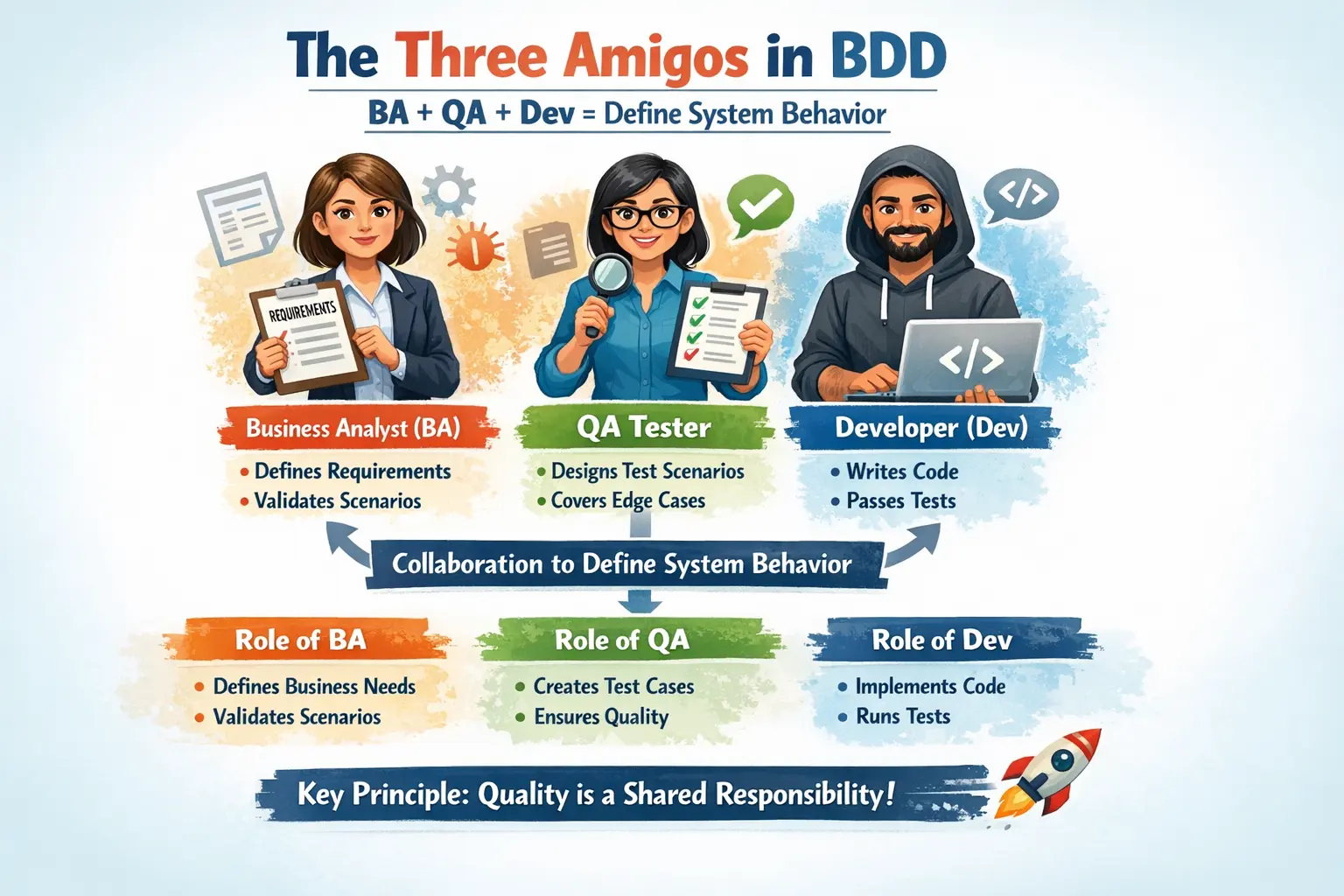
The collaboration model central to BDD is commonly referred to as the “Three Amigos.” This concept symbolizes the partnership between BA, Dev, and QA, where all three roles actively participate in defining and validating system behavior.
The BA represents the business perspective, focusing on what needs to be built. The developer represents the technical perspective, focusing on how it can be built. The QA represents the quality perspective, focusing on whether it works correctly across all scenarios.
Rather than working independently, these three roles come together to discuss requirements, identify scenarios, and agree on expected behavior before development begins. This shared understanding eliminates ambiguity and ensures that everyone is aligned from the outset.
The strength of the Three Amigos model lies in its balance. Each role compensates for the blind spots of the others. Together, they create a comprehensive view of the system that no single role could achieve alone.
Role of Business Analyst (BA)
The Business Analyst plays a crucial role in ensuring that the system aligns with business objectives and user needs. In the context of BDD, the BA is responsible for capturing and articulating business requirements in a way that is clear, concise, and meaningful to all stakeholders.
The BA defines business goals, rules, and constraints. They provide the context necessary for understanding why a feature is needed and what value it delivers. This context is essential for creating meaningful scenarios that reflect real-world usage.
In BDD, the BA actively participates in scenario discussions. They help shape the scenarios by ensuring that they accurately represent business behavior. They review Gherkin scenarios to confirm that the language used is business-readable and free from technical jargon.
One of the key contributions of the BA is ensuring that scenarios reflect actual user behavior rather than theoretical or overly simplified cases. This helps prevent gaps between documented requirements and real-world usage.
Ultimately, the BA ensures that the system being built is aligned with business intent. Without this role, scenarios risk becoming technically correct but functionally irrelevant.
Role of QA (Tester)
The QA role in BDD extends far beyond traditional testing responsibilities. Instead of validating the system after development, QA becomes an integral part of defining behavior and ensuring quality from the beginning.
QA professionals are responsible for identifying scenarios, including edge cases and negative flows that might not be immediately obvious. They translate requirements into structured, testable scenarios using Gherkin syntax.
In the BDD process, QA often acts as a facilitator for Three Amigos discussions. They help bridge the gap between business and technical perspectives by asking critical questions and clarifying ambiguities.
QA also plays a key role in designing automation strategies. They ensure that scenarios are not only readable but also executable. This involves creating step definitions, integrating automation tools, and maintaining the overall test framework.
A critical responsibility of QA is maintaining a behavior-focused approach. Instead of writing scenarios that describe UI interactions, QA ensures that scenarios describe what the system does, not how it does it.
The QA role ensures completeness and quality. By considering multiple perspectives and potential failure points, QA helps create a robust set of scenarios that thoroughly validate system behavior.
Role of Developer (Dev)
The developer’s role in BDD is to bring scenarios to life through implementation. Developers ensure that the application behaves as defined in the scenarios and meets both functional and technical requirements.
In the BDD workflow, developers participate in scenario discussions to assess feasibility. They identify technical constraints, dependencies, and potential challenges that may impact implementation.
Developers use BDD scenarios as a guide for coding. Instead of writing code based solely on requirements documents, they write code to satisfy the scenarios. This ensures that development is aligned with expected behavior from the start.
In many cases, developers also contribute to automation by writing or supporting step definitions. This collaboration between QA and developers strengthens the automation framework and improves overall efficiency.
When scenarios fail during execution, developers are responsible for diagnosing and fixing the underlying issues. This immediate feedback loop helps maintain alignment between code and expected behavior.
The developer’s key contribution is ensuring that behavior is implemented correctly and efficiently. Without this role, scenarios would remain theoretical and unfulfilled.
Shared Responsibilities Across Roles
One of the defining characteristics of BDD is shared responsibility. Unlike traditional models where quality is primarily the responsibility of QA, BDD distributes ownership across all roles.
Requirement understanding is a shared activity. All three roles must have a clear understanding of what needs to be built. Scenario discussions involve contributions from BA, QA, and Dev, ensuring that multiple perspectives are considered.
Scenario review is another collaborative activity. Each role validates scenarios from their perspective—business accuracy, test completeness, and technical feasibility.
Automation support is typically shared between QA and developers. While QA may lead the effort, developers often contribute to implementation and optimization.
Quality ownership is collective. In BDD, quality is not something that is tested at the end—it is built into the process from the beginning.
How Collaboration Happens in Real Projects
In real-world projects, BDD collaboration follows a structured workflow that integrates all three roles.
Before the sprint begins, the BA presents the business requirement. QA and developers ask questions to clarify details and identify potential gaps. This initial discussion sets the foundation for scenario creation.
During scenario creation, QA drafts the scenarios based on the requirement. The BA reviews them to ensure they accurately reflect business intent, while developers validate their feasibility.
During development, developers write code guided by the scenarios, and QA works on automating them. This parallel effort ensures that scenarios are ready for execution as soon as development is complete.
Once scenarios are executed, results are analyzed. Any failures are discussed collaboratively, and necessary fixes are implemented. This continuous feedback loop ensures that issues are addressed early and efficiently.
Impact of Missing Roles
BDD relies on balanced participation from all three roles. When one role is absent or disengaged, the process breaks down.
Without BA involvement, scenarios may lose alignment with business intent. They may become overly technical or fail to address real user needs.
Without QA involvement, scenarios may lack depth. Edge cases, negative flows, and potential failure points may be overlooked, leading to gaps in coverage.
Without developer involvement, scenarios may become unrealistic or difficult to implement. This can lead to delays and frustration during development.
Each role is essential. The absence of any one role compromises the effectiveness of BDD.
Common Anti-Patterns in BDD
Despite its collaborative nature, BDD can fail if roles are not properly aligned. One common anti-pattern is when QA writes scenarios in isolation without input from BA or developers. This leads to incomplete or misaligned scenarios.
Another issue arises when BA treats scenarios as documentation rather than executable specifications. This reduces their effectiveness and disconnects them from automation.
Developers ignoring scenarios until tests fail is another common problem. This reactive approach undermines the proactive nature of BDD.
Writing scenarios after development is also a critical mistake. BDD is a shift-left approach, and scenarios should be defined before coding begins.
Finally, including UI details in scenarios reduces readability and increases maintenance effort. Scenarios should focus on behavior, not implementation.
Benefits of Role-Based Collaboration
When BA, QA, and developers collaborate effectively, the benefits are significant. Requirements become clearer, reducing ambiguity and misinterpretation. Early discussions help identify potential issues before development begins, minimizing rework.
Collaboration leads to faster delivery because fewer defects are introduced and fewer corrections are needed. The shared understanding also improves confidence in releases, as all stakeholders are aligned on expected behavior.
Most importantly, role-based collaboration fosters a culture of quality. Instead of treating quality as a separate phase, it becomes an integral part of the development process.
Interview Perspective
From an interview standpoint, understanding the roles in BDD is essential. A strong answer should emphasize that BDD relies on collaboration between BA, QA, and developers.
The BA defines business intent, QA ensures completeness and quality, and developers ensure correct implementation. All three roles share ownership of quality and work together through the Three Amigos model.
Candidates should also highlight that BDD replaces handoffs with collaboration and that success depends on active participation from all roles.
Key Takeaway
Behavior Driven Development is not just a methodology—it is a collaborative mindset that transforms how teams build software. The roles of BA, QA, and developers are not isolated responsibilities but interconnected contributions that together define, build, and validate system behavior.
The Three Amigos model ensures that business intent, technical feasibility, and quality are addressed simultaneously. This alignment reduces defects, improves efficiency, and delivers software that truly meets user needs.
In BDD, quality is not owned by one role—it is owned by the entire team.