BDD Workflow in Real Projects
Behavior Driven Development (BDD) is often misunderstood as just a testing approach or a tool-driven practice. In reality, BDD is a structured, collaborative workflow that transforms how software is designed, developed, and validated. It shifts the focus from isolated activities to continuous collaboration and feedback, ensuring that what is built aligns closely with business expectations.
In real-world projects, BDD is not a one-time activity or a phase that happens after requirements are defined. Instead, it is a continuous workflow that begins with requirement discovery and extends through development, testing, and deployment. It integrates business, development, and testing perspectives into a unified process where behavior is defined, validated, and continuously verified.
Understanding the BDD workflow in practical terms is essential for implementing it effectively in Agile environments and for delivering high-quality, business-aligned software.
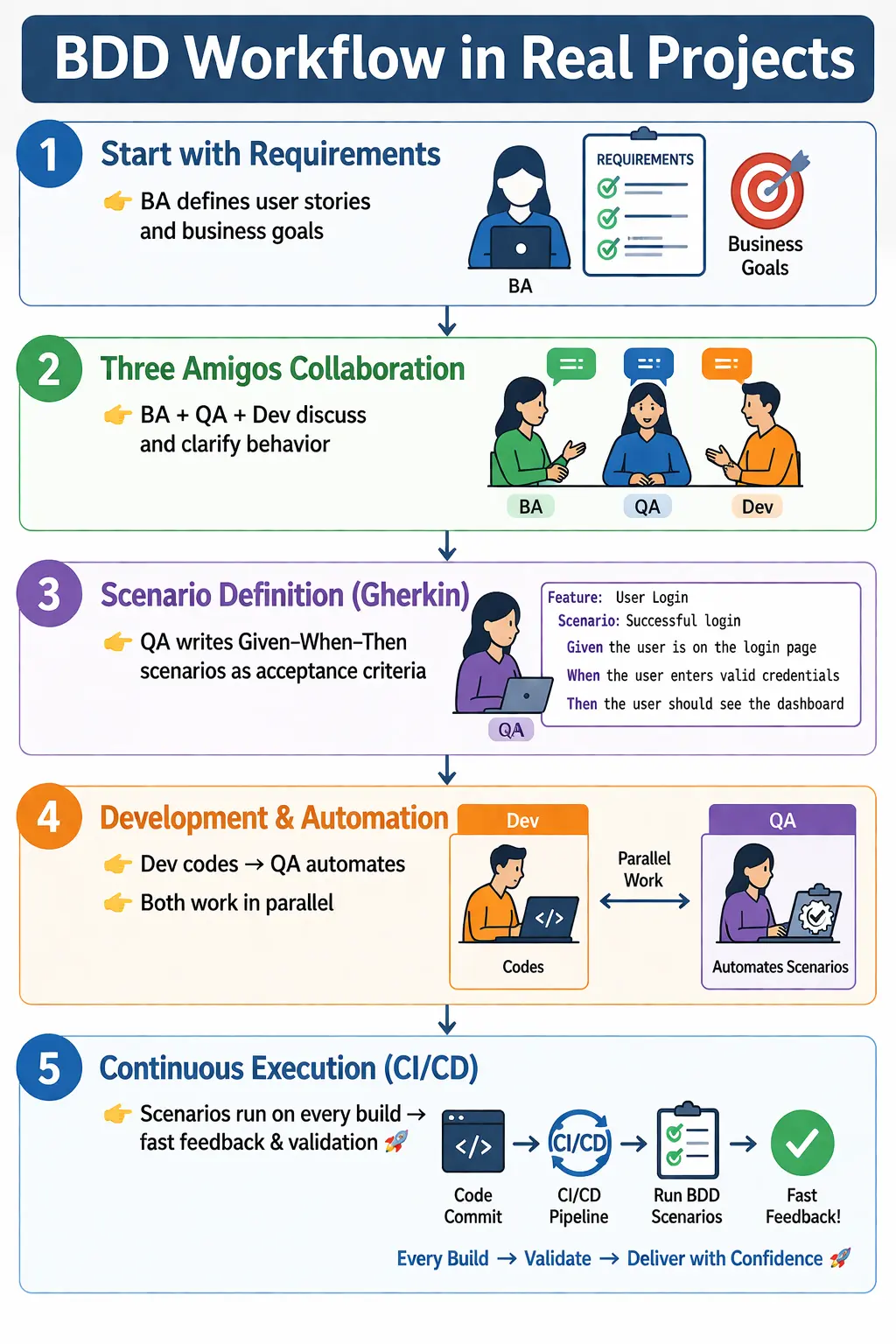
BDD Workflow as a Continuous Feedback Loop
The BDD workflow is best understood as a continuous feedback loop rather than a fixed sequence of documents and handoffs. A story begins with a business need, but that need becomes clearer through conversation, examples, scenario definition, implementation, automation, execution, and review. Each activity improves the team’s understanding of the expected behavior. When something is unclear, the workflow loops back to clarification. When a scenario fails, the workflow loops back to analysis. When business rules change, the workflow loops back to scenario refinement.
This looping nature is what makes BDD useful in real projects. Requirements are rarely perfect at the beginning. Stakeholders may know the goal but not every condition. Developers may discover technical constraints. QA may identify edge cases that were not obvious. Product owners may adjust priorities after seeing working software. BDD accepts this reality and creates a structured way to keep everyone aligned. Instead of treating change as a disruption, the workflow uses feedback to improve the behavior definition continuously.
BDD Starts Before Coding
One of the most important rules of a real BDD workflow is that it starts before coding. If scenarios are written only after development is complete, the team is not practicing BDD in its strongest form. At that point, Gherkin becomes a test documentation format rather than a collaboration tool. The real purpose of BDD is to clarify expected behavior before implementation begins so that developers build the right thing and testers validate the right thing.
Starting before coding does not mean every detail must be perfect before the sprint begins. It means the team should agree on the important examples, business rules, and acceptance expectations before committing to implementation. A developer should not have to guess what the product owner meant. QA should not have to discover basic rule gaps after the feature is built. BA, Dev, and QA should begin the story with enough shared understanding to move confidently.
Backlog Refinement in the BDD Workflow
In Agile teams, BDD usually begins during backlog refinement. The product owner or business analyst introduces a user story and explains the business need. The team discusses the value of the feature, the main users, the expected outcome, and the business rules. QA starts identifying testable scenarios and edge cases. Developers ask about technical dependencies, data needs, integrations, and implementation constraints. This is where vague stories become clearer.
A refined BDD story should not be only a one-line requirement. It should include enough examples for the team to understand the behavior. For example, instead of saying that a user should be able to reset a password, the team should discuss successful reset, invalid email, expired reset link, reused link, password rule violation, and confirmation behavior. These examples help the team decide whether the story is ready for development. Refinement prevents poorly understood work from entering the sprint.
Story Readiness and Acceptance Criteria
BDD improves story readiness because scenarios act as concrete acceptance criteria. A story is ready when the team understands who the user is, what behavior is expected, what business rules apply, what examples demonstrate success and failure, and what conditions are outside the scope. This prevents sprint planning from becoming a guessing exercise. Scenarios make acceptance criteria specific and testable.
Good acceptance criteria do not describe every technical step. They describe observable business behavior. In BDD, the Given part establishes context, the When part describes the action, and the Then part describes the expected outcome. This structure helps the team avoid ambiguous acceptance statements such as “system should work properly” or “user should get an error.” Instead, the expected behavior is expressed through examples that everyone can review.
Three Amigos as the Workflow Engine
The Three Amigos discussion is the engine of the BDD workflow. The Business Analyst or Product Owner brings the business perspective, the developer brings the technical perspective, and QA brings the quality and scenario perspective. The purpose is not to hold a ceremonial meeting. The purpose is to expose assumptions early. Each role asks different questions, and those questions improve the final behavior definition.
The BA may clarify why a rule exists and what business outcome is expected. The developer may explain that a rule depends on another service or that a simpler implementation could achieve the same result. QA may identify alternate flows, invalid data, boundary cases, or missing validation. When these perspectives come together, the story becomes clearer. The Three Amigos model prevents one role from designing behavior alone and later discovering that others understood it differently.
From Conversation to Examples
BDD conversations should produce examples. Examples are more powerful than abstract statements because they reveal details. A rule such as “expired links should not work” is useful, but an example makes it clearer: Given a password reset link expired after 30 minutes, when the user opens it after 45 minutes, then the system should reject the link and show a message to request a new one. This example can be discussed, implemented, tested, automated, and demonstrated.
Examples also reveal disagreement. One stakeholder may think a link expires after 15 minutes, another may expect 24 hours, and a developer may need to know whether expiry is based on creation time or last access time. Without examples, these differences remain hidden. BDD workflow turns hidden assumptions into visible conversations. Once the example is agreed, it becomes a shared reference for the team.
Writing Effective Gherkin Scenarios
Scenario definition is where examples become structured Gherkin. Effective Gherkin is business-readable, specific, and focused on behavior. It should not describe low-level UI mechanics unless the UI behavior itself is the requirement. A scenario that says the user clicks a blue button with a particular selector is less useful than a scenario that says the user submits a valid password reset request. The first is implementation detail; the second describes behavior.
Good scenarios should be small enough to understand and focused enough to validate one behavior. Very large scenarios become hard to read and maintain. Too many tiny scenarios can also become noisy. The team should aim for a practical balance. A scenario should express meaningful behavior, cover an important example, and be stable enough to serve as living documentation. QA often leads scenario drafting, but BA and Dev should review the scenarios before implementation.
Scenario Review Before Development
Scenario review is an important checkpoint in the BDD workflow. Before development begins, the team should review whether scenarios accurately reflect business intent, cover important flows, avoid unnecessary technical detail, and are feasible to automate. BA checks business correctness. QA checks coverage and testability. Dev checks implementation feasibility and technical assumptions. This review prevents weak scenarios from becoming the basis for development.
Reviewed scenarios become a contract, but not a rigid contract that blocks learning. If new information appears during development, the team can update scenarios. The key is that changes should be explicit and collaborative. Updating scenarios silently or after the fact can break trust. BDD scenarios are shared artifacts, so their maintenance should remain visible to the team.
Development Guided by Behavior
Once scenarios are agreed, development is guided by behavior rather than vague requirement text. Developers can read the scenarios and understand what the system must do. The scenarios help define the expected outcome and reduce interpretation gaps. This behavior-guided development improves focus because implementation is tied to visible examples. A developer can ask, “Does my code satisfy this scenario?” rather than guessing what done means.
This does not mean developers code only for the exact examples and ignore broader design. Developers still need to build maintainable, reusable, secure, and scalable code. But scenarios provide a clear behavioral target. They help ensure that technical implementation does not drift away from business expectation. When a developer is uncertain, the scenario becomes a discussion anchor.
Automation in the BDD Workflow
Automation is a major part of many BDD workflows, but it should not be confused with BDD itself. BDD is the collaboration and behavior-definition practice. Automation is the mechanism that executes those behavior specifications repeatedly. When used well, Cucumber automation turns scenarios into executable checks that provide fast feedback. When used poorly, it becomes a fragile layer of UI scripts written in business-looking language.
QA often leads automation, but developers should support it. Developers may help create stable test hooks, APIs, data setup mechanisms, service mocks, or reusable utilities. They may also help maintain step definitions and improve framework design. Strong BDD automation requires clean boundaries between feature files, step definitions, page objects or service clients, and reusable framework code. Without this design, automation becomes hard to maintain as the product grows.
Execution in Local and CI Environments
BDD scenarios can be executed locally by developers and QA, and they can also run in continuous integration pipelines. Local execution helps validate behavior while the work is still in progress. CI execution helps ensure that committed changes do not break agreed behavior. This dual execution model supports fast feedback and regression safety.
In real projects, CI execution requires stable environments, reliable test data, proper dependency management, browser configuration, reporting, and failure analysis. If the environment is unstable, BDD reports lose credibility. A scenario that fails due to test data setup or environment downtime may create noise. Teams must invest in execution reliability so that failed scenarios are meaningful signals rather than routine distractions.
Feedback Handling and Failure Analysis
When a BDD scenario fails, the team should investigate the reason carefully. A failure may mean the application behavior is wrong. It may also mean the scenario expectation is outdated, the test data is invalid, the automation step is broken, the environment is unstable, or the requirement has changed. Treating every failure as a developer bug is too simplistic. BDD failures are feedback, and feedback must be classified.
Good teams review failures quickly. QA can identify whether the failure is reproducible and whether the automation layer is reliable. Developers can inspect code, logs, and integration behavior. BA can confirm whether the expected behavior still matches business intent. This collaborative failure analysis keeps the workflow healthy. Ignored failures are dangerous because they turn living documentation into untrusted documentation.
Living Documentation in the Workflow
One of the strongest outcomes of BDD is living documentation. Feature files describe expected behavior in readable language, and automation results show whether that behavior still works. This combination is more useful than static requirement documents that become outdated after implementation. In a healthy workflow, the scenarios evolve with the system and remain trustworthy.
Living documentation requires discipline. If scenarios are not reviewed, if failed tests are ignored, or if business changes are not reflected in feature files, documentation becomes stale. The workflow must include regular scenario maintenance. When a feature changes, scenarios should change. When behavior is removed, obsolete scenarios should be removed. When a production defect is found, a new scenario may be added to prevent recurrence.
BDD Workflow and Sprint Ceremonies
BDD can fit naturally into Agile ceremonies. During backlog refinement, examples and business rules are discussed. During sprint planning, scenarios help define scope and acceptance. During daily work, scenarios guide development and automation. During review or demo, scenarios help show completed behavior. During retrospective, the team can inspect whether scenarios were created early enough, whether automation was stable, and whether collaboration improved.
This integration is important because BDD should not become a separate process that feels like extra work. It should improve the existing Agile flow. If BDD meetings, feature files, and automation reports are disconnected from sprint planning and delivery, the team may treat them as overhead. When BDD supports decision-making, implementation, validation, and demo, it becomes useful.
Incremental Adoption of BDD
Real teams do not need to automate every scenario immediately to begin using BDD. A team can start by using Three Amigos discussions and example-based acceptance criteria. Then they can write a small number of high-value Gherkin scenarios. Later, they can automate critical flows. This incremental approach is often more successful than trying to convert every requirement into automated scenarios overnight.
Incremental adoption helps teams learn. They discover which scenarios are valuable, how to write readable Gherkin, how to structure step definitions, how to manage test data, and which areas are worth automating. BDD should evolve based on feedback. The goal is better collaboration and confidence, not maximum scenario count.
Measuring BDD Workflow Health
A healthy BDD workflow can be measured through practical signals. Are scenarios discussed before coding? Are BA, Dev, and QA actively involved? Are scenarios readable by business stakeholders? Are failed scenarios investigated quickly? Are feature files updated when behavior changes? Is automation stable enough to trust? Are scenarios used in demos and acceptance discussions? These indicators show whether BDD is functioning as a workflow or merely as a tool layer.
Teams should avoid measuring BDD only by the number of feature files or automated scenarios. A large suite of poorly written scenarios does not mean the workflow is strong. Quality matters more than quantity. The best BDD workflow produces clear understanding, useful examples, maintainable automation, fast feedback, and reliable living documentation.
Interview-Ready Understanding of BDD Workflow
In interviews, BDD workflow should be explained as a collaborative, iterative process that starts before coding. A strong answer should mention requirement discovery, Three Amigos discussion, scenario definition in Gherkin, development guided by scenarios, automation through step definitions, execution in CI, feedback analysis, and continuous validation. It should also explain that BDD is not just Cucumber automation; it is a shared behavior-definition practice.
A practical example makes the answer stronger. For password reset, the BA explains rules such as link expiry, QA identifies scenarios such as invalid email and expired link, developers identify token-generation and security constraints, scenarios are written in Given-When-Then format, development and automation happen in parallel, and scenarios are executed continuously. This demonstrates how BDD works in real projects rather than only as theory.
What Is BDD Workflow?
The BDD workflow is a structured and iterative process that converts business requirements into executable behavior specifications before development begins and ensures that these behaviors are continuously validated throughout the lifecycle of the project.
Unlike traditional workflows where requirements are handed off from one team to another, BDD promotes a collaborative approach. It replaces sequential handoffs with shared discussions and continuous feedback loops. Every stage of the workflow involves multiple roles contributing their expertise to ensure clarity, feasibility, and quality.
At its core, the BDD workflow answers a critical question: “Are we building the right thing, and are we building it correctly?” It does so by ensuring that requirements are clearly understood, scenarios are well-defined, and validation happens continuously.
High-Level Stages of the BDD Workflow
The BDD workflow in real projects can be broadly divided into six interconnected stages: requirement discovery, collaborative discussion, scenario definition, development and automation, execution and feedback, and continuous validation.
These stages are not isolated. They form a loop where feedback from later stages influences earlier ones. This iterative nature is what makes BDD effective in dynamic environments where requirements evolve frequently.
Each stage contributes to building a shared understanding of system behavior and ensures that this understanding is consistently validated throughout the project.
Stage 1: Requirement Discovery
The workflow begins with requirement discovery, where the foundation of the feature is established. This stage is typically led by the Business Analyst or Product Owner, who defines the business need, objectives, and constraints.
During this phase, high-level user stories are created. These stories describe what the user wants to achieve and why it is important. The focus is on capturing intent rather than technical details.
The output of this stage is a set of user stories with clear goals and initial acceptance expectations. However, these stories are not yet detailed enough for development. They serve as a starting point for deeper exploration in subsequent stages.
Requirement discovery sets the direction, but it is the collaborative stages that refine and validate this direction.
Stage 2: Three Amigos Discussion
The second stage is where the real transformation begins. The Three Amigos discussion brings together the Business Analyst, QA, and developers to collaboratively analyze the requirement.
This discussion is not a formal meeting with rigid agendas. It is an interactive session where participants ask questions, challenge assumptions, and explore different scenarios. The goal is to uncover ambiguities, identify edge cases, and establish a shared understanding of the requirement.
During this stage, business rules are clarified, constraints are identified, and real-world examples are discussed. These examples form the basis for writing scenarios in the next stage.
The importance of this stage cannot be overstated. Many defects in traditional projects arise from misunderstood requirements. By addressing ambiguities early, the Three Amigos discussion prevents costly rework later.
Stage 3: Scenario Definition
Once the requirement is well understood, the next step is to define scenarios that describe the expected behavior of the system. This stage is typically led by QA, with active involvement from BA and developers.
Scenarios are written in Gherkin using the Given–When–Then structure. This format ensures that scenarios are clear, structured, and readable by all stakeholders. Each scenario represents a specific example of system behavior.
The focus is on covering different types of scenarios, including happy paths, negative flows, and edge cases. This comprehensive coverage ensures that the system is validated under various conditions.
The output of this stage is a set of approved feature files that act as a contract between business, development, and testing. These scenarios define what the system must do and serve as acceptance criteria for the feature.
Stage 4: Development and Automation
With scenarios in place, development and automation activities begin. This stage involves parallel efforts from developers and QA, both working towards the same goal of implementing and validating behavior.
Developers use the scenarios as a reference for implementation. Instead of coding based on abstract requirements, they code to satisfy specific, agreed-upon behaviors. This alignment reduces ambiguity and ensures that development stays focused on business needs.
At the same time, QA works on automating the scenarios. This involves writing step definitions, integrating automation tools, and designing reusable components. Automation ensures that scenarios can be executed repeatedly and consistently.
This parallel workflow enhances efficiency. By the time development is complete, automation is often ready, enabling immediate validation.
Stage 5: Execution and Feedback
The execution stage is where scenarios are run to validate system behavior. This can happen locally during development or as part of continuous integration pipelines.
When scenarios are executed, they provide immediate feedback. If a scenario passes, it confirms that the expected behavior has been implemented correctly. If it fails, it indicates a gap—either in implementation or in understanding.
This feedback loop is one of the most powerful aspects of BDD. It ensures that issues are identified and addressed early, reducing the risk of defects reaching later stages.
Failures are not treated as setbacks but as opportunities to refine understanding and improve the system. Teams analyze failures collaboratively and take corrective actions promptly.
Stage 6: Continuous Validation
The final stage of the workflow is continuous validation, which ensures that system behavior remains consistent over time. In modern development environments, this is achieved through integration with CI/CD pipelines.
Scenarios are executed automatically on every build, providing continuous feedback on system behavior. Reports are generated and shared with stakeholders, offering real-time visibility into the status of the application.
This continuous execution transforms scenarios into living documentation. They not only define behavior but also verify it continuously, ensuring that documentation remains accurate and trustworthy.
Continuous validation shifts the focus from end-of-cycle testing to ongoing quality assurance, enabling teams to maintain high confidence in their releases.
Real-World Example of BDD Workflow
To understand how the BDD workflow operates in practice, consider a feature such as password reset functionality.
The process begins with the BA explaining the business rules, such as how users request a reset and how links expire. QA identifies edge cases, such as invalid emails or expired links. Developers highlight technical constraints, such as token generation and security considerations.
Scenarios are then written to cover these behaviors and are reviewed and approved by all stakeholders. Developers implement the functionality while QA automates the scenarios.
Once executed, the scenarios validate the feature. Any failures are addressed immediately, ensuring that the feature meets both business and technical expectations.
This example illustrates how BDD integrates multiple perspectives into a cohesive workflow.
BDD Workflow in Agile Sprints
BDD aligns naturally with Agile methodologies, fitting seamlessly into sprint activities. During backlog refinement, scenarios are discussed and refined. In sprint planning, scenarios are committed as part of the feature scope.
During development, scenarios guide coding and testing activities. In the testing phase, scenarios are executed to validate behavior. During sprint demos, scenarios serve as proof of functionality, demonstrating how the system behaves.
In retrospectives, teams review scenarios to identify improvements and refine their approach. This integration ensures that BDD becomes an integral part of the Agile lifecycle rather than an additional layer.
Real-World Adaptations of BDD
In practice, teams often adapt BDD to suit their context. Not all scenarios are automated immediately. Some may remain manual initially, especially in early stages of adoption.
Teams typically prioritize high-value scenarios that cover critical business flows. Over time, as the framework matures, more scenarios are automated.
BDD is not an all-or-nothing approach. It evolves incrementally, allowing teams to gradually improve their processes and coverage.
Common Workflow Mistakes
Despite its benefits, BDD can fail if implemented incorrectly. One common mistake is writing scenarios after development, which defeats the purpose of defining behavior upfront.
Another issue is QA working in isolation without involving BA and developers. This leads to incomplete or misaligned scenarios.
Writing overly technical scenarios that include UI details reduces readability and increases maintenance effort. Ignoring failed scenarios also undermines the effectiveness of the workflow.
Treating BDD as merely an automation layer rather than a collaborative process is another critical mistake. BDD is about behavior and collaboration, not just tools.
Benefits of a Proper BDD Workflow
When implemented correctly, the BDD workflow delivers significant benefits. It ensures clear and unambiguous acceptance criteria, reducing misunderstandings and defects.
Early validation of requirements minimizes rework and accelerates delivery. Continuous feedback loops enable faster identification and resolution of issues.
Collaboration improves team alignment, fostering a shared understanding of system behavior. Living documentation provides transparency and builds confidence among stakeholders.
Overall, the BDD workflow enhances both quality and efficiency, making it a valuable approach for modern software development.
Interview Perspective
From an interview standpoint, the BDD workflow is often evaluated in terms of its stages and collaborative nature. A strong answer should highlight that BDD starts before coding, involves the Three Amigos, and uses scenarios as acceptance criteria.
It is important to emphasize that development and testing occur in parallel and that continuous execution ensures ongoing validation. Candidates should also mention that BDD is a feedback loop rather than a linear process.
Demonstrating an understanding of real-world implementation and common challenges adds depth to the response.
Key Takeaway
The BDD workflow is a continuous, collaborative process that transforms requirements into validated behavior. It integrates business, development, and testing perspectives into a unified approach that emphasizes clarity, alignment, and quality.
By starting early, involving all stakeholders, and maintaining continuous validation, BDD ensures that software not only works correctly but also delivers the intended business value.
It is not just a process—it is a mindset that drives better communication, faster feedback, and more reliable software delivery.