BDD vs TDD vs ATDD – A Complete, Real-World Comparison Guide
In modern software development, delivering high-quality applications is no longer just about writing code—it is about building the right product, in the right way, with the right validation at every stage. This is where approaches like Behavior Driven Development (BDD), Test Driven Development (TDD), and Acceptance Test Driven Development (ATDD) play a crucial role.
Although these three practices are often mentioned together, they serve different purposes, operate at different levels, and involve different stakeholders. Understanding their distinctions—and more importantly, how they complement each other—is essential for anyone working in Agile, DevOps, or modern testing environments.
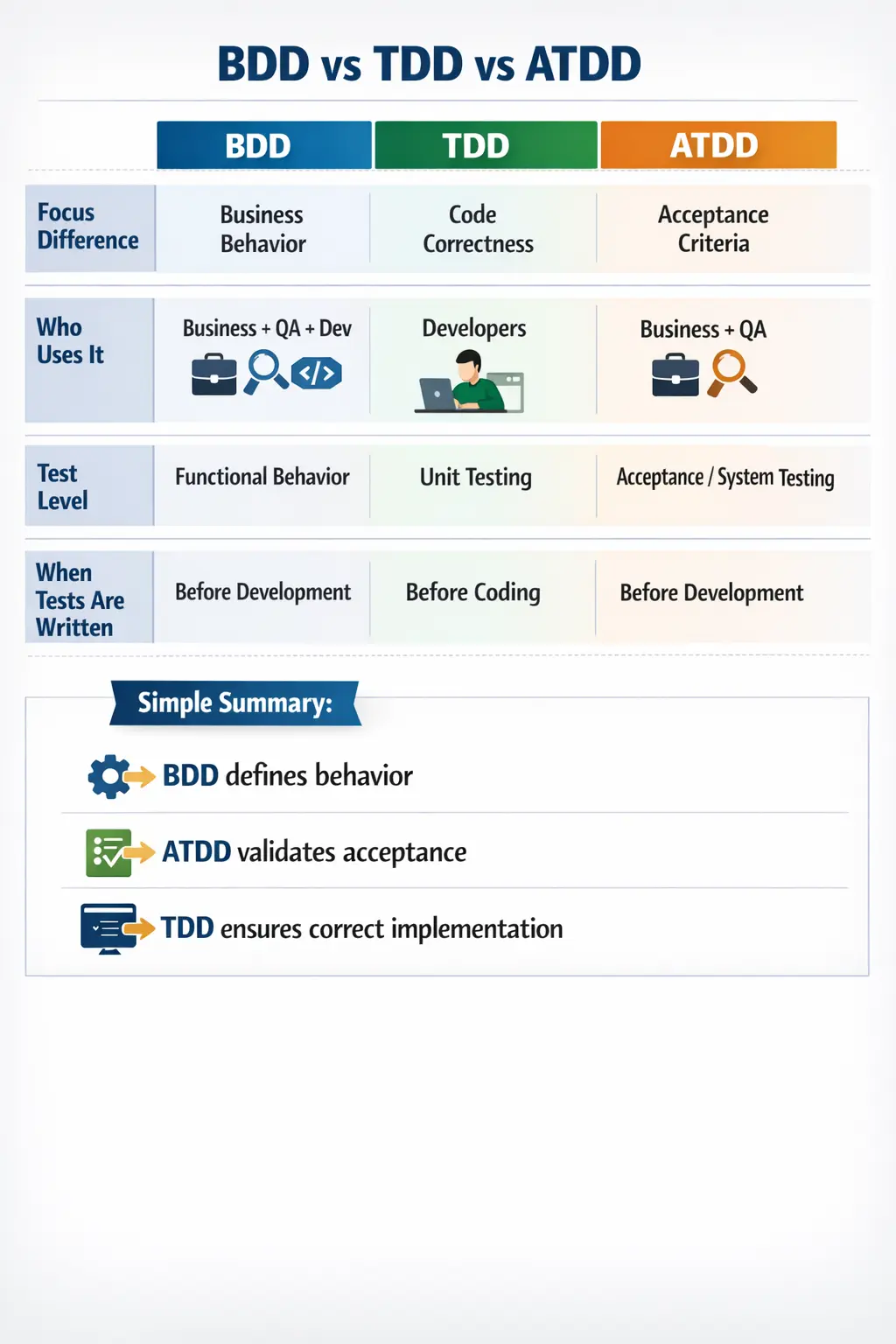
At a high level, all three approaches promote shift-left testing, meaning testing activities start early in the development lifecycle. However, they focus on different aspects: BDD emphasizes business behavior, TDD focuses on code correctness, and ATDD ensures acceptance criteria validation. Together, they form a powerful ecosystem that improves collaboration, reduces defects, and ensures alignment between business expectations and technical implementation.
Why These Three Approaches Are Often Confused
BDD, TDD, and ATDD are often confused because all three move validation earlier in the development process. They all challenge the old habit of writing code first and checking quality only at the end. They also use tests or examples before implementation, which makes them look similar from a distance. However, the intent behind each practice is different. If a team treats them as interchangeable, the result is usually confusion, weak automation, and poor collaboration.
The easiest way to separate them is to ask what problem each one is trying to solve. BDD solves the communication problem between business and technical teams. TDD solves the code design and correctness problem for developers. ATDD solves the acceptance validation problem by making acceptance conditions clear before development. These are related quality problems, but they are not the same problem.
In real projects, a feature can fail at any of these levels. The business behavior may be misunderstood, the acceptance criteria may be incomplete, or the internal code may be poorly designed. BDD, ATDD, and TDD help at different layers of that risk. A mature team does not ask which one is the only correct practice. It asks which layer of quality needs support and how the practices can work together.
BDD Starts with Shared Understanding
Behavior Driven Development begins with the question of shared understanding. Before the team discusses classes, methods, test scripts, or database tables, BDD asks what the system should do from the user's or business's point of view. This is why BDD scenarios are written in business-readable language. The scenario is not meant only for automation engineers. It is meant to be understood by product owners, testers, developers, business analysts, and stakeholders.
A strong BDD conversation turns a vague requirement into concrete examples. For example, a requirement such as "customer should be eligible for discount" is incomplete until the team discusses who qualifies, what happens with expired coupons, what happens when multiple discounts apply, and what message should appear when a user is not eligible. BDD exposes these hidden details through examples before code is written.
This is why BDD is not just "Cucumber syntax." Cucumber is a tool that can automate BDD-style scenarios, but BDD itself is a collaboration practice. If a tester writes Gherkin alone after development is finished, the team may be using Cucumber, but it is not getting the full value of BDD. The value comes from early conversation, shared examples, and agreement on behavior.
TDD Starts with Developer Feedback
Test Driven Development works at a different level. TDD is primarily a developer practice. It helps a developer design small units of code by writing a failing test first, writing only enough code to make the test pass, and then refactoring the code while keeping the test green. This cycle is often called red, green, refactor. The red stage confirms the test fails for the right reason. The green stage confirms the code satisfies the immediate behavior. The refactor stage improves design without changing behavior.
TDD is powerful because it gives developers fast feedback. A developer does not need to wait for a full UI test, manual test cycle, or release build to know whether a method works. Unit tests run quickly and can be executed repeatedly during development. This encourages cleaner design, smaller methods, better separation of concerns, and safer refactoring.
However, TDD does not automatically prove that the business wanted the feature. A developer can write excellent unit tests for the wrong requirement. The code may be clean, modular, and fully tested at the unit level, while still failing to satisfy user expectations. That is why TDD is important but not sufficient by itself. It protects implementation quality, but it does not replace business validation.
ATDD Starts with Acceptance Conditions
Acceptance Test Driven Development focuses on agreement around acceptance criteria. Before coding begins, the team defines what must be true for the feature to be accepted. These acceptance tests are usually broader than unit tests and closer to business requirements. They may validate a full workflow, a user action, an API response, a business rule, or a system-level outcome.
ATDD is especially useful when stakeholders need confidence that a feature meets agreed conditions. For example, if a payment feature must accept valid card details, reject expired cards, calculate tax, update order status, and send confirmation, ATDD helps define those acceptance outcomes before implementation. The team can then build toward clearly measurable conditions.
ATDD and BDD overlap because both encourage collaboration and early examples. The difference is mainly emphasis. BDD is usually more focused on behavior and shared language, often expressed through Given, When, Then scenarios. ATDD is more focused on acceptance criteria and proving that the completed feature satisfies those criteria. In many Agile teams, the two practices are used together naturally.
How the Three Fit the Testing Pyramid
The testing pyramid helps explain why BDD, TDD, and ATDD should not compete. At the bottom of the pyramid are many fast unit tests. TDD fits strongly here because it drives code at the smallest practical level. These tests are quick, reliable, and useful for developers. They catch mistakes in calculation logic, validation rules, transformations, and component behavior.
Higher in the pyramid are integration, API, service, and acceptance tests. ATDD often fits here because it validates that pieces work together to satisfy acceptance criteria. These tests are slower than unit tests but more representative of real system behavior. They help ensure that a feature works beyond isolated code units.
BDD can sit at the acceptance or behavior layer, depending on how the team implements it. A BDD scenario may drive UI automation, API automation, or service-level automation. The important point is not the technical layer alone; it is that the scenario expresses business behavior clearly. A healthy automation strategy avoids using BDD for every tiny technical check. It uses BDD for meaningful behavior and TDD for detailed code-level coverage.
Real Project Workflow
In a real Agile team, the workflow may begin during backlog refinement. The product owner explains a user story, the tester asks about edge cases, the developer asks about technical constraints, and the team discusses examples. This is where BDD thinking is useful. The team may write scenarios that describe the expected behavior in clear language.
Next, the team converts acceptance expectations into measurable checks. This is where ATDD thinking helps. The acceptance conditions become clear enough that the team can say whether the story is done or not. These conditions may later become automated acceptance tests or structured manual checks, depending on the project.
During development, the developer uses TDD to design and verify the code. The developer writes unit tests for validation logic, calculations, service methods, domain rules, and error handling. Once code is integrated, the acceptance and BDD scenarios validate that the completed behavior matches the agreed examples. This creates a chain from conversation to code to verification.
Why One Practice Alone Is Not Enough
Using only BDD can leave technical gaps. A few high-level scenarios may confirm major workflows, but they cannot efficiently cover every small condition inside the code. If a team tries to use UI-level BDD scenarios for all validation, the automation suite becomes slow, brittle, and expensive to maintain. TDD is better for many low-level cases.
Using only TDD can leave business gaps. Developers may have excellent unit coverage, but if the team misunderstood the requirement, the software can still be wrong. TDD answers whether the code behaves as the developer specified. It does not automatically confirm whether the specification reflects stakeholder expectations. BDD and ATDD help with that alignment.
Using only ATDD can also be incomplete. Acceptance tests confirm that a feature meets agreed conditions, but they may not give the developer enough fast feedback during coding. If acceptance tests are large and slow, relying only on them can delay defect discovery. TDD provides faster technical feedback, while BDD improves shared understanding and ATDD confirms acceptance.
Common Mistakes Teams Make
One common mistake is treating BDD as a tool installation. A team may add Cucumber, write feature files, and believe it has adopted BDD. But if business stakeholders never review the scenarios, if examples are written after coding, or if scenarios are filled with technical UI steps, the practice becomes automation syntax rather than behavior-driven collaboration.
Another mistake is using TDD only as test coverage. TDD is not simply writing unit tests before or after code. The discipline is in allowing tests to drive design in small steps. If tests are written only to satisfy a coverage number, the team may miss the design benefits of TDD. Good TDD produces code that is easier to refactor, easier to reason about, and safer to change.
A third mistake is making ATDD too vague. Acceptance tests should be specific enough to decide whether a feature is acceptable. If acceptance criteria say only "login should work," the team has not clarified enough. Strong acceptance conditions include valid paths, invalid paths, error handling, roles, data conditions, and expected outcomes where relevant.
Understanding the Core Definitions
To build a strong foundation, it is important to clearly understand what each approach represents.
Behavior Driven Development (BDD) is a collaborative development approach that focuses on defining application behavior using business-readable examples. It bridges the communication gap between business stakeholders, developers, and testers by expressing requirements in a structured format, typically using Given–When–Then scenarios. BDD ensures that everyone shares a common understanding of what the system should do before development begins.
Test Driven Development (TDD), on the other hand, is a developer-centric practice where unit tests are written before the production code. The goal of TDD is not just testing but improving code design, ensuring correctness, and maintaining clean, modular code. It follows a strict cycle of writing a failing test, writing code to pass the test, and then refactoring.
Acceptance Test Driven Development (ATDD) sits between BDD and TDD. It is a collaborative approach where acceptance criteria are defined as test cases before development begins. These tests validate whether the system meets business expectations at a functional level, ensuring that the final product is acceptable from a user perspective.
While these definitions may seem similar at first glance, the differences become clear when we analyze their focus, ownership, and application.
Primary Focus Areas – What Each Approach Optimizes
The most critical distinction between BDD, TDD, and ATDD lies in what they are trying to achieve.
BDD focuses on business behavior. It answers the question: “What should the system do from a user’s perspective?” It ensures that features are built according to real-world scenarios and business needs.
TDD focuses on code correctness and design. It answers: “Is the code implemented correctly?” It ensures that individual units of code function as expected and are maintainable over time.
ATDD focuses on acceptance criteria. It answers: “Does the system meet business acceptance conditions?” It validates that the system behaves correctly at a functional or system level.
These three layers together ensure that software is built correctly, behaves correctly, and satisfies business expectations.
Audience and Ownership – Who Drives Each Approach
Another key difference lies in who participates in each practice.
BDD is highly collaborative and involves business stakeholders, QA engineers, and developers. Scenarios are written collectively, ensuring that everyone agrees on the expected behavior.
TDD is primarily driven by developers. It is a technical practice focused on writing and validating code at the unit level. Business stakeholders are typically not involved in TDD.
ATDD involves business users and QA teams, with developers supporting implementation. It ensures that acceptance criteria are clearly defined and validated before development.
This difference in ownership highlights an important point: BDD and ATDD promote cross-functional collaboration, while TDD is focused on technical excellence within development.
Test Levels – Where Each Approach Operates
Each approach operates at a different testing level, which is crucial for understanding their role in the testing pyramid.
BDD operates at the functional or behavioral level, validating how the system behaves from an end-user perspective.
TDD operates at the unit level, focusing on individual methods, classes, or components.
ATDD operates at the acceptance or system level, ensuring that the entire system meets business requirements.
This layered approach ensures comprehensive validation—from low-level code correctness to high-level business behavior.
Timing – When Tests Are Written
All three approaches follow shift-left principles, but they differ in timing and intent.
In BDD, scenarios are written before development begins, during requirement discussions. This ensures clarity and shared understanding.
In TDD, tests are written before coding, driving the implementation process itself.
In ATDD, acceptance tests are defined before development, ensuring that business expectations are clear and measurable.
Although all three promote early testing, they operate at different stages of the development lifecycle, creating a continuous validation pipeline.
Syntax and Expression – How Tests Are Written
One of the most visible differences between these approaches is how tests are expressed.
BDD uses a structured, business-readable format:
Given the user has sufficient balance
When the user transfers money
Then the transfer should be successful
This format ensures clarity and accessibility for non-technical stakeholders.
TDD uses technical assertions:
assertEquals(200, calculateTotal());
This is precise and developer-friendly but not easily understood by business users.
ATDD uses semi-technical validation statements:
Verify order placement is successful with valid inputs
These are more readable than TDD but less expressive than BDD scenarios.
The difference in syntax reflects the audience and purpose of each approach.
Tooling Ecosystem
Each approach is supported by a different set of tools aligned with its purpose.
BDD commonly uses tools like Cucumber, SpecFlow, and Behave, which support Given–When–Then syntax and integrate with automation frameworks.
TDD relies on unit testing frameworks such as JUnit, TestNG, and NUnit, which are designed for fast, developer-level testing.
ATDD often uses tools like FitNesse and Cucumber, focusing on acceptance-level validation.
The choice of tools reinforces the idea that these approaches are not interchangeable—they are complementary.
Documentation Value – Living vs Static Artifacts
One of the biggest advantages of BDD is its ability to produce living documentation. BDD scenarios are always up to date because they are directly tied to automated tests and system behavior.
TDD provides technical documentation in the form of unit tests. While useful for developers, it is not accessible to business stakeholders.
ATDD produces acceptance documentation, which helps validate requirements but may not be as expressive or detailed as BDD scenarios.
This makes BDD particularly valuable in projects where communication and documentation are critical.
Strengths of Each Approach
Each approach brings unique strengths to the development process.
BDD excels in clarity and collaboration. It reduces ambiguity, aligns teams, and ensures that development is driven by real business needs.
TDD excels in code quality and design. It promotes clean architecture, reduces defects at the unit level, and provides fast feedback to developers.
ATDD excels in acceptance validation. It ensures that the system meets business expectations and reduces surprises during UAT.
When used together, these strengths create a robust and reliable development process.
Limitations and Challenges
Despite their benefits, each approach has limitations.
BDD requires discipline and collaboration. If treated as just a tool (e.g., writing Gherkin without business involvement), it loses its value.
TDD does not validate business behavior. It ensures code correctness but does not guarantee that the right functionality is implemented.
ATDD can be less expressive than BDD and is often limited to acceptance-level validation.
Understanding these limitations helps teams apply each approach appropriately.
How BDD, TDD, and ATDD Work Together
In real-world projects, these approaches are not alternatives—they are complementary layers of quality assurance.
BDD defines what the system should do in terms of behavior.
ATDD validates whether the system meets acceptance criteria.
TDD ensures the code is implemented correctly.
An ideal workflow looks like this:
- BDD defines behavior through scenarios
- ATDD validates acceptance criteria
- TDD drives code implementation
This layered approach ensures that software is correct at every level—from business expectations to technical implementation.
Real-World Example
Consider a simple requirement: A user should be able to log in.
In BDD, this is defined as behavior:
Given the user has valid credentials
When the user logs in
Then the user should see the dashboard
In ATDD, acceptance is validated by ensuring the login works end-to-end under expected conditions.
In TDD, developers write unit tests for methods such as credential validation and authentication logic.
Each approach addresses a different aspect of the same requirement, ensuring comprehensive validation.
Interview-Ready Summary
From an interview perspective, understanding the distinction between these approaches is critical.
BDD focuses on business behavior and collaboration, ensuring that requirements are clearly understood and validated.
TDD focuses on code quality and correctness, ensuring that the implementation is reliable and maintainable.
ATDD focuses on acceptance validation, ensuring that the system meets business expectations.
BDD and ATDD are collaborative practices, while TDD is developer-centric. Together, they create a complete quality framework.
Key Takeaway
BDD, TDD, and ATDD are not competing methodologies—they are different layers of the same quality strategy. Each addresses a specific gap in traditional development and testing.
BDD ensures that the right features are built.
ATDD ensures that those features meet acceptance criteria.
TDD ensures that the implementation is correct and maintainable.
In one line:
BDD defines behavior, ATDD validates acceptance, and TDD ensures correct implementation.
Mastering how these approaches work individually and together is essential for building high-quality, scalable, and reliable software in modern development environments.