Why BDD Over Traditional Testing
In the evolution of software development practices, one of the most significant shifts has been the move from traditional testing approaches toward more collaborative and behavior-focused methodologies. Among these, Behavior Driven Development (BDD) stands out as a transformative approach that redefines how teams understand, build, and validate software. While traditional testing has served the industry for decades, modern development environments—especially Agile and DevOps—demand faster feedback, stronger collaboration, and clearer alignment with business goals. This is precisely where BDD demonstrates its value.
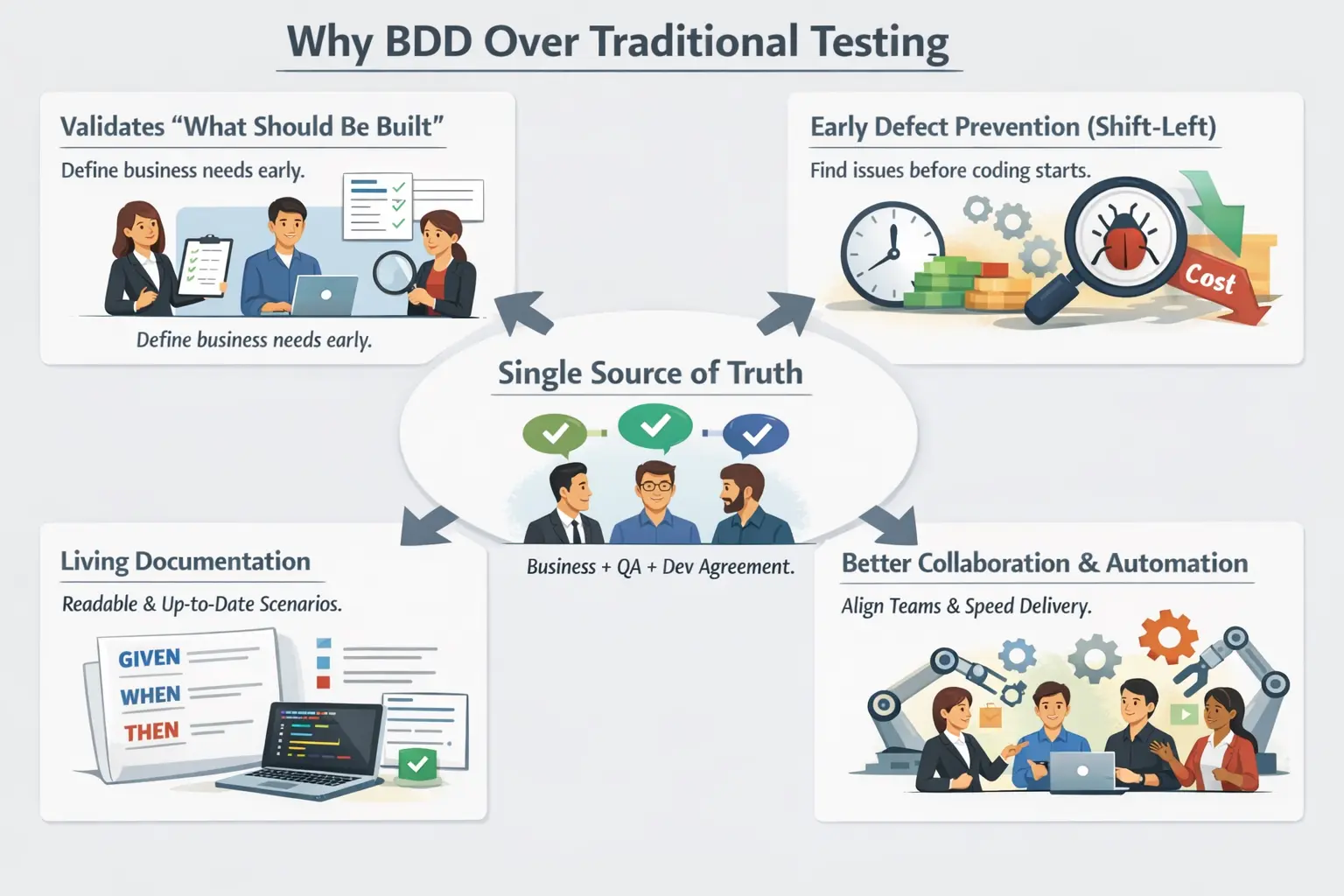
At a fundamental level, the preference for BDD over traditional testing comes down to a single core idea: BDD ensures that software is built based on business behavior, not just technical implementation. Traditional testing often verifies what has already been developed, whereas BDD validates what should be developed before the first line of code is written. This distinction may seem subtle, but in practice, it dramatically impacts quality, efficiency, and team alignment.
Why This Comparison Matters in Real Projects
The question of why teams choose BDD over traditional testing is not just a theoretical interview topic. It comes from a very practical problem that appears again and again in software projects: teams can work very hard, write code correctly, execute many test cases, and still deliver a feature that does not match what the business actually needed. Traditional testing is useful for finding defects in a completed implementation, but it does not automatically guarantee that the team agreed on the correct behavior before development started.
In many projects, the requirement begins as a sentence in a document, a user story in a tracking tool, or a short discussion in a planning meeting. Each person then interprets that requirement from their own perspective. A product owner may think about the business rule, a developer may think about data structures and APIs, a tester may think about validation and edge cases, and a stakeholder may think about user outcomes. If these interpretations are not brought together early, the team may not notice the difference until testing, user acceptance testing, or production feedback.
BDD matters because it forces the team to convert assumptions into concrete examples. Instead of saying, "the customer should receive a discount," the team discusses examples such as what happens for a new customer, an existing customer, a premium customer, an expired coupon, a minimum order value, and a conflicting promotion. These examples reveal hidden rules much earlier than a long requirement paragraph. That is the practical reason BDD is often more valuable than a traditional test-last approach.
Traditional Testing Is Useful, but Often Too Late
Traditional testing is not wrong. Manual test cases, functional testing, regression testing, integration testing, and system testing are still important. A mature team does not reject these activities simply because it adopts BDD. The limitation is that traditional testing often enters the conversation after major design and coding decisions have already been made. At that point, the team can identify problems, but fixing them may require rework across code, database rules, API contracts, UI flows, and acceptance criteria.
This timing creates a common pattern. Requirements are written, developers implement the feature, testers prepare test cases, defects are raised, developers fix them, testers retest, and the release moves forward after several cycles. This process can work, but it is reactive. The team discovers misunderstanding after effort has already been spent. BDD tries to reduce that waste by moving discovery to the beginning of the work.
A useful way to understand the difference is to see traditional testing as an inspection activity and BDD as a clarification activity. Traditional testing inspects whether the built product has problems. BDD clarifies what the product should do before it is built. Inspection is still needed, but clarification prevents many defects from being created in the first place.
BDD Turns Requirements into Examples
One of the strongest reasons to prefer BDD is its use of examples as the center of requirement discussion. Abstract requirements can sound correct while still hiding disagreement. For example, "users must be able to reset their password securely" is a reasonable requirement, but it does not explain what should happen when the email is not registered, the reset link expires, the user enters a weak password, or the same link is used twice. A traditional test case may catch these scenarios later, but BDD asks the team to discuss them earlier.
When the team writes examples in Given, When, Then format, the requirement becomes more concrete. The Given part describes the starting context, the When part describes the action, and the Then part describes the expected outcome. This structure is simple, but it is powerful because it keeps the discussion focused on observable behavior. The team does not begin by debating implementation details. It begins by agreeing on what a user, system, or business process should experience.
This example-driven thinking is especially useful for rules-heavy systems such as banking, insurance, healthcare, e-commerce, trading, tax calculation, subscription billing, and workflow approvals. In these systems, defects often come from missed combinations or unclear business rules, not from simple coding mistakes. BDD helps expose those combinations before they become production problems.
BDD Improves the Role of Testers
In a traditional model, testers are sometimes treated as the final gatekeepers who receive completed work and find defects. That role is important, but it limits the tester's impact. By the time a tester receives the build, many decisions have already been made. The tester can report what is wrong, but the opportunity to prevent misunderstanding may have passed.
BDD brings testers into the requirement conversation earlier. Testers contribute by asking practical questions, challenging assumptions, identifying boundary conditions, and turning vague acceptance criteria into testable examples. This makes the tester a quality partner during discovery, not only a defect reporter during execution. It also improves the quality of scenarios because testers naturally think about negative paths, alternate flows, missing data, invalid states, and user mistakes.
This does not remove the need for exploratory testing or regression testing. Instead, it gives those activities a stronger foundation. When the expected behavior is clear, exploratory testing can focus on risk and discovery instead of basic requirement interpretation. Regression suites become more meaningful because they validate business behavior rather than only checking screen-level actions.
BDD Helps Developers Build with Confidence
Developers also benefit from BDD because scenarios define clear targets before coding begins. In a traditional workflow, a developer may implement based on a requirement document and later learn that the business expected something different. This creates frustration because the code may be technically correct but behaviorally wrong. BDD reduces that risk by giving developers concrete examples of success before implementation starts.
When scenarios are well written, they act like executable acceptance criteria. A developer can read a scenario and understand the condition, action, and outcome. This makes it easier to design APIs, validation logic, database updates, and error handling around real behavior. It also makes code reviews sharper because reviewers can compare the implementation with agreed scenarios rather than relying only on broad requirement text.
In automation projects using Cucumber, the same scenarios can later be connected to step definitions and automated checks. This creates a direct connection between the business conversation and the technical validation. The automation is not a separate interpretation of the requirement; it is tied to the examples the team already agreed upon.
BDD Creates Better Business Participation
A common weakness in traditional testing is that business stakeholders may not be able to read or review technical test cases comfortably. Test cases may contain tool-specific language, locator details, data setup steps, environment notes, and technical assertions. This makes them useful for QA execution, but less useful for business validation. As a result, business stakeholders may only discover gaps during demos, acceptance testing, or after release.
BDD changes the language of validation. Scenarios are written in plain business terms, so a product owner, business analyst, tester, developer, and stakeholder can all review the same artifact. This improves participation because business users can confirm whether the examples reflect real rules. They can also challenge missing cases before the team builds the feature.
This shared readability is one of the main reasons BDD is associated with living documentation. The scenarios are not just notes from a meeting. When maintained well, they remain connected to automated tests and reflect the current behavior of the application. That makes them more valuable than static documents that slowly become outdated.
BDD Reduces Waste in Agile Delivery
Agile teams work in short cycles, so misunderstanding is expensive. A two-week sprint does not leave much room for long handoffs, late clarification, repeated rework, and large defect cycles. Traditional testing can fit into Agile, but if the team waits until the end of the sprint to clarify behavior, defects and requirement gaps may appear too late to fix cleanly.
BDD supports Agile because it encourages conversation before implementation. During refinement or planning, the team can discuss examples, identify missing rules, split unclear stories, and agree on acceptance criteria. This gives development and testing a clearer path during the sprint. It also helps product owners because they can see whether a story is ready for development based on whether its behavior has been described clearly.
In this sense, BDD is not only a testing technique. It is a delivery improvement technique. It reduces waste by preventing the wrong work, reducing ambiguous handoffs, improving scenario quality, and creating faster feedback. The result is not just fewer defects; it is smoother delivery.
BDD and Traditional Testing Can Work Together
Choosing BDD over traditional testing does not mean replacing every traditional testing practice. BDD is strongest at clarifying expected behavior, defining acceptance criteria, and aligning automation with business outcomes. Traditional testing is still valuable for detailed test design, exploratory testing, usability checks, performance testing, security testing, compatibility testing, and deep negative testing. A strong quality strategy uses both approaches in the right place.
For example, a BDD scenario may define that a user with valid credentials can log in and reach the dashboard. Traditional testing may still cover browser compatibility, invalid input combinations, session timeout behavior, SQL injection attempts, accessibility of error messages, and performance under load. BDD gives the team a shared behavioral foundation; broader testing expands coverage around that foundation.
The best answer is therefore not that BDD makes traditional testing useless. The better answer is that BDD solves problems traditional testing often handles too late: unclear requirements, communication gaps, weak business involvement, and automation that is disconnected from user value. Traditional testing remains important, but BDD improves when and how the team reaches agreement.
The Core Reason: Behavior vs Verification
The primary reason organizations adopt BDD over traditional testing lies in the difference between verification and validation. Traditional testing focuses on verifying whether the implemented system works according to the written requirements. However, this approach assumes that the requirements themselves are correct and clearly understood, which is often not the case.
BDD, on the other hand, shifts the focus to validating expected behavior from the outset. It ensures that the team collectively defines what the system should do in real-world scenarios before development begins. This proactive approach reduces ambiguity and prevents teams from building the wrong solution and discovering it too late.
In essence, traditional testing answers:
“Does the system work as built?”
BDD answers:
“Are we building the right system based on business expectations?”
Limitations of Traditional Testing
Traditional testing approaches are often structured around phases, where requirements are documented, development is completed, and testing is performed afterward. While this model can work in stable environments, it introduces several challenges in dynamic and fast-paced projects.
One of the most common issues is the reliance on lengthy requirement documents. These documents are often interpreted differently by different roles. Developers may implement features based on their understanding, while testers validate based on another interpretation. This misalignment leads to defects that are not necessarily technical errors but mismatches in expectation.
Another major limitation is the timing of testing. In traditional models, testing typically begins after development is complete. This means defects are discovered late, when they are more expensive and time-consuming to fix. Additionally, communication between business, development, and testing teams often happens through handoffs rather than collaboration, creating silos that further increase the risk of misunderstanding.
Over time, test cases written in traditional approaches also become outdated. As the system evolves, maintaining these test cases becomes a challenge, and they often fail to reflect the current behavior of the application.
Requirement Clarity and Shared Understanding
One of the most significant advantages of BDD is its ability to create a shared understanding of requirements. In traditional testing, requirements are often interpreted individually by each team member. This leads to inconsistencies in implementation and validation.
BDD eliminates this problem by expressing requirements as examples of behavior. These examples are discussed collaboratively by business stakeholders, developers, and testers before development begins. This ensures that everyone agrees on what the system should do.
By working from the same set of scenarios, BDD creates a single source of truth. This shared understanding reduces ambiguity and ensures that the system behaves as expected from a business perspective.
Early Defect Detection and Prevention
The timing of defect detection is a critical factor in software quality. In traditional testing, defects are typically discovered after development, often during system testing or even later stages. By this point, fixing defects can be costly and may require significant rework.
BDD changes this dynamic by introducing validation early in the development lifecycle. Since scenarios are defined and reviewed before coding begins, potential issues are identified and resolved upfront. This approach shifts the focus from defect detection to defect prevention.
As a result, teams experience fewer defects during later stages, reduced rework, and faster delivery cycles. The cost of fixing defects is significantly lower when they are identified early, making BDD a more efficient approach overall.
Business-Readable Documentation
Documentation has always been a challenge in software development. Traditional test cases are often written in technical language, making them difficult for business stakeholders to understand. Over time, these documents become outdated and are rarely maintained.
BDD addresses this issue by using business-readable language to describe scenarios. These scenarios are written in a simple, structured format that can be easily understood by all stakeholders. More importantly, these scenarios are directly tied to automated tests, ensuring that they remain up to date.
This concept of living documentation is one of the key strengths of BDD. Instead of maintaining separate documents, the scenarios themselves serve as both documentation and validation. This reduces duplication of effort and ensures consistency.
Strong Collaboration Through the Three Amigos
Traditional testing often operates in silos, where business analysts, developers, and testers work independently and communicate through handoffs. This approach increases the risk of miscommunication and delays.
BDD replaces this model with structured collaboration, often referred to as the Three Amigos approach. In this setup, a business representative, a developer, and a tester come together to discuss requirements and define scenarios. This collaborative discussion ensures that all perspectives are considered and that the final scenarios accurately reflect the desired behavior.
By promoting shared ownership of quality, BDD fosters a culture of collaboration rather than isolation. This leads to better decision-making, improved understanding, and higher-quality outcomes.
Focus on Behavior Instead of Implementation
Traditional testing often focuses on verifying specific elements such as screens, buttons, and fields. This approach makes tests highly dependent on the user interface, which can change frequently. As a result, tests become brittle and require constant maintenance.
BDD shifts the focus to behavior rather than implementation. Scenarios describe what the system should do, not how it should do it. This abstraction makes BDD scenarios more stable and less affected by changes in UI or technical design.
Because BDD scenarios are independent of implementation details, they remain valid even when the underlying system changes. This makes them more reusable and maintainable over time.
Better Alignment with Automation
Automation is an essential part of modern software development, but traditional automation approaches often suffer from poor alignment with business goals. Many automation efforts simply replicate manual test cases, resulting in scripts that are difficult to maintain and provide limited value.
BDD improves automation by ensuring that automated tests are based on business behavior. Instead of automating individual test steps, teams automate meaningful scenarios that represent real-world usage.
This approach leads to more robust and reusable automation, better coverage of business-critical functionality, and higher return on investment. Automated BDD scenarios also integrate seamlessly with CI/CD pipelines, enabling continuous validation.
Improved Traceability
Traceability is another area where BDD offers significant advantages. In traditional testing, traceability is often maintained through separate artifacts such as requirement traceability matrices. These artifacts require manual updates and can quickly become outdated.
BDD simplifies traceability by linking scenarios directly to user stories and acceptance criteria. Each scenario represents a specific requirement, and its execution status provides immediate visibility into whether that requirement is met.
This direct mapping eliminates the need for separate traceability documents and ensures that traceability is always accurate and up to date.
Reduced Communication Gaps
Communication gaps are a common source of defects in traditional testing. Misunderstandings between business and technical teams often lead to rework and delays. Statements like “that’s not what I meant” are all too familiar in such environments.
BDD addresses this issue by ensuring that behavior is clearly defined and agreed upon before development begins. By using examples to clarify requirements, BDD eliminates ambiguity and reduces the likelihood of misinterpretation.
This proactive approach leads to smoother development cycles, fewer surprises, and better alignment between stakeholders.
Faster Feedback in Agile and CI/CD
Modern development practices rely heavily on continuous integration and continuous delivery. In such environments, rapid feedback is essential for maintaining quality and speed.
BDD integrates seamlessly with Agile and CI/CD workflows. Scenarios defined during planning are automated and executed continuously, providing immediate feedback on system behavior. This enables teams to detect issues early and respond quickly.
The combination of BDD and CI/CD ensures that quality is validated continuously, not just at the end of the development cycle.
Shared Ownership of Quality
In traditional testing, quality is often seen as the responsibility of the QA team. This creates a disconnect between development and testing, where defects are passed from one team to another.
BDD promotes a culture of shared ownership of quality. Developers, testers, and business stakeholders all contribute to defining and validating behavior. Developers write code to satisfy scenarios, testers ensure completeness, and business stakeholders validate outcomes.
This shared responsibility leads to higher accountability, better collaboration, and improved overall quality.
Real-Time Example
Consider a simple login functionality. In traditional testing, a test case might state: verify login functionality. While this provides a high-level objective, it lacks clarity and detail.
In BDD, the same requirement is expressed as a scenario: given the user has valid credentials, when the user logs in, then the user should be redirected to the dashboard. This scenario clearly defines the expected behavior and can be directly automated.
This clarity ensures that everyone understands what needs to be built and validated.
When Traditional Testing Falls Short
Traditional testing struggles in environments where requirements are unclear, business rules are complex, or changes are frequent. It also faces challenges when automation is critical, as maintaining large sets of UI-based test cases becomes difficult.
BDD excels in these situations by providing clarity, flexibility, and alignment. Its focus on behavior and collaboration makes it well-suited for modern development environments.
Interview-Ready Summary
From an interview perspective, BDD is often preferred over traditional testing because it eliminates ambiguity, enables early validation of requirements, and promotes collaboration among all stakeholders. It produces living documentation, aligns automation with business goals, and reduces defect leakage and rework.
Key Takeaway
The choice between BDD and traditional testing ultimately comes down to how teams approach quality. Traditional testing focuses on verifying what has been built, often too late in the process. BDD, on the other hand, ensures that the right system is built from the beginning by validating behavior through collaboration and examples.
By improving communication, enabling early defect detection, and aligning development with business expectations, BDD provides a more effective and efficient approach to software development. In modern Agile and DevOps environments, it is not just an alternative to traditional testing—it is a necessity for delivering high-quality software with confidence.