Role of HTML in Web Development
In the vast ecosystem of web development, where multiple technologies work together to create modern applications, HTML (HyperText Markup Language) stands as the foundational pillar. Every webpage, regardless of its complexity or functionality, begins with HTML. It defines what content exists, how that content is structured, and how it should be interpreted by browsers. Before styling is applied or interactivity is introduced, HTML establishes the essential blueprint of the application.
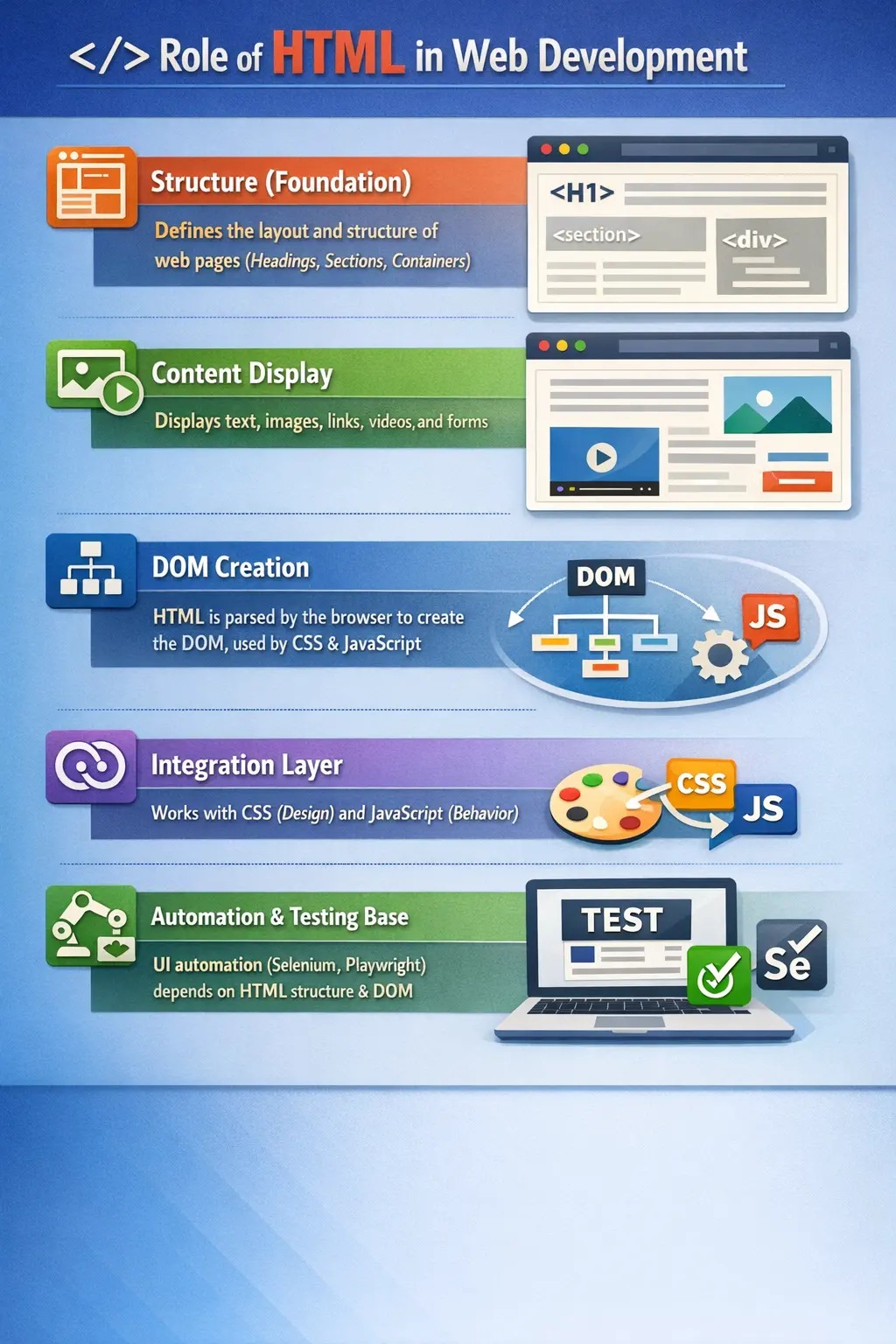
Understanding the role of HTML is not just important for frontend developers—it is equally critical for backend developers, testers, and automation engineers. HTML is the entry point into the web, the layer that connects users to applications, and the medium through which all other technologies operate. Without HTML, there is no web page, no structure, and no meaningful interaction.
HTML as the Structural Backbone
At its most fundamental level, HTML provides the structure of a webpage. It organizes content into logical sections such as headers, navigation areas, main content blocks, and footers. These structural elements create a hierarchy that both browsers and developers can understand.
When a browser loads a webpage, it does not interpret raw text arbitrarily. Instead, it relies on HTML tags to determine how content should be arranged. Headings define importance, paragraphs define textual content, and containers group related elements together. This structured representation ensures that content is displayed in a coherent and predictable manner.
Without HTML, a webpage would be nothing more than unstructured data. There would be no distinction between headings and paragraphs, no organization of sections, and no meaningful layout. HTML transforms raw content into a structured document that can be rendered effectively.
Enabling Content Representation
HTML is responsible for representing all forms of content on the web. Whether it is text, images, links, videos, or forms, HTML provides the necessary elements to display and organize that content.
Textual content is represented using elements like headings and paragraphs, while multimedia content is embedded using tags designed specifically for images, audio, and video. Hyperlinks connect different pages, allowing users to navigate seamlessly across the web.
This ability to represent diverse types of content makes HTML incredibly versatile. It acts as a universal language that browsers can interpret, ensuring that content is accessible and understandable across different platforms and devices.
Creation of the DOM: The Core of Web Interaction
One of the most critical roles of HTML is its involvement in creating the Document Object Model (DOM). When a browser receives an HTML document, it parses the content and constructs a tree-like structure known as the DOM.
The DOM represents the entire webpage as a hierarchy of nodes, where each HTML element becomes an object that can be accessed and manipulated. This structure serves as the foundation for both CSS and JavaScript.
CSS uses the DOM to apply styles to elements, while JavaScript interacts with the DOM to add dynamic behavior. Without HTML, there would be no DOM, and without the DOM, there would be no way to style or manipulate the page programmatically.
In essence, HTML is the starting point of all browser-side processing. It initiates the creation of the DOM, which then becomes the central interface for all further operations.
Providing Semantic Meaning
Beyond structure, HTML also provides semantic meaning to content. Semantic elements describe the purpose of the content they enclose, making it easier for both humans and machines to understand the page.
For example, elements like <article>, <nav>, and <header> convey specific meanings about the content they contain. This is different from generic containers, which provide structure but no inherent meaning.
Semantic HTML improves code readability, making it easier for developers to understand the intent behind different sections of the page. It also plays a crucial role in accessibility, as assistive technologies such as screen readers rely on semantic elements to interpret content correctly.
Furthermore, search engines use semantic HTML to understand the context of a webpage, which directly impacts search engine optimization (SEO).
Foundation for CSS and JavaScript
HTML does not operate in isolation. It works in conjunction with CSS and JavaScript to create complete web applications. While HTML defines the structure, CSS enhances the appearance, and JavaScript adds behavior.
CSS targets HTML elements to apply styles such as colors, layouts, and fonts. JavaScript interacts with HTML elements to handle events, update content dynamically, and implement complex functionality.
Without HTML, there would be nothing for CSS to style or JavaScript to manipulate. It acts as the base layer upon which all other technologies depend. This interdependence highlights the importance of HTML in the overall web development stack.
Enabling Navigation and Connectivity
The concept of the web itself is built on the idea of interconnected documents. HTML enables this connectivity through hyperlinks. By linking one page to another, HTML creates a network of information that users can navigate seamlessly.
Hyperlinks are the foundation of the World Wide Web. They allow users to move between pages, access external resources, and explore content without boundaries. This interconnected structure is what makes the web dynamic and accessible.
Navigation menus, internal links, and external references all rely on HTML to function. Without it, the web would lose its interconnected nature and become a collection of isolated documents.
Supporting User Interaction Through Forms
Modern web applications are not just about displaying content—they are also about interacting with users. HTML plays a crucial role in enabling this interaction through forms and input elements.
Forms allow users to enter data, which can then be processed by the application. Whether it is a login page, a registration form, or a search bar, HTML provides the necessary elements to capture user input.
These elements include text fields, buttons, checkboxes, and dropdowns, all of which are defined using HTML. This capability is essential for building interactive applications that respond to user actions.
Without HTML forms, user interaction would be severely limited, and web applications would lose much of their functionality.
Enhancing SEO (Search Engine Optimization)
Search engines rely heavily on HTML to understand and index web pages. The structure and semantics of HTML play a significant role in determining how content is ranked in search results.
Elements such as headings, meta tags, and semantic tags provide valuable information about the content of a page. Proper use of these elements helps search engines interpret the page more accurately, improving its visibility.
Well-structured HTML not only enhances SEO but also improves user experience. Clear headings, organized content, and meaningful structure make it easier for users to navigate and understand the page.
Ensuring Accessibility
Accessibility is a critical aspect of modern web development, and HTML plays a key role in making web content accessible to all users, including those with disabilities.
Features such as alternative text for images, labels for form inputs, and semantic elements help assistive technologies interpret content correctly. Screen readers, for example, rely on HTML structure to provide meaningful output to visually impaired users.
By using HTML correctly, developers can create inclusive applications that are usable by a wider audience. This is not only a best practice but also a requirement in many regulatory environments.
Universal Compatibility Across Devices
One of the greatest strengths of HTML is its platform independence. HTML works across all browsers and devices, from desktops and laptops to smartphones and tablets.
This universal compatibility ensures that web content can be accessed by anyone, regardless of their device or operating system. It provides a consistent experience, making the web a truly global platform.
Responsive design techniques, combined with HTML structure, allow developers to create applications that adapt to different screen sizes and resolutions.
HTML as an Integration Layer
HTML serves as an integration layer that connects various components of a web application. It links external resources such as CSS files, JavaScript scripts, and multimedia content.
It also acts as a bridge between the frontend and backend, enabling data exchange through forms and APIs. This integration capability makes HTML a central component in the architecture of web applications.
By bringing together different technologies and resources, HTML enables the creation of rich and dynamic user experiences.
Importance in Testing and Automation
From a testing and automation perspective, HTML is extremely important. Automation tools such as Selenium and Playwright rely on the HTML structure of a webpage to locate and interact with elements.
Locators such as XPath and CSS selectors are based entirely on HTML attributes and structure. If the HTML is poorly structured or inconsistent, automation scripts become unstable and difficult to maintain.
This makes HTML knowledge essential for QA engineers and SDETs. Understanding how elements are defined and structured allows testers to create reliable and efficient automation scripts.
Real-World Perspective
In real-world applications, HTML is not just a technical requirement—it is a strategic component of web development. It influences performance, accessibility, SEO, and maintainability.
A well-structured HTML document leads to better user experience, improved search rankings, and more stable automation. Conversely, poorly written HTML can cause rendering issues, accessibility problems, and fragile test scripts.
This highlights the importance of treating HTML as more than just a basic skill. It is a critical part of building high-quality web applications.
Interview Perspective
In interviews, candidates are often asked to explain the role of HTML in web development. A strong answer should emphasize that HTML provides the structure of a webpage, enables browser rendering, and serves as the foundation for CSS and JavaScript.
Candidates may also be asked about the DOM, semantic HTML, and the importance of HTML in SEO and accessibility. Demonstrating a clear understanding of these concepts shows a strong grasp of web fundamentals.
Key Takeaway
HTML is the foundation of web development. It defines the structure of web pages, enables content representation, and acts as the starting point for styling, interactivity, and testing.
Its role extends beyond simple markup—it influences how applications are built, how users interact with them, and how they are discovered and accessed. By mastering HTML, developers and testers gain a deeper understanding of the web and the ability to build more effective and reliable applications.
In essence, HTML is not just a language—it is the backbone of the digital world.