HTML in Agile & Modern Development
In contemporary software engineering, HTML is no longer perceived as a static, one-time markup artifact. Instead, it functions as a living, evolving layer that participates actively in Agile workflows, component-driven architectures, and continuous delivery pipelines. While frameworks, APIs, and tooling have grown increasingly sophisticated, HTML remains the foundational layer that ultimately defines what users see and interact with. In Agile environments—where speed, feedback, and collaboration are paramount—HTML plays a critical role in bridging design intent, development execution, and testing validation.
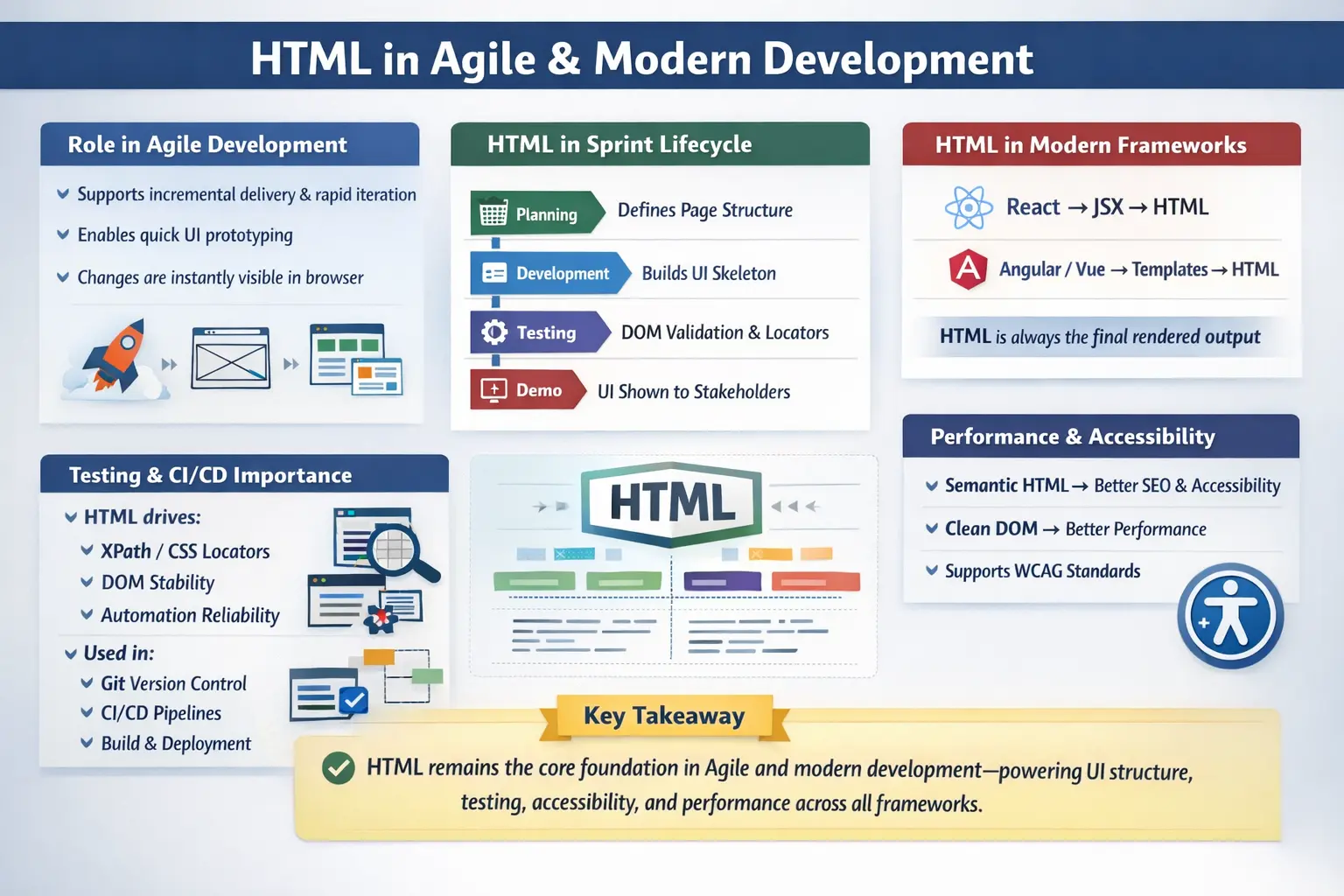
At its core, HTML provides structure. But in modern development, structure is not merely a static blueprint; it is a dynamic contract between multiple stakeholders. Developers rely on it to scaffold features, QA engineers depend on it for automation stability, designers align it with visual systems, and accessibility specialists use it to ensure inclusivity. Understanding HTML in this broader context is essential for building scalable, maintainable, and high-quality web applications.
HTML as an Active Participant in Agile Development
Agile methodologies emphasize iterative delivery, rapid feedback loops, and cross-functional collaboration. HTML naturally aligns with these principles because it allows teams to visualize and validate user interfaces early in the development lifecycle. Unlike backend logic, which often remains invisible until fully integrated, HTML provides immediate, tangible output that stakeholders can review and refine.
During early iterations, HTML enables rapid prototyping. Developers can quickly create page skeletons and layout structures that represent the intended user experience. These prototypes can be shared with product owners and designers, facilitating early feedback and reducing the risk of misaligned expectations. Because HTML is lightweight and easy to modify, changes can be implemented quickly, supporting Agile’s emphasis on adaptability.
Moreover, HTML acts as a communication medium. Business analysts, designers, and testers may not share the same technical depth, but they can all interpret HTML structures. This shared understanding reduces ambiguity and fosters collaboration, making HTML a critical enabler of Agile practices.
HTML Across the Sprint Lifecycle
The role of HTML becomes even more apparent when examined across the different stages of a sprint. During sprint planning, user stories are broken down into actionable tasks. These tasks often include defining page layouts, identifying UI components, and structuring content hierarchies. HTML serves as the first concrete representation of these requirements, translating abstract user stories into tangible elements.
As development progresses, HTML forms the initial layer of implementation. Developers create semantic structures that define headers, navigation menus, content sections, and forms. This structural layer is essential because it provides the foundation upon which CSS and JavaScript build. Without a well-defined HTML structure, styling and interactivity become difficult to manage.
During testing, HTML becomes the primary interface for QA engineers. Automation tools interact with the DOM, which is derived directly from HTML. Testers inspect elements, validate their structure, and create locators using attributes such as id, class, or custom data attributes. A poorly structured HTML document can lead to unstable locators and flaky tests, highlighting the importance of clean and consistent markup.
In sprint reviews and demos, stakeholders evaluate the UI as rendered by the browser. What they see is ultimately HTML transformed into pixels. Feedback on layout, content hierarchy, and usability is based on this rendered output, reinforcing HTML’s role as the visible representation of the product.
HTML in Modern Frontend Frameworks
The rise of frameworks such as React, Angular, and Vue has introduced abstraction layers that may obscure direct interaction with HTML. However, these frameworks do not replace HTML; they generate and manipulate it. JSX in React, template syntax in Angular, and Vue’s declarative templates all compile down to HTML structures that the browser can interpret.
This abstraction can sometimes create the illusion that HTML is less important. In reality, the opposite is true. Developers must understand HTML semantics and structure to use these frameworks effectively. Misusing HTML within a framework can lead to accessibility issues, poor SEO performance, and inefficient rendering.
Even in highly dynamic applications, the browser ultimately renders HTML. The DOM remains the central structure for interaction, styling, and automation. Therefore, a strong understanding of HTML is indispensable, regardless of the framework being used.
Component-Based Development and HTML
Modern web development heavily relies on component-based architecture. Applications are built as collections of reusable components, each responsible for a specific piece of functionality. HTML plays a crucial role in defining these components.
Each component encapsulates a portion of the UI, including its structure, styling, and behavior. HTML defines the boundaries and hierarchy of these components. For example, elements such as <header>, <nav>, <section>, and <footer> provide semantic meaning and organizational clarity.
Component-based design also promotes reusability. A well-structured HTML component can be reused across multiple pages, reducing duplication and improving maintainability. This aligns with Agile principles by enabling faster development and easier iteration.
HTML in CI/CD Pipelines
In modern DevOps environments, HTML is integrated into continuous integration and continuous deployment pipelines. HTML files are version-controlled using systems like Git, ensuring that changes are tracked and can be reviewed collaboratively. Build tools process HTML alongside other assets, optimizing it for performance and compatibility.
Static site generators and server-side rendering frameworks rely heavily on HTML. They produce pre-rendered HTML pages that improve performance and SEO. During deployment, these pages are delivered to users as part of a seamless pipeline that ensures consistency across environments.
Because HTML is part of the build process, errors in markup can break deployments or cause rendering issues. This reinforces the need for validation and adherence to standards within Agile workflows.
HTML and Test Automation
From a testing perspective, HTML is the foundation of UI automation. Tools such as Selenium and Playwright interact directly with the DOM, which is constructed from HTML. The stability of automated tests depends heavily on the quality of the underlying HTML structure.
Well-designed HTML includes meaningful attributes that facilitate reliable element identification. For example, using custom attributes like data-test or data-testid allows testers to create robust locators that are less likely to break when UI changes occur.
Conversely, poorly structured HTML can lead to fragile tests. Frequent changes in class names or deeply nested elements can make locators unreliable, increasing maintenance overhead. In Agile environments, where changes are frequent, maintaining stable automation requires disciplined HTML design.
Accessibility and Compliance
Accessibility is a critical aspect of modern web development, and HTML plays a central role in achieving it. Semantic elements such as <nav>, <article>, and <button> convey meaning to assistive technologies, enabling users with disabilities to navigate and interact with applications effectively.
ARIA attributes further enhance accessibility by providing additional context where native semantics are insufficient. Agile teams often incorporate accessibility requirements into their definition of done, ensuring that HTML structures meet compliance standards such as WCAG.
Failure to use semantic HTML can result in poor accessibility, legal risks, and a diminished user experience. Therefore, accessibility considerations must be integrated into HTML design from the outset.
HTML and Performance Optimization
Performance is a key concern in modern applications, and HTML contributes significantly to rendering efficiency. A well-structured HTML document minimizes DOM complexity, reducing the computational cost of rendering and updates.
Techniques such as lazy loading, minimizing unnecessary elements, and avoiding deep nesting improve performance. Clean HTML also enhances the effectiveness of CSS and JavaScript, as simpler structures are easier to style and manipulate.
In the context of Core Web Vitals, HTML influences metrics such as Largest Contentful Paint (LCP) and First Contentful Paint (FCP). Optimizing HTML is therefore essential for delivering fast and responsive user experiences.
Collaboration Across Teams
HTML serves as a common language across various roles within a development team. Developers, testers, designers, and SEO specialists all interact with HTML in different ways, but they share a common understanding of its structure and purpose.
Designers use HTML to translate visual concepts into structured layouts. QA engineers rely on it for automation and validation. SEO specialists analyze it to ensure proper indexing and ranking. This shared interaction fosters collaboration and reduces communication gaps.
In Agile teams, where cross-functional collaboration is essential, HTML acts as a unifying layer that aligns different perspectives and expertise.
HTML in DevOps and Microfrontend Architectures
Modern architectures such as micro frontends further emphasize the importance of HTML. In these systems, different teams develop independent UI modules that are composed into a single application. HTML fragments from multiple sources are integrated to form the final interface.
APIs provide data, but HTML remains the medium through which this data is presented. Even in highly decoupled systems, HTML acts as the final presentation layer that users interact with.
Challenges in Modern Development
Despite its importance, HTML is often undervalued in modern development. Over-reliance on frameworks can lead to neglect of semantic structure, resulting in poor accessibility and SEO performance. Dynamic DOM manipulation can introduce complexity, making debugging and testing more difficult.
Inconsistent naming conventions and excessive nesting can further degrade maintainability. These challenges highlight the need for disciplined HTML practices, even in highly abstracted environments.
Best Practices for Agile Teams
To maximize the value of HTML in Agile development, teams should adopt best practices such as using semantic elements, maintaining clean and simple structures, and incorporating test-friendly attributes. Avoiding unnecessary complexity and ensuring accessibility compliance are also critical.
Regular code reviews and collaboration between developers and testers can help maintain high standards. By treating HTML as a first-class citizen, teams can improve quality, performance, and maintainability.
Real-World Insight
Even in the most advanced frameworks, HTML remains the final output rendered by the browser. Developers may write JSX or template syntax, but the browser ultimately processes HTML. Testers interact with the DOM derived from HTML, and users experience the UI built on it.
This reinforces a fundamental truth: no matter how advanced the tools, HTML is always present at the core of web applications.
Interview Perspective
In interviews, HTML’s role in Agile and modern development is often described as providing the structural foundation for UI components, enabling rapid iteration, and supporting collaboration across teams. It is also highlighted as critical for testing, accessibility, and performance optimization.
A strong answer emphasizes that HTML is not replaced by frameworks but rather abstracted and generated by them.
Key Takeaway
HTML is not just a markup language; it is a foundational layer that supports the entire web development ecosystem. In Agile environments, it enables rapid iteration, fosters collaboration, and ensures that applications are accessible, performant, and testable.
One-Line Insight
HTML remains the stable structural foundation in a rapidly evolving ecosystem of frameworks, tools, and architectures.