Evolution of HTML (HTML → HTML4 → XHTML → HTML5)
The evolution of HTML is a direct reflection of how the web itself has matured—from a simple medium for sharing static documents to a powerful platform capable of running complex, interactive, and highly dynamic applications. Each version of HTML was not merely an incremental update; it was a response to real-world limitations, emerging user expectations, and rapid advancements in browser capabilities. Understanding this evolution is essential not only for historical context but also for appreciating modern web standards, debugging legacy systems, and answering interview questions with depth and clarity.
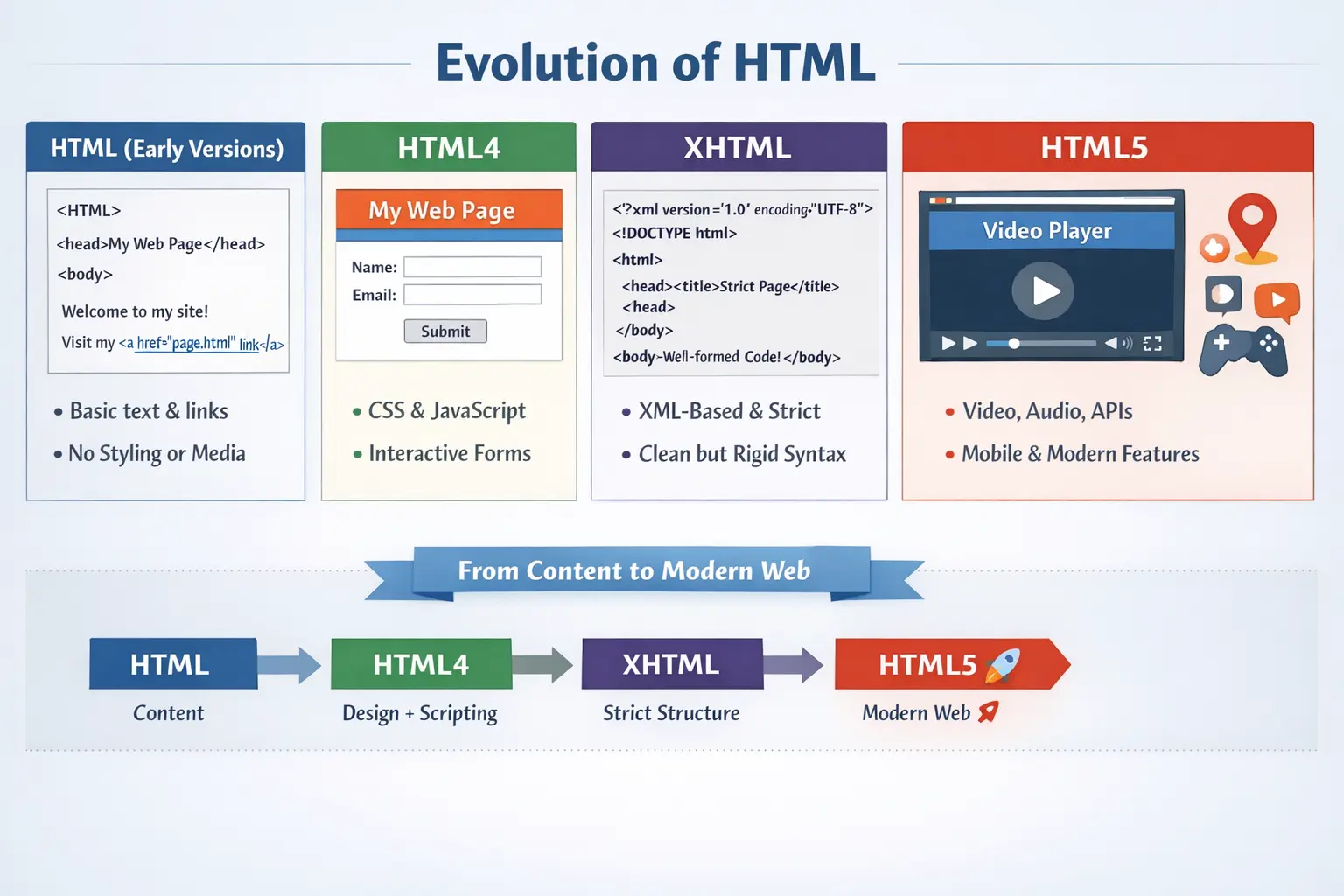
At its core, HTML has always served a single purpose: to define the structure of content on the web. However, how that structure is expressed, extended, and integrated with other technologies has changed significantly over time. The journey from early HTML to HTML5 represents a shift from simplicity to sophistication, from static pages to full-fledged web applications.
The Early Days of HTML (HTML 1.0 – HTML 3.2)
HTML began in the early 1990s, introduced by Tim Berners-Lee as part of the foundational technologies of the World Wide Web. At that time, the web was not designed for aesthetics or interactivity. Its sole purpose was to enable researchers and academics to share documents across different systems.
Early versions of HTML were extremely minimal. They included only a small set of tags such as paragraphs, headings, and links. These tags were sufficient to create basic documents but offered no control over styling or layout. There was no concept of colors, fonts, or positioning. The browser simply rendered content in a default format.
A typical early HTML page might consist of a paragraph and a hyperlink, with no visual differentiation beyond simple text formatting. There was no support for multimedia, meaning images, audio, and video were either absent or handled externally. There was also no scripting capability, so pages were entirely static.
This simplicity was both a strength and a limitation. On one hand, it ensured universal compatibility and ease of use. On the other hand, it severely restricted the ability to create engaging user experiences. As the web grew in popularity, these limitations became increasingly apparent.
The primary focus during this phase was content delivery. The idea of design or interaction had not yet entered the mainstream web development mindset.
HTML 4: The Rise of Styling and Interactivity (1997–1999)
As the internet expanded beyond academic use into commercial and consumer domains, the demand for more visually appealing and interactive websites increased. HTML 4 was introduced to address these needs and marked a significant shift in how web pages were built.
One of the most important advancements in HTML 4 was the introduction of support for CSS. This allowed developers to separate content from presentation, a concept that remains fundamental in modern web development. Instead of embedding styling directly within HTML using tags like <font>, developers could use CSS to control appearance.
HTML 4 also introduced improved support for forms, enabling user input and interaction. This was a critical step toward building dynamic web applications such as login systems, registration forms, and search functionalities.
Another major addition was the integration of JavaScript. While JavaScript existed independently, HTML 4 provided a standardized way to embed and interact with scripts, enabling client-side logic and interactivity.
Frames were also introduced, allowing developers to divide the browser window into multiple sections. While this feature was widely used at the time, it later became obsolete due to usability and accessibility issues.
Despite these advancements, HTML 4 had significant drawbacks. It allowed poor coding practices, such as mixing structure and presentation. Different browsers implemented HTML features inconsistently, leading to compatibility issues. Developers often had to write browser-specific code to achieve consistent results.
The focus of HTML 4 can be summarized as the transition from pure content to content combined with presentation and early interactivity.
XHTML: The Push for Strictness and Standardization (2000)
As HTML continued to evolve, its flexibility began to create problems. Developers often wrote inconsistent and poorly structured code, making it difficult for browsers to interpret pages reliably. To address these issues, XHTML was introduced as a stricter, more disciplined version of HTML.
XHTML was based on XML, a markup language designed for structured data. This meant that XHTML inherited XML’s strict syntax rules. All tags had to be properly closed, written in lowercase, and correctly nested. Attributes had to be quoted, and even minor errors could prevent a page from rendering correctly.
This strictness brought several advantages. XHTML encouraged clean, well-structured code that was easier to maintain and process. It also made web pages more predictable and machine-readable, which was beneficial for data exchange and integration.
However, these benefits came at a cost. XHTML was often too rigid for practical use. Developers found it unforgiving, as even small mistakes could break an entire page. Additionally, browser support for strict XML parsing was inconsistent, limiting its adoption.
As a result, XHTML never fully replaced HTML. Instead, it served as an important step in promoting better coding practices and highlighting the need for standardization.
The focus of XHTML was discipline—enforcing structure and consistency in a growing and increasingly complex web ecosystem.
HTML5: The Modern Web Platform (2014 – Present)
HTML5 represents the most significant evolution in the history of HTML. It was designed to address the shortcomings of previous versions while supporting the demands of modern web applications.
One of the key goals of HTML5 was to reduce reliance on external plugins such as Flash. Instead of requiring third-party tools for multimedia, HTML5 introduced native support for audio and video. This made it easier to embed rich media directly into web pages.
Another major advancement was the introduction of semantic elements. Tags such as <header>, <nav>, <article>, <section>, and <footer> provided meaningful structure to web pages. This improved readability, accessibility, and search engine optimization.
HTML5 also introduced new form input types, such as email, date, and number. These inputs enhanced user experience by providing built-in validation and better support for mobile devices.
In addition to structural improvements, HTML5 introduced powerful APIs. Features such as local storage, geolocation, canvas, and drag-and-drop enabled developers to build complex, interactive applications directly within the browser.
The doctype declaration was simplified, making it easier to write and understand HTML documents. At the same time, HTML5 maintained a flexible syntax, allowing developers to write code without the strict constraints of XHTML.
Perhaps most importantly, HTML5 was designed with mobile devices in mind. As smartphones and tablets became dominant, HTML5 ensured that web applications could adapt to different screen sizes and input methods.
The focus of HTML5 is clear: enabling modern, high-performance web applications with rich functionality and seamless user experiences.
Comparing the Evolution
Looking at the progression from early HTML to HTML5, it becomes clear that each version addressed specific challenges. Early HTML focused on content, HTML 4 introduced styling and interactivity, XHTML enforced discipline, and HTML5 combined flexibility with powerful features.
The evolution also reflects a shift in priorities. Initially, the goal was to share information. Later, it became important to present that information attractively. Eventually, the focus moved toward creating interactive and application-like experiences.
HTML5 stands out as the culmination of this evolution. It integrates the lessons learned from previous versions while providing a comprehensive platform for modern development.
Key Transition Insights
Each stage in the evolution of HTML represents a distinct phase in web development. Early HTML was about simplicity and accessibility. HTML 4 introduced complexity and visual appeal. XHTML emphasized structure and correctness. HTML5 brought everything together into a unified, flexible, and powerful standard.
This progression highlights an important principle: web technologies evolve in response to real-world needs. As user expectations grow, so do the capabilities of the tools used to build the web.
Real-World Impact of HTML Evolution
The introduction of HTML5 had a profound impact on the web. It eliminated the need for many external plugins, simplifying development and improving security. It enabled responsive design, allowing websites to adapt to different devices. It also made it possible to build single-page applications, which behave more like traditional desktop software.
For developers, HTML5 provided a richer set of tools and greater flexibility. For users, it delivered faster, more interactive, and more accessible experiences.
From a testing perspective, HTML5 also improved automation. Semantic elements and standardized structures make it easier to locate elements and write stable test scripts.
Interview Perspective
In interviews, understanding the evolution of HTML is often used to assess a candidate’s foundational knowledge. A strong answer should explain how HTML progressed from simple markup to a full-featured platform.
Candidates should emphasize the key differences between versions, the reasons behind each transition, and the impact on modern web development. Mentioning HTML5 features such as semantic tags, multimedia support, and APIs demonstrates a clear understanding of current standards.
Key Takeaway
The evolution of HTML is a story of continuous improvement. From basic document markup to a powerful application platform, HTML has adapted to meet the changing needs of the web.
HTML defines the structure, but its evolution defines the possibilities. By understanding how HTML has changed over time, developers and testers gain valuable insight into modern web technologies and best practices.
In one line, the journey can be summarized as follows: HTML began as a tool for sharing content, evolved through phases of styling and structure, and ultimately became HTML5—a comprehensive platform for building modern, interactive web applications.