Why API Testing Is Critical in Modern Applications
In contemporary software engineering, API testing has evolved from a specialized activity into a foundational discipline that underpins system reliability, scalability, and delivery speed. As applications have shifted from monolithic architectures to distributed, microservices-driven ecosystems, the role of APIs has expanded dramatically. Every meaningful interaction—whether between frontend and backend, between internal services, or with external platforms—flows through APIs. Consequently, validating these APIs is no longer optional; it is essential.
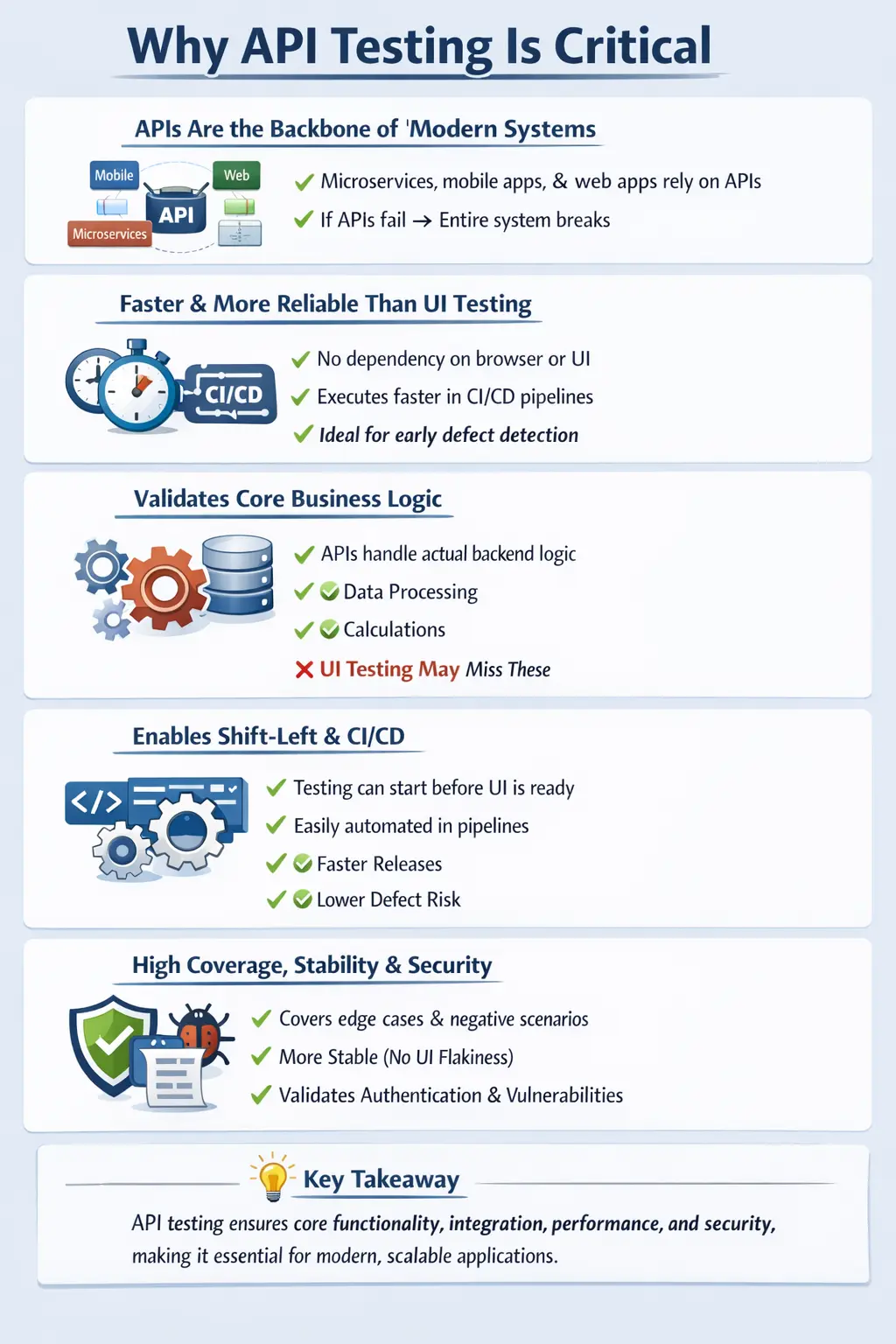
Why API Testing Became a Core Skill
API testing became a core skill because application behavior increasingly lives behind interfaces rather than only on screens. A user may see buttons, forms, dashboards, and messages, but the real business action often happens when the UI calls an API. Login, search, checkout, payment, profile update, report generation, file upload, order tracking, notification delivery, and data synchronization are usually powered by API calls. If those calls fail, the visible application fails.
This shift changed the role of testing. Earlier, many teams focused heavily on UI testing because the user interface was the most obvious place to validate behavior. UI testing is still important, but it is not enough for modern systems. The UI may hide defects, transform messages, or fail to expose important backend problems. API testing allows teams to validate the system closer to the business logic and integration layer, where many serious defects originate.
For testers, API testing provides a faster and more precise way to understand system quality. Instead of waiting for a page to load and then checking visible text, a tester can send a request directly to the service and inspect the response. This makes it easier to verify status codes, response structure, field values, authorization rules, error messages, and data consistency. API testing is therefore not only an automation skill; it is a way of thinking about system behavior at the service level.
API Defects Often Have High Business Impact
API defects can create serious business impact because APIs often support critical workflows. A broken authentication API can prevent users from logging in. A defective payment API can block revenue. A pricing API that calculates totals incorrectly can create financial loss. A notification API that fails silently can leave users uninformed. A data API that exposes the wrong records can create privacy and compliance problems.
The impact is greater because one API may serve multiple clients. The same backend API may be used by a website, mobile app, partner integration, admin portal, and internal automation process. If that API breaks, all connected clients may be affected at once. A UI defect may affect one screen, but an API defect can affect an entire ecosystem.
This is why API testing should focus on risk. Not every endpoint carries the same importance. Critical APIs that handle login, payment, orders, personal data, permissions, and business transactions deserve strong coverage. Testing these APIs early and continuously protects the most valuable parts of the application.
API Testing Finds Problems Before the UI Is Ready
One of the practical reasons API testing is critical is that it can begin before the user interface is complete. In many Agile projects, backend endpoints are developed before the final UI screens are ready. If testers wait for the UI, feedback is delayed. By testing APIs directly, QA teams can validate backend behavior while frontend development continues in parallel.
This helps sprint delivery. Suppose a team is building a registration flow. The UI may still be under design, but the registration API may already support user creation, email validation, duplicate checks, password rules, and response messages. Testers can validate these rules through API calls before the screen is finished. When the UI is later connected, many backend defects have already been removed.
This early feedback reduces rework. If an API returns the wrong error code or misses a required validation, the backend team can fix it before the frontend depends on that behavior. If the problem is found only during end-to-end UI testing, both frontend and backend teams may need to rework their code. API testing supports shift-left testing by finding service-level issues as soon as endpoints are available.
API Testing Strengthens Contract Reliability
An API is a contract between the provider and the consumer. The provider promises that certain endpoints, methods, request fields, response fields, status codes, and error formats will behave in a defined way. The consumer builds against that contract. If the provider changes the contract unexpectedly, consumers can break. API testing helps protect this contract.
For example, if a response field changes from userId to id, a mobile app may fail to read the value. If an API changes a success status from 201 to 200 without agreement, automated clients may behave differently. If an error response changes structure, frontend error handling may break. These issues are not always visible through basic UI testing, but API tests can detect them directly.
In microservices, contract reliability becomes even more important. One service may consume another service's API. A small incompatible change can break downstream services. Contract testing, schema validation, and backward compatibility checks help teams ensure that services can evolve safely. API testing is the practical mechanism that keeps contracts trustworthy.
API Testing Improves Debugging
When an end-to-end UI test fails, the failure may come from many places: browser timing, UI locator changes, frontend logic, API response, backend service, database, network, authentication, or test data. Debugging can be slow because the failure is observed at the surface. API testing narrows the investigation by checking the backend interface directly.
If an API test fails, the team can inspect the request, response, status code, headers, payload, logs, and backend behavior. This makes the defect easier to isolate. If the API returns the correct response but the UI displays the wrong value, the issue is likely in the frontend. If the API response itself is wrong, the issue is likely in backend logic, data mapping, or integration. This separation saves time.
API tests also make defects easier to reproduce. A tester can share the exact endpoint, method, headers, request body, and response. Developers can replay the request in Postman, curl, logs, or automated tests. Clear reproducibility improves defect resolution and reduces back-and-forth communication.
API Testing Supports Better Negative Testing
Negative testing is often easier and deeper at the API layer. A UI may prevent users from entering invalid input, but a direct API caller can still send invalid data. A secure and reliable backend must handle invalid requests even if the UI normally blocks them. API testing allows testers to bypass UI restrictions and test how the backend behaves under invalid, missing, malformed, or unauthorized inputs.
For example, a tester can send an empty request body, invalid data type, missing token, expired token, negative quantity, extremely long string, invalid date, unsupported currency, duplicate transaction ID, or unauthorized role. These tests confirm that the API validates input properly and returns meaningful errors instead of crashing or accepting bad data.
This is important because APIs may be consumed by mobile apps, external systems, automation scripts, or malicious users. The backend cannot rely only on the frontend to protect it. API testing helps ensure that validation rules are enforced where they matter most: at the service boundary.
API Testing Is Essential for Security
APIs are a major attack surface. They expose data and operations directly to clients, so weak API security can create serious risk. API testing helps verify authentication, authorization, sensitive data exposure, input validation, rate limiting, token handling, and error message safety. These checks are critical because attackers often target APIs directly rather than using the normal UI.
Authentication testing verifies whether only valid users can access protected endpoints. Authorization testing verifies whether users can access only the resources and actions allowed for their role. For example, a normal user should not be able to access admin APIs, update another user's profile, or retrieve someone else's order data by changing an ID in the request.
Security-focused API testing also checks whether error responses reveal internal information such as stack traces, database names, server paths, or implementation details. It checks whether invalid input is rejected safely. It checks whether tokens expire correctly and whether sensitive fields are hidden or masked. These validations protect both users and business systems.
API Testing Reduces Overdependence on UI Automation
UI automation is valuable, but too much reliance on UI automation can make a test suite slow and fragile. Browser tests depend on page rendering, locators, timing, animations, dynamic content, and browser behavior. API tests are usually faster, more stable, and easier to run frequently. A strong testing strategy moves many checks from the UI layer to the API layer where appropriate.
For example, instead of testing every validation rule through the UI, teams can validate many rules through API tests and keep a smaller number of UI tests for end-to-end user journeys. This follows the test pyramid principle. Unit tests cover small code units, API tests cover service and integration behavior, and UI tests cover critical user flows. This balance improves speed and reliability.
Reducing UI overload also improves maintenance. If a button locator changes, dozens of UI tests may fail even though the backend behavior is correct. API tests are not affected by such UI changes. This allows the automation suite to give more reliable feedback about actual business logic and integration behavior.
API Testing Helps Validate Data Integrity
Modern applications depend heavily on data consistency. API testing can validate whether data sent in a request is processed, transformed, stored, and returned correctly. It can check whether created records contain the right values, whether updates preserve existing fields, whether deleted records are handled properly, and whether related systems receive correct information.
For example, an order creation API may need to calculate subtotal, discount, tax, shipping, final amount, inventory update, payment status, and order confirmation. API testing can validate these details directly. A UI may show only the final amount, but API testing can inspect the full response and sometimes verify backend data through additional endpoints or database checks.
Data integrity defects are often serious because they can affect reports, billing, customer records, compliance, and downstream systems. API testing helps catch these issues closer to the data processing layer. This makes it an important part of quality control for business-critical systems.
API testing focuses on verifying the correctness, performance, security, and reliability of these interfaces. Unlike UI testing, which validates presentation and user interactions, API testing operates at the core of the system, where business logic resides. This positioning makes it uniquely powerful for detecting defects early, ensuring integration stability, and enabling rapid delivery cycles. To understand why API testing is critical, it is necessary to examine its role across architecture, development workflows, testing strategy, and real-world system behavior.
APIs as the Backbone of Modern Systems
Modern applications are fundamentally API-driven. In a microservices architecture, each service exposes its functionality through APIs, and all communication between services happens via these interfaces. Even in traditional web applications, the frontend is decoupled from the backend and interacts exclusively through APIs.
Consider a typical system:
- A web UI calls APIs to fetch and display data
- A mobile app consumes the same APIs for its interface
- Backend services communicate with each other through APIs
- External systems integrate using public or partner APIs
In this model, APIs are the single source of truth for system behavior. If an API fails, the entire system fails—regardless of how polished the UI appears. A login screen may render perfectly, but if the authentication API is broken, users cannot log in. Similarly, a payment page may look correct, but if the payment API fails, transactions cannot be processed.
This centrality makes API testing indispensable. It ensures that the backbone of the system—the APIs—remains stable, reliable, and correct under all conditions.
Faster Feedback Compared to UI Testing
One of the most compelling advantages of API testing is the speed at which it provides feedback. UI tests are inherently slower because they involve:
- Browser initialization
- DOM rendering
- Element interaction
- Synchronization and waits
API tests, by contrast, operate directly at the HTTP layer. They send requests and validate responses without any dependency on the UI. This results in significantly faster execution times.
In practical terms, this means:
- Hundreds of API tests can run in the time it takes to execute a handful of UI tests
- Failures are detected earlier in the development cycle
- Debugging is simpler because failures are isolated to backend logic
This speed makes API testing ideal for continuous integration pipelines, where rapid feedback is critical. Developers can receive immediate validation of their changes, reducing the time between defect introduction and detection.
Validation of Core Business Logic
APIs encapsulate the core business logic of an application. They handle data processing, enforce rules, manage workflows, and interact with databases. UI layers, on the other hand, primarily focus on presentation.
API testing directly validates:
- Data transformations and calculations
- Business rules and constraints
- Workflow correctness (e.g., order processing, approvals)
- Data persistence and retrieval
For example, in an e-commerce application:
- The UI displays product information
- The API calculates discounts, taxes, and totals
If the API incorrectly calculates a discount, the UI may still display the result without indicating an error. Only API testing can reliably detect such issues.
This depth of validation ensures that the system behaves correctly at its core, not just at its surface.
Enabling Shift-Left Testing
Shift-left testing emphasizes moving testing activities earlier in the development lifecycle. API testing plays a crucial role in this approach because APIs are often available before the UI is fully developed.
In Agile environments:
- Backend APIs are developed first
- Frontend development may lag behind
- QA teams can begin testing as soon as APIs are ready
This enables:
- Parallel development and testing
- Early detection of defects
- Reduced risk of late-stage surprises
By validating APIs early, teams can identify and fix issues before they propagate to the UI or downstream systems. This significantly reduces the cost and complexity of defect resolution.
Critical Role in Microservices Architecture
Microservices architecture introduces a new level of complexity. Instead of a single application, the system consists of multiple independent services, each responsible for a specific function. These services communicate exclusively through APIs.
In such environments, API testing ensures:
- Correct communication between services
- Data consistency across distributed components
- Proper handling of service dependencies
- Contract validation between producers and consumers
Without robust API testing, integration failures become inevitable. A change in one service can break another if the API contract is not respected. This is why techniques like contract testing (e.g., using tools like Pact) are often employed in microservices ecosystems.
API testing acts as the glue that holds distributed systems together, ensuring that all components interact correctly.
Support for Continuous Integration and Delivery (CI/CD)
Modern development practices rely heavily on CI/CD pipelines to automate build, test, and deployment processes. API testing integrates seamlessly into these pipelines due to its speed, reliability, and independence from UI layers.
In a typical pipeline:
- Code is committed to a repository
- Build is triggered
- API tests are executed automatically
- Results determine whether the build proceeds
API tests provide:
- Fast regression validation
- Immediate feedback on code changes
- Confidence for frequent deployments
Because API tests are deterministic and less prone to flakiness, they are well-suited for automated pipelines. This enables teams to achieve continuous delivery with high confidence.
Improved Test Coverage
API testing significantly enhances overall test coverage by enabling scenarios that are difficult or impossible to validate through the UI.
These include:
- Negative testing (invalid inputs, error conditions)
- Edge cases (boundary values, unusual combinations)
- Data validation (response structure, schema compliance)
- Error handling (status codes, messages)
- Security validations (authentication, authorization)
For example, testing how an API handles malformed input is straightforward, whereas simulating such scenarios through the UI may be complex or impractical.
By covering these deeper layers, API testing ensures a more comprehensive validation of the system.
Stability and Reduced Flakiness
UI tests are notoriously fragile. They can fail due to:
- Minor UI changes
- Timing issues (elements not yet loaded)
- Browser inconsistencies
- Dynamic content rendering
API tests, on the other hand, are:
- Independent of UI changes
- Less affected by timing issues
- Consistent across environments
This makes them more stable and easier to maintain. A stable test suite is critical for long-term automation success, as flaky tests erode confidence and increase maintenance effort.
Essential for Security Testing
APIs expose application data directly, making them a critical attack surface. Security vulnerabilities at the API level can lead to severe consequences, including data breaches and unauthorized access.
API testing helps validate:
- Authentication mechanisms (e.g., tokens, OAuth)
- Authorization rules (role-based access)
- Data exposure (sensitive information leaks)
- Input validation (preventing injection attacks)
Testing APIs against common vulnerabilities (such as those listed in OWASP Top 10) is essential for ensuring system security. Unlike UI testing, which may not expose all endpoints, API testing provides direct access to these critical interfaces.
Enabling Reliable Third-Party Integrations
Modern applications rarely operate in isolation. They integrate with external systems such as:
- Payment gateways
- Messaging services
- Mapping platforms
- Identity providers
These integrations are facilitated through APIs. API testing ensures that:
- External services are correctly integrated
- Responses are handled properly
- Failures are managed gracefully
For example, if a payment API fails, the system must handle the error without crashing or losing data. API testing validates these scenarios and ensures robustness in real-world conditions.
Real-World Impact of API Failures
The consequences of API failures can be severe and immediate. A single API defect can lead to:
- Payment failures in e-commerce systems
- Login issues in authentication services
- Data inconsistencies across systems
- Complete system outages
These failures directly impact user experience, business operations, and revenue. API testing acts as a safeguard against such high-impact defects by validating critical functionality before deployment.
Strategic Role in Test Pyramid
In the test automation pyramid, API tests occupy a critical middle layer:
- Unit tests validate individual components
- API tests validate integration and business logic
- UI tests validate end-to-end user experience
API testing provides the optimal balance between coverage and speed. It allows teams to validate complex scenarios without the overhead of UI testing, making it a cornerstone of an effective testing strategy.
Interview-Ready Summary
API testing is critical because it validates the core functionality of modern applications, including business logic, integrations, performance, and security. It provides faster and more reliable feedback than UI testing, supports CI/CD pipelines, enables shift-left testing, and ensures stability in microservices architectures.
Key Takeaway
API testing is not just another testing layer—it is the foundation of reliable software delivery. By validating the core interactions that power modern systems, it ensures that applications are robust, scalable, and ready for real-world usage.
One-Line Insight
👉 API testing ensures the system works where it matters most—at the core, not just at the surface.