What Is an API? (Application Programming Interface)
In modern software engineering, the term API (Application Programming Interface) appears everywhere—from web applications and mobile apps to cloud services and microservices architectures. Despite its frequent use, the concept is often misunderstood or oversimplified. At its core, an API is not just a technical construct; it is a contractual interface that defines how different software systems communicate with each other in a predictable, structured, and controlled manner. Understanding APIs deeply is essential for developers, testers, architects, and anyone involved in building or validating modern applications.
Why APIs Are Fundamental to Modern Software
APIs are fundamental because most modern applications are no longer built as one single, isolated program. A web application may have a frontend written in JavaScript, a backend written in Java or Node.js, a database running separately, an authentication service, a payment gateway, a notification service, cloud storage, and analytics integrations. These systems need a reliable way to talk to each other without knowing every internal detail. APIs provide that communication boundary.
Without APIs, each system would need to understand the internal structure of every other system it depends on. That creates tight coupling. If one team changes a database table, another application might break. If one service changes its internal code, multiple clients may need changes. APIs reduce this risk by exposing a stable contract. The client only needs to know what request to send and what response to expect. The server can change its internal implementation as long as the contract remains compatible.
This contract-based communication is what makes large software systems manageable. A mobile app does not need to know how a bank calculates account balance internally. It calls an API and receives structured data. An e-commerce website does not need to implement card processing itself. It calls a payment API. A weather app does not generate forecasts independently. It consumes weather data from an API. APIs allow software teams to build smaller pieces that work together through clear boundaries.
API as a Contract Between Systems
The most important way to understand an API is to think of it as a contract. A contract defines what is allowed, what is required, and what will be returned. In an API, this contract includes endpoint paths, supported methods, request parameters, headers, request body structure, authentication rules, response status codes, response body format, error messages, and sometimes rate limits or usage rules.
For example, an API contract may say that a client can send a GET request to /users/101 and receive user details in JSON format. It may also say that if the user does not exist, the response should return a 404 status code with a clear error body. If authentication is missing, the response should return 401. These rules make communication predictable. The client can write code confidently because it knows how the server is expected to behave.
Good API contracts also protect both sides from unnecessary dependency. The client does not need to know whether the server stores user data in MySQL, PostgreSQL, MongoDB, Redis, or another service. The server does not need to know whether the client is a web page, mobile app, automation framework, or third-party integration. The API contract is the shared agreement between them.
Request and Response Thinking
Most web APIs are understood through request and response thinking. A client sends a request to the API, and the server returns a response. The request contains the target endpoint, method, headers, optional parameters, and sometimes a body. The response contains a status code, headers, and usually a body with data or error details. This simple flow powers a large part of the modern internet.
Consider a login API. The client sends a username and password to an authentication endpoint. The server validates the credentials, checks user status, applies security rules, and returns either a success response with a token or an error response explaining why login failed. The frontend can then use the response to show the dashboard, display an error message, or ask the user to verify the account.
This request-response model is also why API testing is so direct. A tester can send a request without opening the UI and inspect the exact response. If the status code is wrong, the response schema is invalid, the data is incorrect, or the error message is unclear, the issue can be identified at the API layer. This makes API testing faster and more focused than relying only on browser-based validation.
APIs Hide Complexity
A good API hides unnecessary complexity from the client. The client should not need to understand how many database queries are executed, which internal services are called, how caching is handled, or how business rules are implemented. The client only needs the exposed interface. This is abstraction, and it is one of the main reasons APIs are powerful.
For example, a travel booking API may internally check flight availability, pricing, taxes, passenger rules, seat inventory, payment status, and ticket confirmation. The client may simply send a booking request and receive a booking confirmation or a clear failure response. The API hides the complex orchestration behind a manageable interface.
This abstraction supports maintainability. The backend team can improve internal performance, change database structure, introduce caching, or split functionality into microservices without forcing every client to change. As long as the public API contract remains stable, clients continue working. This separation is essential in large-scale systems.
APIs Enable Independent Development
APIs allow teams to work independently. A frontend team can build screens against a documented API contract while the backend team implements the service. A mobile team can consume the same endpoints used by a web application. A third-party partner can integrate with a public API without accessing internal code. This independence speeds up development and reduces coordination overhead.
In real projects, API contracts are often documented using tools such as OpenAPI or Swagger. These specifications describe endpoints, request bodies, response schemas, authentication rules, and examples. When documentation is accurate, testers and developers can understand API behavior without reading backend code. This makes onboarding easier and improves communication between teams.
Independent development does not mean no coordination. API changes must be managed carefully. If a backend team removes a field or changes a response format unexpectedly, clients may break. This is why API versioning, backward compatibility, deprecation policies, and contract testing are important in mature projects.
APIs in Layered Architecture
In a typical web application, the UI does not directly access the database. Instead, the UI calls backend APIs. The API layer receives the request, validates it, applies business logic, interacts with data sources, and returns the response. This layered structure improves security, maintainability, and scalability. It also creates clear points for testing.
For example, when a user updates a profile, the browser sends an API request to the backend. The backend checks authentication, validates input, applies business rules, updates the database, and returns the updated profile or an error. The UI displays the result. Each layer has a responsibility. The frontend handles presentation. The API handles communication and business access. The backend services handle logic and persistence.
This layered approach is important for testers. A defect visible in the UI may originate in the frontend, API, backend service, database, or integration. API testing helps isolate where the problem occurs. If the API returns correct data but the UI displays it incorrectly, the defect may be in the frontend. If the API returns wrong data, the issue is likely in backend logic, data handling, or service integration.
APIs and Security Boundaries
APIs are also security boundaries. They define who can access which functionality and under what conditions. Authentication confirms the identity of the caller. Authorization checks what the caller is allowed to do. Validation ensures that input is acceptable. Rate limiting protects against abuse. Logging and monitoring help detect suspicious activity.
A poorly secured API can expose sensitive data or allow unauthorized actions. For example, if a user can change another user's profile by modifying an ID in the request, the API has an authorization problem. If an API accepts unvalidated input, it may be vulnerable to injection attacks. If error responses expose internal stack traces, attackers may learn about system internals. These are serious API quality concerns.
Because APIs are often accessed directly by clients, testers must not assume that UI restrictions are enough. A button may be hidden in the UI, but a user might still call the API directly. API testing should verify authentication, authorization, input validation, error handling, and data exposure. Security is part of API quality.
APIs and Automation
APIs are highly suitable for automation because they are structured and predictable. API tests can send requests, validate status codes, compare response bodies, check schemas, verify headers, and confirm database effects. These tests usually run faster than UI tests because they do not need browser rendering, page loading, or visual interaction.
Automation engineers often use tools such as Postman, Newman, Rest Assured, Playwright API testing, Karate, or custom frameworks to validate APIs. They can create tests for positive flows, negative flows, boundary conditions, authentication, authorization, contract validation, performance basics, and data integrity. API automation provides strong feedback earlier in the testing pipeline.
API automation also supports test data setup. Instead of using the UI to create users, orders, or records before a test, automation can call APIs directly to prepare data. This makes UI tests faster and more reliable. In mature test frameworks, APIs are often used both as the system under test and as helpers for setup and cleanup.
What Makes a Good API?
A good API is predictable, consistent, secure, well-documented, versioned, and easy to consume. Endpoint names should be meaningful. HTTP methods should match the action. Response status codes should be appropriate. Error messages should be clear enough for clients to handle. Response schemas should be stable and documented. Authentication and authorization should be enforced consistently.
Consistency matters. If one endpoint returns errors in one format and another endpoint returns a completely different format, client handling becomes difficult. If one endpoint uses userId and another uses user_id without reason, confusion increases. If response fields appear and disappear unexpectedly, clients become fragile. Good API design reduces surprises.
Documentation is also part of API quality. Developers and testers should be able to understand how to call the API, what inputs are required, what responses are possible, and what errors mean. Undocumented APIs slow down integration and increase defects. Good documentation makes APIs easier to test, maintain, and adopt.
Common API Problems in Real Projects
Common API problems include incorrect status codes, missing validation, inconsistent response formats, unclear error messages, slow response times, broken authentication, weak authorization, missing required fields, incorrect data mapping, and poor backward compatibility. These issues may not always be visible immediately in the UI, but they can affect clients, integrations, and automation.
For example, an API may return 200 OK even when an operation fails. This makes client handling difficult because the frontend cannot rely on status codes. Another API may return sensitive internal information in error messages. Another may accept invalid data and create corrupted records. These problems show why API testing is essential.
API defects can have a wide impact because one API may serve many clients. A single broken endpoint can affect web users, mobile users, partners, and internal systems at the same time. This is why API reliability is critical in modern applications.
An API enables systems that may be built using different technologies, hosted on different platforms, and developed by different teams to interact seamlessly. Without APIs, modern distributed systems would collapse into tightly coupled, unmanageable codebases. APIs provide the abstraction layer that makes scalability, integration, and automation possible.
Core Definition of an API
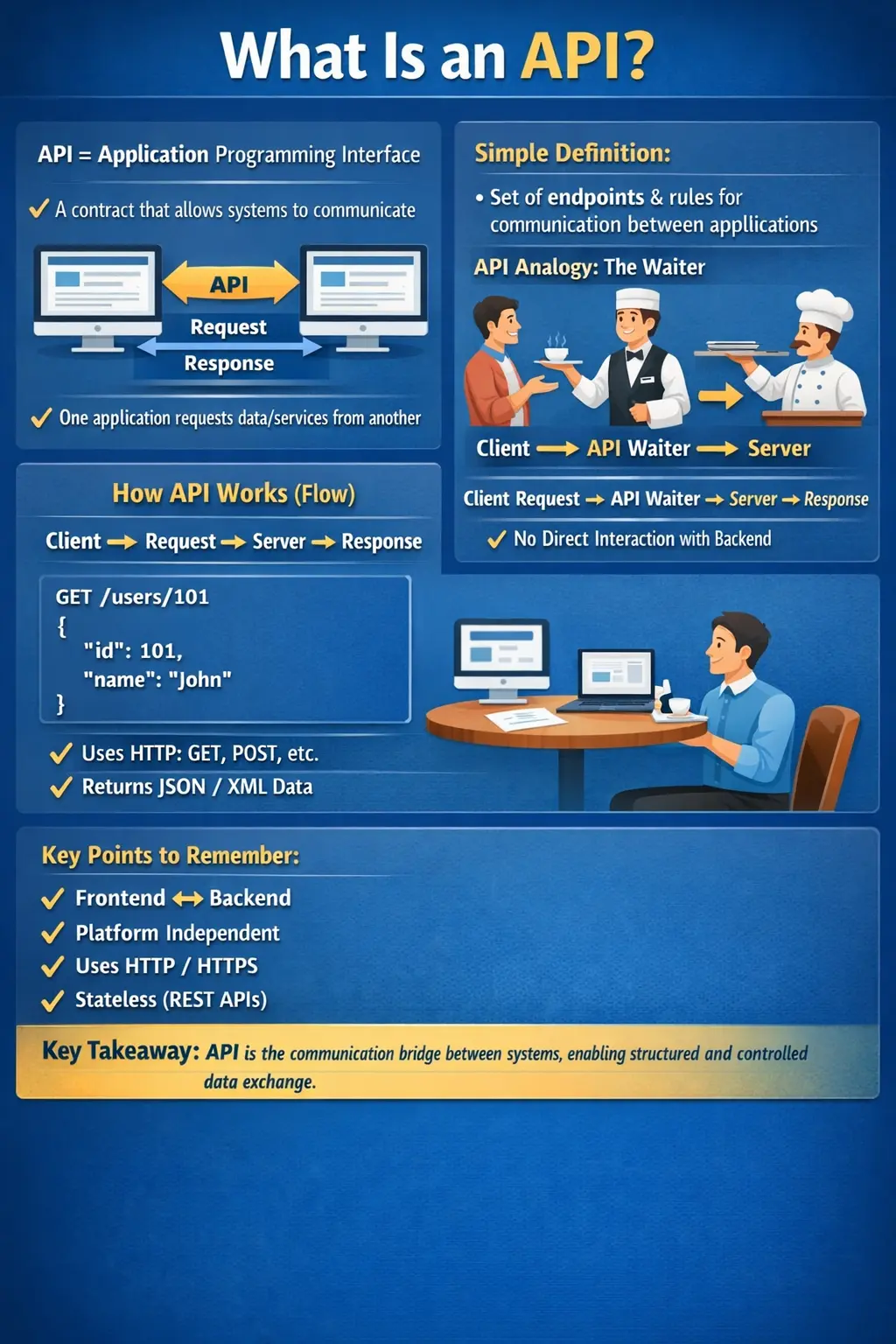
An API can be formally defined as a set of rules, protocols, and endpoints that allow one software application to request and consume functionality or data from another application. It acts as an intermediary layer that hides the internal implementation details of a system while exposing only what is necessary for interaction.
From an interview perspective, a concise definition would be:
👉 An API is a set of endpoints and rules through which one application communicates with another to request data or services.
This definition captures the essence of APIs: structured communication governed by predefined rules.
Real-World Analogy: The Restaurant Model
To understand APIs intuitively, consider a restaurant scenario. When you visit a restaurant, you do not go directly into the kitchen to prepare your food. Instead, you interact with a waiter.
In this analogy:
- You (the customer) represent the client
- The waiter represents the API
- The kitchen represents the server
You place an order with the waiter, who takes your request to the kitchen. The kitchen prepares the food and sends it back through the waiter, who delivers it to you. At no point do you interact directly with the kitchen or need to understand how the food is prepared.
Similarly, in software systems:
- The client sends a request
- The API processes and routes the request
- The server performs the operation
- The API returns the response
This abstraction is what makes APIs powerful. They allow systems to interact without exposing internal complexity.
Technical Breakdown: How APIs Work
At a technical level, APIs operate using a request–response model. This model defines how communication flows between systems.
1. Client (Consumer)
The client is the system that initiates the request. This could be:
- A web browser
- A mobile application
- A backend service
- An automation script (e.g., Rest Assured, Postman)
The client does not need to know how the server processes the request—it only needs to know how to call the API.
2. Server (Provider)
The server is responsible for:
- Receiving the request
- Processing business logic
- Interacting with databases or other services
- Sending back a response
The server implements the functionality that the API exposes.
3. API Layer
The API layer defines the contract between the client and the server. This includes:
- Endpoints (URLs): Where requests are sent
- HTTP Methods: What action to perform (GET, POST, PUT, DELETE)
- Data Format: How data is structured (JSON, XML)
- Authentication Rules: Who is allowed to access the API
- Validation Rules: What inputs are acceptable
This structured contract ensures that both client and server can evolve independently without breaking communication.
Example of an API Call (REST API)
Consider the following API request:
GET https://api.example.com/users/101
In this request:
- GET is the HTTP method indicating a read operation
- /users/101 is the endpoint specifying the resource
- The client is requesting data for user with ID 101
The server processes this request and returns a response, typically in JSON format:
{
  "id": 101,
  "name": "John",
  "email": "john@example.com"
}
This response is structured, predictable, and easy for the client to consume. The client does not need to know how the data was retrieved—whether from a database, cache, or another service.
Key Characteristics of APIs
APIs have several defining characteristics that make them essential in modern systems.
Interface-Based Communication
APIs provide an interface, not an implementation. Clients interact with the API without knowing how the backend works. This abstraction promotes loose coupling between systems.
Platform Independence
APIs enable communication between systems built using different technologies. For example:
- A Java backend can serve a React frontend
- A Python service can interact with a mobile app
- A Node.js API can integrate with a .NET system
This interoperability is critical in heterogeneous environments.
Standardized Protocols
Most APIs use standard protocols like HTTP or HTTPS. These protocols define how requests and responses are structured, ensuring consistency across systems.
Statelessness (in REST APIs)
In RESTful APIs, each request is independent. The server does not store client state between requests. This statelessness improves scalability and simplifies server design.
Reusability and Scalability
APIs can be reused across multiple clients and services. A single API can serve web apps, mobile apps, and third-party integrations simultaneously, making systems highly scalable.
Types of APIs
APIs come in different forms, each suited for specific use cases.
REST APIs
REST (Representational State Transfer) APIs are the most widely used. They:
- Use HTTP methods (GET, POST, PUT, DELETE)
- Typically return JSON
- Are stateless and scalable
REST APIs are the standard choice for web and mobile applications.
SOAP APIs
SOAP (Simple Object Access Protocol) APIs are:
- XML-based
- Highly structured
- Often used in enterprise systems requiring strict contracts
They are less common today but still used in legacy systems.
GraphQL APIs
GraphQL allows clients to request exactly the data they need. Instead of multiple endpoints, it uses a single endpoint with flexible queries.
gRPC APIs
gRPC is a high-performance API framework:
- Uses Protocol Buffers (binary format)
- Supports streaming
- Ideal for microservices communication
Each type has its strengths, but REST remains the most prevalent in modern development.
Why APIs Matter in Real Projects
APIs are the backbone of modern software architecture. They enable communication between different layers and services.
Frontend–Backend Communication
In web applications, the frontend (UI) interacts with the backend through APIs. For example:
- A React app calls an API to fetch user data
- The API returns JSON
- The UI renders the data
Without APIs, frontend and backend would be tightly coupled.
Mobile Applications
Mobile apps rely heavily on APIs to fetch and send data. For example:
- Login authentication
- Fetching user profiles
- Submitting transactions
The app itself contains minimal logic; most functionality is exposed via APIs.
Microservices Architecture
In microservices, applications are split into smaller, independent services. These services communicate exclusively through APIs.
For example:
- User Service → handles authentication
- Order Service → manages orders
- Payment Service → processes payments
APIs act as the glue that connects these services.
Third-Party Integrations
APIs enable integration with external systems such as:
- Payment gateways (Stripe, PayPal)
- Maps (Google Maps API)
- Authentication (OAuth, social login)
These integrations would be impossible without standardized APIs.
APIs in Testing and Automation
From a testing perspective, APIs are extremely important. API testing focuses on validating:
- Request correctness
- Response structure
- Data accuracy
- Performance
- Security
Tools like Postman, Rest Assured, and Playwright API testing are widely used.
API testing is often faster and more reliable than UI testing because it bypasses the frontend and directly interacts with the backend.
API Lifecycle and Governance
In enterprise environments, APIs are managed throughout their lifecycle:
- Design: Define endpoints and contracts
- Development: Implement business logic
- Testing: Validate functionality and performance
- Deployment: Release to production
- Versioning: Maintain backward compatibility
Proper governance ensures that APIs remain stable and scalable over time.
Common Misconceptions About APIs
There are several misconceptions about APIs that can lead to confusion.
One common myth is that APIs are only for web applications. In reality, APIs are used in desktop apps, operating systems, and even hardware communication.
Another misconception is that APIs always involve HTTP. While HTTP APIs are common, APIs can also use protocols like WebSockets, gRPC, or even local method calls.
Some also assume APIs expose internal logic, but in reality, APIs abstract and protect internal implementation details.
Interview-Ready Explanation
For interviews, it is important to provide both a short and detailed answer.
Short Answer:
An API is a set of endpoints and rules that allows one application to communicate with another to request data or services.
Detailed Answer:
An API acts as an interface between systems, enabling structured communication through defined endpoints, methods, and data formats. It follows a request–response model where the client sends a request, the server processes it, and the API returns a response. APIs are essential for frontend–backend interaction, microservices communication, and third-party integrations.
Key Takeaway
An API is fundamentally a communication bridge between systems. It enables applications to exchange data and functionality in a controlled, structured, and scalable manner. By abstracting complexity and enforcing contracts, APIs make modern software architecture possible.
One-Line Insight
👉 An API is the contract that enables systems to communicate without exposing their internal implementation.