Why HTML Is Still Relevant in Modern Web Applications
In an era dominated by sophisticated JavaScript frameworks, microservices architectures, and cloud-native deployments, it is easy to assume that foundational technologies like HTML have become less important. Tools such as React, Angular, and Vue often abstract away the direct writing of HTML, giving the impression that developers no longer need to think in terms of markup. However, this perception is fundamentally misleading. Despite all modern abstractions, HTML remains the backbone of every web application. It is not just relevant—it is indispensable.
To understand why HTML continues to hold such a central role, it is necessary to examine how modern web applications actually function. Regardless of how complex the frontend stack becomes, every application ultimately delivers content to the browser in the form of HTML. The browser does not understand React components, Angular directives, or Vue templates. It understands only three core technologies: HTML, CSS, and JavaScript. Among these, HTML is the structural foundation—the entry point from which everything else begins.
HTML as the Final Output of Every Web Application
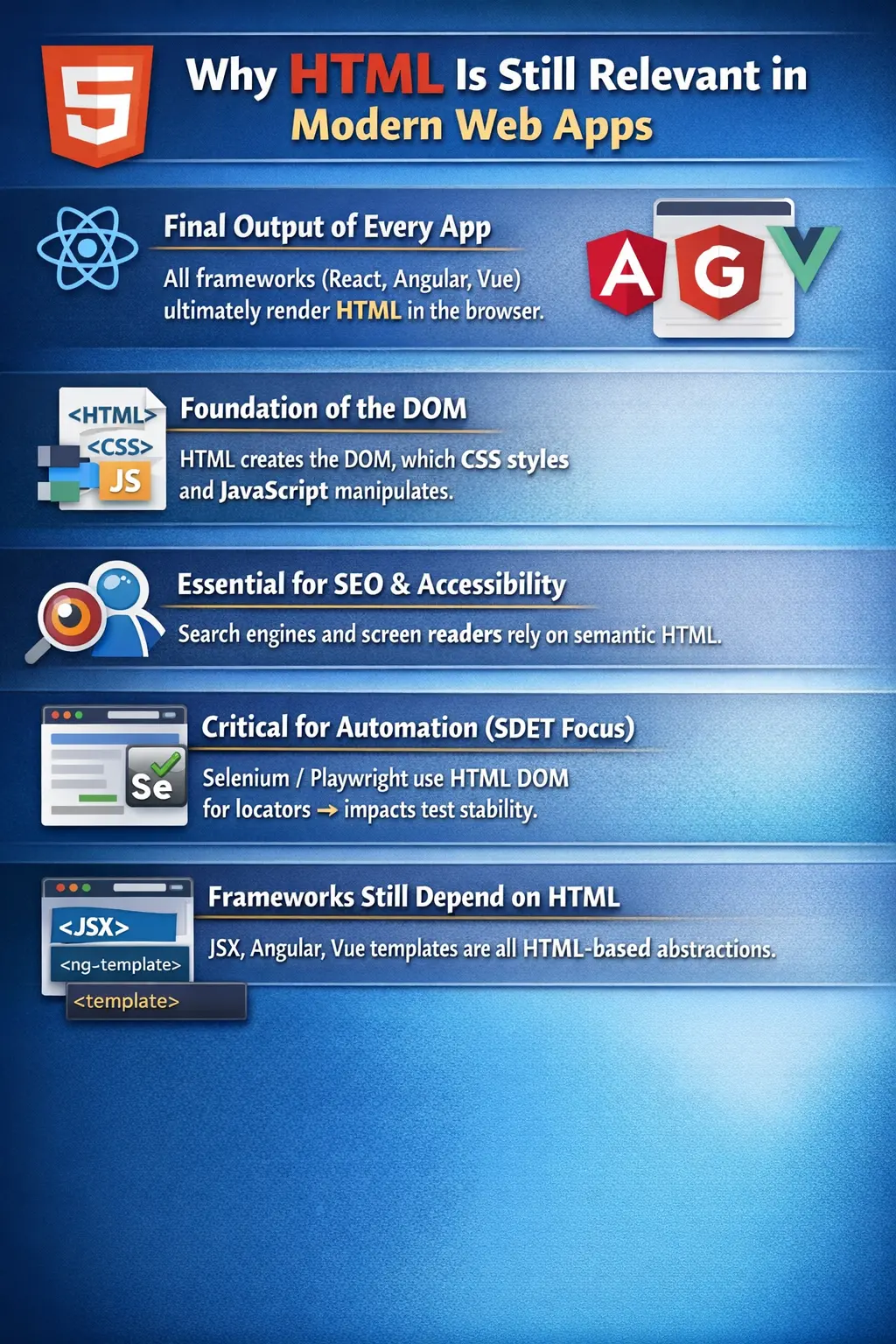
Modern frameworks may change how developers write code, but they do not change what browsers consume. Whether a developer writes JSX in React, templates in Angular, or components in Vue, the end result is always HTML rendered in the browser.
In React, JSX syntax looks like a hybrid between JavaScript and HTML, but under the hood, it is transformed into JavaScript function calls that ultimately generate DOM elements. Angular compiles its templates into efficient instructions that produce HTML structures. Vue follows a similar approach, compiling templates into render functions that manipulate the DOM.
In all these cases, the abstraction layer exists only during development. At runtime, the browser receives and renders HTML. This is a critical point: no matter how advanced the framework, HTML is always the final output. Without HTML, there is nothing for the browser to display.
This reality reinforces a simple but powerful truth—HTML is not optional. It is the medium through which all visual content is delivered.
The Foundation of the DOM
The Document Object Model, commonly referred to as the DOM, is the internal representation of a web page within the browser. It is constructed by parsing HTML. Every element, attribute, and piece of content defined in HTML becomes a node in the DOM tree.
This DOM serves as the central interface for both CSS and JavaScript. CSS uses the DOM to apply styles, determining how elements appear on the screen. JavaScript interacts with the DOM to create dynamic behavior, such as responding to user input, updating content, or triggering animations.
Automation tools like Selenium and Playwright also rely heavily on the DOM. They locate elements using selectors derived from HTML structure, such as XPath or CSS selectors. If the HTML is poorly structured or inconsistent, automation becomes unstable and difficult to maintain.
Thus, HTML is not just about structure—it is the foundation upon which the entire web application operates. Without HTML, there is no DOM, and without the DOM, there is no styling, no interactivity, and no automation.
HTML and Search Engine Optimization (SEO)
Search engines rely primarily on HTML to understand and index web content. When a search engine crawler visits a webpage, it parses the HTML to extract meaningful information. This includes headings, metadata, links, and structured content.
Semantic HTML plays a crucial role in this process. Tags such as <h1>, <article>, <section>, and <meta> provide context and meaning, helping search engines interpret the importance and relevance of content. Poorly structured HTML can lead to incorrect indexing or reduced visibility in search results.
Even in applications built with modern frameworks, SEO considerations often require server-side rendering or pre-rendering to ensure that HTML content is available to crawlers. This highlights another important point: regardless of the technology stack, effective SEO always depends on well-structured HTML.
In competitive digital environments, where visibility directly impacts business outcomes, HTML remains a key factor in achieving search engine success.
Accessibility and Inclusive Design
Accessibility is an essential aspect of modern web development, ensuring that applications are usable by individuals with disabilities. HTML plays a central role in enabling accessibility.
Screen readers and assistive technologies rely on semantic HTML to interpret and navigate content. Elements such as <nav>, <button>, <label>, and <form> provide meaningful context, allowing users to understand and interact with the application effectively.
Proper use of attributes like alt for images and label for form inputs further enhances accessibility. Without these elements, assistive technologies struggle to convey information accurately, leading to a poor user experience.
Frameworks may provide tools and components to support accessibility, but they ultimately depend on underlying HTML semantics. Developers who lack a strong understanding of HTML often create applications that are difficult or impossible to use for certain groups of users.
Thus, HTML is not only a technical requirement but also a critical component of inclusive design.
Performance and Rendering Efficiency
Performance is a key concern in modern web applications, especially with the growing importance of metrics such as Core Web Vitals. HTML has a direct impact on performance, particularly during the initial page load.
When a browser receives an HTML document, it begins parsing it immediately to construct the DOM. The complexity and size of the HTML structure influence how quickly this process occurs. Clean, well-organized HTML results in faster parsing and rendering, while bloated or poorly structured HTML can slow down performance.
Server-side rendering (SSR) further emphasizes the importance of HTML. By delivering fully rendered HTML from the server, applications can provide faster initial load times and improved user experience, especially on slower devices or networks.
In performance-critical applications, HTML is often optimized to reduce unnecessary elements, minimize nesting, and improve overall efficiency. These optimizations demonstrate that HTML is not just a passive structure but an active contributor to application performance.
The Backbone of UI Automation
From a testing and automation perspective, HTML is absolutely critical. Tools like Selenium, Playwright, and Cypress interact with web applications by targeting elements in the DOM. These elements are defined by HTML.
Selectors such as XPath and CSS are derived directly from HTML structure. Attributes like id, class, name, and custom data attributes are used to locate elements reliably. If the HTML is inconsistent, overly dynamic, or poorly structured, automation scripts become fragile and prone to failure.
This is a common challenge in real-world projects. Applications with unstable HTML structures often result in flaky tests, increased maintenance effort, and reduced confidence in automation.
Conversely, well-structured HTML leads to stable, maintainable automation frameworks. For SDET professionals, understanding HTML is not optional—it is essential for designing robust test strategies.
Frameworks Still Depend on HTML Concepts
Modern frameworks may abstract HTML, but they do not eliminate it. In fact, they are built on HTML concepts.
React’s JSX syntax closely resembles HTML, allowing developers to define UI components in a familiar structure. Angular templates extend HTML with additional directives and bindings. Vue templates also use HTML as their foundation.
These abstractions enhance productivity but do not replace the need for HTML knowledge. Developers must still understand how elements are structured, how attributes work, and how the DOM behaves.
Without this understanding, it becomes difficult to debug issues, optimize performance, or design effective automation strategies. Frameworks may change the way HTML is written, but they do not change its importance.
Progressive Enhancement and Resilience
HTML enables the concept of progressive enhancement, where a basic level of functionality is provided using HTML alone, and additional features are layered on using CSS and JavaScript.
This approach ensures that applications remain usable even in environments where JavaScript is disabled or limited. It also improves resilience, allowing applications to degrade gracefully under constrained conditions.
In critical applications, such as government or healthcare systems, this reliability is particularly important. HTML provides the baseline functionality that ensures accessibility and usability across a wide range of scenarios.
Forms and Data Interaction
User interaction in web applications often begins with HTML forms. Whether it is logging in, registering, searching, or making a purchase, HTML forms serve as the primary interface for data input.
These forms define input fields, validation rules, and submission mechanisms. Even when JavaScript enhances form behavior, the underlying structure remains rooted in HTML.
This makes HTML a key component in both frontend and backend communication. Data submitted through forms is processed by servers, making HTML an integral part of the application lifecycle.
Universal Standardization and Compatibility
One of HTML’s greatest strengths is its universality. It is supported by all browsers, across all devices, and remains backward compatible with older versions.
This consistency ensures that web applications can reach a global audience without requiring platform-specific adaptations. Whether a user accesses a site on a desktop, tablet, or smartphone, HTML provides a reliable foundation for rendering content.
In a rapidly evolving technological landscape, this stability is invaluable. It allows developers to build applications with confidence, knowing that HTML will continue to function as expected.
Real-World Perspective
In practical terms, every modern web application—regardless of its complexity—relies on HTML. Components in a React application eventually render as HTML elements. Angular and Vue follow the same pattern.
Browsers display HTML. Automation tools interact with HTML. Search engines index HTML. Accessibility tools interpret HTML.
Even when developers do not write HTML directly, they are still working with it indirectly. This makes HTML an unavoidable and essential part of web development.
Common Misconceptions
A common misconception is that modern frameworks have replaced HTML. In reality, they have only abstracted it. These frameworks generate HTML dynamically, but they do not eliminate its role.
Understanding this distinction is crucial. Developers who rely solely on framework abstractions often struggle when faced with debugging or optimization tasks that require knowledge of the underlying HTML structure.
Conclusion
HTML remains relevant because it is the foundation upon which the entire web is built. It defines structure, enables rendering, supports accessibility, drives SEO, and serves as the backbone for automation and performance optimization.
Modern tools and frameworks may change how developers interact with HTML, but they do not replace it. Instead, they build upon it, extending its capabilities while relying on its fundamental principles.
In essence, HTML is the constant in an ever-changing technological landscape. It is the language that browsers understand, the structure that applications depend on, and the foundation that developers must master.
Interview-Ready Summary
HTML remains relevant because it is the core structural language of the web. It forms the DOM, enables SEO and accessibility, supports performance optimization, and serves as the base for styling, interactivity, and automation.
One-Line Insight
Modern frameworks may abstract HTML, but they never replace it—they depend on it completely.