Static vs Dynamic Web Pages
The distinction between static and dynamic web pages is one of the most fundamental concepts in web development. It defines how content is created, delivered, and experienced by users. At a high level, the difference lies in whether the content of a webpage remains fixed or changes at runtime based on data, user interaction, or system logic. This concept not only influences how websites are built but also impacts performance, scalability, security, and testing strategies.
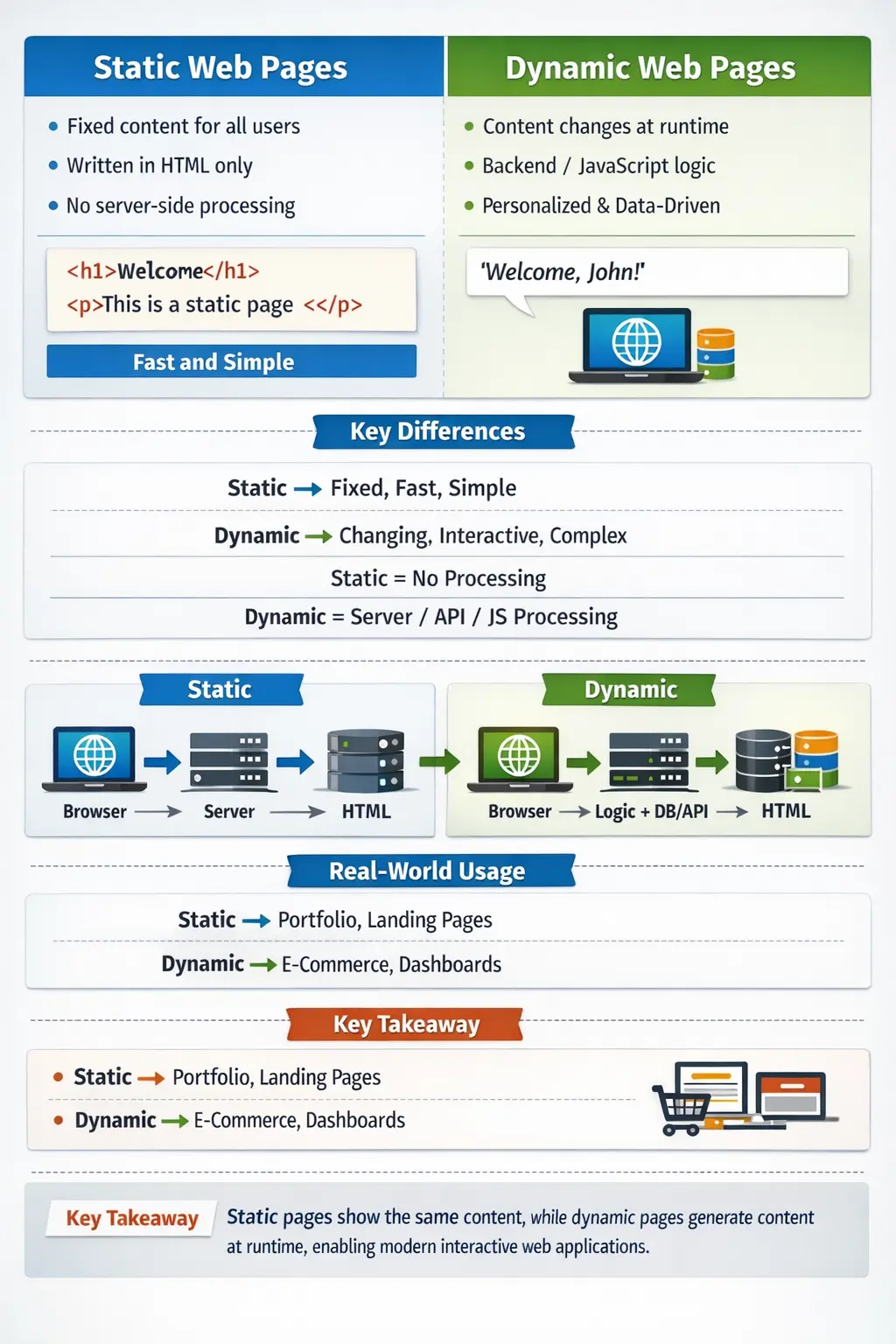
Understanding static versus dynamic web pages is essential for developers, testers, and architects because it forms the basis of how modern web applications function. Even though today’s applications are often hybrid in nature, combining both approaches, the foundational distinction remains critical for making informed design and implementation decisions.
What Is a Static Web Page?
A static web page is a webpage that delivers fixed content to the user. The content is pre-written in HTML and does not change unless the developer manually updates the file. When a user requests a static page, the server simply retrieves the HTML file and sends it directly to the browser without any processing or modification.
A basic example of a static page looks like this:
<!DOCTYPE html>
<html>
<body>
    <h1>Welcome</h1>
    <p>This is a static page</p>
</body>
</html>
Every user who accesses this page will see exactly the same content. There is no personalization, no data fetching, and no runtime logic involved.
Static web pages are simple by design. They rely entirely on HTML (and optionally CSS) to define structure and presentation. Because there is no server-side computation or database interaction, the response time is extremely fast.
Characteristics of Static Web Pages
Static web pages are defined by their simplicity and predictability. The content is hardcoded into HTML files, meaning there is no dependency on external systems such as databases or APIs. This makes them highly reliable and easy to deploy.
Another important characteristic is performance. Since the server does not perform any processing, static pages are served almost instantly. This makes them ideal for scenarios where speed is critical.
Security is also a major advantage. Because there is no backend logic or database interaction, the attack surface is significantly reduced. There are fewer opportunities for vulnerabilities such as SQL injection or server-side exploits.
However, the simplicity of static pages also limits their capabilities. They cannot adapt to user input, display personalized content, or handle complex workflows. This makes them unsuitable for modern applications that require dynamic behavior.
What Is a Dynamic Web Page?
A dynamic web page is a webpage whose content is generated at runtime. Unlike static pages, dynamic pages do not rely solely on pre-written HTML. Instead, they use logic—either on the server side or client side—to create content based on various factors such as user input, database data, or API responses.
For example, a dynamic page might display personalized content like:
<h1>Welcome, John</h1>
<p>Your last login: Today</p>
In this case, the content is not fixed. It changes depending on the user, the time, or other contextual data.
Dynamic pages are the foundation of modern web applications. They enable features such as user authentication, dashboards, e-commerce functionality, and real-time updates.
Characteristics of Dynamic Web Pages
Dynamic web pages are defined by their flexibility and intelligence. They can adapt to different users, display real-time data, and respond to interactions. This is achieved through a combination of server-side and client-side technologies.
Server-side processing involves generating HTML on the server using programming languages such as Java, Node.js, or PHP. Client-side processing, on the other hand, uses JavaScript frameworks like React, Angular, or Vue to update the page dynamically in the browser.
Dynamic pages often rely on external data sources such as databases or APIs. This allows them to present up-to-date information and support complex business logic.
However, this flexibility comes with increased complexity. Dynamic pages require more infrastructure, more code, and more maintenance. They are also slightly slower than static pages due to the additional processing involved.
Core Differences Between Static and Dynamic Pages
The fundamental difference between static and dynamic web pages lies in how content is generated and delivered. Static pages provide the same content to every user, while dynamic pages generate content based on data and context.
Static pages are simple, fast, and secure but lack flexibility. Dynamic pages are powerful and adaptable but require more resources and careful design.
From a technical perspective, static pages do not require server-side processing, while dynamic pages often depend on backend logic and data sources. This distinction influences everything from architecture to deployment strategies.
How Static and Dynamic Pages Work Internally
The internal workflow of static and dynamic pages highlights their differences clearly. When a static page is requested, the browser sends a request to the server, and the server responds by sending the HTML file directly. The browser then renders the page.
In contrast, dynamic pages involve multiple steps. The browser sends a request to the server, which processes the request using business logic. The server may interact with databases or APIs, generate HTML dynamically, and then send the result back to the browser.
In client-side dynamic applications, the initial HTML is often minimal. JavaScript then fetches data from APIs and updates the DOM dynamically, creating a highly interactive experience.
Types of Dynamic Web Pages
Dynamic web pages can be broadly categorized into server-side and client-side dynamic pages.
Server-side dynamic pages generate HTML on the server before sending it to the browser. This approach is commonly used in traditional web applications and frameworks like Spring, Node.js, and PHP.
Client-side dynamic pages rely on JavaScript to update the content after the page has loaded. This is the foundation of Single Page Applications (SPAs), where the page does not reload but updates dynamically based on user interactions.
Both approaches have their advantages and are often combined in modern architectures.
Real-World Examples
Static web pages are commonly used for simple websites such as portfolios, documentation sites, and landing pages. These pages do not require user interaction or real-time data, making them ideal for static implementation.
Dynamic web pages, on the other hand, power complex applications such as e-commerce platforms, social media feeds, and banking dashboards. These applications require real-time data, personalization, and interactive features.
For example, an Amazon product page is dynamic because it displays different content based on user preferences, inventory, and recommendations. Similarly, a Facebook feed is dynamic because it updates continuously with new posts and interactions.
Advantages and Disadvantages
Static web pages offer several advantages, including speed, simplicity, and security. They are easy to develop and deploy, making them suitable for small projects and content-driven websites.
However, they lack scalability and cannot handle complex use cases. Any change requires manual updates, which can be time-consuming for large websites.
Dynamic web pages provide flexibility, scalability, and personalization. They can handle complex workflows and integrate with multiple data sources. This makes them ideal for modern applications.
The downside is increased complexity. Dynamic pages require backend systems, databases, and additional infrastructure. They are also more challenging to test and maintain.
Modern Reality: Hybrid Applications
In today’s web development landscape, most applications are neither purely static nor purely dynamic. Instead, they are hybrid, combining the strengths of both approaches.
For example, a website may use static HTML for initial loading and then fetch dynamic data using JavaScript. Server-Side Rendering (SSR) is another hybrid approach where the initial HTML is generated on the server, and subsequent updates are handled on the client side.
This hybrid model provides the best of both worlds: fast initial load times and dynamic interactivity.
Testing Perspective (Critical Insight)
From a testing standpoint, the difference between static and dynamic pages is highly significant. Static pages are easier to test because the DOM structure remains consistent. Test scripts can reliably locate elements without worrying about changes.
Dynamic pages, however, introduce complexity. The DOM may change based on user actions or asynchronous data loading. This requires testers to use synchronization techniques such as explicit waits in tools like Selenium or Playwright.
Dynamic applications also involve additional challenges such as handling AJAX calls, validating API responses, and ensuring consistency across different states.
For QA and SDET professionals, understanding dynamic behavior is essential for building robust and reliable test automation frameworks.
Common Misconceptions
One common misconception is that static pages are outdated. In reality, they are still widely used and are highly effective for specific use cases. Another misconception is that dynamic pages are always better. While they offer more functionality, they also introduce complexity and overhead.
It is important to choose the right approach based on the requirements of the application rather than assuming one is superior to the other.
Interview Perspective
In interviews, candidates are often asked to explain the difference between static and dynamic web pages. A strong answer should clearly define both concepts and highlight their key differences.
It is also beneficial to provide examples and explain real-world use cases. Demonstrating an understanding of how these concepts apply to modern applications and testing scenarios can significantly strengthen the response.
Key Takeaway
Static and dynamic web pages represent two fundamental approaches to delivering web content. Static pages provide fixed, fast, and secure content, while dynamic pages enable personalized, data-driven, and interactive experiences.
Modern applications often combine both approaches to achieve optimal performance and functionality. Understanding this distinction is essential for designing scalable systems, building efficient applications, and implementing effective testing strategies.
One-Line Difference
Static web pages deliver the same content to every user, while dynamic web pages generate content at runtime based on data, logic, or user interaction.