HTML vs CSS vs JavaScript
Modern web development is built on a powerful and well-defined trio of technologies: HTML, CSS, and JavaScript. These three form the core foundation of every web application, from the simplest static webpage to the most complex enterprise systems. While they often work together seamlessly, each technology has a distinct responsibility. Understanding this separation is not just important-it is essential for designing scalable applications, debugging issues effectively, and building reliable automation frameworks.
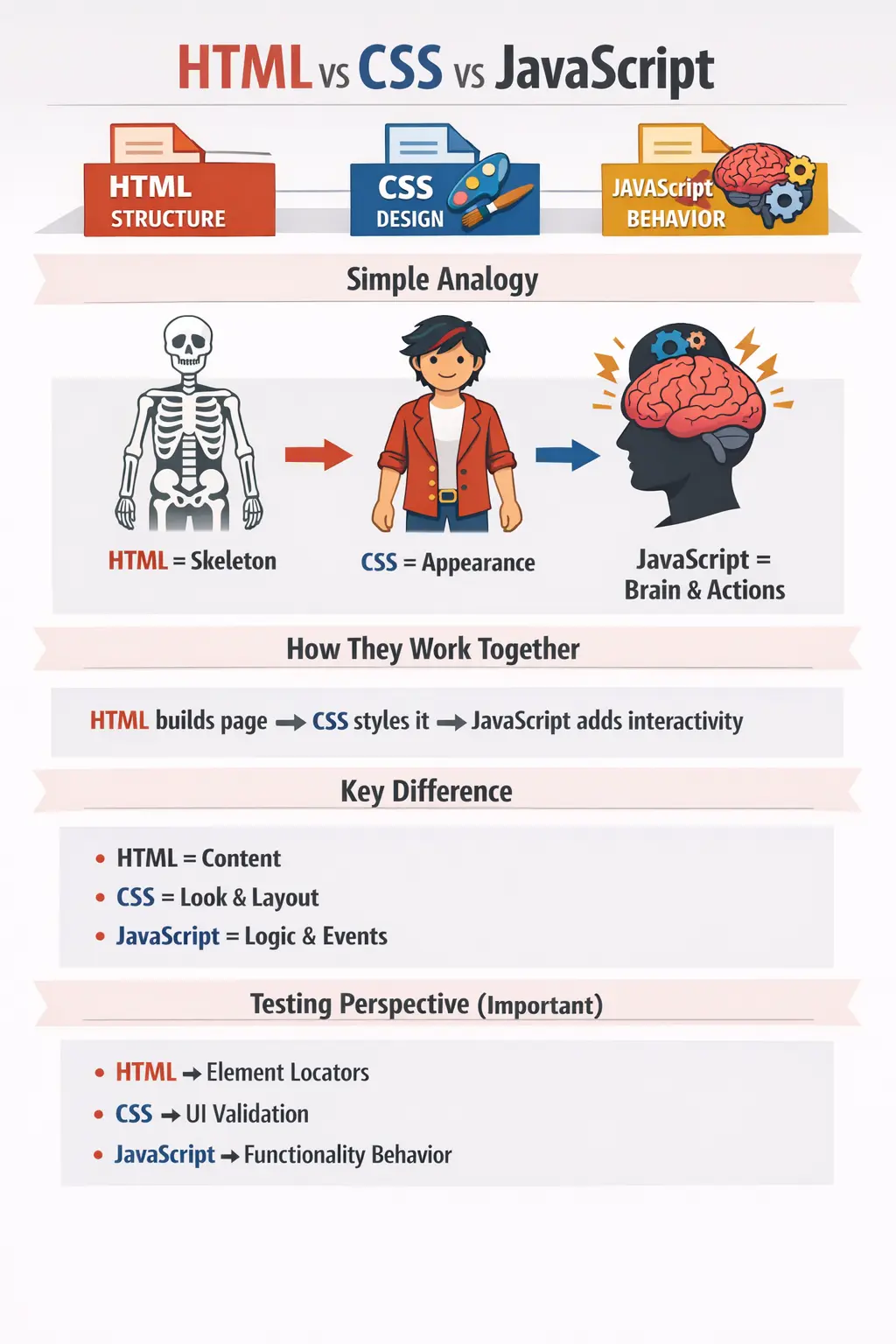
At a high level, HTML defines what exists, CSS defines how it looks, and JavaScript defines how it behaves. This separation of concerns is a fundamental principle in web development. When these responsibilities are clearly maintained, applications become easier to build, maintain, and test.
The Core Definitions
To understand how these technologies differ, it is important to start with their core definitions. HTML, or HyperText Markup Language, is responsible for structuring the content of a webpage. It defines elements such as headings, paragraphs, images, and forms. CSS, or Cascading Style Sheets, is used to control the visual presentation of that content, including layout, colors, fonts, and responsiveness. JavaScript, on the other hand, is a programming language that adds logic and interactivity, enabling dynamic behavior such as event handling, API calls, and DOM manipulation.
These definitions may seem simple, but they represent a powerful architectural separation. Each technology operates at a different layer, and together they form a complete web application.
A Simple Analogy for High Recall
A useful way to understand the relationship between HTML, CSS, and JavaScript is through a real-world analogy. Imagine a webpage as a human body. HTML acts as the skeleton, providing the structure and framework. CSS is like the skin and appearance, defining how the body looks. JavaScript functions as the brain and muscles, enabling movement and interaction.
Without the skeleton, there is no structure. Without the skin, there is no visual identity. Without the brain and muscles, there is no functionality. Similarly, a webpage requires all three technologies to be complete and functional.
HTML: The Structure Layer
HTML is the starting point of every webpage. It defines the structure and organizes content into meaningful elements. These elements include headings, paragraphs, lists, images, links, and forms. Each element plays a specific role in shaping the layout and meaning of the page.
When a browser loads an HTML document, it parses the content and creates the Document Object Model (DOM). The DOM is a hierarchical representation of the page, where each HTML element becomes a node in the tree. This structure serves as the foundation for both CSS and JavaScript.
HTML also provides semantic meaning to content. Elements such as <header>, <article>, and <nav> help describe the purpose of different sections, improving readability, accessibility, and search engine optimization.
Without HTML, there is no content to display. It is the blueprint that defines what the webpage contains.
CSS: The Presentation Layer
While HTML defines structure, CSS is responsible for presentation. It controls how HTML elements are displayed on the screen, including their layout, colors, fonts, spacing, and responsiveness.
CSS allows developers to separate design from structure. This means that the same HTML content can be styled in different ways without changing the underlying structure. This separation improves maintainability and enables consistent design across multiple pages.
CSS also plays a crucial role in responsive design. By using techniques such as media queries and flexible layouts, developers can ensure that webpages adapt to different screen sizes and devices.
Without CSS, webpages would appear plain and unstyled. Content would still exist, but it would lack visual appeal and usability.
JavaScript: The Behavior Layer
JavaScript is the layer that brings web pages to life. It adds interactivity and dynamic behavior, enabling users to interact with the application in meaningful ways.
Through JavaScript, developers can respond to user actions such as clicks, form submissions, and keyboard input. It allows for real-time updates, animations, and communication with backend services through APIs.
JavaScript interacts with the DOM created by HTML, allowing it to modify content, change styles, and create new elements dynamically. This makes it a powerful tool for building interactive and responsive applications.
Without JavaScript, webpages would be static. Users could view content, but they would not be able to interact with it in a meaningful way.
How They Work Together
The true power of web development lies in how HTML, CSS, and JavaScript work together. The process begins with HTML defining the structure of the page. The browser then parses the HTML and creates the DOM. CSS is applied to this DOM to style the elements, and finally, JavaScript interacts with the DOM to add behavior.
This layered approach ensures that each technology performs its role independently while contributing to the overall functionality of the application. The result is a cohesive and dynamic user interface.
For example, a button on a webpage is defined using HTML. Its appearance is styled using CSS, and its click behavior is implemented using JavaScript. Each layer contributes to the final user experience.
Key Differences Between HTML, CSS, and JavaScript
Although these technologies work together, their differences are significant. HTML is a markup language, CSS is a style sheet language, and JavaScript is a programming language. HTML is responsible for structure, CSS for design, and JavaScript for logic.
HTML is parsed by the browser to create the DOM, CSS is applied during the rendering process to style the DOM, and JavaScript is executed by the browser's JavaScript engine to manipulate the DOM and handle events.
Another important distinction is dependency. HTML can exist independently, but CSS and JavaScript typically depend on HTML to function. Without HTML, there is nothing to style or manipulate.
Understanding these differences is crucial for designing and debugging web applications effectively.
Real-World Responsibilities
In real-world scenarios, each technology plays a specific role. Consider a login form. HTML defines the input fields and labels, CSS styles the layout and appearance, and JavaScript handles validation and submission logic.
Similarly, in a navigation menu, HTML defines the structure of the menu, CSS controls its layout and styling, and JavaScript enables dynamic behavior such as dropdowns and animations.
This clear separation of responsibilities ensures that each part of the application can be developed and maintained independently.
Perspective from Testing and Automation
From a QA and SDET perspective, understanding the distinction between HTML, CSS, and JavaScript is critical. Automation tools such as Selenium and Playwright rely heavily on the HTML structure to locate elements. Locators such as XPath and CSS selectors are based entirely on HTML.
CSS, while not directly tested in most cases, affects the visual layout and can influence UI validation. Issues in CSS may result in misaligned elements or poor user experience.
JavaScript drives dynamic behavior. Failures in JavaScript can lead to broken functionality, such as buttons not responding or data not loading correctly.
In automation testing, different types of failures can often be traced back to these layers. A missing HTML element results in locator failures, a CSS issue causes visual defects, and a JavaScript error leads to functional failures.
Understanding this separation helps testers identify the root cause of issues more efficiently.
Common Mistakes in Using These Technologies
One of the most common mistakes is mixing responsibilities. Developers sometimes use HTML for styling, which should be handled by CSS. Similarly, overusing JavaScript for tasks that can be achieved with HTML or CSS leads to unnecessary complexity.
Ignoring semantic HTML is another mistake. It not only affects readability but also impacts SEO and accessibility.
Another issue is overloading JavaScript with logic that could be handled more simply. Maintaining a clear separation of concerns is essential for building clean and maintainable code.
Importance of Separation of Concerns
The principle of separation of concerns is central to web development. By keeping structure, presentation, and behavior separate, developers can create modular and scalable applications.
This separation makes it easier to update one aspect of the application without affecting others. For example, changing the design of a webpage does not require modifying the HTML structure or JavaScript logic.
It also improves collaboration, as different team members can work on different layers simultaneously.
Interview Perspective
In interviews, candidates are often asked to explain the difference between HTML, CSS, and JavaScript. A strong answer should clearly define each technology and its role.
Candidates should emphasize that HTML provides structure, CSS controls presentation, and JavaScript adds behavior. They may also be asked about how these technologies interact and why separation of concerns is important.
Providing real-world examples and explaining their interaction demonstrates a deeper understanding.
Key Takeaway
HTML, CSS, and JavaScript form the foundation of modern web development. Each technology has a distinct role, but together they create complete and interactive web applications.
HTML defines what content exists, CSS determines how it looks, and JavaScript controls how it behaves. Maintaining this separation is essential for building scalable, maintainable, and efficient applications.
By mastering these three technologies and understanding how they work together, developers and testers gain the ability to create, analyze, and optimize web applications effectively.
In essence, this triad is not just a set of tools—it is the core architecture of the web itself.