API Testing vs Unit Testing
Introduction
In modern software development, quality assurance is not achieved through one testing technique. Reliable applications are protected by a layered testing strategy where each layer checks a different kind of risk. Unit testing and API testing are two of the most important layers in that strategy. They both help teams find defects early, but they do not test the same thing, they do not run at the same level, and they do not provide the same kind of confidence.
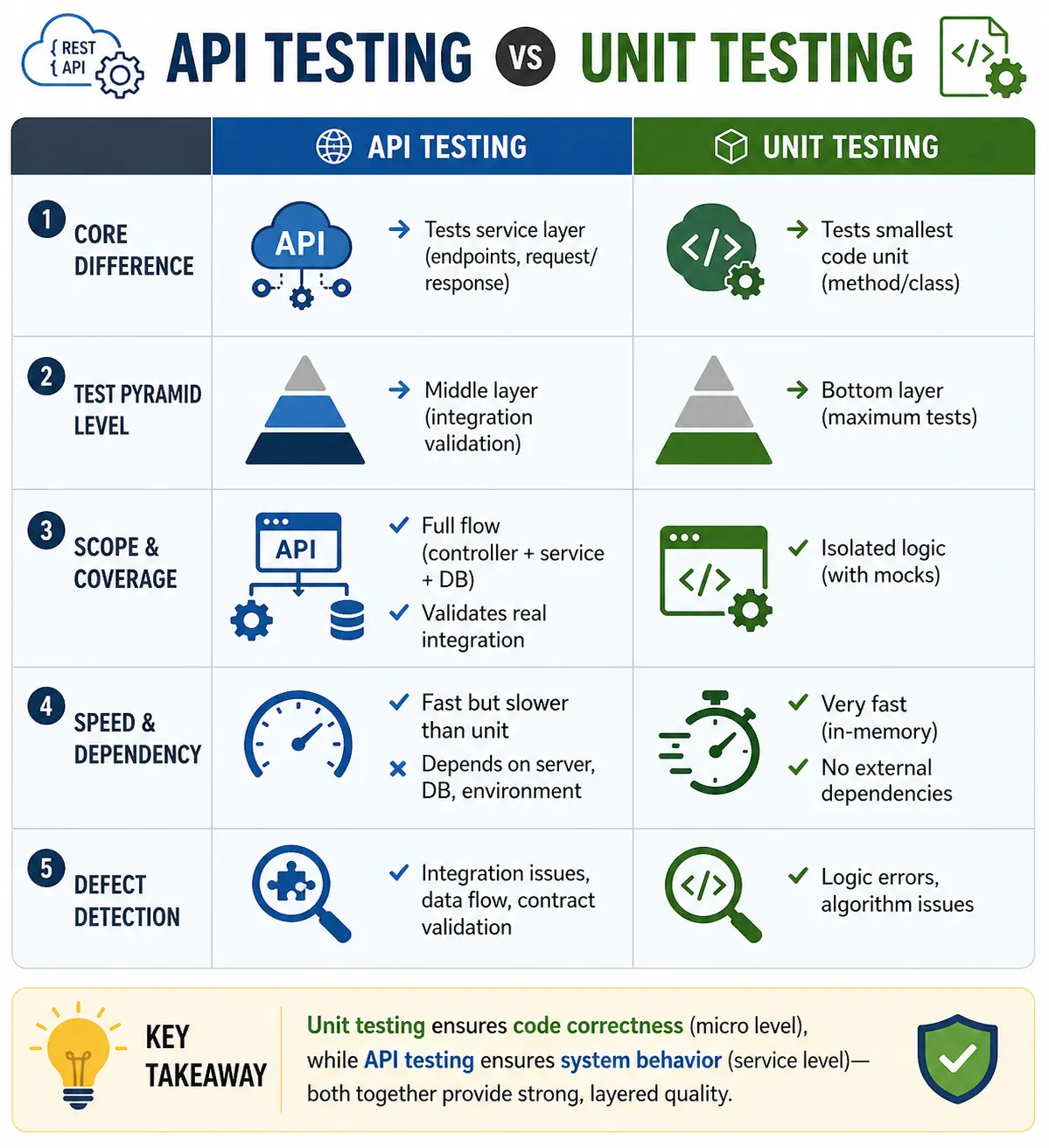
Unit testing works at the lowest practical level of application code. It checks individual methods, functions, classes, or small components in isolation. API testing works at the service boundary. It sends requests to application endpoints and verifies responses, contracts, status codes, payloads, authentication, business rules, and integration behavior. A unit test may prove that a discount calculation method returns the right value. An API test may prove that the order API applies that discount correctly when a real request is sent through the service layer.
This distinction matters for testers, developers, SDETs, and interview preparation. If a team relies only on unit tests, it may miss integration defects. If a team relies only on API tests, it may catch defects later than necessary and spend more time debugging. Good teams use both. Unit tests provide fast developer feedback at the code level. API tests provide broader confidence that application components work together through real service interfaces.
Core Definitions and Intent
Unit testing is the practice of testing the smallest meaningful units of code in isolation. A unit may be a method, function, class, validator, utility, calculation rule, mapper, or small service method. The purpose is to confirm that the unit behaves correctly for expected input, invalid input, boundary values, and edge cases. Dependencies are usually mocked or stubbed so the test focuses only on the logic being tested.
API testing is the practice of testing application behavior through API endpoints. A tester or automation script sends an HTTP request to an endpoint and validates the response. The API test may exercise several layers of the application: routing, controller logic, request validation, authentication, authorization, business logic, data access, database interaction, external service calls, and response formatting. The purpose is to confirm that the system behaves correctly from the consumer's point of view.
The simplest difference is this: unit testing asks whether a specific piece of code works correctly, while API testing asks whether the system behaves correctly when its components interact through an API. Unit testing is code-focused. API testing is behavior-focused at the service boundary. Both are necessary because applications fail in both places.
Position in the Test Pyramid
The test pyramid is a useful model for understanding where unit tests and API tests belong. Unit tests form the base of the pyramid. They are usually the most numerous tests because they are fast, cheap to run, and easy to execute during development. API tests sit in the middle layer. They are fewer than unit tests, but they validate broader system behavior. UI tests sit at the top. They are valuable but slower and more fragile because they depend on the browser, page rendering, visual layout, and user interface flows.
UI Tests
  |
API Tests
  |
Unit Tests
This model does not mean one layer is more important than another. It means each layer should be used for the risk it is best suited to handle. Unit tests are ideal for small logic checks. API tests are ideal for service behavior, contracts, and integration. UI tests are ideal for validating the user experience and end-to-end journeys. If a team puts every validation into UI tests, feedback becomes slow. If a team puts every validation into unit tests, integration defects can escape. API testing fills the critical middle layer.
In Agile and DevOps environments, this layered structure is especially useful. Unit tests can run on every code change. API tests can run after the service is built and deployed to a test environment. UI tests can run for the most important user journeys. This keeps feedback fast while still giving meaningful release confidence.
Scope and Coverage
The scope of unit testing is intentionally narrow. A unit test should focus on one small behavior. For example, a unit test may verify that a tax calculation method returns the correct tax for a given amount, that an email validator rejects an invalid email, or that a mapper converts an entity into a response object correctly. The test should not depend on the database, network, browser, file system, or external APIs unless the unit being tested specifically requires that dependency and the project design allows it.
API testing has a broader scope. An API test validates what happens when a consumer sends a real request to an endpoint. The request may travel through routing, validation, service logic, repositories, database queries, security filters, serializers, and response handlers. This gives API testing more realistic coverage of how the application behaves when used by a frontend, mobile app, partner system, or another microservice.
For example, unit tests may prove that a coupon discount rule works correctly in isolation. API tests can prove that POST /cart/apply-coupon accepts a valid coupon, rejects an expired coupon, blocks a coupon for the wrong user, updates the cart total correctly, returns the expected status code, and preserves the response contract expected by the frontend. This is a wider and more business-representative validation.
Isolation and Dependencies
Isolation is one of the strongest features of unit testing. A good unit test removes external uncertainty. If a class depends on a payment service, database repository, email sender, or time provider, the unit test often replaces those dependencies with mocks or stubs. This allows the test to focus only on the unit's own logic. When the test fails, the defect is usually close to the tested code.
API tests are less isolated. They need a running application or service. They may need environment configuration, test data, authentication tokens, database records, service dependencies, gateway routing, or mock external systems. This makes API tests more realistic, but also more complex. If an API test fails, the cause may be application logic, data setup, configuration, authentication, database state, serialization, service dependency, or environment instability.
This difference is not a weakness. It is the reason both test types exist. Unit tests reduce uncertainty to validate small code behavior. API tests intentionally include more real application behavior to validate whether components work together. The tradeoff is speed and simplicity versus realism and integration confidence.
Execution Speed
Unit tests are usually very fast. They run in memory, without starting a full server or making real network calls. A healthy codebase can run hundreds or thousands of unit tests quickly. This makes unit tests ideal for developer machines, pre-commit checks, and early CI pipeline stages. Fast unit tests encourage developers to run them frequently.
API tests are slower than unit tests because they usually involve HTTP request-response cycles, application startup or deployed environments, security filters, data access, serialization, and sometimes downstream dependencies. Even so, API tests are normally much faster than full UI tests because they bypass browser automation and visual rendering.
The practical strategy is to run unit tests first and often. API tests should run after the application is built and available in a test environment. A small API smoke suite can run on every build or deployment. A larger API regression suite can run on pull requests, nightly builds, or release candidates depending on size and execution time.
Types of Defects Unit Testing Finds
Unit testing is excellent for finding logic defects. If a calculation is wrong, a condition is reversed, a null value is not handled, a boundary case is missed, or a helper method formats data incorrectly, a unit test can catch the defect early. Because the test focuses on a small unit, the failure is usually easy to diagnose.
Unit tests are also useful for edge cases that would be expensive to create through an API. For example, a pricing function may need tests for zero amount, negative amount, very large amount, rounding behavior, tax-exempt items, multiple currencies, and decimal precision. Testing all of this only through API calls would be slower and harder to debug. Unit tests handle this kind of fine-grained validation better.
Another strength is developer feedback. Developers can write unit tests while writing the code. If a unit test fails, they can fix the logic immediately before integration begins. This reduces the cost of defects because the issue is found close to where it was introduced.
Types of Defects API Testing Finds
API testing finds defects that unit tests often cannot reveal. These include wrong endpoint routing, incorrect HTTP methods, missing request validation, wrong status codes, incorrect response payloads, serialization problems, authentication failures, authorization defects, database mapping issues, environment configuration errors, and integration failures between layers.
For example, unit tests may prove that the service method creates an order correctly. The API can still fail if the controller maps the request body incorrectly, if the endpoint expects the wrong content type, if authentication rejects a valid token, if the database transaction fails, or if the response field name does not match the documented contract. These issues appear when the system is exercised through its API boundary.
API tests also find consumer-facing defects. A frontend, mobile app, or partner system does not call private methods. It calls APIs. If the API response has a missing field or wrong error format, the consumer may fail even if internal unit tests pass. API testing protects the contract between provider and consumer.
API Contracts and Consumer Confidence
API testing is closely connected to API contracts. A contract defines how a consumer should call the provider and what the provider promises to return. It includes endpoint paths, HTTP methods, request headers, authentication rules, query parameters, path parameters, request body schema, response body schema, status codes, and error formats. Unit testing does not usually validate this full external contract. API testing does.
This is one of the main reasons API tests are important in microservices and distributed systems. A provider service may change a response field from customerId to id. The internal unit tests may still pass because the service logic works. But a consumer expecting customerId may break. API tests or contract tests can catch this before release.
API testing gives confidence that the application behaves correctly from the outside. This is different from proving that internal code is correct. Users, clients, services, and partners depend on the outside behavior. A system with strong unit tests but weak API tests can still fail at integration boundaries.
Test Data Handling
Unit tests usually use simple in-memory test data. A developer can create objects directly in the test, pass them to the method under test, and assert the result. Because external systems are mocked, unit tests are normally deterministic. They do not fail because a database record was missing or another test changed shared data.
API tests often need more careful data management. They may require test users, products, orders, accounts, tokens, roles, permissions, and database state. Some tests create data through setup APIs. Some use seeded reference data. Some verify cleanup after execution. If data is shared carelessly, API tests can become flaky, especially when running in parallel.
For example, an API test for duplicate email must know whether the email already exists. If multiple tests use the same email, results become unreliable. A better approach is to generate unique data or create known setup data before the test. Test data strategy is a major difference between unit and API testing.
Debugging Differences
Debugging a unit test failure is usually direct. The failing assertion points to a small method or class. The input is controlled. Dependencies are mocked. The developer can inspect the function, fix the logic, and rerun the test quickly. This makes unit tests useful for local development and refactoring.
Debugging an API test failure can require more investigation. A 500 response may come from business logic, database constraints, missing configuration, environment secrets, dependency failures, serialization errors, or unexpected data. A 401 may come from token generation, token expiry, gateway validation, or wrong test credentials. A slow response may come from database queries, downstream services, or infrastructure.
Good API test reports should capture the method, URL, headers where safe, request body, response status, response body, response time, environment, build number, and correlation id where available. Without this information, debugging becomes slower. API tests provide valuable confidence, but they need better reporting than many unit tests because the failure surface is broader.
Tooling Ecosystem
Unit testing tools are designed for code-level tests. In Java, common tools include JUnit and TestNG. Mockito is commonly used for mocking dependencies. In JavaScript, teams may use Jest, Vitest, Mocha, or similar tools. In .NET, NUnit, xUnit, and MSTest are common. These tools run close to the code and are optimized for fast execution.
API testing tools are designed for request and response validation. Postman is useful for manual exploration and automated collections. REST Assured is popular for Java-based API automation. Karate supports BDD-style API tests. SoapUI is used in many enterprise environments. curl is useful for quick checks. Many teams also build custom API frameworks around HTTP clients, JSON libraries, reporting tools, and CI/CD systems.
The tool choice should match the team and project. The important point is not the tool name. The important point is whether the tests are readable, reliable, maintainable, environment-aware, and integrated into the delivery pipeline. A poorly designed API automation suite can be as painful as no automation.
Role in CI/CD Pipelines
Unit tests and API tests both play important roles in CI/CD. Unit tests usually run first because they are fast and close to the code. If unit tests fail, the build should stop early. There is no reason to deploy an application to an API test environment if basic code-level tests are already failing.
API tests usually run after the application is built and deployed to a testable environment. A pipeline may start the service locally, deploy it to a containerized test environment, or run tests against a shared QA environment. The API tests then validate service behavior through real endpoints. This stage catches integration problems that unit tests cannot detect.
A practical pipeline may run unit tests on every commit, a small API smoke suite after deployment, a module-level API suite for changed services, and a full API regression suite nightly or before release. This keeps feedback fast while still protecting critical workflows. The exact balance depends on project size, test execution time, and release risk.
Real-World Payment Example
Consider a payment feature. A unit test may verify that a method calculates total amount correctly. It may test tax, discount, service fee, rounding, and currency formatting. These checks should be fast and isolated. They should not need a running payment API or database. If the calculation logic is wrong, the unit test catches it early.
An API test for the same feature validates the complete payment endpoint behavior. It may send POST /payments with a valid card token, amount, currency, order id, and customer id. It verifies that the API returns the correct status code, response body, transaction id, payment status, and error behavior. It may also test invalid card token, insufficient funds, duplicate payment request, expired token, unsupported currency, and gateway timeout.
Both tests are valuable. The unit test proves the calculation function works. The API test proves the payment API works as a service. If only unit tests exist, endpoint mapping, security, and integration defects can escape. If only API tests exist, low-level calculation defects may be found later and take longer to debug.
When to Use Unit Testing
Use unit testing when validating small pieces of logic. It is the best choice for algorithms, calculations, validators, parsers, mappers, utility methods, decision branches, boundary values, and error handling inside a class or function. Unit tests are also valuable when refactoring because they confirm that internal behavior remains stable after code changes.
Unit testing is especially useful when the test scenario has many small variations. For example, a password strength validator may need many combinations of length, uppercase letters, lowercase letters, digits, special characters, spaces, and invalid symbols. Testing all combinations through an API would be inefficient. Unit tests are the right level.
Unit tests should be readable and focused. A unit test that requires complex environment setup is probably testing too much. If it needs a real database, external API, full server startup, or multiple services, it may no longer be a true unit test. That does not make it bad, but it should be classified honestly as integration or API-level testing.
When to Use API Testing
Use API testing when validating service behavior through endpoints. It is the right choice for request validation, response structure, HTTP status codes, authentication, authorization, API contracts, business workflows, database persistence through the service layer, integration between layers, and regression coverage at the service boundary.
API testing is also useful when the UI is not ready. In Agile teams, backend APIs are often available before screens are complete. QA can validate business behavior using API tools instead of waiting for frontend development. This supports shift-left testing and gives developers feedback earlier in the sprint.
API tests should represent meaningful behaviors. A good API test does not simply check that an endpoint returns something. It verifies that the response is correct, useful, secure, and aligned with the contract. For negative scenarios, it verifies that the API rejects invalid input with clear and documented errors.
Common Mistakes
A common mistake is expecting unit tests to prove that the full system works. Unit tests prove isolated logic. They do not prove that the API endpoint is mapped correctly, that JSON serialization works, that authentication is configured, or that the database interaction succeeds. Teams that rely only on unit tests often discover integration issues late.
Another mistake is using API tests for every small rule. API tests are broader and slower than unit tests. If a calculation has twenty boundary combinations, most of those should be unit tests. A smaller number of API tests can verify that the calculation is connected correctly to the endpoint. This keeps the API suite maintainable.
Teams also make the mistake of writing brittle API tests. Overchecking every response field, depending on unordered data, sharing test data, hardcoding environment values, and ignoring cleanup can make API automation unreliable. API tests should validate important behavior without becoming sensitive to harmless implementation details.
Another mistake is using mocks carelessly in unit tests. Mocks are useful for isolation, but they can create false confidence if they do not behave like real dependencies. A unit test may pass because the mock returns ideal data, while the real dependency returns nulls, errors, different formats, or slower responses. Unit tests need realistic assumptions, and API tests need to verify real integration behavior.
How They Work Together
Unit testing and API testing work best as partners. Unit tests catch defects close to the code. API tests catch defects at the service boundary. Together, they reduce risk more effectively than either approach alone. The goal is not to choose one over the other. The goal is to put each test at the level where it gives the most value.
For a customer creation feature, unit tests may validate email format logic, duplicate-check logic, field-length validation, name normalization, and mapper behavior. API tests may validate POST /customers for valid customer creation, missing email, duplicate email, invalid token, unauthorized role, response body structure, and database-visible retrieval through GET /customers/{id}. This combination gives strong coverage without forcing every rule through the slowest layer.
This layered approach also improves debugging. If a unit test fails, the problem is likely in small code logic. If unit tests pass but an API test fails, the issue may be wiring, integration, configuration, data, serialization, security, or contract behavior. The failure pattern itself becomes useful diagnostic information.
Designing a Balanced Test Suite
A balanced test suite does not try to push every validation into one layer. The team should first ask what kind of confidence is needed. If the question is about a small formula, condition, mapper, parser, validator, or branching rule, a unit test is usually the best answer. If the question is about whether a real endpoint accepts the right request and returns the right response, an API test is usually the better answer.
Consider a tax calculation feature. Unit tests should verify the calculation for normal rates, zero tax, exempt products, rounded decimal values, invalid amounts, and different regions. These cases can run quickly and isolate the logic. API tests should then verify that the order API actually uses the tax calculation correctly, returns the correct total, rejects invalid region data, and exposes the expected response contract to the consumer. This avoids duplicate testing while still covering both code correctness and service behavior.
Another useful practice is to keep API tests focused on business-visible behavior. If a rule is already heavily tested at unit level, the API layer may only need a few representative checks to prove that the rule is connected correctly. If the API contract itself is risky, such as authentication, response schema, status codes, or error format, then API tests should cover it directly. This balance keeps the suite fast enough for CI/CD while still meaningful for release decisions.
Teams should also review test failures over time. If many API tests fail because of small calculation defects, perhaps more unit tests are needed. If many production issues happen because unit-tested code was wired incorrectly, more API or integration coverage is needed. The test strategy should evolve based on real defects, not only theory.
Interview-Ready Summary
API testing and unit testing operate at different layers of the application. Unit testing validates individual methods, functions, or classes in isolation. It is fast, developer-focused, and effective for logic, algorithms, validation rules, and boundary cases. API testing validates service endpoints by sending requests and checking responses. It verifies contracts, status codes, payloads, authentication, authorization, business rules, data flow, and integration between components.
Unit tests form the base of the test pyramid and should usually be more numerous. API tests form the middle layer and provide broader confidence than unit tests while still being faster and more stable than many UI tests. Unit tests answer whether a piece of code works correctly. API tests answer whether the system behaves correctly when accessed through its service interface.
A strong interview answer should mention that both are required. Unit tests alone cannot catch integration and contract issues. API tests alone are not efficient for every small code path. A mature QA strategy uses unit tests for low-level correctness and API tests for service-level behavior, regression confidence, and real consumer-facing validation.
Key Takeaway
Unit testing validates code in isolation. API testing validates the system in action through service endpoints. Unit tests are fast, focused, and excellent for internal logic. API tests are broader, more realistic, and excellent for verifying contracts and integration behavior. They solve different problems and should not be treated as replacements for each other.
In practical software projects, the strongest quality strategy uses both. Developers rely on unit tests for fast feedback while building and refactoring. QA engineers and SDETs rely on API tests to validate backend behavior, business rules, security, response structures, and service communication. When these layers work together, teams get faster feedback, better defect isolation, stronger regression protection, and higher confidence in releases.
The best decision is usually not whether API testing is better than unit testing, but where each validation belongs. Put small code rules in unit tests, put service contracts and integration behavior in API tests, and keep only true user journeys in UI tests. That separation keeps automation faster, clearer, and easier to maintain as the application grows. It also makes interview explanations stronger because the reasoning is based on risk, speed, coverage, maintainability, and practical delivery confidence for teams.