API Testing vs Integration Testing
In modern, distributed systems, validating software behavior requires more than checking individual components in isolation. Applications today are composed of multiple layers—controllers, services, databases, external APIs, message queues—and these components must work both individually and collectively. This is where API testing and integration testing come into play.
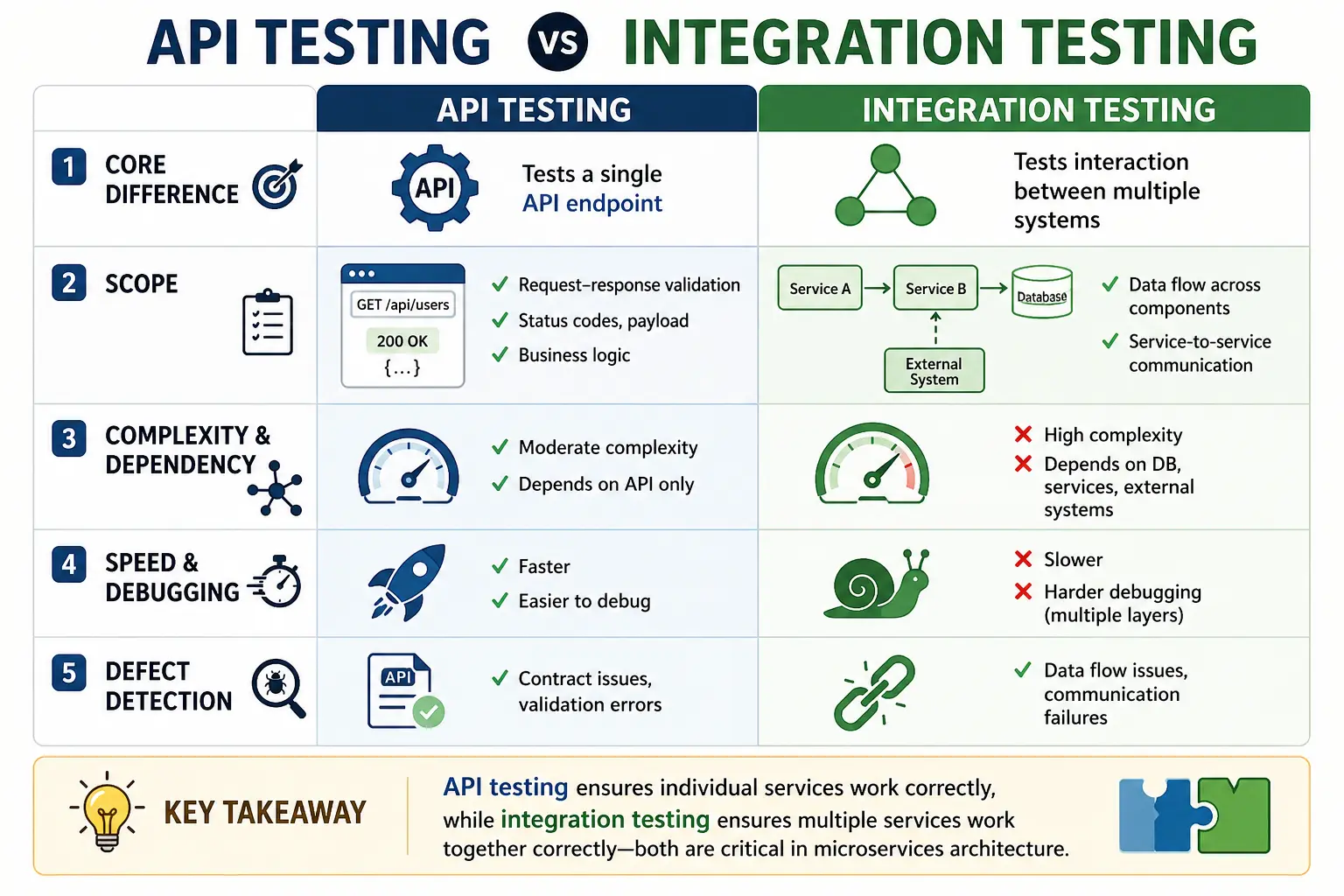
Although these two testing approaches are often confused—because both deal with interactions—they serve distinct purposes in the test strategy. API testing focuses on validating the correctness of individual service endpoints, while integration testing focuses on validating the correctness of interactions between multiple components or systems.
Understanding this distinction is critical for designing scalable test frameworks, especially in microservices-based architectures where system behavior emerges from the collaboration of many independent services.
Core Definitions and Intent
At a high level, both API testing and integration testing validate behavior beyond unit-level logic. However, their intent differs in scope and depth.
API testing is concerned with verifying that a specific API endpoint behaves correctly. It focuses on the contract between client and service, ensuring that requests are processed properly and responses are accurate and compliant with expectations.
Integration testing, on the other hand, validates how multiple components or systems interact. It ensures that data flows correctly across boundaries—between services, databases, external APIs, and other integrations.
In simple terms:
- API testing answers: Does this API work correctly?
- Integration testing answers: Do these components work correctly together?
This difference reflects a shift from endpoint-level validation to system-level interaction validation.
Scope of Testing
The scope of API testing is relatively focused. It targets a single API endpoint or service and validates:
- Request structure and parameters
- Response status codes
- Response payload correctness
- Business logic execution
For example, when testing a POST /users API, API testing ensures that:
- The request payload is accepted
- The correct status code (e.g., 201 Created) is returned
- The response contains the expected data
Integration testing expands this scope significantly. It validates the interaction between multiple components, such as:
- API layer
- Service layer
- Database
- External systems (e.g., email services, payment gateways)
In the same POST /users scenario, integration testing would verify:
- The user is correctly stored in the database
- A confirmation email is triggered
- Data consistency is maintained across systems
This broader scope makes integration testing more comprehensive but also more complex.
Architectural Layer Perspective
From an architectural standpoint, API testing operates at the service layer, directly interacting with APIs. It validates the behavior of a single service in isolation (though not as isolated as unit tests).
Integration testing operates across layers and services, validating how components interact within the system. It often spans:
- Controller → Service → Repository
- Service → Database
- Service → External APIs
In microservices architectures, integration testing often validates service-to-service communication, which is critical for system stability.
Practical Example: API vs Integration Testing
API Testing Scenario
An API test for user registration would:
- Send a request to POST /users
- Validate the response status code
- Verify the response body structure and content
This ensures that the API endpoint behaves correctly from a contract perspective.
Integration Testing Scenario
An integration test for the same feature would validate the entire workflow:
- API receives the request
- Service processes the data
- User is stored in the database
- Email service is triggered
- Data consistency is maintained
This ensures that all components involved in the workflow interact correctly.
Dependency Differences
Dependency is a key differentiator between API testing and integration testing.
API testing depends on:
- The API endpoint being available
- Backend services functioning correctly
However, it often mocks or bypasses deeper integrations to keep tests focused.
Integration testing depends on:
- Multiple systems being available
- Databases, external services, and infrastructure
- Network communication between components
This makes integration testing more environment-dependent and harder to set up.
Complexity and Debugging
API testing is moderately complex. Since it focuses on a single endpoint, failures are easier to isolate and debug. If an API test fails, the issue is typically within:
- Request validation
- Business logic
- Response formatting
Integration testing is inherently more complex. Failures can originate from multiple sources, including:
- Incorrect data flow between services
- Database inconsistencies
- External service failures
- Network issues
Debugging integration tests requires tracing interactions across multiple components, which can be time-consuming and requires deeper system understanding.
Defect Detection Capabilities
API testing and integration testing are effective at detecting different types of defects.
API testing identifies:
- Contract mismatches
- Incorrect status codes
- Validation errors
- Business logic issues within a service
Integration testing identifies:
- Data flow issues across components
- Communication failures between services
- Inconsistencies between systems
- Failures in end-to-end backend workflows
In essence, API testing ensures that each service behaves correctly, while integration testing ensures that services collaborate correctly.
Execution Speed
Speed is another important differentiator.
API tests are relatively fast because they:
- Focus on a single endpoint
- Avoid deep system dependencies
- Use controlled environments
Integration tests are slower because they:
- Involve multiple components
- Require real infrastructure
- Perform more complex operations
This difference makes API testing suitable for frequent execution in CI/CD pipelines, while integration testing is typically executed less frequently, often during system validation phases.
Test Data Management
Test data handling becomes more complex as we move from API testing to integration testing.
API testing typically uses:
- Controlled or mock data
- Isolated test environments
- Predictable inputs and outputs
Integration testing requires:
- Coordinated data across multiple systems
- Database setup and cleanup
- Synchronization between services
Managing test data in integration testing is a significant challenge, especially in distributed systems.
Real-World Usage Patterns
In real-world projects, API testing and integration testing serve different roles.
API testing is used for:
- Daily regression testing
- Continuous integration pipelines
- Functional validation of services
Integration testing is used for:
- Validating system behavior before release
- Testing complex workflows
- Ensuring stability across multiple services
For example, in a microservices-based e-commerce system:
- API tests validate individual services like cart, payment, and inventory
- Integration tests validate the complete order processing workflow
Role in Microservices Architecture
In microservices environments, the distinction between API testing and integration testing becomes even more important.
API testing ensures that each microservice adheres to its contract. This is critical for maintaining independence between services.
Integration testing ensures that microservices can communicate and collaborate effectively. Without it, even correctly functioning services can fail when combined.
Both are essential:
- API testing ensures local correctness
- Integration testing ensures global correctness
Key Differences Summary
The differences between API testing and integration testing can be summarized as follows:
- API testing focuses on a single endpoint, while integration testing focuses on multiple components
- API testing validates request–response behavior, while integration testing validates data flow across systems
- API testing is faster and easier to debug, while integration testing is slower and more complex
- API testing has moderate dependencies, while integration testing has high dependencies
These differences highlight why both approaches are necessary but serve different purposes.
Strategic Testing Approach
An effective testing strategy does not choose between API testing and integration testing—it uses both appropriately.
A typical approach is:
- Use API testing for frequent validation of service behavior
- Use integration testing for validating complex workflows and system interactions
This layered strategy ensures that defects are caught early and that the system behaves correctly under real-world conditions.
Understanding the Boundary Between API and Integration Testing
The confusion between API testing and integration testing usually comes from the fact that an API test can include some integration behavior. When an API test sends a request to a running service, that service may call a database, perform validation, access configuration, or call another internal component. Because of that, people sometimes say API testing is integration testing. In practice, it is better to separate the intent of the test. The intent of an API test is to validate the API contract and endpoint behavior. The intent of an integration test is to validate that multiple components collaborate correctly.
For example, a test that sends POST /users and verifies that the response contains a user id is mainly an API test. It checks whether the endpoint accepts the request and returns the expected response. If the same test also verifies that the user record is stored in the database, that a welcome email job is created, and that an audit record is written, the test moves closer to integration testing. The endpoint is still involved, but the purpose has expanded beyond the API response.
This distinction helps teams organize test suites properly. API tests can remain fast, focused, and suitable for frequent execution. Integration tests can be deeper and fewer, reserved for workflows where multiple systems must be proven together. Without this separation, test suites become slow, confusing, and difficult to maintain. A team may think it has good API coverage, but the tests may actually be broad integration tests that fail for many reasons.
API Testing Focuses on the Contract
API testing focuses heavily on the contract between the API provider and the consumer. The contract defines the endpoint path, HTTP method, headers, authentication requirements, request body, response body, status codes, error format, content type, and field rules. Consumers such as web applications, mobile apps, partner systems, and other services depend on this contract. If the contract changes unexpectedly, consumers can break even when the provider's internal logic appears correct.
A strong API test validates that the provider honors this contract. If the documentation says POST /customers returns 201 Created with customerId, name, email, and status, the test should confirm that behavior. If invalid email should return 400 with a specific validation error, the test should confirm that too. API testing protects the externally visible behavior of the service.
Contract focus is especially important in microservices. One service may provide an API consumed by five other services. If the provider removes a field or changes a data type, all consumers may be affected. Unit tests inside the provider may still pass because the internal code is valid, but consumer-facing behavior has changed. API testing and contract testing help catch this risk before release.
Integration Testing Focuses on Collaboration
Integration testing focuses on whether connected parts of the system work together correctly. The components may be application layers, internal modules, databases, external APIs, message queues, caches, authentication services, or third-party platforms. Integration testing is about collaboration across boundaries. It answers whether data moves correctly, whether one component understands another component's output, and whether the complete backend workflow behaves as expected.
Consider user registration. An API test may validate that POST /users returns the right response when valid data is submitted. An integration test may validate that the user is saved to the database, a verification token is generated, an email message is queued, an audit log is written, and the login service can later authenticate that user after verification. This test proves that several pieces of the system work together.
Integration testing is deeper but also more expensive. It needs more setup, more data, more environment stability, and more debugging effort. A failure can come from the API layer, service logic, database schema, email provider, queue configuration, or environment secrets. Because of this, integration tests should be designed carefully around important workflows rather than created for every small rule.
Layer-Level Perspective
In a layered web application, API testing usually targets the API layer and the service behavior behind it. The request enters through a controller or route, the service layer handles business rules, the repository or data access layer may interact with the database, and the response is serialized back to the caller. API tests validate this service boundary from the outside.
Client or Test Tool
  |
API Endpoint
  |
Service Logic
  |
Data Access or Dependency
  |
Response
Integration testing may start at the same API endpoint, but it intentionally verifies more layers or more systems. It may confirm that database records changed correctly, that events were published, that another service received the data, or that an external provider was called. The test is less about one endpoint alone and more about the connected behavior of the system.
This layer-level view also helps in defect analysis. If an API response format is wrong, that is usually an API contract defect. If the response is correct but a downstream reporting system does not receive the created data, that is more likely an integration defect. The difference improves defect reporting and helps the right team investigate faster.
Example: Customer Creation
Take a customer creation feature. The API endpoint is POST /customers. A basic API test sends valid customer details and validates that the API returns 201 Created, a customer id, correct response fields, and the expected content type. Additional API tests send missing email, invalid phone number, duplicate email, invalid token, and unauthorized role. These tests verify endpoint behavior and contract rules.
An integration test for the same feature goes further. It may verify that the customer is stored in the database, the customer can be retrieved by another API, a welcome email event is published, an audit log is written, and a CRM integration receives the customer record. This test validates that multiple parts of the system collaborate correctly after customer creation.
Both test types are valuable, but their purpose is different. The API tests should run frequently because they are focused and give fast feedback about the endpoint. The integration test may run less frequently or in a dedicated pipeline because it depends on more systems. If the welcome email provider is down, the integration test may fail even though the customer API contract still works. That distinction is important.
Example: Order Processing in Microservices
In a microservices-based e-commerce system, order processing may involve Order Service, Payment Service, Inventory Service, Shipping Service, and Notification Service. API testing can validate each service endpoint independently. Order Service can be tested for creating orders, retrieving orders, updating order status, and rejecting invalid requests. Payment Service can be tested for successful authorization, declined cards, invalid tokens, duplicate payment requests, and refund behavior.
Integration testing validates the flow between services. When an order is placed, does Order Service call Payment Service correctly? If payment succeeds, does Inventory Service reserve stock? If inventory reservation fails, does the order move to the right status? If payment times out, does the system avoid duplicate charges? If Notification Service is down, does order placement still complete or fail? These are integration questions.
In distributed systems, this distinction prevents overuse of end-to-end tests. It is better to have strong API tests for each service and focused integration tests for critical workflows. Testing every variation through the full order flow would be slow and hard to debug. Testing each service contract separately and then validating the most important service collaborations gives a better balance.
Execution Frequency and Pipeline Placement
API tests are usually suitable for frequent pipeline execution. A small API smoke suite can run after every deployment to verify that important endpoints are reachable and behaving correctly. A larger API regression suite can run on pull requests, nightly builds, or release candidates depending on size and stability. Because API tests are faster than UI tests and narrower than broad integration tests, they are a strong fit for CI/CD.
Integration tests often run at a different cadence. Since they depend on multiple components, databases, external systems, queues, and environment configuration, they can be slower and more fragile. Teams may run selected integration tests in pull request pipelines for affected services, broader integration tests in nightly builds, and critical integration flows before release. The goal is to get useful feedback without making every code change wait for a huge distributed test suite.
A practical pipeline may look like this: unit tests run first, service API tests run after the service starts, contract tests verify consumer-provider compatibility, selected integration tests validate important collaborations, and UI tests validate critical user journeys. This structure lets teams find defects at the earliest useful layer.
Test Data Management Differences
API testing needs controlled data, but the data is often limited to the endpoint under test. A customer API test may create one customer, validate the response, and clean it up. An order API test may create a cart and then place an order. The setup can still be meaningful, but it is usually focused around one service or endpoint behavior.
Integration testing often needs coordinated data across systems. An order workflow may need a customer in User Service, product data in Product Service, inventory in Inventory Service, payment test credentials in Payment Service, shipping configuration in Shipping Service, and notification templates in Notification Service. If any part is missing or inconsistent, the integration test may fail.
This is why integration tests require stronger data strategy. Teams may use seeded data, setup APIs, test data builders, database snapshots, service virtualization, or environment reset jobs. They must also handle cleanup carefully. If integration tests leave half-created records across services, later tests may fail unpredictably. Data isolation is one of the hardest parts of reliable integration testing.
Mocking and Service Virtualization
Mocks and stubs can be used in both API testing and integration testing, but their purpose differs. In API testing, a team may mock a downstream dependency to keep the tested service focused. For example, Order Service API tests may mock Payment Service so testers can verify order validation without depending on a real payment system. This keeps tests faster and more stable.
In integration testing, teams usually want more real collaboration. However, some external systems may still be virtualized. A payment gateway, email provider, credit bureau, tax service, or shipping provider may be expensive, slow, rate-limited, or unavailable in test environments. Service virtualization can simulate these dependencies while preserving realistic contracts.
The risk is that mocks drift away from reality. If the mock returns fields that the real provider no longer returns, tests may pass falsely. Good teams keep mocks aligned with contracts, use contract testing, and include a smaller number of real integration checks against actual dependencies where practical. Mocks improve speed, but they must not replace all real validation.
Debugging and Failure Analysis
API test failures are usually easier to diagnose than broad integration failures because the scope is narrower. If POST /users returns 400 instead of 201, the tester can inspect the request payload, endpoint, headers, token, validation rules, and response body. The failure is often within the API provider or its immediate configuration.
Integration test failures require tracing across components. A user registration workflow may fail because the API accepted the user but the email event was not published. Or the event was published but the queue consumer was down. Or the consumer processed the message but the email provider rejected the template. Or the email was sent but the audit record failed. The visible test failure may be far from the root cause.
Good logging and observability are essential for integration testing. Tests should capture correlation ids, request ids, timestamps, environment names, payload references, response bodies, and service logs where possible. Without those details, integration failures consume a lot of investigation time. This is another reason to keep integration tests focused on valuable workflows.
Common Misconceptions
One misconception is that API testing and integration testing are the same. They overlap in some situations, but their intent is different. API testing focuses on endpoint behavior and contract validation. Integration testing focuses on connected component behavior and data flow across boundaries.
Another misconception is that API testing is always isolated. In reality, many API tests use real databases or dependencies. However, the main validation goal may still be the API endpoint and contract. The classification should be based on what the test is trying to prove, not only which technology it touches.
A third misconception is that integration testing can replace API testing. Broad integration tests may prove that a workflow works, but they may not cover every endpoint, validation rule, error response, or contract detail. API tests provide focused coverage that integration tests cannot efficiently provide.
A fourth misconception is that API tests are enough for microservices. Individual services may work correctly, but the system can still fail when services communicate. Integration tests are needed for critical workflows, especially where data consistency, retries, timeouts, events, and downstream dependencies are involved.
Best Practices for API Testing
API tests should be contract-focused and business-aware. They should validate important status codes, response bodies, headers, schema, authentication, authorization, request validation, and error formats. They should include positive scenarios, negative scenarios, boundary cases, and security-related cases. A test that only checks status code 200 is usually too weak for meaningful API confidence.
API tests should also be stable and repeatable. Use controlled data, avoid unnecessary dependence on test order, clean up created records where practical, and avoid hardcoding environment-specific values. If tests run in CI/CD, they should produce clear reports and fail for real reasons.
For microservices, API tests should protect service contracts. They should verify that provider changes do not break consumers. If consumer-driven contract testing is available, it can complement regular API tests by making consumer expectations explicit.
Best Practices for Integration Testing
Integration tests should focus on high-value collaborations rather than every small rule. Good candidates include order placement, payment processing, user registration, account transfer, report generation, notification workflows, and cross-service data synchronization. These are flows where multiple components must work together for the business outcome to be correct.
Integration tests should be designed with clear failure diagnostics. A test should make it easy to know which step failed and what evidence was collected. If a workflow depends on an event, the test should capture whether the event was published, consumed, and processed. If it depends on an external service, the test should show whether the call happened and what response was received.
Teams should avoid making integration tests too large. A test that covers login, product search, cart, payment, shipping, notification, refund, and reporting in one flow is hard to debug and maintain. Split integration tests by meaningful business workflow. One test should have a clear purpose and a limited number of reasons to fail.
Choosing the Right Test Level
The right test level depends on the risk being validated. If the risk is an endpoint contract, use API testing. If the risk is a workflow across multiple systems, use integration testing. If the risk is small internal logic, use unit testing. If the risk is user experience through the browser, use UI testing. This decision keeps the test suite efficient.
For example, validating that missing email returns 400 belongs in API testing. Validating that customer creation writes records to customer, audit, and notification systems belongs in integration testing. Validating the email format function belongs in unit testing. Validating that the user sees a success message on the web page belongs in UI testing.
This separation is practical, not theoretical. It reduces duplicate coverage, improves speed, and makes failures easier to understand. It also helps during interviews because you can explain why a scenario belongs at a specific level instead of saying every scenario should be automated everywhere.
Interview-Ready Summary
API testing validates individual service endpoints by focusing on request–response behavior and business logic, while integration testing validates the interaction between multiple components, ensuring correct data flow and communication across systems. API testing is faster and easier to debug, whereas integration testing is more complex but essential for validating real-world system behavior.
Key Takeaway
API testing ensures that each service works correctly in isolation, while integration testing ensures that services work correctly together. Both are essential for building reliable, scalable systems, especially in modern microservices architectures.
The most practical approach is to keep API tests focused on endpoint behavior and contract confidence, then use integration tests for selected workflows where multiple systems must cooperate. This balance keeps feedback fast while still validating real business behavior. It also prevents teams from building one large test suite that is too slow for daily use and too broad to debug quickly. Clear separation improves maintenance, reporting, ownership, and release decision-making across the project, especially for Agile, DevOps, and microservices teams. It also helps new testers explain failures with better context during reviews.
One-Line Insight
👉 API testing validates individual services; integration testing validates how those services collaborate.