Why TestNG Over JUnit?
Introduction
In the Java testing ecosystem, two names appear more frequently than almost any others: JUnit and TestNG. Both frameworks are designed to help developers and testers create automated tests, execute them efficiently, and validate software quality. While JUnit is one of the oldest and most widely adopted testing frameworks in Java, TestNG was created to address limitations found in earlier versions of JUnit and to provide advanced capabilities required by large-scale automation projects.
For developers focused primarily on unit testing, JUnit remains an excellent choice. However, for automation engineers building Selenium frameworks, API automation suites, mobile automation solutions, and enterprise-level testing platforms, TestNG often becomes the preferred framework because of its flexibility, powerful execution controls, rich configuration options, and advanced reporting capabilities.
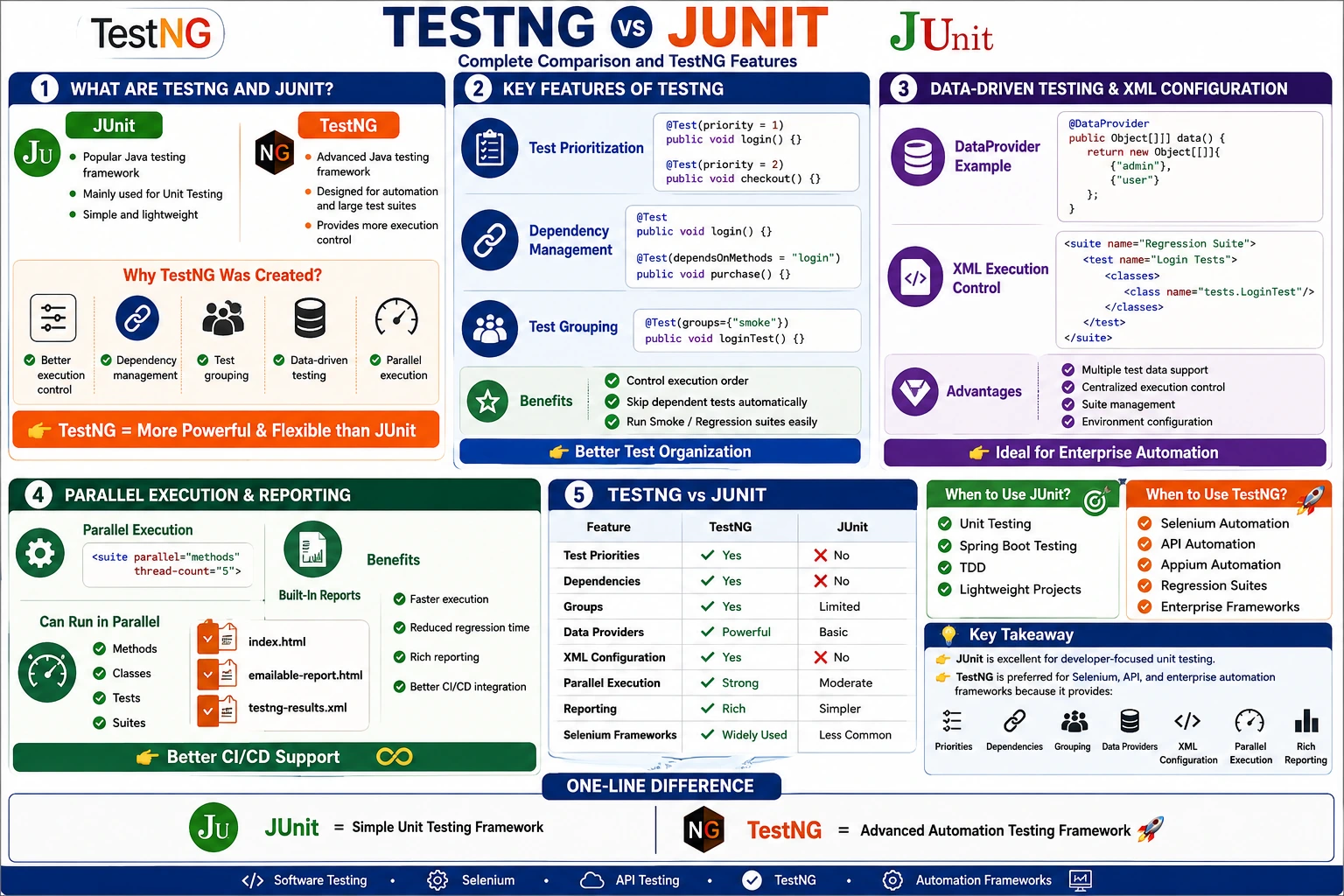
The question "Why TestNG over JUnit?" is one of the most common interview questions in Selenium and automation testing interviews. To answer it effectively, it is important to understand not only what TestNG provides but also why those features matter in real-world projects.
This article explores the origins of TestNG, its advantages over JUnit, practical use cases, architectural benefits, and why it has become the backbone of many enterprise automation frameworks.
The Evolution of Java Testing Frameworks
Before comparing TestNG and JUnit, it is useful to understand how automated testing evolved in Java.
In the early days of Java development, developers often relied on manual verification or custom test programs to validate functionality. As software systems became larger and more complex, the need for structured testing frameworks increased.
JUnit emerged as a revolutionary solution by providing:
- Test methods
- Assertions
- Test runners
- Repeatable execution
It established many of the concepts that modern testing frameworks still use today.
However, as automation testing expanded beyond simple unit tests into UI automation, integration testing, API testing, regression testing, and enterprise-scale validation, testers began encountering limitations. Managing thousands of automated tests required features that JUnit initially did not provide.
This need led to the development of TestNG.
Why Was TestNG Created?
TestNG stands for Test Next Generation.
The framework was created specifically to address challenges that automation engineers faced when using earlier versions of JUnit. Its goal was not to replace JUnit entirely but to provide additional capabilities necessary for large and complex automation environments.
Several limitations motivated the creation of TestNG:
Limited Test Execution Control
JUnit offered relatively simple execution mechanisms. Managing complex execution flows required custom solutions.
Lack of Dependency Management
Many automation scenarios require one test to execute only after another test succeeds. Earlier JUnit versions lacked native support for such dependencies.
Weak Grouping Capabilities
Organizing tests into smoke, sanity, regression, or module-specific categories was difficult.
Limited Parameterization
Executing the same test with multiple datasets required additional complexity.
Limited Parallel Execution
Large automation suites needed faster execution through parallelism.
Basic Configuration Options
Enterprise frameworks required richer lifecycle management and execution control.
TestNG was designed specifically to solve these problems and provide features targeted at automation engineers.
Philosophy Behind TestNG
The philosophy of TestNG is simple:
Provide a framework that supports both developers and testers while offering enterprise-grade test execution capabilities.
While JUnit focuses heavily on developer-centric testing and unit testing, TestNG expands its scope to support:
- Functional testing
- Regression testing
- End-to-end testing
- Integration testing
- UI automation
- Data-driven testing
- Parallel execution
This broader focus makes TestNG particularly attractive for QA automation teams.
Better Annotation Support
One of the first advantages users notice in TestNG is its extensive annotation system.
Annotations define what should happen before and after different stages of test execution.
TestNG provides a rich hierarchy of lifecycle annotations:
@BeforeSuite
@BeforeTest
@BeforeClass
@BeforeMethod

@Test

@AfterMethod
@AfterClass
@AfterTest
@AfterSuite
These annotations allow precise control over setup and cleanup activities.
For example:
- Launch browser before suite execution
- Create database connections before tests
- Initialize test data before classes
- Perform cleanup after methods
This fine-grained control becomes extremely valuable in enterprise frameworks.
By comparison, JUnit traditionally provides a smaller set of lifecycle annotations:
@BeforeEach
@AfterEach
@BeforeAll
@AfterAll
@Test
Although sufficient for many unit-testing scenarios, they offer less flexibility for large automation suites.
Built-In Test Prioritization
In real-world automation projects, execution order sometimes matters.
Consider an e-commerce application:
- Login
- Search Product
- Add to Cart
- Checkout
TestNG allows explicit prioritization.
@Test(priority = 1)
public void login() {}

@Test(priority = 2)
public void checkout() {}
The framework executes tests according to assigned priorities.
This feature simplifies workflow-oriented automation.
JUnit does not provide a comparable built-in priority mechanism.
As a result, managing ordered execution often requires additional configuration or custom implementation.
Powerful Dependency Management
Dependency management is one of TestNG's most celebrated features.
Consider a scenario where purchasing a product requires successful login.
@Test
public void login() {}

@Test(dependsOnMethods = "login")
public void purchase() {}
If the login test fails:
purchase = skippedThe framework automatically manages dependencies and prevents meaningless failures.
This capability is extremely useful for:
- Business workflows
- End-to-end scenarios
- Sequential operations
- Multi-step user journeys
JUnit lacks native dependency management.
For enterprise automation frameworks, this difference alone often justifies choosing TestNG.
Test Grouping Capabilities
Large projects typically contain thousands of automated tests.
Running every test for every build is inefficient.
Organizations often classify tests into categories such as:
- Smoke
- Sanity
- Regression
- Integration
- Performance validation
TestNG supports grouping through annotations.
@Test(groups = {"smoke"})
public void loginTest() {}

@Test(groups = {"regression"})
public void paymentTest() {}
These groups can then be executed selectively using XML configuration.
Benefits include:
- Faster feedback
- Targeted execution
- Efficient CI/CD pipelines
- Better release management
JUnit provides tagging mechanisms in newer versions, but TestNG's grouping system remains highly popular in automation frameworks.
Superior Data-Driven Testing
Modern applications require testing with numerous combinations of input data.
Examples include:
- Multiple user roles
- Different browsers
- Various product combinations
- Different account types
TestNG provides the powerful @DataProvider feature.
@DataProvider
public Object[][] data() {
    return new Object[][] {
        {"admin"},
        {"user"}
    };
}

@Test(dataProvider = "data")
public void login(String user) {
}
The same test executes repeatedly with different datasets.
Advantages include:
- Reduced code duplication
- Better test coverage
- Easier maintenance
- Scalable automation
Although JUnit supports parameterized tests, TestNG's DataProvider mechanism is often considered more flexible for automation frameworks.
XML-Based Execution Control
One of TestNG's strongest features is the testng.xml configuration file.
Example:
<suite name="Regression Suite">
    <test name="Login Tests">
        <classes>
            <class name="tests.LoginTest"/>
        </classes>
    </test>
</suite>
This file acts as the central execution controller.
Through XML configuration, teams can manage:
- Suite execution
- Group execution
- Class execution
- Parallel runs
- Environment configuration
- Parameter passing
This level of control is invaluable in enterprise projects.
JUnit does not provide an equivalent centralized execution model.
Built-In Parallel Execution
Execution speed is critical in CI/CD pipelines.
A regression suite containing 2,000 tests may take hours if executed sequentially.
TestNG supports parallel execution natively.
<suite parallel="methods" thread-count="5">Execution can occur in parallel at different levels:
- Methods
- Classes
- Tests
- Suites
This dramatically reduces execution time.
For example:
- Sequential execution: 4 hours
- Parallel execution: 45 minutes
Such improvements directly impact release velocity.
Rich Reporting Capabilities
Reporting is essential for understanding test results.
TestNG automatically generates reports such as:
index.html
emailable-report.html
testng-results.xml
These reports provide:
- Passed tests
- Failed tests
- Skipped tests
- Execution time
- Failure details
The built-in reporting experience is significantly richer than traditional JUnit reporting.
This visibility helps teams quickly diagnose issues and communicate quality metrics.
Flexible Parameterization
Modern automation frameworks often run across multiple environments:
- Development
- QA
- UAT
- Production-like environments
They may also support multiple browsers:
- Chrome
- Firefox
- Edge
TestNG provides flexible parameterization.
@Parameters("browser")
@Test
public void launch(String browser) {
}
Parameters can originate from:
- XML files
- DataProviders
- External files
- Databases
This flexibility supports enterprise-grade automation frameworks.
Better Integration with Automation Tools
TestNG integrates naturally with many popular automation technologies.
Examples include:
- Selenium
- Rest Assured
- Appium
- Maven
- Jenkins
- Allure Reports
- Extent Reports
Most enterprise Selenium frameworks are built around TestNG because its architecture aligns naturally with automation requirements.
Real-World E-Commerce Example
Consider an online shopping application.
Workflow:
Login
   ↓
Search Product
   ↓
Add To Cart
   ↓
Checkout
   ↓
Payment
Using TestNG:
@Test
public void login() {}

@Test(dependsOnMethods = "login")
public void searchProduct() {}

@Test(dependsOnMethods = "searchProduct")
public void addToCart() {}

@Test(dependsOnMethods = "addToCart")
public void checkout() {}
TestNG automatically manages execution flow and dependencies.
This approach produces cleaner and more maintainable automation code.
When JUnit May Be a Better Choice
Despite TestNG's advantages, JUnit remains highly relevant.
JUnit is often preferred for:
Pure Unit Testing
Developers writing method-level tests frequently choose JUnit.
Spring Boot Applications
Spring Boot has deep integration with JUnit.
Test-Driven Development
Many TDD practitioners prefer JUnit.
Lightweight Projects
Small applications may not require TestNG's advanced features.
Developer-Centric Testing
Backend teams often standardize on JUnit.
JUnit continues to be an excellent framework in these scenarios.
When TestNG Is the Better Choice
TestNG typically becomes the preferred option when working with:
- Selenium Automation
- API Automation
- End-to-End Testing
- Regression Suites
- Enterprise Automation Frameworks
- Parallel Test Execution
- Data-Driven Testing
- CI/CD Pipelines
In these environments, TestNG's advanced capabilities provide substantial productivity gains.
TestNG in Modern Automation Architecture
Modern automation frameworks often include:
TestNG
    ↓
Selenium / Rest Assured
    ↓
Page Objects / Service Layers
    ↓
Reporting
    ↓
CI/CD Pipeline
TestNG sits at the center of execution management.
It orchestrates:
- Test lifecycle
- Dependencies
- Parallel execution
- Data providers
- Reporting integration
This central role explains why many enterprise automation architectures adopt TestNG as their execution engine.
Interview Perspective
A common interview question is:
Why do Selenium frameworks prefer TestNG over JUnit?
A strong answer would be:
TestNG provides advanced automation features such as priorities, dependencies, groups, DataProviders, XML-based execution control, parallel execution, and richer reporting. These capabilities make it more suitable for large-scale Selenium and API automation frameworks compared to JUnit, which is primarily optimized for unit testing.
Conclusion
Both JUnit and TestNG are powerful Java testing frameworks, and neither is universally "better" in every situation. The choice depends on the testing requirements and project goals.
JUnit excels in developer-focused testing, TDD, Spring Boot applications, and lightweight projects. TestNG, on the other hand, was designed to address limitations encountered in large automation projects and therefore provides advanced capabilities such as lifecycle management, priorities, dependencies, groups, DataProviders, XML configuration, parallel execution, and comprehensive reporting.
For automation engineers working with Selenium, Rest Assured, Appium, CI/CD pipelines, and enterprise-scale regression suites, TestNG often becomes the framework of choice because it offers the flexibility, control, and scalability required by modern testing environments. Its ability to manage complex execution flows while reducing maintenance effort makes it one of the most valuable tools in the automation ecosystem.
Ultimately, understanding both frameworks is important, but mastering TestNG provides a significant advantage for anyone building robust and scalable automation frameworks in real-world projects.