What Is TestNG?
Modern software applications are expected to deliver high quality, fast releases, stable functionality, and reliable user experiences across browsers, devices, APIs, and distributed systems. As applications became larger and more complex, manual testing alone was no longer sufficient. Automation testing emerged as a critical part of software engineering, enabling teams to execute thousands of tests quickly and repeatedly. However, automation itself also needed proper structure, execution control, reporting, configuration management, and scalability. This is where testing frameworks became essential.
TestNG is one of the most powerful and widely used testing frameworks in the Java ecosystem. It plays a central role in Selenium automation, API testing, integration testing, and enterprise automation frameworks. TestNG provides a structured and flexible way to organize, execute, manage, and report automated tests efficiently. It is considered one of the foundational technologies for Java automation engineers and is heavily used in real-world enterprise projects.
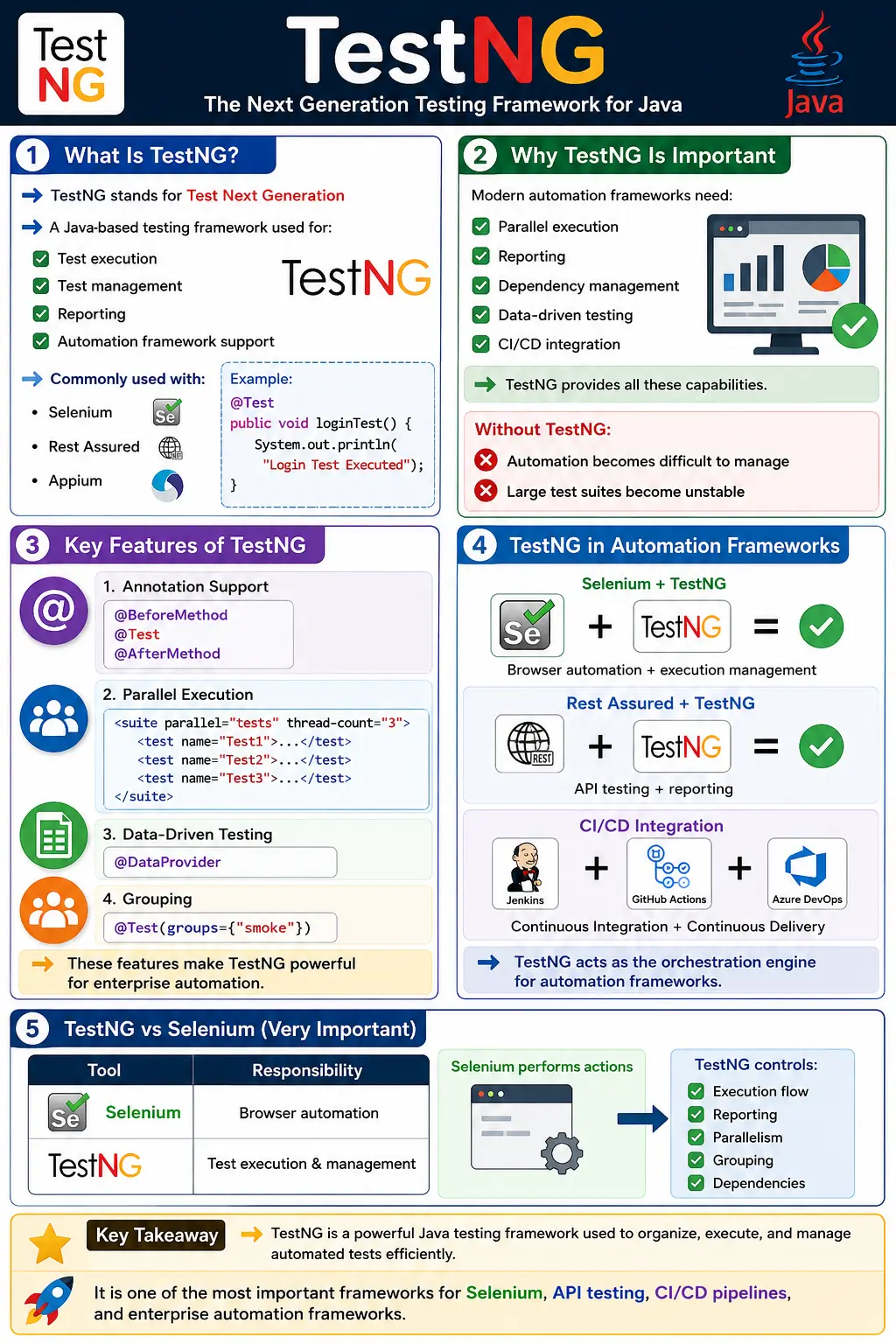
The name TestNG stands for “Test Next Generation.” It was developed as an improved alternative to older testing frameworks such as JUnit and NUnit. While earlier frameworks were useful for unit testing, they lacked many advanced capabilities required for large-scale automation frameworks. TestNG was created specifically to address these limitations and provide features suitable for modern automation needs.
Understanding the Purpose of TestNG
At its core, TestNG is a Java-based testing framework designed to help developers and automation engineers create, organize, execute, and manage automated tests in a scalable and maintainable way.
TestNG provides several critical capabilities:
- Test execution management
- Annotation-driven configuration
- Parallel execution
- Dependency handling
- Data-driven testing
- Reporting and logging
- Grouping and prioritization
- CI/CD integration
Without a framework like TestNG, automation code would quickly become difficult to maintain. As test suites grow larger, engineers need mechanisms to:
- Reuse setup code
- Execute tests selectively
- Control execution flow
- Handle dependencies
- Generate reports
- Run tests in parallel
TestNG solves these problems effectively.
Why TestNG Was Created
Before TestNG became popular, automation engineers commonly used older frameworks such as JUnit. Although JUnit worked well for simple unit testing, enterprise automation frameworks required more advanced features.
Older frameworks had limitations such as:
- Limited configuration support
- Weak dependency handling
- Minimal parallel execution capability
- Basic reporting features
- Poor support for large automation suites
As enterprise systems became larger and Agile development accelerated release cycles, testing frameworks needed to evolve.
TestNG was designed to address these challenges by introducing features such as:
- Powerful annotations
- XML-based suite management
- Parallel execution
- Flexible configuration
- Data providers
- Advanced grouping
- Dependency management
- Built-in reporting
This made TestNG highly suitable for modern automation ecosystems.
Where TestNG Is Used
TestNG is extremely popular in automation testing projects.
It is commonly integrated with:
| Technology | Purpose |
|---|---|
| Selenium | UI Automation |
| Rest Assured | API Automation |
| Appium | Mobile Automation |
| Maven | Build Management |
| Jenkins | CI/CD Execution |
| Extent Reports | Advanced Reporting |
TestNG itself does not automate browsers or APIs directly. Instead, it acts as the orchestration and execution engine that manages automated tests.
For example:
- Selenium performs browser actions
- Rest Assured sends API requests
- Appium automates mobile apps
- TestNG controls execution, reporting, and organization
This separation of responsibilities is extremely important in enterprise automation frameworks.
Basic Structure of a TestNG Program
A simple TestNG program demonstrates how the framework identifies and executes tests.
Example:
import org.testng.annotations.Test;

public class LoginTest {

    @Test
    public void verifyLogin() {
        System.out.println("Login Test Executed");
    }
}
In this example:
- @Test marks the method as a test case
- verifyLogin() is the test method
- TestNG engine identifies and executes it automatically
The framework scans annotations, discovers test methods, executes them, and generates reports.
How TestNG Works Internally
Internally, TestNG follows a structured execution flow.
TestNG Engine
      ↓
Reads Annotations
      ↓
Identifies Test Methods
      ↓
Executes Tests
      ↓
Generates Reports
When execution begins:
- TestNG loads the test classes
- It scans annotations such as @Test, @BeforeMethod, and @AfterMethod
- It builds execution flow internally
- Tests are executed in defined order
- Reports are generated automatically
This annotation-driven execution model is one of TestNG’s strongest advantages.
Annotation-Based Framework
One of the most powerful features of TestNG is its annotation-based design.
Annotations control execution behavior and lifecycle management.
Common annotations include:
| Annotation | Purpose |
|---|---|
| @Test | Marks test method |
| @BeforeMethod | Runs before each test |
| @AfterMethod | Runs after each test |
| @BeforeClass | Runs before class execution |
| @AfterClass | Runs after class execution |
Example:
@BeforeMethod
public void setup() {
    System.out.println("Browser launched");
}

@Test
public void loginTest() {
    System.out.println("Login executed");
}

@AfterMethod
public void teardown() {
    System.out.println("Browser closed");
}
Annotations eliminate the need for manual execution control logic.
Parallel Execution in TestNG
Modern automation suites can contain thousands of test cases. Sequential execution becomes slow and inefficient.
TestNG supports parallel execution, allowing multiple tests to run simultaneously.
Benefits include:
- Faster execution
- Reduced regression time
- Better CI/CD performance
- Improved resource utilization
Example:
<suite name="Suite" parallel="tests" thread-count="3">Parallel execution is one of the key reasons TestNG is heavily used in enterprise automation frameworks.
Data-Driven Testing with DataProvider
Real-world testing often requires running the same test with multiple datasets.
TestNG supports this using @DataProvider.
Example:
@DataProvider
public Object[][] data() {
    return new Object[][] {
        {"admin", "admin123"},
        {"user", "user123"}
    };
}
This allows the same test method to execute multiple times with different inputs.
Advantages include:
- Reusable test logic
- Better coverage
- Reduced code duplication
- Scalable test design
Data-driven testing is widely used in login testing, API validation, form testing, and database verification.
Dependency Management in TestNG
In enterprise workflows, some tests depend on others.
Example:
- Checkout requires login
- Payment requires cart creation
- Order history requires successful purchase
TestNG supports dependency management using:
@Test
public void login() {
}

@Test(dependsOnMethods = "login")
public void checkout() {
}
This ensures logical execution flow and avoids invalid test execution sequences.
Test Grouping in TestNG
Large automation frameworks require organized execution.
TestNG supports grouping of tests.
Examples:
- Smoke
- Regression
- Sanity
- Integration
Example:
@Test(groups = {"smoke"})This allows selective execution of test categories.
Benefits include:
- Faster execution
- Environment-specific runs
- Better suite management
- CI/CD flexibility
Reporting Capabilities
Test execution without reporting is incomplete.
TestNG automatically generates reports such as:
- HTML Reports
- XML Reports
- Emailable Reports
Reports contain:
- Passed tests
- Failed tests
- Skipped tests
- Execution time
- Stack traces
Reporting is extremely important in CI/CD pipelines and enterprise automation.
TestNG Architecture Overview
A simplified TestNG architecture looks like this:
Java Code
    ↓
TestNG Annotations
    ↓
TestNG Engine
    ↓
Execution Controller
    ↓
Listeners & Reporters
    ↓
Reports Generated
The framework acts as the central orchestration layer for automation execution.
TestNG XML Configuration
One of TestNG’s strongest features is XML-based execution control using testng.xml.
This file allows engineers to:
- Define suites
- Define tests
- Control parallel execution
- Include/exclude classes
- Configure groups
Example:
<suite name="Regression Suite">
    <test name="Login Tests">
        <classes>
            <class name="tests.LoginTest"/>
        </classes>
    </test>
</suite>
This provides centralized execution management.
TestNG in Selenium Frameworks
TestNG is deeply integrated into Selenium automation frameworks.
Responsibilities are divided clearly.
Selenium Responsibilities
- Browser automation
- Element interaction
- UI operations
TestNG Responsibilities
- Test execution
- Suite management
- Assertions
- Reporting
- Parallel execution
- Configuration handling
This separation improves framework maintainability.
TestNG in API Automation
TestNG is also heavily used in API testing.
Example stack:
- Rest Assured → API calls
- TestNG → execution + assertions + reporting
TestNG manages:
- Test organization
- Assertions
- Dependency flow
- Reporting
This makes it ideal for API regression suites.
TestNG and CI/CD Pipelines
Modern Agile development requires continuous integration and deployment.
TestNG integrates easily with:
- Jenkins
- GitHub Actions
- Bamboo
- Azure DevOps
Benefits include:
- Automated regression testing
- Faster release cycles
- Continuous validation
- Parallel execution support
CI/CD integration is one of the reasons TestNG remains highly relevant in enterprise environments.
Advantages of TestNG
TestNG offers several powerful advantages.
Easy Test Management
Large test suites become easier to organize.
Annotation Support
Execution becomes highly configurable.
Parallel Execution
Reduces overall execution time.
Dependency Handling
Supports logical workflow execution.
Data-Driven Testing
Enables reusable tests with multiple inputs.
Better Reporting
Provides detailed built-in reports.
CI/CD Friendly
Integrates well with modern pipelines.
Limitations of TestNG
Despite its strengths, TestNG also has limitations.
Java-Centric Framework
Primarily designed for Java ecosystems.
Learning Curve
Advanced features require practice.
Configuration Complexity
Large XML suites can become difficult to manage.
TestNG vs JUnit
TestNG and JUnit are often compared.
| Feature | TestNG | JUnit |
|---|---|---|
| Parallel Execution | Strong Support | Limited Earlier |
| Dependency Testing | Yes | Limited |
| DataProvider | Powerful | Simpler |
| Grouping | Advanced | Basic |
| XML Configuration | Yes | Minimal |
| Reporting | Better Built-In | Simpler |
TestNG is generally preferred for enterprise automation frameworks due to its flexibility.
Important Real-World Insight
A common misunderstanding is believing TestNG performs browser automation.
This is incorrect.
TestNG is:
- A testing framework
- A test execution engine
- A reporting and orchestration tool
Selenium performs browser automation.
A useful analogy:
| Tool | Role |
|---|---|
| Selenium | Driver of the car |
| TestNG | Traffic controller and trip manager |
Selenium performs actions.
TestNG manages:
- When to run
- What to run
- Execution order
- Reporting
- Parallelism
Industry Usage of TestNG
TestNG is widely used in:
- Banking automation frameworks
- E-commerce testing
- API regression suites
- Enterprise Selenium frameworks
- Mobile automation projects
- Hybrid automation frameworks
Its flexibility and scalability make it highly suitable for large enterprise ecosystems.
Interview Perspective
A short interview answer:
TestNG is a Java-based testing framework used for organizing, executing, and reporting automated tests.
A stronger real-time answer:
TestNG is a next-generation Java testing framework widely used in Selenium and API automation. It provides features such as annotations, parallel execution, dependency management, grouping, data-driven testing, XML configuration, and reporting, making it highly suitable for enterprise automation frameworks.
Key Takeaway
TestNG is one of the most important frameworks in Java automation ecosystems. It provides powerful capabilities for organizing, executing, managing, and reporting automated tests efficiently. From Selenium UI automation to API regression pipelines, TestNG acts as the orchestration engine that enables scalable and maintainable automation frameworks.
Understanding TestNG deeply is essential for automation engineers, SDETs, QA professionals, and Java developers working in modern Agile and CI/CD environments.
One-Line Insight
👉 Selenium performs automation, but TestNG controls, organizes, and scales it for real-world engineering environments.