Evolution of TestNG
Introduction
The evolution of TestNG is closely connected to the evolution of software testing itself. As Java applications became larger, more complex, and increasingly business-critical, traditional testing approaches began to show significant limitations. Development teams needed a framework that could not only execute tests but also support large-scale automation, complex execution flows, data-driven testing, reporting, and integration with modern development practices. TestNG emerged as the answer to these challenges and quickly established itself as one of the most influential testing frameworks in the Java ecosystem.
The name TestNG stands for "Test Next Generation." The name itself reflects the framework's purpose—to become the next generation of testing beyond the capabilities offered by earlier frameworks. TestNG was designed to retain the simplicity that made JUnit successful while introducing advanced features required by enterprise-level applications and automation frameworks.
Today, TestNG is widely used in Selenium automation, API testing, mobile automation, continuous integration pipelines, and enterprise test frameworks. Understanding how TestNG evolved provides valuable insight into why it became such an important tool and why it continues to remain relevant in modern software development.
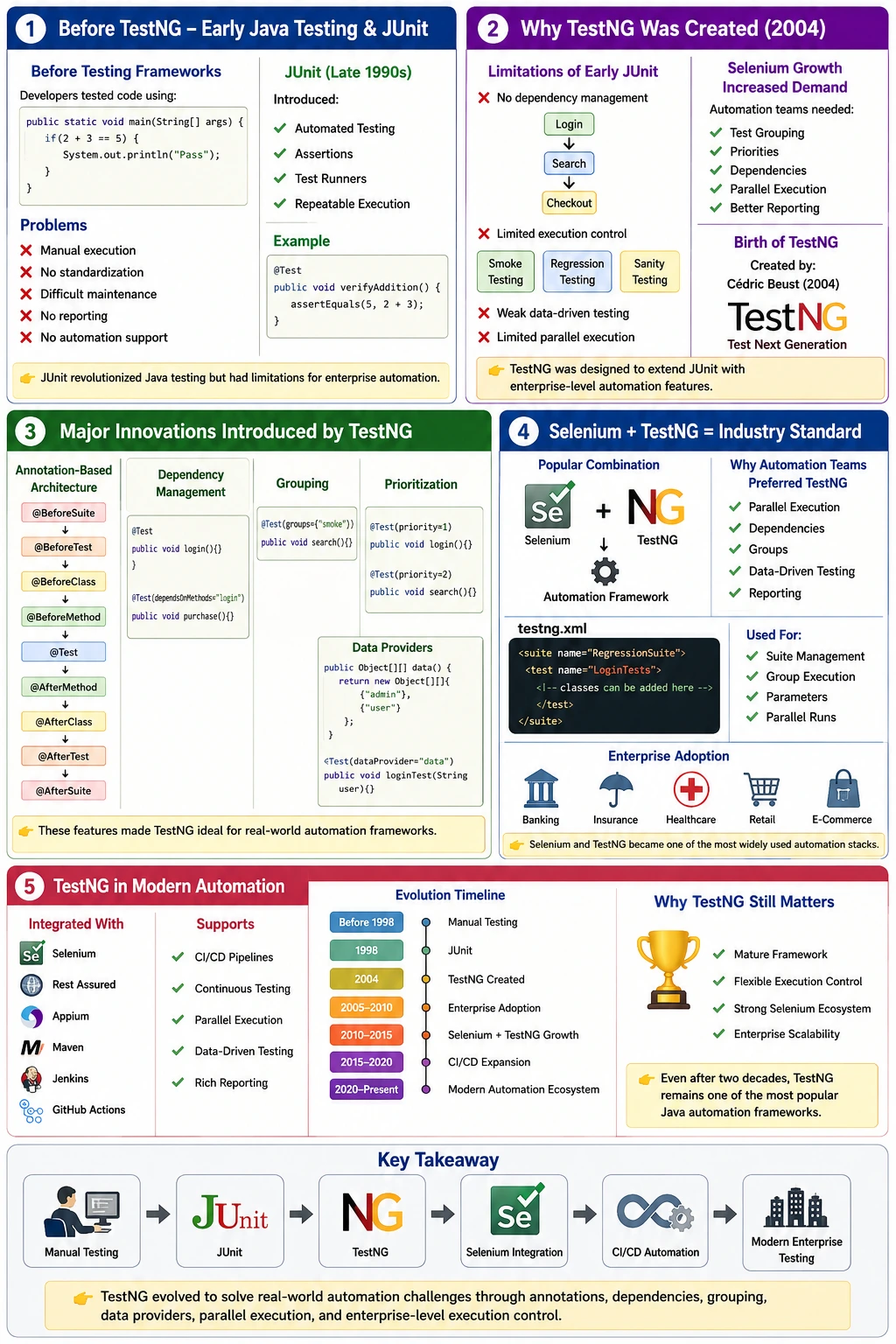
The Early Days of Java Testing
Before dedicated testing frameworks became popular, testing Java applications was largely a manual process. Developers typically wrote small programs containing a main() method and manually verified the output. Testing was often inconsistent, repetitive, and difficult to maintain.
A typical approach looked like this:
public class CalculatorTest {

    public static void main(String[] args) {
        Calculator calc = new Calculator();

        if(calc.add(2,3) == 5) {
            System.out.println("Pass");
        } else {
            System.out.println("Fail");
        }
    }
}
While this approach worked for small examples, it became impractical as applications grew. Teams faced several major problems:
- No standardized testing methodology
- Manual execution of test cases
- Difficult maintenance of large test suites
- No structured reporting
- No test organization mechanism
- No automated regression testing
As software complexity increased, organizations realized that a systematic testing framework was necessary.
The Rise of JUnit
The first major breakthrough in Java testing came with the introduction of JUnit in the late 1990s. JUnit transformed software testing by providing a standardized approach for writing and executing automated tests.
JUnit introduced several revolutionary concepts:
- Automated unit testing
- Assertions
- Test runners
- Test organization
- Repeatable test execution
A simple JUnit test looked like this:
@Test
public void verifyAddition() {
    assertEquals(5, 2 + 3);
}
Compared to manual testing, this represented a massive improvement. Developers could now execute tests automatically, validate expected results, and integrate testing into their development workflow.
JUnit quickly became the industry standard for Java unit testing and remains highly popular today.
Limitations of Early JUnit Versions
Although JUnit solved many problems, enterprise software projects soon exposed several limitations.
As applications grew larger and automation became more sophisticated, teams needed capabilities that early JUnit versions did not provide.
Lack of Dependency Management
Many business workflows require tests to execute in a specific order.
For example:
Login
  ↓
Search Product
  ↓
Add to Cart
  ↓
Checkout
Early JUnit versions had no built-in support for defining dependencies between tests.
Teams had to create custom workarounds, which often became difficult to maintain.
Limited Execution Control
Enterprise projects frequently require selective execution of tests.
Examples include:
- Smoke testing
- Sanity testing
- Regression testing
- Environment-specific testing
JUnit provided only basic execution capabilities, making advanced test management challenging.
Weak Data-Driven Testing Support
Organizations often needed to execute the same test with multiple datasets.
For example:
Login Test
   ↓
Admin User
Normal User
Guest User
Invalid User
Early JUnit versions did not provide robust mechanisms for parameterized testing, forcing developers to write repetitive code.
No Advanced Parallel Execution
As automation suites expanded, execution time became a serious concern.
Consider a Selenium suite containing:
500 UI Tests
     ↓
Single Thread
     ↓
Several Hours
Organizations needed parallel execution capabilities to reduce feedback time.
JUnit initially lacked sophisticated support for large-scale parallel execution.
Growing Selenium Requirements
The rise of Selenium introduced new challenges.
Automation engineers required features such as:
- Test grouping
- Prioritization
- Dependency management
- Suite execution
- Parallel testing
- Enhanced reporting
These requirements pushed the industry toward a more advanced testing framework.
Birth of TestNG
In 2004, software engineer Cédric Beust created TestNG.
The objective was straightforward:
Combine the simplicity of JUnit with the power needed for enterprise automation.
The framework's name reflected its mission:
TestNG
=
Test Next Generation
TestNG was not designed to replace everything JUnit offered. Instead, it aimed to extend testing capabilities and provide features that automation teams desperately needed.
The framework immediately attracted attention because it addressed real-world testing challenges that were becoming increasingly common in enterprise environments.
Design Goals Behind TestNG
TestNG was built around several core objectives.
Better Test Organization
Large projects often contain thousands of test cases.
TestNG introduced mechanisms to organize tests logically and execute only the required subsets.
Flexible Execution Control
Teams wanted more control over test execution.
TestNG enabled:
- Ordered execution
- Prioritized execution
- Dependency-based execution
- Selective execution
Data-Driven Testing
Instead of duplicating tests, teams could run the same test against multiple datasets.
This significantly reduced code duplication.
Workflow-Based Testing
Many business processes follow sequential workflows.
TestNG introduced dependency management that allowed tests to reflect actual business flows.
Parallel Execution
Faster feedback became a critical requirement.
TestNG provided built-in support for parallel execution, allowing large test suites to complete significantly faster.
Rich Reporting
Managers, developers, and testers needed better visibility into test results.
TestNG introduced detailed reporting mechanisms that went far beyond simple console output.
Annotation-Based Architecture
One of the most important innovations introduced by TestNG was its rich annotation model.
Instead of relying on naming conventions, TestNG used annotations to control execution flow.
Examples include:
@BeforeSuite
@BeforeTest
@BeforeClass
@BeforeMethod

@Test

@AfterMethod
@AfterClass
@AfterTest
@AfterSuite
This gave developers fine-grained control over test execution.
The lifecycle became predictable, maintainable, and easy to understand.
This annotation-driven architecture remains one of TestNG's greatest strengths.
Dependency Management
Dependency management became one of the framework's most celebrated features.
Example:
@Test
public void login() {
}

@Test(dependsOnMethods = "login")
public void purchase() {
}
In this scenario:
- Login executes first
- Purchase executes only if Login succeeds
This feature aligned naturally with real business workflows.
Instead of forcing artificial test independence, TestNG allowed logical dependencies where appropriate.
Grouping Support
As test suites expanded, selective execution became essential.
TestNG introduced groups:
@Test(groups = {"smoke"})
public void loginTest() {
}
Groups allowed teams to create categories such as:
- Smoke Tests
- Regression Tests
- Sanity Tests
- Integration Tests
This dramatically improved test management.
Instead of running thousands of tests, teams could execute only the subset relevant to a particular release or build.
Priority-Based Execution
Another major enhancement was execution prioritization.
Example:
@Test(priority = 1)
public void login() {
}

@Test(priority = 2)
public void checkout() {
}
Priorities allowed teams to control execution order without relying on naming conventions.
This capability became particularly useful in automation frameworks involving workflow testing.
Data Providers
TestNG revolutionized data-driven testing through Data Providers.
Example:
@DataProvider
public Object[][] data() {
    return new Object[][]{
        {"admin"},
        {"user"}
    };
}
A single test could now run multiple times using different datasets.
Benefits included:
- Reduced duplication
- Improved maintainability
- Better test coverage
- Cleaner test design
Data Providers quickly became a favorite feature among automation engineers.
The Selenium Revolution
During the late 2000s and early 2010s, Selenium rapidly became the dominant UI automation tool.
As Selenium adoption increased, TestNG emerged as the preferred testing framework.
The combination became an industry standard:
Selenium
     +
TestNG
     ↓
Automation Framework
The partnership worked exceptionally well because TestNG provided exactly the capabilities Selenium projects required.
Benefits included:
- Parallel execution
- Grouping
- Dependencies
- Reporting
- Retry mechanisms
- XML configuration
This combination remains one of the most widely used automation stacks today.
Introduction of testng.xml
One of TestNG's most influential innovations was XML-based execution control.
Example:
<suite name="RegressionSuite">

    <test name="LoginTests">
        <classes>
            <class name="tests.LoginTest"/>
        </classes>
    </test>

</suite>
The testng.xml file enabled:
- Centralized execution control
- Group execution
- Parameterization
- Parallel execution
- Suite organization
This made large automation frameworks significantly easier to manage.
Enterprise Adoption
As TestNG matured, enterprise adoption accelerated.
Organizations in industries such as:
- Banking
- Insurance
- Healthcare
- Retail
- E-commerce
- Telecommunications
began adopting TestNG for automation frameworks.
Several factors drove adoption:
- Scalability
- Flexibility
- Rich feature set
- Selenium compatibility
- Enterprise-level execution control
TestNG became a standard component in many large-scale automation solutions.
Evolution of Parallel Execution
Execution speed became increasingly important as continuous integration gained popularity.
Traditional execution:
1000 Tests
     ↓
Single Thread
     ↓
Hours of Execution
TestNG parallel execution:
1000 Tests
     ↓
10 Threads
     ↓
Much Faster Completion
Parallel execution significantly reduced feedback cycles.
This capability became especially valuable in Agile and DevOps environments.
Reporting Evolution
Test reporting evolved significantly over time.
Early Testing Era
Console OutputTestNG Reporting
HTML Reports
XML Reports
Emailable Reports
Modern Reporting Ecosystem
TestNG integrates seamlessly with:
- Extent Reports
- Allure Reports
- Jenkins Dashboards
- Custom Reporting Solutions
This evolution transformed reporting from a developer-focused activity into a business-friendly communication tool.
TestNG in Agile and DevOps
Modern software development emphasizes:
- Continuous Integration
- Continuous Testing
- Continuous Delivery
TestNG aligns perfectly with these practices.
Key strengths include:
- Fast execution
- Automation support
- CI/CD integration
- Parallel testing
- Framework extensibility
Tools commonly integrated with TestNG include:
- Maven
- Gradle
- Jenkins
- GitHub Actions
- Selenium
- Rest Assured
- Appium
This makes TestNG a central component of modern testing ecosystems.
TestNG in Modern Automation Frameworks
Today, TestNG is rarely used in isolation.
Instead, it forms part of comprehensive automation frameworks.
Examples include:
Selenium + TestNG
Used for web UI automation.
Rest Assured + TestNG
Used for API automation.
Appium + TestNG
Used for mobile automation.
Maven + TestNG
Used for dependency and build management.
Jenkins + TestNG
Used for continuous integration execution.
Its flexibility allows teams to create highly scalable automation solutions.
TestNG vs Modern JUnit
Over time, JUnit evolved significantly.
JUnit 5 introduced:
- Better extensions
- Parameterized testing
- Improved architecture
As a result, some historical advantages of TestNG have narrowed.
However, TestNG still offers strengths in:
- Dependency management
- Suite organization
- Grouping
- Execution flexibility
- Mature Selenium ecosystem support
Many enterprise automation teams continue to prefer TestNG because of these capabilities.
Current Position of TestNG
Today, TestNG remains one of the most widely used testing frameworks for:
- Selenium Automation
- API Automation
- Mobile Automation
- Regression Testing
- Enterprise Frameworks
- CI/CD Pipelines
Although new testing frameworks continue to emerge, TestNG remains highly relevant due to its maturity, stability, and extensive feature set.
Evolution Timeline
The journey of TestNG can be summarized as:
Before 1998
     ↓
Manual Testing

1998
     ↓
JUnit Introduced

2004
     ↓
TestNG Created
(Cédric Beust)

2005–2010
     ↓
Enterprise Adoption

2010–2015
     ↓
Selenium + TestNG Growth

2015–2020
     ↓
CI/CD Expansion

2020–Present
     ↓
Modern Automation Ecosystem
This timeline highlights how TestNG evolved alongside industry needs.
Key Innovations Introduced by TestNG
| Feature | Importance |
|---|---|
| Annotations | Lifecycle control |
| Dependencies | Workflow testing |
| Groups | Selective execution |
| Priorities | Execution ordering |
| Data Providers | Data-driven testing |
| XML Configuration | Centralized control |
| Parallel Execution | Faster feedback |
| Reporting | Better visibility |
| Listener Support | Advanced customization |
These innovations collectively transformed TestNG into a powerful enterprise testing framework.
Interview Perspective
From an interview standpoint, understanding the evolution of TestNG is important because it explains why many of its features exist.
A strong answer would be:
TestNG was created by Cédric Beust in 2004 to overcome limitations in early JUnit versions. It introduced advanced capabilities such as annotations, dependency management, grouping, prioritization, data-driven testing, XML-based configuration, parallel execution, and rich reporting. These features made TestNG particularly suitable for enterprise automation frameworks and helped it become one of the most widely adopted testing frameworks in Selenium, API, and mobile automation projects.
Conclusion
The evolution of TestNG reflects the broader evolution of software testing. As applications became larger, automation became essential, and development practices shifted toward Agile and DevOps, traditional testing approaches were no longer sufficient. TestNG emerged as a next-generation solution that combined simplicity with powerful enterprise capabilities.
From annotation-based execution and dependency management to grouping, parallel testing, data providers, XML configuration, and reporting, TestNG introduced features that addressed real-world testing challenges. Its close integration with Selenium, Rest Assured, Appium, Maven, and CI/CD tools further strengthened its position within modern automation ecosystems.
Even after two decades, TestNG remains a highly respected and widely used testing framework. Its maturity, flexibility, and rich execution-control capabilities continue to make it a preferred choice for automation engineers around the world. Understanding its evolution not only provides historical context but also helps developers and testers appreciate the design decisions that make TestNG such a powerful tool in modern software quality assurance.