Why Do People Trade Stocks?
People trade stocks to earn money by taking advantage of changes in stock prices. Depending on their financial goals, risk tolerance, available capital, knowledge level, and investment horizon, different people participate in the stock market for different reasons. Some traders want short-term profits. Some investors want long-term wealth. Some people want dividend income. Some want to protect their money from inflation. Others want to participate in the growth of strong companies and build financial security over time.
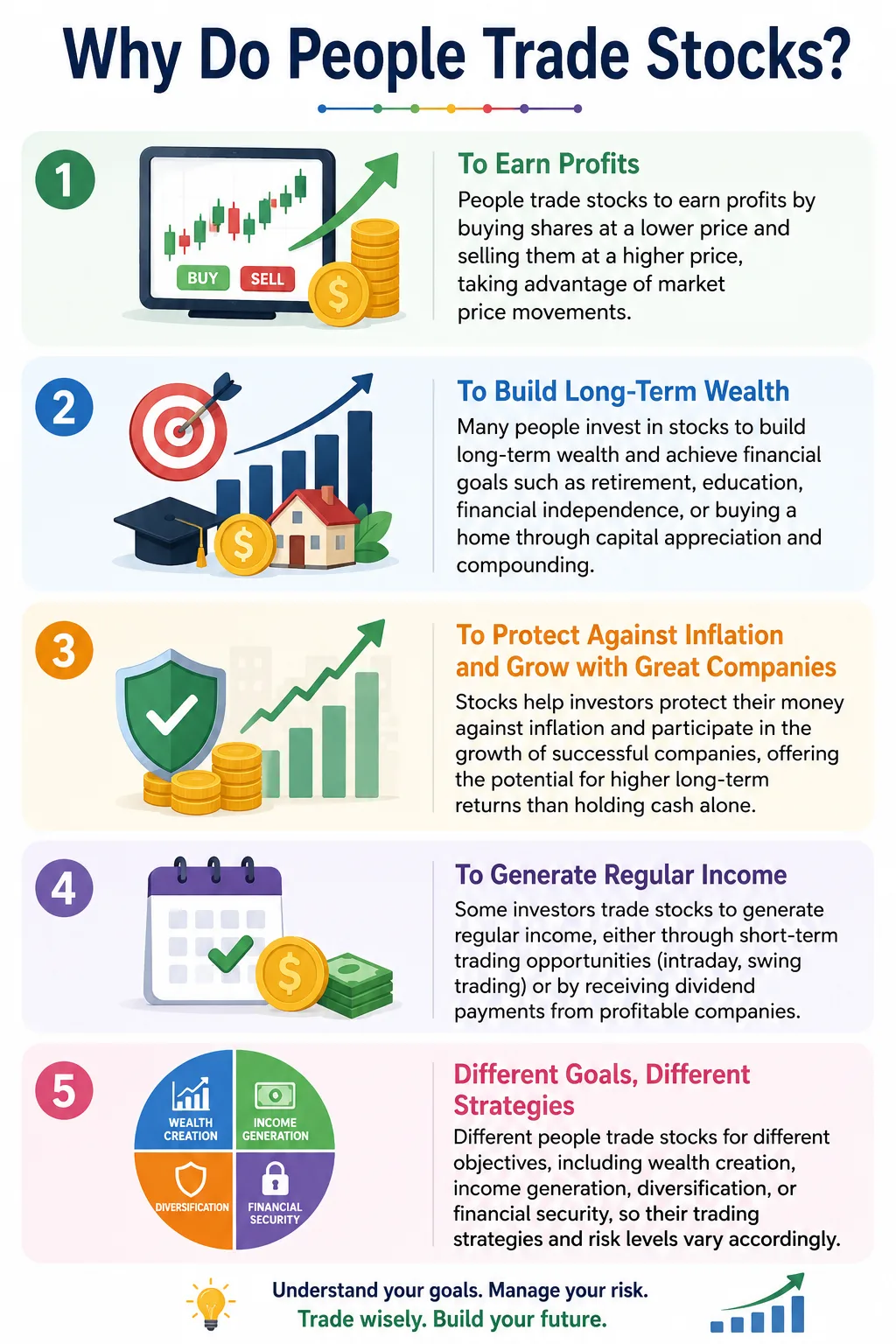
At a simple level, people trade stocks to generate profits, grow their wealth, earn income, and achieve financial goals by buying and selling company shares. But behind that simple definition, there are many different motivations. A student learning the market, a working professional investing monthly, an intraday trader watching price charts, a dividend investor building income, and an institutional fund manager handling large capital may all participate in the same stock market, but their objectives are not the same.
This is why understanding why people trade stocks is important before learning strategies, indicators, chart patterns, or order types. The reason for trading influences the style of trading, the time horizon, the risk level, and the decision-making process. A person who wants retirement wealth should not trade like a scalper. A person who wants intraday income should not think like a ten-year investor. The market offers many opportunities, but each participant must be clear about the purpose of participation.
Simple Definition
People trade stocks to generate profits, grow their wealth, earn income, and achieve financial goals by buying and selling company shares. A stock represents partial ownership in a company. When the company performs well or when market demand for its shares increases, the stock price may rise. When performance weakens or market sentiment turns negative, the stock price may fall. Traders and investors try to benefit from these changes while managing the risk of loss.
The word "trade" is often used for short-term buying and selling, while "invest" is often used for long-term ownership. In everyday discussion, people may use both words loosely. What matters is the objective. If someone buys a stock to sell after a small price move, that is trading. If someone buys a stock because they believe the company will grow for many years, that is investing. Both involve buying company shares, but the mindset and process are different.
To Earn Profits from Price Movement
The most common reason people trade stocks is to make money from price movements. A trader buys a stock at one price and hopes to sell it at a higher price. The difference between the selling price and buying price becomes profit, after deducting brokerage fees, taxes, and other charges. This is the basic idea that attracts many people to the stock market.
For example, suppose a trader buys Microsoft stock at $400 and later sells it at $430. The gross profit is $30 per share. If the trader bought 10 shares, the gross profit would be $300 before costs. If the trader bought 100 shares, the gross profit would be $3,000 before costs. The larger the price increase and the larger the position size, the higher the potential profit. But the same principle also works in reverse. If the price falls, the trader can lose money.
This profit motive is simple, but successful execution is not simple. Price movement is uncertain. A stock can rise for reasons that are easy to explain later but difficult to predict before the move. A trader must understand entry, exit, risk, position size, market condition, and emotional control. Profit is the goal, but risk management is what keeps the trader in the game.
To Grow Wealth Over Time
Many people participate in the stock market to grow wealth over several years. Over time, quality companies can increase in value as they grow revenue, improve profits, expand into new markets, develop better products, and strengthen their competitive position. When the value of a company grows, shareholders may benefit through higher stock prices.
For example, a person may invest $10,000 in a strong company or diversified stock portfolio. If the value grows to $20,000 after several years, the investor's wealth has doubled through capital appreciation. This growth does not happen in a straight line. Stock prices can rise, fall, remain flat, and become volatile. But long-term investors accept short-term fluctuations because they focus on the larger growth journey.
Wealth creation through stocks is often connected to patience and compounding. When profits are reinvested and capital grows over time, returns can build on earlier returns. This is one of the reasons long-term investing is widely used for retirement planning and financial independence. However, long-term investing still requires analysis. Not every company grows. Not every stock is worth holding. Choosing quality assets and managing risk remain important.
To Beat Inflation
Inflation reduces the purchasing power of money. If prices rise over time, the same amount of cash buys fewer goods and services. For example, $100 may buy groceries today, but after several years, the same groceries may cost $120. If money stays in a low-interest account and earns less than inflation, its real value decreases even though the account balance may look unchanged.
Stocks have historically offered the potential for returns that outpace inflation over long periods. This does not mean stocks are safe or guaranteed. Stock prices can fall sharply, and some companies can fail. But ownership in productive businesses gives investors a chance to participate in economic growth. If companies can increase revenue and profits over time, their shares may help investors preserve and grow purchasing power.
This is one of the reasons people choose stocks instead of keeping all money in cash. Cash provides stability and liquidity, but it may not grow enough to beat inflation. Stocks involve risk, but they offer growth potential. A balanced financial plan often uses both: cash for short-term needs and emergencies, and growth assets such as stocks for long-term goals.
To Earn Dividend Income
Some companies share part of their profits with shareholders through dividends. A dividend is a payment made by a company to its shareholders, usually from profits. Not all companies pay dividends. Some companies reinvest profits back into growth. Others pay regular dividends, especially mature companies with stable cash flows.
For example, suppose an investor owns 1,000 shares of a company, and the company pays a $1 dividend per share during the year. The investor receives $1,000 in annual dividend income before taxes. If the company continues paying dividends regularly, the investor may receive recurring income while still owning the shares.
Dividend investors often seek a combination of income and capital appreciation. They may choose companies with a history of stable dividends, growing dividends, strong cash flow, and reasonable debt levels. Dividend income can be useful for retirees, conservative investors, or anyone building passive income. However, dividends are not guaranteed. A company can reduce or stop dividends if business conditions weaken.
To Generate Regular Trading Income
Some people trade stocks actively to generate regular income from short-term price movements. Intraday traders buy and sell within the same trading day. Swing traders hold positions for days or weeks. Scalpers may take many trades within minutes or seconds, trying to capture very small price changes. Their goal is not to wait years for company growth but to take advantage of market movement in shorter timeframes.
Active trading requires a different mindset from long-term investing. A trader must focus on price action, volume, trend, support and resistance, momentum, news, risk-reward, and execution. The trader must also control emotions because short-term movement can be fast and stressful. A profitable setup can fail. A losing trade can tempt the trader to average down or revenge trade. Discipline is essential.
Many beginners are attracted to active trading because it appears to offer quick income. The reality is more demanding. Regular income from trading is not guaranteed. Markets change, winning streaks and losing streaks happen, and transaction costs can reduce profits. Active trading should be approached as a skill that requires education, practice, risk management, and continuous review.
To Build Long-Term Financial Security
People also invest in stocks to prepare for important future goals. These goals may include retirement, children's education, buying a house, financial independence, or creating generational wealth. Stocks are often used as part of long-term financial planning because they offer growth potential over many years.
Long-term financial security is not built through random trades. It is built through consistent saving, disciplined investing, diversified allocation, and patience. A person may invest regularly in quality stocks, mutual funds, or exchange-traded funds. Over time, regular contributions and market growth can help build a meaningful portfolio.
Compounding plays an important role in long-term wealth creation. When returns are reinvested, future returns can be earned on a larger base. The longer the time horizon, the more powerful compounding can become. This is why starting early can make a large difference. Even small amounts invested consistently over many years can grow significantly if managed wisely.
To Take Advantage of Market Opportunities
Markets constantly move because of earnings announcements, economic data, interest rate changes, company news, global events, and investor sentiment. These movements create opportunities for traders and investors. A company may announce strong earnings, causing buyers to push the price higher. A sector may benefit from a government policy. A market correction may create opportunities to buy quality stocks at lower prices.
Traders try to identify opportunities created by such events. Some use technical analysis to study charts and price behavior. Some use fundamental analysis to study company performance and valuation. Some combine both. Opportunity-based trading requires preparation because market moves often happen quickly. A trader who has a watchlist, plan, and risk rules is better prepared than someone who reacts emotionally to news.
Not every market movement is an opportunity. Some moves are noisy, risky, or driven by rumors. Skilled participants learn to separate high-quality opportunities from random volatility. They also understand that missing a trade is better than entering a poor trade. The market will always provide another opportunity, but lost capital is harder to recover.
To Diversify Investments
Many investors do not keep all their money in one asset. They diversify across stocks, bonds, mutual funds, ETFs, gold, real estate, cash, and other assets. Diversification helps reduce the impact of poor performance in any single investment. If one stock or sector performs badly, other holdings may help balance the portfolio.
Stocks provide access to many industries, such as technology, banking, healthcare, energy, consumer goods, manufacturing, and communication. Investors can choose individual stocks or diversified funds. This allows them to participate in different parts of the economy. A diversified stock portfolio may reduce company-specific risk compared with owning only one or two stocks.
Diversification does not eliminate risk. During broad market declines, many stocks can fall together. But diversification can reduce the danger of depending entirely on one company, one sector, one geography, or one asset class. It is one of the most important principles in portfolio management.
To Participate in Company Growth
Buying shares means owning a small part of a company. If the company grows, expands, becomes more profitable, and builds a stronger business, shareholders may benefit. This is one of the most powerful reasons people invest in stocks. They are not only trading numbers on a screen; they are participating in the growth of real businesses.
For example, a company may launch new products, enter new markets, improve margins, acquire competitors, or build a strong brand. If these efforts increase profits and investor confidence, the stock price may rise over time. Long-term shareholders benefit from this growth through capital appreciation and sometimes dividends.
This is why fundamental analysis matters for investors. Understanding a company's business model, revenue, profit, debt, management, competitive advantage, and industry position helps investors judge whether the company has long-term growth potential. Buying a stock only because the price is moving can be risky. Buying because the company has strong fundamentals and reasonable valuation can be part of a more thoughtful strategy.
To Hedge Against Other Risks
Some market participants use stocks or stock-related instruments to offset risks in other investments or business activities. Institutional investors, fund managers, large corporations, and professional traders may use equity positions, index products, futures, options, or sector exposures as part of risk management. This is more advanced than basic investing, but it is an important reason some participants trade.
For example, a fund manager may adjust stock exposure based on market risk. A professional trader may use one position to offset another. A large institution may balance portfolios across sectors and asset classes. Hedging does not always remove risk completely, but it can reduce or reshape risk. It requires strong knowledge and should not be attempted casually by beginners.
Different People Have Different Objectives
Not everyone in the stock market wants the same thing. A long-term investor wants to build wealth over many years. A swing trader wants to profit from price movements over days or weeks. An intraday trader wants to earn profits within the same trading day. A scalper wants to capture very small price changes through many trades. A dividend investor wants regular income from dividends. A portfolio manager wants balanced, risk-adjusted returns. An institutional investor manages large pools of capital for clients or organizations.
These differences matter because strategy must match objective. A scalper cannot use the same decision process as a retirement investor. A dividend investor should not evaluate stocks only by intraday chart patterns. A long-term investor should not panic over every small price movement. Clarity of objective prevents confusion and emotional decisions.
| Participant Type | Main Objective |
|---|---|
| Long-Term Investor | Build wealth over many years |
| Swing Trader | Profit from price movements over days or weeks |
| Intraday Trader | Earn profits within the same trading day |
| Scalper | Capture very small price changes through many trades |
| Dividend Investor | Generate regular income from dividends |
| Portfolio Manager | Achieve balanced, risk-adjusted returns |
| Institutional Investor | Manage large pools of capital for clients or organizations |
Benefits of Trading Stocks
Stock trading and investing offer several potential benefits. The first is capital appreciation. If a stock rises after purchase, the investor can gain from the price increase. This potential for growth is one of the main reasons stocks are included in many financial plans.
Another benefit is dividend income. Some companies pay shareholders regularly, creating income in addition to potential price gains. Stocks also offer liquidity in many markets. Highly traded shares can often be bought or sold quickly during market hours. This makes stocks more flexible than some assets that may take weeks or months to sell.
Online brokers have also made stock market access easier. Depending on the market and broker, people can start with relatively small amounts of capital. They can choose different styles, such as long-term investing, swing trading, intraday trading, dividend investing, or portfolio investing. Stocks also provide access to companies across many industries, allowing investors to participate in broad economic growth.
Risks of Trading Stocks
People trade stocks despite risks, and those risks must be understood clearly. The most obvious risk is capital loss. If the stock price falls after purchase, the trader or investor may lose money. Losses can be small or large depending on position size, volatility, leverage, and risk management.
Market volatility is another risk. Prices can change quickly due to news, earnings, global events, interest rates, or sentiment. Emotional decision-making can make this worse. Fear can cause early exits. Greed can cause overexposure. Hope can prevent a trader from accepting a loss. Overconfidence can lead to oversized positions.
Company-specific risk also matters. A company can face poor earnings, management issues, debt problems, lawsuits, regulatory trouble, product failures, or competitive pressure. Economic downturns and unexpected global events can affect entire markets. Successful traders and investors manage these risks through analysis, diversification, position sizing, stop losses, and disciplined planning.
Common Misconceptions
One common misconception is that stock trading is guaranteed income. It is not. No stock trade is guaranteed, and no investor is right all the time. Even experienced professionals face losses. The goal is not to avoid every loss but to manage risk and make better decisions over time.
Another misconception is that most traders become wealthy overnight. Quick profits can happen, especially during strong market moves, but quick profits are not the same as lasting skill. Many beginners make money during favorable conditions and then lose it when the market changes. Sustainable success requires process, discipline, and continuous learning.
Frequent trading does not automatically increase profits. More trades can mean more costs, more emotional pressure, and more mistakes. Quality matters more than quantity. A patient trader who waits for good opportunities may perform better than an active trader who takes random trades all day.
A Real-World Example
Suppose you buy 100 shares of a company at $50 each. Your total investment is $5,000. If the stock rises to $60, the value becomes $6,000, and the gross profit is $1,000 before costs and taxes. This shows the reward side of stock trading.
Now consider the opposite scenario. If the same stock falls to $45, the value becomes $4,500, and the loss is $500. This shows why understanding both potential rewards and risks is essential before trading. The same trade idea can produce profit or loss depending on market movement after entry.
This example also shows why position size matters. Buying 10 shares, 100 shares, or 1,000 shares changes the financial impact. A small price move can become a large profit or loss if the position is too big. Responsible traders decide risk before entering, not after the trade starts moving against them.
How to Think About Your Own Reason
Before trading stocks, every person should ask a simple question: why am I entering the market? If the answer is quick money, the risk of poor decisions is high. If the answer is long-term wealth, the strategy should match that goal. If the answer is income, the person must decide whether that income is expected from dividends, active trading, or a combination of methods.
Clear goals help define time horizon. A retirement investor may think in years or decades. A swing trader may think in days or weeks. An intraday trader may think in minutes or hours. Clear goals also define acceptable risk. Money needed for rent, debt payments, emergency expenses, or near-term commitments should not be risked in speculative trading.
Once the goal is clear, the participant can choose a suitable path. Long-term investors may focus on diversified portfolios, company fundamentals, and regular contributions. Active traders may focus on technical setups, risk-reward, stop losses, and trading journals. Dividend investors may study cash flow, payout ratios, and dividend history. The stock market is broad enough for many approaches, but each approach needs discipline.
Matching the Reason with the Right Strategy
The reason for trading stocks should always match the strategy being used. Many beginners struggle because their goal and method do not align. For example, a person may say they want long-term wealth but then react emotionally to every small intraday price movement. Another person may say they want short-term trading income but then hold losing trades for months because they do not want to accept a loss. These mismatches create confusion and often lead to poor decisions.
If the goal is long-term wealth, the strategy should focus on quality, diversification, valuation, patience, and regular investment. The investor should care more about business performance than daily price noise. Short-term volatility is still uncomfortable, but it is not the main decision driver if the long-term thesis remains strong. In this approach, time horizon is an advantage, and frequent emotional trading can become harmful.
If the goal is short-term trading income, the strategy must focus on trade setups, entry timing, stop loss placement, risk-reward, position sizing, and review. The trader cannot rely only on a good company name. Even strong companies can fall in the short term. Active traders must respect price behavior and risk. They should know before entering a trade where they are wrong and how much they are willing to lose.
If the goal is dividend income, the focus is different again. The investor should study dividend history, cash flow, payout ratio, debt, business stability, and whether the company can continue paying dividends. A high dividend yield alone is not enough. Sometimes a very high yield signals risk because the stock price has fallen sharply or the market doubts the dividend can continue.
If the goal is diversification, the investor should think about overall portfolio balance rather than one exciting stock. This may involve spreading capital across sectors, market capitalizations, geographies, or asset classes. Diversification helps reduce dependency on one outcome. It may not produce the highest possible return in every market phase, but it can reduce the damage caused by a single poor decision.
The best market participants are clear about their reason before they enter a position. They know whether they are trading, investing, earning income, hedging risk, or building a long-term portfolio. This clarity affects every decision: which stock to choose, how much capital to allocate, how long to hold, when to exit, and how to respond when the market moves unexpectedly. Without that clarity, the same stock can become a trade, an investment, and an emotional burden all at once.
Key Takeaways
People trade stocks primarily to earn profits and build long-term wealth. Stock trading can provide capital gains, dividend income, inflation protection, diversification, and opportunities to meet financial goals. Different participants, from long-term investors to intraday traders, have different objectives and strategies.
Trading offers opportunity, but it also involves significant risk. Stock prices can fall, market conditions can change, and emotional decisions can damage capital. Education, discipline, analysis, position sizing, and risk management are essential for long-term survival and improvement.
The most important lesson is that people should trade or invest with a clear purpose. A clear purpose shapes the strategy. Strategy shapes behavior. Behavior shapes results. Without clarity, stock market participation can become random and emotional. With clarity, it can become a structured path toward financial goals.