What Is Stock Trading?
Stock trading is the buying and selling of shares of publicly listed companies with the goal of earning a profit from changes in their market price. When a person buys a stock, that person becomes a partial owner, or shareholder, of the company. If the stock price rises after the purchase, the trader may sell the shares at a higher price and make a profit. If the stock price falls, the trader may sell at a lower price or continue holding the shares, but the position has moved against them and may result in a loss.
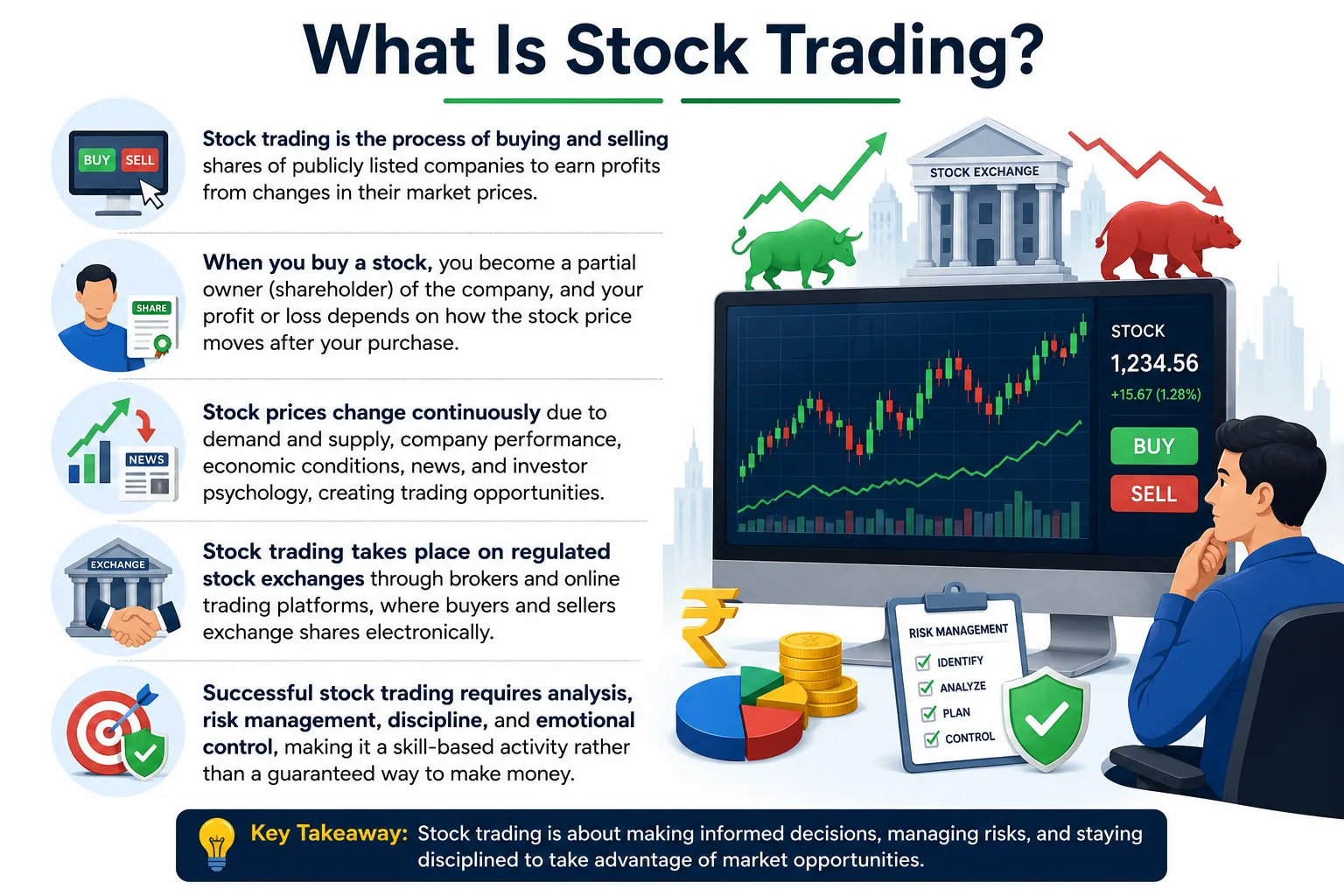
At its simplest level, stock trading looks easy: buy at a lower price and sell at a higher price. In real markets, however, the process is more complex because prices keep changing due to demand, supply, news, earnings, interest rates, global events, investor expectations, and market psychology. A stock price is not fixed by one person. It is continuously discovered through the actions of thousands or millions of buyers and sellers who place orders in the market.
Stock trading is different from simply saving money or passively holding an investment. A trader actively studies the market and makes decisions about when to enter, when to exit, how much money to risk, and what to do if the trade goes wrong. The goal is not only to find profitable opportunities but also to protect capital. This is why stock trading must be understood as a skill-based activity that combines knowledge, analysis, discipline, and risk management.
Simple Definition
Stock trading is the process of buying and selling company shares on a stock exchange to profit from price movements. A share represents a small unit of ownership in a company, and a stock exchange provides the regulated marketplace where these shares can be traded. The trader uses a broker or trading platform to place buy and sell orders, and those orders are matched with other market participants.
This definition is important because it separates stock trading from general interest in the market. A person may read business news, follow company performance, or watch stock prices without actually trading. Trading begins when a person commits capital to a market position and accepts the possibility of profit or loss. Every trade has a financial outcome, and every outcome depends on both market movement and the trader's decision-making process.
A Real-World Example
Imagine that Apple Inc. shares are trading at $200 per share. A trader decides to buy 10 shares. The total value of the purchase is 10 shares multiplied by $200, which equals $2,000. At this point, the trader owns 10 Apple shares, and the future result depends on what happens to the market price after the purchase.
In the first scenario, suppose the stock price rises to $220 after a week. If the trader sells all 10 shares at $220, the total selling value becomes $2,200. Since the original purchase value was $2,000, the gross profit is $200 before brokerage fees, taxes, and other charges. This is the basic positive outcome that most beginners imagine when they first learn about trading.
In the second scenario, suppose the stock price falls to $180. If the trader sells the 10 shares at $180, the total selling value becomes $1,800. Since the trader bought the shares for $2,000, the gross loss is $200 before charges. The same stock, same quantity, and same trader can produce either profit or loss depending on how the price moves after entry.
This simple example captures the heart of stock trading. Profit is not created at the moment of buying. Profit or loss becomes meaningful only after the price changes and the position is closed or valued. This is why timing, analysis, risk control, and emotional control matter so much. A trader cannot control the market price, but a trader can control position size, entry plan, exit plan, and risk exposure.
Why Stock Prices Change
Stock prices change because the market constantly balances buyers and sellers. When more participants are willing to buy a stock aggressively, the price tends to rise. When more participants are willing to sell aggressively, the price tends to fall. This balance is influenced by both facts and expectations. Sometimes a company performs well, but the stock still falls because the market expected even better results. Sometimes a company has weak current earnings, but the stock rises because investors expect future growth.
Company earnings and financial performance are major drivers of stock prices. If a company increases revenue, improves profit margins, reduces debt, or announces strong future guidance, buyers may become more interested. On the other hand, disappointing earnings, weak demand, rising costs, or management concerns may reduce investor confidence and push the stock lower.
Business growth prospects also influence price movement. Stock markets often value the future more than the past. A company with strong expansion plans, new products, growing market share, or innovative technology may attract buyers even if current profits are modest. Traders watch how the market reacts to such expectations because future growth narratives can create powerful price trends.
Economic conditions are another important factor. Inflation, interest rates, employment data, consumer spending, currency movement, and government policy can all affect stock prices. When interest rates rise, borrowing becomes more expensive for companies and consumers, and some investors may move money away from stocks into safer interest-bearing assets. When economic growth is strong, many companies may benefit from higher demand, and the broader market may rise.
Industry trends also matter. A strong company in a weak industry may struggle, while an average company in a fast-growing industry may attract attention. For example, technology, banking, energy, healthcare, and consumer sectors may perform differently depending on economic cycles and policy changes. Traders often study sectors because money tends to rotate from one area of the market to another.
News and major events can move prices quickly. Earnings announcements, product launches, lawsuits, mergers, acquisitions, regulatory changes, geopolitical tensions, and central bank decisions can all create volatility. Some traders specialize in reacting to news, while others avoid trading during highly uncertain events because price movement can become unpredictable.
Investor sentiment and market psychology can be just as powerful as numbers. Fear, greed, confidence, panic, and excitement influence buying and selling behavior. During optimistic periods, traders may pay higher prices because they expect continued growth. During fearful periods, even good companies may fall sharply because market participants want to reduce risk. Understanding this emotional layer helps traders avoid assuming that markets always move logically in the short term.
Where Stock Trading Happens
Stock trading happens on stock exchanges. A stock exchange is a regulated marketplace where shares of listed companies are bought and sold. Examples include the New York Stock Exchange, NASDAQ, the National Stock Exchange of India, the Bombay Stock Exchange, and the London Stock Exchange. These exchanges provide the infrastructure, rules, and systems needed for orderly trading.
In earlier times, trading was associated with physical trading floors where brokers shouted orders and negotiated prices. Modern trading is mostly electronic. Orders are entered through trading platforms, routed through brokers, and matched by exchange systems. The process happens extremely fast, but the underlying idea remains the same: buyers and sellers meet in a regulated market to exchange ownership of shares.
Exchanges also provide transparency. They publish price data, trading volume, market depth, opening and closing prices, and other information that traders use for decision-making. Regulation helps reduce fraud and unfair practices, although it does not remove market risk. Even in a regulated marketplace, prices can move sharply, and traders can lose money if they are unprepared.
Who Can Trade Stocks?
Most individuals can trade stocks if they have the required accounts, funds, and access to a broker. A broker acts as the intermediary between the trader and the stock exchange. The trader places an order through the broker's platform, and the broker routes that order to the market. In many countries, online brokers have made stock trading accessible to ordinary retail participants.
A trader usually needs a trading account with a registered broker. In some countries, such as India, a Demat account is also required to hold shares electronically. In other markets, shares are held through brokerage accounts under local settlement systems. The exact account structure depends on the country, but the broad requirement is the same: the trader needs a legal and regulated way to access the market.
A trader also needs sufficient funds. This does not mean a beginner should start with large capital. In fact, beginners often benefit from starting small while learning. But every trade requires capital, and every trade carries the possibility of loss. A trader should never use money needed for essential living expenses, debt payments, or emergency needs. Trading capital should be risk capital, not survival capital.
Access to a trading platform is also necessary. A trading platform allows users to view charts, watch prices, place orders, monitor positions, and review account balances. Modern platforms may also provide watchlists, alerts, research reports, news, option chains, technical indicators, and portfolio analytics. These tools are useful, but they do not replace knowledge. A powerful platform in the hands of an undisciplined trader can still produce poor results.
Main Types of Stock Trading
Stock trading can be practiced in different styles depending on time horizon, risk appetite, skill level, and market availability. The main styles include intraday trading, swing trading, positional trading, scalping, and long-term investing. Each style has different requirements and should not be mixed casually without understanding the difference.
Intraday trading means buying and selling on the same trading day. The trader does not carry the position overnight. This style focuses on short-term price movement and requires quick decisions, active monitoring, strict stop losses, and strong emotional control. Intraday trading can be attractive because capital is not locked for long periods, but it can also be stressful and risky for beginners.
Swing trading involves holding positions for several days or weeks. The trader aims to capture short- to medium-term price moves. Swing traders often use technical analysis, chart patterns, support and resistance, momentum signals, and sometimes fundamental triggers. Compared with intraday trading, swing trading gives more time for a trade idea to develop, but it also involves overnight risk because news can affect prices when the market is closed.
Positional trading involves holding stocks for weeks to months. This style focuses on larger trends rather than small daily fluctuations. Positional traders may combine technical analysis with company fundamentals, sector trends, and macroeconomic views. It requires patience because positions may move slowly, and temporary pullbacks are common even within a larger trend.
Scalping is an extremely short-term style where traders execute many trades within minutes or even seconds. The goal is to capture small profits repeatedly. Scalping requires speed, experience, low transaction costs, excellent execution, and strong discipline. It is not usually suitable for beginners because small mistakes can accumulate quickly.
Long-term investing is not trading in the strict active sense, but beginners often compare the two. Long-term investors hold stocks for years and focus on company growth, competitive advantage, earnings quality, management, valuation, and wealth creation. Investors are less concerned with short-term price movements, while traders focus more on timing and price behavior. Both approaches can be valid, but they require different mindsets.
Goals of Stock Trading
Traders may enter the market with different goals. Some want to generate regular income, some want to grow capital, some want to benefit from market volatility, and others want to diversify their financial activity. A trader must be clear about the goal because the goal influences strategy, risk level, trade frequency, and time commitment.
Generating regular income from trading is possible for some skilled traders, but it is not guaranteed. Beginners should be careful with the idea of monthly income from trading because markets are uncertain. Some months may provide many opportunities, while others may be choppy or difficult. A trader who forces trades just to meet an income target may take unnecessary risk.
Growing capital is a more realistic long-term objective when combined with discipline. Instead of trying to double money quickly, a trader may focus on protecting capital, improving process, and compounding results slowly. This approach is less exciting, but it is more aligned with survival in financial markets.
Many traders are attracted to volatility because price movement creates opportunity. A stock that does not move much may not offer useful trading setups, while a volatile stock may provide entries and exits. However, volatility is a double-edged sword. It can create profit potential, but it can also cause fast losses. Traders must match position size to volatility so that one trade does not damage the account badly.
Trading can also support diversification when used carefully. A person may have long-term investments, savings, and a separate trading account. Keeping these purposes separate helps avoid confusion. A failed trade should not become an accidental long-term investment, and a long-term investment should not be sold impulsively because of short-term market noise.
Advantages of Stock Trading
Stock trading offers several advantages when approached responsibly. One advantage is the potential for high returns. Strong price movements can create opportunities for traders who know how to identify setups and manage risk. This potential attracts many people to the market, but it must always be balanced with the reality that high return potential usually comes with high risk.
Liquidity is another advantage in many widely traded stocks. Liquidity means there are enough buyers and sellers for traders to enter and exit positions without major difficulty. Highly liquid stocks usually have tighter bid-ask spreads and smoother execution. Low-liquidity stocks can be dangerous because prices may move sharply when a trader tries to buy or sell.
Online brokers have made market access easier than ever. A trader can open an account, watch live prices, analyze charts, and place orders from a computer or mobile device. This convenience is useful, but it also creates a risk of overtrading. Because trading is easy to access, some beginners trade too often without proper analysis.
Another advantage is flexibility. Different people can choose different styles based on their time and personality. A full-time market participant may prefer intraday trading, while a working professional may prefer swing trading or positional trading. There is no single correct style for everyone. The best style is the one that matches the trader's schedule, temperament, and skill level.
In some markets and through certain instruments, traders may also profit from falling prices using short selling or derivatives. This ability can be useful during bearish conditions, but it requires advanced understanding and strict risk control. Beginners should first understand basic stock buying and selling before using advanced strategies.
Risks of Stock Trading
The biggest risk in stock trading is capital loss. A trader can lose money when the market moves against the position. Losses are not rare events; they are a normal part of trading. The difference between a disciplined trader and an undisciplined trader is not the absence of losses, but how losses are controlled.
Market volatility can create sudden price movement. A stock may rise or fall sharply because of earnings, news, global events, or broad market sentiment. If a trader uses excessive position size, even a small adverse move can create a large loss. This is why position sizing is one of the most important practical skills in trading.
Emotional decision-making is another major risk. Fear can cause a trader to exit good trades too early or avoid valid opportunities. Greed can cause a trader to hold too long, increase risk, or ignore warning signs. Hope can make a trader refuse to accept a loss. Anger can lead to revenge trading after a losing trade. These emotional patterns are common, and every serious trader must learn to manage them.
Overtrading is especially dangerous for beginners. Overtrading means taking too many trades, often without proper setups, because the trader feels the need to be active. Frequent trading increases transaction costs and emotional pressure. A good trader does not need to trade every market movement. Waiting for quality setups is part of the skill.
Leverage can magnify both gains and losses. In some markets, traders can borrow funds or use margin to take larger positions than their available capital. While leverage may increase profit potential, it can also create losses beyond what a beginner expects. Leverage should be used only after understanding its risks clearly.
Economic and geopolitical events can also affect stock prices. Elections, wars, central bank decisions, inflation shocks, currency movement, supply chain issues, and policy changes can move entire markets. Traders cannot control these events. They can only decide how much risk to carry and whether to avoid trading during uncertain periods.
Skills Required to Become a Successful Trader
Successful trading requires more than buying and selling. Technical analysis is one useful skill. It involves studying price charts, trends, support and resistance, volume, candlestick behavior, and indicators. Technical analysis helps traders understand market behavior and plan entries and exits, but it is not a magic prediction tool.
Fundamental analysis is also important, especially for swing, positional, and investment-oriented decisions. It involves studying company earnings, revenue, profit, debt, cash flow, valuation, business model, industry position, and management quality. A trader who understands fundamentals can better interpret why a stock may be strong or weak over time.
Risk management is the foundation of trading survival. A trader must decide how much money to risk per trade, where to place a stop loss, how much capital to allocate, and when to avoid a trade. Without risk management, even a trader with good analysis can lose money because one bad trade can damage the account.
Trading psychology is equally important. Markets test patience, discipline, confidence, and emotional balance. A trader must learn to follow a plan even when the market feels exciting or frightening. The ability to accept small losses without panic is a key part of long-term consistency.
Position sizing connects risk management with actual execution. A trader may have a correct market view but still lose too much money if the position is too large. Proper position sizing ensures that each trade has a controlled impact on the overall account. This allows the trader to survive losing streaks and continue learning.
Discipline and patience are often more valuable than prediction. Discipline means following the trading plan, respecting stop losses, avoiding random trades, and reviewing mistakes honestly. Patience means waiting for the right setup instead of forcing action. Continuous learning keeps the trader improving as markets change.
Common Misconceptions About Stock Trading
One common misconception is that stock trading provides guaranteed income. It does not. Markets are uncertain, and even experienced traders face losing trades and difficult periods. Anyone who enters trading expecting guaranteed income is likely to take emotional and unrealistic decisions.
Another misconception is that trading is a get-rich-quick method. Some people may make quick profits, especially during strong market phases, but quick profit is not the same as long-term skill. A trader who makes money without understanding risk may lose it just as quickly. Sustainable trading depends on process, not excitement.
Winning a few trades does not prove long-term success. A beginner may win because of luck, a favorable market, or random movement. Long-term performance is measured across many trades and different market conditions. Consistency requires a repeatable strategy, controlled risk, and honest review.
Many beginners also believe that successful traders predict the market perfectly. In reality, professional traders often think in probabilities. They know that any single trade can fail. Their focus is on taking trades where potential reward is reasonable compared with risk, and where the overall process can be profitable over many attempts.
Stock Trading as a Process
A good trading process usually starts with market preparation. The trader identifies the broader market condition, checks important news, reviews watchlists, and studies potential setups. This preparation helps reduce random decision-making during live market hours.
The next step is trade planning. A trade plan includes the stock to trade, entry price, stop loss, target area, position size, reason for the trade, and conditions that would cancel the idea. Writing or mentally defining these points before entry helps the trader stay objective.
Execution comes after planning. The trader places the order and monitors the position according to the plan. Execution discipline matters because hesitation, chasing price, moving stop losses emotionally, or exiting too early can damage results even when analysis is good.
Review is the final step. After the trade closes, the trader studies what happened. Was the setup valid? Was the entry disciplined? Was the risk controlled? Did emotions interfere? A trading journal helps identify repeated mistakes and strengths. Without review, the trader may repeat the same errors for months or years.
Trading vs Investing
Trading and investing both involve stocks, but they are not the same. Trading focuses on price movement over shorter periods. Investing focuses on owning quality assets for long-term growth. A trader may sell quickly when the setup fails, while an investor may hold through volatility if the long-term company thesis remains strong.
The difference matters because confusion creates poor decisions. A person may buy a stock for a short-term trade, watch it fall, and then call it a long-term investment to avoid accepting the loss. This is not investing; it is emotional avoidance. Similarly, an investor may panic during normal market corrections and sell a good long-term holding like a short-term trader. Clear intention before entry prevents this confusion.
Beginner-Friendly Way to Approach Stock Trading
A beginner should first learn market basics before risking meaningful money. This includes understanding stocks, exchanges, brokers, order types, charts, risk-reward, stop losses, and trading styles. Jumping directly into live trading without these foundations can lead to avoidable mistakes.
Paper trading or small-size trading can help beginners practice. Paper trading means practicing with simulated money, while small-size trading means using very limited real capital. Both approaches help develop familiarity with order placement, price movement, and emotional reactions.
Beginners should focus less on making quick money and more on building a process. A useful early goal is to learn how to avoid big losses. Once a trader can protect capital, the next goal is to identify valid setups. After that, the trader can work on consistency, review, and gradual improvement.
Key Takeaways
Stock trading is the buying and selling of company shares to profit from price movements. Traders earn profits when they sell at a higher price than they bought, and they incur losses when prices move against them. Trading takes place on regulated stock exchanges through licensed brokers and electronic platforms.
Prices change because of demand, supply, company performance, economic conditions, news, interest rates, industry trends, and investor psychology. A trader must understand that the market is uncertain and that no strategy wins all the time. Success depends on knowledge, preparation, discipline, and effective risk management rather than prediction or luck.
The most important lesson for beginners is that stock trading is not just about finding stocks that may rise. It is about building a complete decision-making process. A trader needs a reason to enter, a plan to exit, a limit on risk, and the discipline to follow the plan. When approached responsibly, stock trading can become a structured learning journey. When approached casually, it can become expensive speculation.
Important Note
This Stock Trading course is for educational learning only. It is not financial advice, investment advice, or a recommendation to buy or sell any stock. Stock markets involve risk, and learners should study carefully, understand local regulations, and consult qualified professionals where required before making financial decisions.