Trader vs Investor
A trader and an investor both participate in the stock market, but they do not participate in the same way. Both may buy shares of publicly listed companies, both may use brokerage accounts, and both may benefit when market prices move in their favor. The difference is in their purpose, time horizon, decision-making process, risk control, emotional pressure, and method of earning returns. An investor aims to build wealth over the long term by owning quality assets, while a trader seeks to profit from shorter-term price movements by buying and selling more frequently.
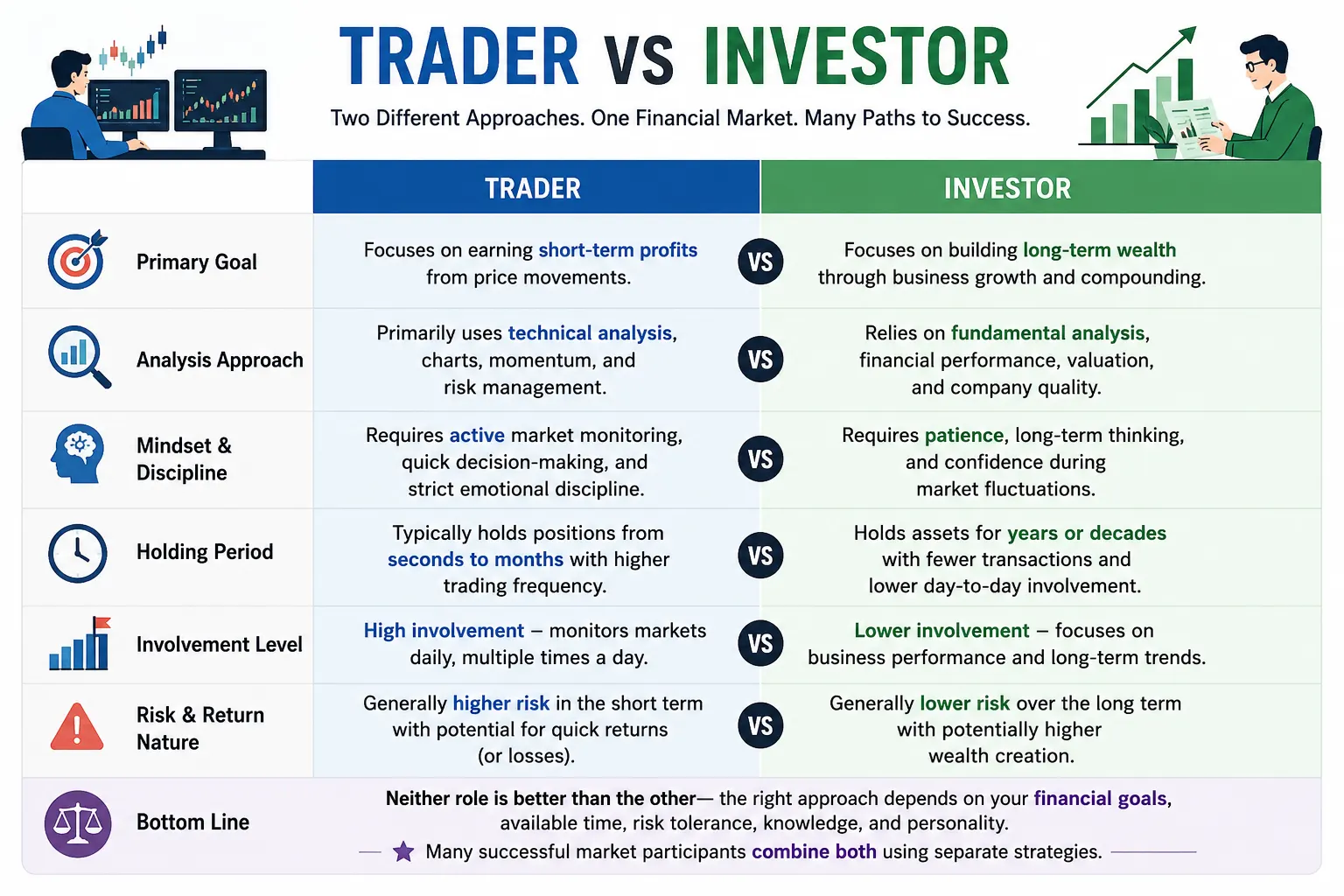
This distinction is important for every beginner because many losses happen when people confuse the two roles. A person may enter a stock as a short-term trade, but when the price falls, they suddenly call it an investment to avoid accepting a loss. Another person may buy a stock for long-term wealth creation but watch every small price movement like an intraday trader and exit emotionally. The market does not reward confusion. Before buying any stock, a person should know whether the decision is a trade or an investment.
The same company can be used by different people for different purposes. One person may buy NVIDIA, Apple, Microsoft, Reliance, Infosys, or any other major stock because they believe the business will grow over the next decade. Another person may buy the same stock only because the chart shows a short-term breakout, momentum setup, or intraday opportunity. The stock is the same, but the plan is different. That plan determines how the person should analyze, enter, manage, and exit the position.
Simple Definition
A trader buys and sells financial assets to profit from short-term price movements. The trader is interested in price behavior, timing, volatility, momentum, support, resistance, volume, and risk-reward. A trader may hold a position for seconds, minutes, hours, days, weeks, or sometimes a few months, depending on the trading style. The goal is not necessarily to own the business for a long time. The goal is to capture a price move and exit according to a defined plan.
An investor buys and holds financial assets for the long term to benefit from business growth, capital appreciation, dividends, and compounding. The investor is interested in the quality of the business, management, financial performance, competitive advantage, valuation, industry growth, and long-term prospects. An investor may hold a stock for years or decades if the investment thesis remains strong.
Both trading and investing can be legitimate market approaches. Neither is automatically superior. The better choice depends on the person's financial goals, available time, knowledge, temperament, risk tolerance, and ability to follow a process. A person who can analyze businesses patiently may become a good investor. A person who can manage risk, follow charts, control emotions, and make disciplined decisions may become a good trader. The skill set is different, and beginners should respect that difference.
Real-World Example
Suppose NVIDIA stock is trading at $150. An investor may buy 100 shares at $150 and hold them for ten years. The investor expects that the company will continue growing, generating revenue, improving earnings, expanding its market position, and creating long-term value. If the company performs well and the stock appreciates significantly over time, the investor benefits from capital appreciation. If the company pays dividends, the investor may also receive income along the way.
A trader may also buy 100 shares of NVIDIA at $150, but with a completely different intention. The trader may notice strong momentum, a breakout above resistance, high volume, or a favorable intraday setup. The trader may sell at $155 the same day or after a few days, capturing a $5 per share move. Once the trade is closed, the trader looks for the next opportunity. The trader is not necessarily concerned with holding NVIDIA for ten years. The focus is the short-term setup.
Both people used the same stock, but their objectives were different. The investor wanted long-term participation in business growth. The trader wanted short-term profit from price movement. The investor may tolerate temporary declines if the long-term thesis remains valid. The trader may exit quickly if the setup fails. This example shows why the difference between trader and investor is not just about buying and selling. It is about intention.
Primary Goal
The primary goal of a trader is to generate profits from price movement. Traders look for opportunities where the probability of a favorable price move is higher than the risk they are taking. They may use technical analysis, chart patterns, price action, indicators, volume behavior, news catalysts, or market sentiment. A trader's success depends on finding setups, managing losses, protecting capital, and repeating a process consistently.
The primary goal of an investor is long-term wealth creation. Investors usually focus on owning assets that can become more valuable over time. They may buy shares of strong companies, diversified funds, or other long-term assets. Investors benefit from business growth, earnings expansion, dividends, and compounding. Their success depends on choosing quality assets, buying at reasonable valuations, diversifying wisely, and staying patient through market cycles.
This difference in goal changes every other decision. A trader may sell a profitable position after a small move because the trade target has been reached. An investor may ignore the same small move because the long-term value of the business is more important. A trader may exit a losing position quickly because the setup is invalid. An investor may hold through a decline if the business remains strong and the original thesis is intact.
Holding Period
Holding period is one of the clearest differences between traders and investors. Traders usually operate with shorter time horizons. A scalper may hold a position for seconds or minutes. An intraday trader opens and closes positions within the same trading day. A swing trader may hold for a few days or weeks. A position trader may hold for weeks or months, but the intention is still usually to capture a market move rather than own a business indefinitely.
Investors usually operate with longer time horizons. They may hold assets for several years, ten years, twenty years, or even longer. The investor's goal is to let business growth and compounding work over time. Long-term investing accepts that markets will rise and fall many times, but the investor focuses on whether the asset can create value across cycles.
Holding period affects psychology. Short-term traders face frequent decisions and quick feedback. Long-term investors face slower feedback and must handle uncertainty over years. A trader may feel pressure from every price tick. An investor may feel pressure during major market declines or long periods of underperformance. Both require emotional discipline, but the type of discipline differs.
Focus: Price Movement vs Business Growth
A trader primarily focuses on price movement. The trader studies how buyers and sellers are behaving in the market. Price action, trend direction, support and resistance, moving averages, candlestick patterns, breakouts, breakdowns, volume spikes, volatility, and momentum all matter. A trader may not need to know every detail of the company's long-term business if the trade is based on a short-term technical setup.
An investor primarily focuses on business growth. The investor asks whether the company can generate revenue, earn profits, manage debt, expand margins, defend market share, innovate, and grow over time. The investor studies financial statements, management quality, industry outlook, competitive advantage, valuation, and long-term risks. Price matters, but price is compared with value.
This does not mean traders ignore fundamentals completely or investors ignore price completely. A smart trader may avoid trading during major earnings risk or may use news as a catalyst. A smart investor still cares about valuation and price paid. But the emphasis is different. Traders are usually price-first. Investors are usually business-first.
Analysis Style
Traders commonly use technical analysis. Technical analysis studies price charts, trends, patterns, indicators, volume, volatility, and market behavior. A trader may use tools such as support and resistance, moving averages, relative strength index, MACD, Bollinger Bands, Fibonacci levels, trendlines, candlestick patterns, and volume analysis. The purpose is to identify entry points, exit points, stop losses, and risk-reward opportunities.
Investors commonly use fundamental analysis. Fundamental analysis studies the economic and financial strength of a business. An investor may review revenue growth, earnings, profit margins, cash flow, debt levels, return on equity, competitive advantage, management quality, industry position, and valuation ratios. The purpose is to decide whether the business is strong enough to own and whether the current price is reasonable compared with future potential.
Both analysis styles require skill. Technical analysis is not simply drawing lines on a chart. It requires understanding market structure, probability, risk, and execution. Fundamental analysis is not simply buying famous companies. It requires understanding financial health, valuation, competitive forces, and long-term uncertainty. The trader and investor both need knowledge, but they apply it differently.
Number of Transactions
Traders usually make more transactions than investors. An active day trader may place several trades in a single day. A swing trader may place several trades in a month. A scalper may place many trades in a single session. This higher activity creates more opportunities, but it also creates more chances to make mistakes. More trades mean more transaction costs, more decision points, and more emotional pressure.
Investors usually make fewer transactions. They may spend more time researching before buying and then hold the investment for long periods. They may add more shares during corrections, rebalance periodically, or sell when the investment thesis changes. Because transaction frequency is lower, costs are often lower and decision-making is less frequent.
High transaction frequency does not automatically mean higher returns. A trader can be active and still lose money if the strategy lacks an edge or discipline is weak. Low transaction frequency does not automatically mean safety. An investor can hold a poor-quality business for years and lose capital. The quality of the decision matters more than the number of transactions.
Time Commitment
Trading generally requires more active time. Intraday traders need to watch markets during trading hours, monitor entries and exits, manage risk, react to movement, and review performance. Swing traders may need less screen time than day traders, but they still need regular chart review, market scanning, and position management. Trading casually without time and focus can be risky.
Investing generally requires less daily monitoring. Investors may spend significant time researching before buying, but after the investment is made, they usually review periodically. They may follow quarterly results, annual reports, company announcements, valuation changes, and portfolio allocation. They do not need to watch every price tick unless they choose to do so.
This makes investing more practical for many people with full-time jobs, businesses, studies, or family responsibilities. Trading can also be done by people with other responsibilities, but the style must match available time. A person who cannot watch the market during trading hours should be careful with intraday trading. Swing trading or long-term investing may be more realistic.
Risk Level
Trading is generally considered higher risk because decisions are frequent, price movement is short term, and leverage or margin may be used in some markets. Short-term price movement can be unpredictable. News, earnings, global events, liquidity, and sudden sentiment changes can move prices quickly. A trader must manage losses strictly because repeated small losses or one large uncontrolled loss can damage capital.
Investing is generally lower risk over long periods when done with diversification, quality selection, and patience, but it is not risk-free. Companies can fail, industries can decline, valuations can become excessive, and long bear markets can occur. Investors can lose money if they buy weak businesses, overpay, lack diversification, or sell emotionally during market downturns.
The key point is that both traders and investors need risk management. Traders manage risk with stop losses, position sizing, risk per trade, and trade plans. Investors manage risk with asset allocation, diversification, quality analysis, valuation discipline, and long-term planning. Risk is not removed by choosing one approach. It is managed differently.
Income Generation
A trader earns money primarily through trading profits. The trader may buy low and sell high, or in markets where it is permitted, short-sell to profit from falling prices. Some traders focus on small frequent profits, while others wait for larger moves. Trading income depends on execution, strategy, risk management, market conditions, and consistency.
An investor earns money mainly through capital appreciation and dividends. Capital appreciation occurs when the value of the investment increases over time. Dividends are payments some companies distribute to shareholders from profits. Investors may also benefit from compounding when gains and dividends are reinvested and allowed to grow over many years.
Trading income can appear faster, but it can also be unstable. Investing income may develop slowly, but compounding can become powerful over long periods. A beginner should not assume that trading is easier because profits can happen quickly. Quick profits require skill, and quick losses are also possible.
Emotional Pressure
Traders face intense emotional pressure because decisions are frequent and outcomes are visible quickly. A trader may experience fear after entering a trade, greed when a trade moves favorably, frustration after a loss, and overconfidence after a win. Emotional mistakes such as revenge trading, overtrading, moving stop losses, exiting too early, or holding losers too long are common.
Investors face a different emotional challenge. They need patience. They must handle market corrections, bad news, slow growth periods, and temporary underperformance. It can be difficult to hold a long-term investment when the market is falling or when other stocks are rising faster. Investors must avoid panic selling and also avoid blindly holding when the business quality has actually deteriorated.
Both roles require discipline. The trader's discipline is immediate and execution-focused. The investor's discipline is patient and thesis-focused. A person should choose the role that matches their temperament. Someone who becomes anxious watching intraday price movement may struggle as a trader. Someone who cannot wait for long-term results may struggle as an investor.
Skills Required for Traders
A trader needs technical analysis, risk management, fast decision-making, chart reading, emotional discipline, and execution skill. The trader must understand entries, exits, stop losses, position sizing, trade management, and risk-reward. A trader should also maintain a trade journal to review decisions and improve over time.
Risk management is especially important. A trader can be wrong many times and still survive if losses are small and controlled. But one undisciplined trade can create serious damage. This is why professional traders often focus on protecting capital first and making profit second. The market will always offer new opportunities, but capital must be preserved to participate in them.
A trader also needs the ability to wait. Beginners often think trading means constant action. In reality, good trading often means waiting for the right setup and ignoring weak opportunities. Patience is not only an investor's skill. Traders also need patience, but their patience is used to wait for high-quality setups and then act decisively.
Skills Required for Investors
An investor needs fundamental analysis, business understanding, financial statement reading, valuation awareness, patience, portfolio management, and long-term thinking. Investors should understand how companies make money, what risks they face, how competitive advantage works, and whether the current price is reasonable compared with future potential.
Investors also need asset allocation and diversification skills. Even a good company can face unexpected problems. A portfolio that depends too much on one stock, one sector, or one idea can become risky. Diversification helps reduce the impact of individual mistakes while still allowing long-term growth.
Patience is one of the investor's strongest skills. Many long-term returns come from staying invested through uncomfortable periods. However, patience should not become stubbornness. If the business thesis breaks, if management quality deteriorates, if debt becomes dangerous, or if valuation becomes irrational, an investor may need to review or exit. Good investing combines patience with judgment.
Advantages of Being a Trader
Trading offers frequent opportunities. Markets move every day, and different stocks, sectors, or instruments may create setups. A trader does not need to wait years for a company to grow. If a valid setup appears and the market moves favorably, the trader can make a profit in a shorter time.
Trading can also be flexible across market conditions. Depending on the market, instrument, and rules, traders may find opportunities in rising markets, falling markets, or sideways markets. Some traders focus on momentum, some on reversals, some on breakouts, and some on mean reversion. This flexibility attracts active market participants.
Another advantage is active involvement. Some people enjoy studying charts, planning trades, managing positions, and reviewing performance. For them, trading can become a structured skill. But this advantage applies only when trading is treated seriously, not as gambling or random buying and selling.
Advantages of Being an Investor
Investing offers the potential for long-term wealth creation. By owning quality businesses or diversified assets over time, investors can benefit from growth, dividends, and compounding. This makes investing suitable for long-term goals such as retirement, education planning, home buying, and financial independence.
Investing usually requires less daily monitoring than trading. Investors still need to review their portfolios, but they do not need to watch every minute of market movement. This can reduce stress and make investing practical for people who cannot dedicate full-time attention to markets.
Investing may also involve lower transaction costs because buying and selling are less frequent. Over long periods, reduced costs and compounding can make a meaningful difference. Investors can also benefit from time in the market, which is often more important than perfectly timing every market move.
Challenges Faced by Traders
Traders face high emotional pressure. Since trades are short term, results appear quickly. A few losses can affect confidence, and a few wins can create overconfidence. The trader must remain disciplined in both situations. Emotional control is often more difficult than learning chart patterns.
Traders also face transaction costs, slippage, spreads, taxes, and execution risk. Frequent trading means these costs can accumulate. A strategy that looks profitable before costs may become weak after costs. Traders must calculate realistic net results, not just gross profits.
Another challenge is consistency. Markets change. A strategy that works in a trending market may fail in a sideways market. A trader must adapt without abandoning discipline. This requires review, journaling, and continuous learning. Trading is not a one-time skill. It must be maintained.
Challenges Faced by Investors
Investors face the challenge of patience. A good investment may take years to show meaningful results. During that time, the stock may decline, move sideways, or underperform the broader market. Investors must avoid reacting emotionally to every short-term movement.
Investors also face business risk. A company that looks strong today may face competition, regulation, management problems, technology disruption, debt issues, or declining demand. Long-term investing requires periodic review because businesses are not static. A buy-and-hold approach should not become buy-and-ignore.
Another challenge is valuation. Even a great company can be a poor investment if bought at an extremely high price. Investors must understand that quality and price both matter. Long-term confidence should be supported by analysis, not blind belief.
Can Someone Be Both?
Yes, someone can be both a trader and an investor, but the two activities should be separated clearly. Many experienced market participants maintain a long-term investment portfolio and also allocate a smaller portion of capital to trading. For example, a person may keep 80% of capital in long-term investments and use 20% for active trading. This allows participation in long-term wealth creation while also pursuing shorter-term opportunities.
The key is to keep the rules separate. The investment portfolio should be managed with investment logic: business quality, valuation, diversification, and long-term goals. The trading account should be managed with trading logic: setups, stop losses, position sizing, and risk-reward. Mixing the two creates problems.
The most dangerous mistake is turning a failed trade into an investment. If a trader buys a stock for a breakout and the breakout fails, the trade plan should decide the exit. Saying "I will hold it for the long term now" is usually not investing. It is avoiding a loss. Similarly, an investor should not panic-sell a long-term holding because of a small intraday move. Clear classification prevents emotional decisions.
Common Misconceptions
One misconception is that every trader is also an investor. This is not true. A trader may have no intention of owning a business for years. The trader may only care about a price setup. Another misconception is that every investor is a trader. Long-term investors may buy and sell rarely. They participate in the market, but their process is different from active trading.
Another misconception is that traders are always more profitable than investors because they are more active. Activity does not equal profitability. A trader who takes many poor trades may lose money faster than an investor who patiently holds quality assets. On the other hand, investors are not automatically safe. A person can lose money by holding weak companies for years.
Some people also think investors ignore the market. Good investors do not ignore the market; they review periodically. They simply do not react to every small movement. Similarly, successful traders are not random speculators. Good traders follow plans, manage risk, and review performance. Both roles require discipline.
Trader vs Investor Comparison
| Aspect | Trader | Investor |
|---|---|---|
| Objective | Profit from short-term price changes | Build long-term wealth |
| Holding Period | Seconds to months | Years to decades |
| Primary Focus | Price action and momentum | Business performance and value |
| Analysis | Mostly technical analysis | Mostly fundamental analysis |
| Trading Frequency | High | Low |
| Time Required | High | Moderate to low |
| Risk Style | Immediate risk control with stop losses | Long-term risk control with diversification |
| Stress Level | Usually higher | Usually lower, but not absent |
How Beginners Should Decide
Beginners should choose based on goals, time, personality, and risk tolerance. If a person wants long-term wealth creation and cannot monitor markets daily, investing may be more suitable. If a person enjoys active market analysis, can dedicate focused time, and is willing to learn risk management deeply, trading may be explored carefully.
Capital should also be considered. Essential money should not be used for high-risk trading. Money needed for rent, education, emergency expenses, loan payments, or near-term goals should be protected. Trading capital should be risk capital. Investment capital should also be planned according to time horizon and risk tolerance.
A practical path for beginners is to learn investing basics first, because it builds understanding of companies, markets, risk, compounding, and financial planning. Trading can be learned gradually through education, paper trading, small position sizes, journaling, and strict risk limits. There is no need to rush. The market will always provide future opportunities.
Key Takeaways
A trader focuses on short-term price movements, while an investor focuses on long-term business growth and wealth creation. Traders generally rely more on technical analysis, price action, volume, momentum, and risk-reward setups. Investors generally rely more on fundamental analysis, company quality, valuation, dividends, and compounding.
Trading usually requires more time, faster decisions, stricter risk control, and stronger emotional discipline under pressure. Investing usually requires patience, business understanding, portfolio management, and the ability to stay calm during market cycles. Both approaches can work when they match the person's goals and temperament.
The most important lesson is clarity. A trade should have a trading plan. An investment should have an investment thesis. If the reason for buying is clear, the exit decision becomes easier. If the reason is unclear, market movement can turn into confusion. Successful market participation begins with knowing whether you are acting as a trader or as an investor.