Investing vs Trading
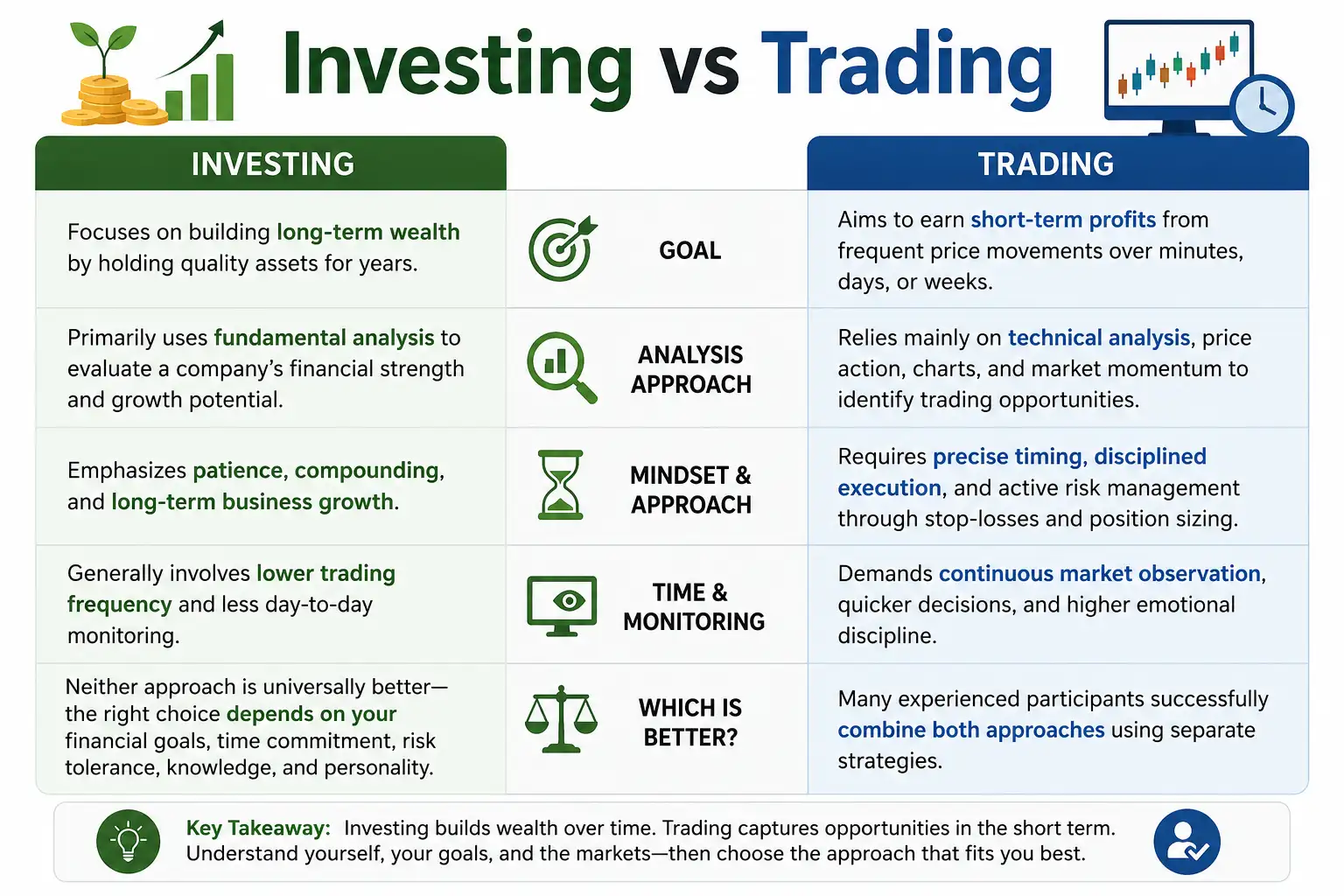
Although investing and trading both involve buying and selling financial assets such as stocks, ETFs, mutual funds, and other market instruments, they are not the same activity. They differ significantly in time horizon, objectives, strategies, risk, decision-making, emotional pressure, and the amount of attention required. The primary distinction is simple: investors focus on long-term wealth creation, while traders aim to profit from short-term price movements.
This difference may sound small at first, but it changes almost everything about how a person participates in the market. An investor may buy shares of a strong company and hold them for many years because they believe the company will grow. A trader may buy the same company for a few minutes, hours, days, or weeks because the price chart shows a short-term opportunity. The asset may be the same, but the reason for entering, the analysis used, the risk plan, and the exit decision are completely different.
Understanding this difference is essential for beginners. Many people lose money because they confuse investing and trading. They enter a stock as a short-term trade, but when it falls, they call it a long-term investment to avoid accepting a loss. Others buy for long-term wealth but panic during normal market corrections because they watch prices like intraday traders. Clarity matters. Before buying any asset, a person should know whether the decision is an investment or a trade.
Simple Definition
Investing is buying assets with the intention of holding them for the long term to benefit from business growth, capital appreciation, dividend income, and compounding. Investors usually focus on the quality of the company or asset, the strength of its fundamentals, and its potential to grow over years.
Trading is buying and selling assets over shorter periods to profit from price fluctuations. Traders focus more on price movement, market momentum, technical patterns, volume, support and resistance, and risk-reward setups. A trader may not care about owning the company for many years. The goal is to capture a price move and exit according to plan.
Both investing and trading can be useful when done properly. Both can also be risky when done without knowledge. The key is alignment. The method must match the goal, time horizon, personality, and risk tolerance of the person using it.
A Real-World Example
Suppose Apple stock is trading at $200. An investor buys 100 shares at $200 and holds them for 10 years. Over time, the business grows, earnings improve, new products succeed, and the stock rises to $500. The investor may also receive dividends if the company pays them. In this case, wealth increases through long-term appreciation and possible income. The investor's success depends on patience, company growth, valuation, and the ability to stay invested through market cycles.
A trader may also buy Apple stock at $200, but with a completely different plan. The trader may notice strong intraday momentum or a breakout pattern and buy 100 shares at $200. If the stock reaches $210 after a few hours or days, the trader sells and earns $10 per share before costs. The trader then looks for the next opportunity. The trader's success depends on timing, execution, position sizing, risk control, and emotional discipline.
Both the investor and trader made money in this example, but they did not use the same approach. The investor relied on long-term business growth and compounding. The trader relied on short-term price movement. The investor accepted years of market fluctuation. The trader focused on a shorter move and exited quickly. This example shows why the difference between investing and trading is not only about buying and selling. It is about purpose.
Key Differences
The most important difference between investing and trading is the primary goal. Investing aims for long-term wealth creation. Trading aims for short-term profit from price movement. Because the goals differ, the methods also differ. Investors often rely on fundamental analysis. Traders often rely on technical analysis, market behavior, volume, and price action, sometimes combined with fundamentals.
| Feature | Investing | Trading |
|---|---|---|
| Primary Goal | Long-term wealth creation | Short-term profit |
| Holding Period | Years to decades | Seconds to months |
| Focus | Company growth | Price movement |
| Decision Basis | Fundamental analysis | Technical analysis and market behavior |
| Number of Trades | Low | High |
| Time Commitment | Low to moderate | High |
| Market Monitoring | Occasional | Continuous |
| Transaction Costs | Generally lower | Can be higher due to frequent trades |
| Emotional Pressure | Lower | Higher |
| Risk Profile | Generally lower over long periods, not risk-free | Generally higher because of short-term volatility |
The table gives a quick comparison, but the deeper difference is mindset. An investor thinks like a business owner. A trader thinks like a market operator. The investor asks whether the company can grow over time. The trader asks whether the price can move favorably within the planned timeframe. Neither mindset is automatically superior. Each is useful for a different purpose.
Investing Explained
Investing means purchasing assets because you believe their value will grow over time. In the stock market, this usually means buying shares of companies that have strong business models, growth potential, competitive advantages, financial strength, or attractive valuations. Investors are less concerned with daily price fluctuations and more concerned with long-term value creation.
Investors typically evaluate the business model, revenue growth, profitability, competitive advantage, financial statements, industry outlook, management quality, debt levels, cash flow, and valuation. They may study whether the company can grow earnings over many years and whether the current price is reasonable compared with future potential. This is why fundamental analysis is central to investing.
The objective of investing is to benefit from capital appreciation, dividend income, and long-term compounding. Capital appreciation happens when the value of the investment increases. Dividend income comes when companies distribute part of their profits to shareholders. Compounding happens when returns build on previous returns over time. This is why long-term investing can become powerful when practiced patiently and consistently.
For example, if you invest $10,000 in a strong company or diversified fund and it grows at an average annual return of 10% for 15 years, the investment could grow to more than $40,000 through compounding. Actual returns are never guaranteed, and markets can be volatile, but the example shows why time matters in investing. The longer the time horizon, the more opportunity compounding has to work.
Trading Explained
Trading focuses on taking advantage of short-term market movements. A trader does not necessarily need to believe that a company will grow for many years. The trader needs a setup where price may move favorably within the chosen timeframe. This timeframe may be minutes, hours, days, weeks, or months depending on the trading style.
Traders typically analyze charts, candlestick patterns, support and resistance, trend direction, technical indicators, trading volume, volatility, market momentum, and news catalysts. Some traders also use fundamentals, especially for swing or position trades, but technical analysis often plays a larger role because trading decisions depend heavily on timing.
For example, a trader may buy a stock at $100 and sell it at $103 the same day. The profit is $3 per share before costs. The trader then looks for another opportunity. This process may be repeated whenever suitable setups appear. Unlike investing, the trader is not depending on years of business growth. The trader is depending on a planned price movement.
Trading requires active decision-making. The trader must know where to enter, where to exit, where to place a stop loss, how much capital to risk, and what conditions invalidate the trade. Because the timeframe is shorter, emotional pressure is often higher. Prices can move quickly, and hesitation or impulsive action can affect results.
Types of Investing
Value investing involves buying stocks that appear undervalued based on fundamentals. A value investor looks for situations where the market price is lower than the estimated intrinsic value of the business. This approach requires patience because undervalued stocks may remain undervalued for some time before the market recognizes their worth.
Growth investing focuses on companies expected to grow faster than the overall market. Growth investors may accept higher valuations if they believe revenue, earnings, or market share can expand significantly. This style can produce strong returns, but it can also be volatile if growth expectations are not met.
Dividend investing focuses on companies that pay regular dividends. Investors using this approach may look for stable cash flows, dividend history, sustainable payout ratios, and strong balance sheets. The goal is often a combination of income and long-term appreciation.
Index investing involves investing in index funds or ETFs that track a market index. Instead of choosing individual stocks, the investor gains exposure to a broad market or sector. This approach is popular because it offers diversification, simplicity, and lower maintenance.
Long-term investing means holding quality investments for many years regardless of short-term market fluctuations. The investor focuses on wealth creation through time, discipline, and compounding. This approach does not mean ignoring the portfolio completely; periodic review is still necessary.
Types of Trading
Intraday trading means opening and closing positions within the same trading day. The trader does not hold the position overnight. This style requires active monitoring, fast decisions, and strict risk control. It can offer frequent opportunities but also creates high emotional pressure.
Swing trading involves holding positions for several days or weeks. Swing traders try to capture short- to medium-term price moves. They often use chart patterns, trend analysis, support and resistance, volume, and momentum. This style requires less screen time than intraday trading but still needs regular monitoring.
Scalping involves making many quick trades to capture small price movements. Scalpers may hold positions for seconds or minutes. This style requires speed, experience, low transaction costs, and strong execution discipline. It is usually not beginner-friendly.
Position trading holds trades for weeks or months while following longer-term trends. It sits between short-term trading and long-term investing. Position traders may combine technical and fundamental analysis to capture larger market moves.
Momentum trading focuses on stocks showing strong upward or downward price momentum. Momentum traders attempt to participate while the price movement is strong and exit when momentum weakens. This strategy requires discipline because momentum can reverse quickly.
Advantages of Investing
Investing offers the potential for long-term wealth creation. By owning quality assets over time, investors can benefit from business growth, capital appreciation, dividends, and compounding. This makes investing suitable for long-term financial goals such as retirement, education funding, buying a home, or financial independence.
Investing usually requires less daily monitoring than active trading. An investor still needs to review holdings periodically, but they do not need to watch every price tick. This makes investing more suitable for people with jobs, businesses, studies, or other responsibilities. Lower trade frequency also means transaction costs are generally lower.
Investing can also be less stressful than active trading because the focus is long term. Short-term price fluctuations still matter, but they are not the main decision driver if the investment thesis remains valid. A patient investor can avoid many emotional decisions caused by daily market noise.
Advantages of Trading
Trading offers the opportunity to profit in the short term. A trader does not need to wait years for a company to grow. If a valid setup appears and the market moves favorably, a trade can produce results quickly. This is one reason active market participants are attracted to trading.
Trading can also provide more frequent opportunities. Markets move every day, and different stocks show different patterns. Traders can adapt to rising markets, falling markets, and sideways markets depending on their strategy. In some markets and instruments, traders may also benefit from downward movement through short selling or derivatives, though these require advanced understanding and strong risk control.
Trading gives active participants a sense of direct involvement. Some people enjoy analyzing charts, planning trades, managing entries and exits, and reviewing performance. For those with the right temperament, discipline, and time commitment, trading can be a structured skill-based activity.
Disadvantages of Investing
Investing requires patience. Returns may take years to develop, and the path is rarely smooth. Even strong companies can face corrections, recessions, weak quarters, or market-wide declines. Investors must be emotionally prepared to hold through volatility when the long-term thesis remains valid.
Capital may also be tied up for longer periods. Money invested for long-term goals should not be money needed for immediate expenses. If an investor is forced to sell during a market decline because they need cash, the long-term plan can be damaged. This is why emergency funds and asset allocation matter.
Returns are not guaranteed. A company may fail to grow, lose competitive advantage, face management problems, or become overvalued. Long-term investing reduces some short-term noise, but it does not remove risk. Investors still need analysis, diversification, and periodic review.
Disadvantages of Trading
Trading requires significant time and attention. Active traders must monitor markets, analyze setups, manage open positions, and review results. This can be difficult for people who cannot dedicate focused time. Entering trades casually during a busy day can lead to poor decisions.
Trading also creates higher emotional pressure. Short-term price movement can trigger fear, greed, impatience, revenge trading, and overconfidence. A trader may exit too early, hold too long, ignore stop losses, or overtrade after a loss. Emotional discipline is one of the hardest parts of trading.
Frequent transaction costs can reduce profitability. Brokerage fees, taxes, spreads, slippage, and other charges matter more when trades are frequent. A strategy that looks profitable before costs may perform poorly after costs. Traders must consider the full cost of execution.
Short-term volatility creates greater risk. Prices can move sharply due to news, earnings, global events, or sudden market sentiment changes. Poor risk management can lead to substantial losses. This is why position sizing and stop loss planning are essential for traders.
Which Is Better?
There is no universally better choice between investing and trading. The better approach depends on the individual. Investing is generally suitable for people who want long-term wealth creation, have limited time to monitor markets, prefer a lower-maintenance approach, and are comfortable holding investments through market cycles.
Trading may suit people who enjoy analyzing markets regularly, can dedicate time each day, have strong discipline, understand risk management, and accept the higher risks associated with active trading. Trading is not automatically better because it is active, and investing is not automatically safer because it is long term. Both require knowledge.
Many experienced market participants combine both approaches. They may maintain a long-term investment portfolio for wealth creation while allocating a smaller portion of capital to active trading. This can work if the two activities are kept separate. The investor side should follow investment rules, and the trading side should follow trading rules. Confusing the two can create problems.
Common Misconceptions
One common misconception is that investing is the same as trading. They both involve market participation, but they are different disciplines. Investing focuses on ownership and long-term growth. Trading focuses on price movement and shorter-term opportunities.
Another misconception is that trading guarantees faster wealth creation. Trading can produce quick profits, but it can also produce quick losses. Frequent trading does not automatically mean better results. Without strategy, discipline, and risk management, active trading can damage capital quickly.
Long-term investing is also misunderstood. It is not "buy and forget." Investments still require periodic review. Companies change, industries change, valuations change, and personal goals change. Long-term investors should avoid emotional over-monitoring, but they should not ignore their portfolio completely.
Successful trading is not constant buying and selling. It depends on patience, setup quality, risk control, execution, and review. Sometimes the best trading decision is not to trade. Beginners often underestimate the value of waiting.
How to Choose Your Approach
Choosing between investing and trading begins with self-awareness. A person should ask how much time they can dedicate, how much risk they can tolerate, how emotionally stable they are during losses, and what financial goal they are trying to achieve. A person with a long-term retirement goal and limited market time may be better suited to investing. A person with time, discipline, and interest in market behavior may explore trading carefully.
Capital also matters. Money needed for rent, emergency expenses, debt payments, or near-term goals should not be exposed to high-risk trading. Investing also carries risk, but long-term planning can be structured with asset allocation and diversification. Trading capital should be risk capital, meaning money that can be lost without damaging essential life needs.
Beginners often benefit from learning investing first because it builds understanding of businesses, markets, risk, and compounding. Trading can be learned later with small capital, paper trading, journaling, and strict risk limits. There is no need to rush into active trading. The market will continue to offer opportunities, but lost capital and poor habits are harder to repair.
Different Decision-Making Process
The decision-making process in investing is usually slower and broader. An investor studies the company, industry, financial performance, competitive advantage, valuation, management quality, and long-term opportunity. The investor asks whether the business can become more valuable over time. The decision is not based only on today's price movement. It is based on the relationship between business quality, expected growth, and current price.
The decision-making process in trading is usually faster and more focused on market behavior. A trader studies whether the price is showing a tradable setup. The trader may look at trend direction, volume, candlestick behavior, support and resistance, moving averages, momentum indicators, volatility, and news catalysts. The trader asks whether the probability of a favorable short-term move is good enough compared with the risk.
This difference affects how each participant reacts to price movement. If an investor buys a fundamentally strong company for a ten-year goal, a short-term fall may not matter unless the business thesis changes. If a trader buys for a breakout and the breakout fails, the trader may exit quickly because the trade idea is invalid. The same price movement can mean different things depending on whether the position is an investment or a trade.
Different Risk Management Style
Risk management in investing often focuses on diversification, asset allocation, valuation discipline, quality selection, and periodic review. An investor reduces risk by not depending on one company, one sector, or one market condition. Investors also manage risk by avoiding overpaying for weak businesses and by keeping money for short-term needs outside volatile assets.
Risk management in trading is more immediate. A trader must decide the stop loss, position size, risk per trade, target area, and exit condition before entering. Because trades are short term, losses must be controlled quickly. A trader who refuses to accept small losses can turn a manageable trade into a large account problem. This is why trading plans often define risk before profit.
Investors and traders both need risk management, but the tools differ. An investor may tolerate a 20% portfolio decline during a market correction if the long-term thesis remains valid. A short-term trader may exit after a 1% or 2% adverse move if the setup fails. Neither response is automatically right or wrong. The right response depends on the original plan.
Different Emotional Challenges
Investors face the emotional challenge of patience. They must handle market corrections, negative news, slow periods, and temporary underperformance. It can be difficult to hold a good investment when the market is fearful. It can also be difficult not to chase overvalued stocks during euphoric markets. Long-term investing requires emotional stability and the ability to think beyond daily price movement.
Traders face the emotional challenge of speed and discipline. They must make decisions quickly without becoming impulsive. They must accept losses, avoid revenge trading, avoid overtrading, and follow stop losses. A trader may have several decisions to make in one day, and each decision can create emotional pressure. This makes psychology one of the most important parts of trading.
Both approaches require discipline, but the form of discipline differs. Investors need the discipline to stay invested in quality assets and review rationally. Traders need the discipline to follow a plan trade by trade. A person should choose the approach that fits their temperament. Someone who cannot watch short-term price movement calmly may not be suited for active trading. Someone who cannot wait years for results may struggle with long-term investing.
Different Time Commitment
Investing generally requires less daily time. An investor may study companies deeply before buying and then review holdings periodically. They may read quarterly reports, track business performance, review portfolio allocation, and monitor major changes. But they usually do not need to watch the market every minute. This makes investing practical for people with full-time jobs, businesses, studies, or family responsibilities.
Trading usually requires more active time. Intraday traders may need to watch charts during market hours, track entries and exits, monitor news, and manage risk in real time. Swing traders may not need to watch every minute, but they still need regular review of charts, open positions, and market conditions. Scalpers and day traders need even more attention because decisions happen quickly.
Time commitment is one of the most realistic factors beginners should consider. Many people like the idea of trading but cannot dedicate focused time. Trading casually while distracted can be dangerous. Investing may be more suitable for people who want market participation without constant screen time. The best approach is the one a person can follow consistently.
Combining Investing and Trading
Many experienced market participants combine investing and trading, but they do it with separation. They may maintain a core investment portfolio for long-term wealth and use a smaller trading account for active opportunities. This can work well if the rules are clear. The investment portfolio should not be disturbed by short-term emotions, and the trading account should not become a place where losing trades are converted into forced investments.
For example, a person may invest 80% of market capital in long-term diversified holdings and use 20% for swing trading. The long-term portfolio may be reviewed monthly or quarterly. The trading capital may be managed with stop losses, trade journals, and shorter-term setups. This separation helps the person benefit from both approaches without confusing them.
The danger comes when the boundaries disappear. A trader may buy a stock for a short-term breakout, watch it fall, and then say it is now a long-term investment. That is not a planned investment; it is an avoided loss. Similarly, an investor may buy a stock for long-term growth and then sell it quickly because of a small intraday drop. That is not disciplined investing; it is emotional trading. Clear rules prevent these mistakes.
Beginner Guidance
Beginners should avoid thinking that trading is a shortcut and investing is slow or boring. Both require learning. Investing teaches patience, business understanding, valuation, diversification, and compounding. Trading teaches timing, risk control, execution, and emotional discipline. A beginner who learns the basics of both can make better decisions about which path fits them.
A practical starting point is to build financial stability first. This means having emergency savings, avoiding high-interest debt, and not risking essential money. After that, learning long-term investing can help build a foundation. Once the beginner understands market basics, they can experiment with trading using paper trading or very small capital. The goal should be skill development, not quick profit.
Keeping records is useful for both investors and traders. Investors can record why they bought an asset, what they expect from the business, and what conditions would make them review the holding. Traders can record setup, entry, stop loss, target, result, and emotional mistakes. Written records reduce confusion and improve learning.
Key Takeaways
Investing focuses on long-term ownership and wealth creation, while trading focuses on short-term price movements. Investors primarily rely on fundamental analysis, business growth, compounding, and patience. Traders often rely more on technical analysis, price action, momentum, execution, and risk management.
Investing typically requires less frequent decision-making, while trading demands continuous observation and disciplined execution. Investing may involve lower emotional pressure for people with long-term patience, while trading can create higher stress because price movement happens quickly. Both approaches can be effective when aligned with a person's goals, knowledge, risk tolerance, and time commitment.
The most important lesson is to avoid mixing the two without clarity. A trade should have a trade plan. An investment should have an investment thesis. When the reason for buying is clear, the exit decision becomes clearer. When the reason is unclear, market movement can turn into confusion, emotion, and poor decision-making.