V-Model (Verification and Validation Model): A Quality-Driven SDLC Approach
Introduction to the V-Model
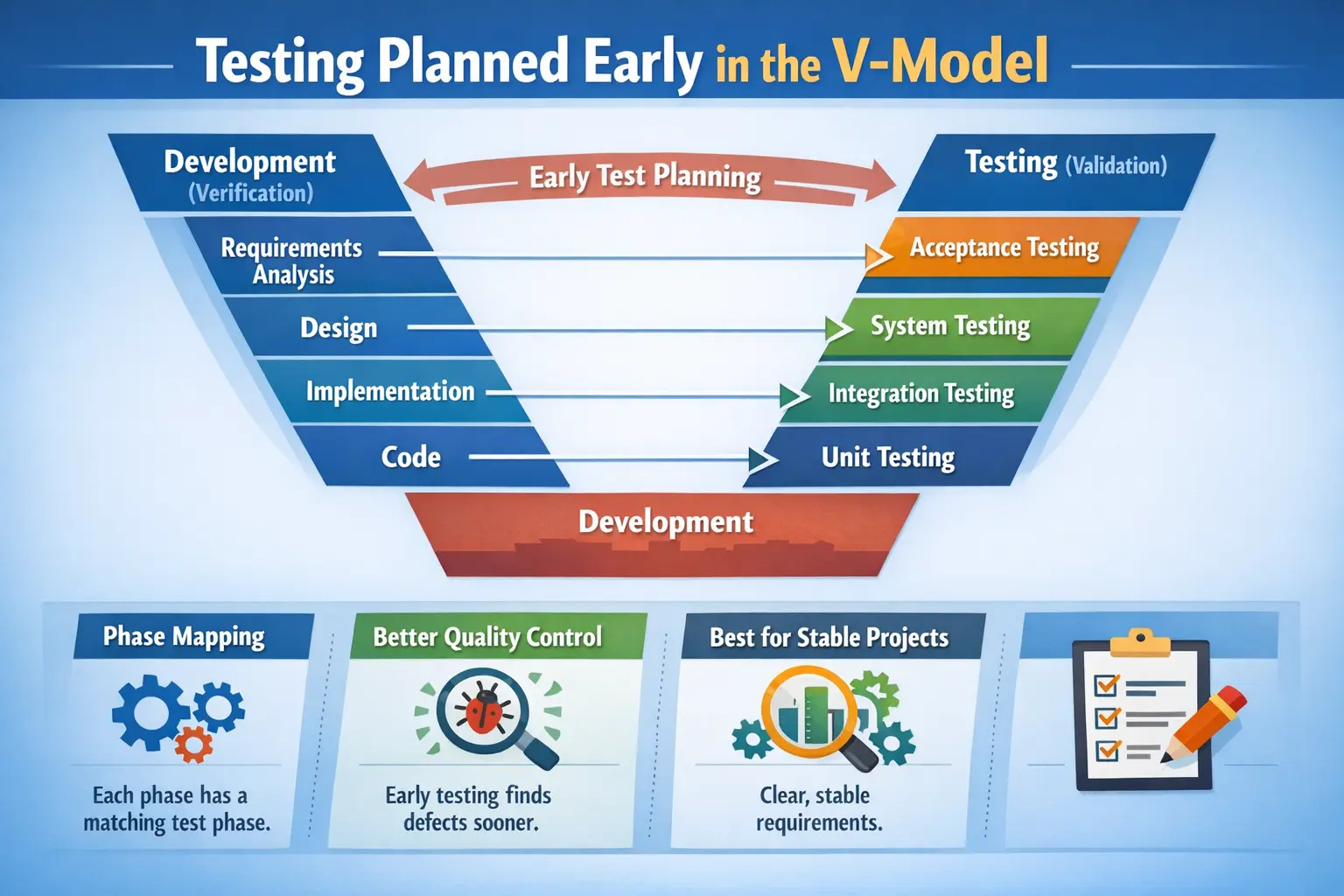
The V-Model, short for Verification and Validation Model, is a Software Development Life Cycle approach where testing activities are planned alongside development activities. Instead of waiting until coding is finished, the V-Model integrates testing early and throughout the lifecycle. The structure visually resembles a “V,” where the left side represents verification activities and the right side represents validation activities.
Verification focuses on building the product correctly, while validation focuses on building the right product. Together, they create a balanced and quality-focused development process.
Why the V-Model Matters
The V-Model matters because it changes the way teams think about quality. In many weak development processes, testing is treated as an activity that begins only after developers finish coding. That approach often creates a large quality gap. Requirements may be misunderstood, design decisions may be difficult to verify, and testers may receive the application late with very little time to evaluate it properly. The V-Model avoids this problem by connecting development and testing from the beginning. It tells the team that every decision made on the development side should have a matching validation activity on the testing side.
This makes the model especially useful for projects where defects are costly, risky, or difficult to fix after release. If a banking application calculates interest incorrectly, if a medical system records patient data inaccurately, or if an automotive control system behaves unpredictably, the impact can be serious. In such environments, teams cannot depend only on late-stage testing. They need early reviews, test planning, traceability, and disciplined validation. The V-Model provides that structure.
The model also helps teams communicate more clearly. Business analysts, developers, testers, architects, and stakeholders can see how requirements move through design, implementation, and validation. Instead of asking testing teams to verify vague expectations at the end, the team defines what will be tested much earlier. This improves shared understanding and reduces the chance that a feature is built correctly from a technical perspective but still fails to satisfy the real business need.
Verification and Validation as Two Sides of Quality
The V-Model is built around two complementary ideas: verification and validation. Verification asks whether the team is building the product correctly. It is concerned with requirements, design documents, technical specifications, and development artifacts. When a tester reviews a requirement for ambiguity, when an architect reviews a design for completeness, or when a team checks whether a specification is testable, they are performing verification activities.
Validation asks whether the team built the right product. It requires running the software and checking whether the application behaves as users and business stakeholders expect. Validation includes unit testing, integration testing, system testing, and acceptance testing. A feature may pass verification if it matches the written specification, but it may fail validation if real users cannot complete their work with it. That is why the V-Model combines both sides instead of treating them as separate concerns.
In practical terms, verification reduces defects before code is written, while validation detects defects in the working product. A strong testing process needs both. If verification is weak, testers may spend a lot of time reporting defects that could have been avoided through better requirement and design reviews. If validation is weak, the team may have clean documents but a product that does not work correctly in real usage. The V-Model keeps these two responsibilities connected.
V-Model as an Improvement Over Late Testing
The biggest practical strength of the V-Model is that it prevents testing from becoming a last-minute activity. Late testing usually creates pressure, shortcuts, and poor coverage. Testers may not have enough time to understand requirements, prepare realistic data, identify regression risks, or verify all critical workflows. Defects found late are also more expensive because they may require code changes, design adjustments, retesting, and release delays.
In the V-Model, test planning starts when the corresponding development artifact is created. When business requirements are written, acceptance testing ideas are also considered. When system design is created, system testing scope is planned. When high-level design defines modules and interfaces, integration testing scenarios are identified. When low-level design defines detailed logic, unit testing expectations become clearer. This approach turns testing into a planned quality activity rather than an emergency activity.
This does not mean that all tests are executed early. Execution still happens after the software or component is available. The important point is that test thinking begins early. Testers can ask questions, challenge assumptions, find missing acceptance criteria, and prepare coverage before the application reaches the test environment. As a result, validation becomes more focused, traceable, and efficient.
Left Side: Verification Thinking
The left side of the V-Model represents the stages where the team defines what will be built. It usually begins with business requirements and moves into system design, high-level design, and low-level design. Each level adds detail. A requirement may state what the user needs, a system design may describe the application architecture, a high-level design may break the system into modules, and a low-level design may explain detailed component behavior.
For testers, this side is not passive. Manual testers do not wait silently until the right side begins. They review requirements for clarity, completeness, consistency, and testability. They identify missing negative scenarios, unclear business rules, undefined error messages, and assumptions that may later become defects. They also begin preparing the thinking behind acceptance tests, system tests, integration tests, and detailed test cases.
A simple example is a login requirement. If the requirement says, "The user should be able to log in with valid credentials," a tester should ask what happens with invalid credentials, locked accounts, expired passwords, inactive users, empty fields, case sensitivity, session timeout, and repeated failed attempts. These questions are verification activities because they improve the requirement before coding starts.
Requirement Analysis and Acceptance Test Planning
Requirement analysis sits at the top of the left side of the V. This is where business needs, user expectations, rules, constraints, and acceptance criteria are captured. In the V-Model, this phase maps to acceptance testing. Acceptance testing confirms whether the final system meets business expectations. For that reason, acceptance test planning should begin as soon as requirements are understood.
A tester reviewing requirements should think from the user's perspective. The question is not only whether a feature can be technically implemented, but whether the feature supports the workflow that users actually need. If the requirement is about password reset, acceptance testing should confirm that the user can request a reset link, receive the email, open a valid link, enter a new password according to rules, and log in with the new password. It should also consider expired links, reused links, invalid email addresses, and security messages.
This early acceptance thinking prevents a common failure: building exactly what was written, but not what the business intended. The V-Model reduces that risk by linking requirements directly to acceptance validation. A requirement without acceptance coverage becomes visible as a gap, and an acceptance test without a requirement becomes questionable because its purpose is unclear.
System Design and System Test Planning
System design explains how the application will work as a complete system. It may include architecture, major components, data flow, external systems, environment assumptions, security boundaries, and system-level behavior. In the V-Model, system design maps to system testing. System testing evaluates the complete integrated application against the defined system behavior.
During this stage, testers think about end-to-end flows, environment dependencies, data requirements, and non-functional concerns. For example, if the system design includes an external payment gateway, testers should plan how payment success, payment failure, timeout, duplicate transaction, cancellation, and gateway unavailability will be tested. If the design includes reporting, testers should consider data accuracy, filters, exports, user permissions, and performance under realistic volumes.
This mapping makes system testing more disciplined. Instead of writing random end-to-end cases after the build arrives, testers derive system tests from the design. This improves coverage and helps the team prove that the entire application works as a coherent product, not just as a collection of independent features.
High-Level Design and Integration Test Planning
High-level design usually explains the major modules of the system and how those modules interact. It describes interfaces, responsibilities, data exchange, and dependency points. In the V-Model, high-level design maps to integration testing because integration testing verifies whether modules communicate and work together correctly.
Integration defects are common in real projects. One module may send data in a format another module does not expect. A service may return a response that is not handled properly. A database update may happen in one component but not be reflected in another. A UI may call an API correctly for a success scenario but fail when the API returns a validation error. These problems are often missed when teams only test each component individually.
The V-Model helps testers identify these risks during design. If module boundaries are known early, integration scenarios can be planned early. Testers can ask which interfaces exist, what data moves between modules, what happens when communication fails, and how errors are logged or displayed. This makes integration testing more purposeful and reduces surprises after modules are combined.
Low-Level Design and Unit Test Planning
Low-level design describes the internal logic of components, classes, functions, database queries, rules, and algorithms. In the V-Model, this phase maps to unit testing. Unit testing validates the smallest testable parts of the application, usually by developers, before they are integrated into larger flows.
Although manual testers may not write unit tests in many teams, they still benefit from understanding this mapping. Good unit testing reduces the number of basic logic defects that reach manual testing. For example, if a discount calculation has clear low-level rules, unit tests can verify boundary values, invalid inputs, rounding rules, tax behavior, and exception handling. Manual testers can then focus more on workflows, integration, usability, and business validation.
This level also reinforces the idea that quality is shared. The V-Model does not say that only testers are responsible for quality. Developers contribute through unit testing, reviewers contribute through design and code reviews, and testers contribute through requirement analysis, test design, execution, and validation. The model works best when all roles understand their part in the quality chain.
Traceability in the V-Model
Traceability is one of the most important strengths of the V-Model. Traceability means that requirements, design elements, test cases, test execution results, and defects can be linked to each other. If a requirement exists, the team should be able to identify which test cases validate it. If a test case fails, the team should know which requirement or design area is affected. If a requirement changes, the team should know which tests must be updated.
This is especially valuable in regulated domains. Auditors, customers, or internal quality teams may ask for evidence that every requirement was tested. A traceability matrix can show that mapping clearly. It can also reveal missing coverage. If a requirement has no test case, that is a quality risk. If many test cases do not connect to requirements, the team may be testing without a clear purpose.
Traceability also supports impact analysis. When a business rule changes, the team does not have to guess what might be affected. They can examine linked designs, test cases, and defects. This makes change management more controlled, which is one reason the V-Model is common in projects where documentation and accountability matter.
Practical Example: Password Reset in the V-Model
Consider a password reset feature. During requirement analysis, the team defines that a registered user can request a password reset link by entering an email address. Acceptance test planning begins here. Testers identify business scenarios such as valid email, unregistered email, expired link, reused link, weak password, and successful login after reset.
During system design, the team explains how the UI, backend service, email service, token generation, and user database work together. System test planning considers the complete flow from request to login. During high-level design, module interactions become clearer. Integration testing plans cover UI-to-API behavior, API-to-email service communication, token validation, and database updates. During low-level design, developers identify unit tests for token expiry logic, password rule validation, and error handling.
When the feature is built, validation happens on the right side. Unit tests validate small functions. Integration tests validate communication between services. System tests validate the complete password reset process. Acceptance testing confirms that the business need is satisfied. This example shows the central strength of the V-Model: every development decision has a matching testing responsibility.
Interview-Ready Understanding of the V-Model
In interviews, the best way to explain the V-Model is to avoid describing it as only a diagram. The diagram is useful, but the real meaning is early test planning and direct mapping between development and testing phases. A strong answer should mention that requirements map to acceptance testing, system design maps to system testing, high-level design maps to integration testing, and low-level design maps to unit testing.
It is also important to mention when the model is useful and when it is not. The V-Model works well when requirements are stable, documentation is important, traceability is required, and reliability matters. It is less suitable when requirements change constantly or when teams need frequent user feedback through rapidly evolving prototypes. This balanced explanation shows practical understanding rather than memorized theory.
Core Idea of the V-Model
The main concept behind the V-Model is that every development phase has a corresponding testing phase. Test planning does not start after development; it starts as soon as requirements and designs are defined. This parallel planning ensures that quality is considered from the beginning.
By linking development stages directly to testing stages, the V-Model reduces misunderstandings and improves traceability between requirements and tests.
Structure of the V-Model
Verification Side (Left Side)
The left side focuses on defining and refining what will be built. It begins with requirement analysis, where business and user needs are documented. It continues with system design, high-level design, and low-level design. Each stage adds more detail and clarity to the solution.
Manual testers play an important role here by reviewing requirements, identifying ambiguities, and thinking ahead about how features will be validated. Early involvement helps prevent defects rather than just detecting them.
Validation Side (Right Side)
The right side focuses on evaluating the built product. Unit testing validates small components, integration testing checks interactions between modules, system testing verifies the complete system, and acceptance testing confirms that business needs are met.
Because these tests are planned during earlier phases, validation becomes more systematic and aligned with requirements.
Mapping Between Development and Testing
A defining feature of the V-Model is its clear mapping. Requirements connect to acceptance testing, system design connects to system testing, high-level design connects to integration testing, and low-level design connects to unit testing. This mapping ensures that every specification has a validation method.
Such traceability improves coverage and accountability.
| Development Phase | Corresponding Testing Phase |
|---|---|
| Requirement Analysis | Acceptance Testing |
| System Design | System Testing |
| High-Level Design | Integration Testing |
| Low-Level Design | Unit Testing |
Key Characteristics
The V-Model emphasizes early test planning and strong requirement traceability. Testing is not treated as a final step but as a continuous partner to development. Compared to purely sequential models, defects are often detected earlier, reducing rework.
The model is structured and disciplined, making it suitable for environments that value predictability and documentation.
Role of Manual Testers
Manual testers are active throughout the V-Model. During requirement analysis, they review requirements and think about acceptance scenarios. During design phases, they prepare system and integration scenarios and evaluate testability. During development, they design detailed test cases. During testing, they execute tests, perform regression checks, and validate requirements.
Their early involvement increases overall quality and reduces late surprises.
Advantages of the V-Model
The V-Model supports early test planning, clear traceability, and reduced defect leakage. Its structured nature encourages discipline and thorough documentation. Because testing is aligned with development, coverage is often more systematic.
Disadvantages of the V-Model
The model can be rigid and less flexible when requirements change frequently. Changes after design can be costly. Users may not see working software until later stages, which can delay feedback. For highly dynamic projects, this rigidity can be a limitation.
When the V-Model Works Best
The V-Model is well suited for projects with stable requirements and high reliability needs. Safety- critical and regulated domains often prefer it because of its traceability and structured validation. Industries such as medical, automotive, and aerospace frequently use V-Model practices.
Comparison with Waterfall
While both Waterfall and V-Model are sequential, the V-Model places stronger emphasis on early testing. In Waterfall, test planning is often delayed, whereas the V-Model integrates it from the start. This reduces risk and improves defect detection timing.
| Aspect | Waterfall | V-Model |
|---|---|---|
| Testing Planning | Late | Early |
| Verification | Limited | Strong |
| Validation | After dev | Mapped to each phase |
| Risk | Higher | Lower |
Common Pitfalls
Some teams treat the V-Model as identical to Waterfall and ignore its early testing benefits. Others skip proper traceability between requirements and tests. Weak early planning reduces the model’s advantages.
Interview Perspective
In interviews, the V-Model is commonly described as an SDLC model where verification and validation are planned in parallel with development. A strong answer highlights the mapping between development and testing phases and the focus on early defect prevention.
Key Takeaway
The V-Model strengthens quality by integrating testing early and systematically into development. It works best when requirements are stable and reliability is critical. By aligning verification and validation, the V-Model helps teams build software that is both correct and suitable for its purpose.