Test Pyramid
The Test Pyramid is a widely recognized model in software testing that describes the ideal distribution of tests across different testing levels. It emphasizes having a large number of low-level tests and a smaller number of high-level tests in order to achieve fast feedback, stable results, and efficient defect detection. The model highlights that testing should not be concentrated only at the user interface level but should be distributed across multiple layers of the application.
The Test Pyramid answers an important question in modern software testing: “Where should we focus testing effort to maximize quality efficiently?” By structuring testing activities across layers, teams can detect defects earlier, reduce testing costs, and improve product stability.
Although the Test Pyramid is often associated with test automation strategies, it is equally important for manual testers. The model represents a quality strategy that encourages early validation and balanced testing efforts rather than excessive reliance on end-to-end testing.
The Test Pyramid helps teams understand that testing is most effective when defects are prevented or detected as early as possible. Lower-level tests tend to be faster and cheaper, while higher-level tests are slower and more complex. By organizing testing activities properly, teams can improve quality without increasing effort unnecessarily.
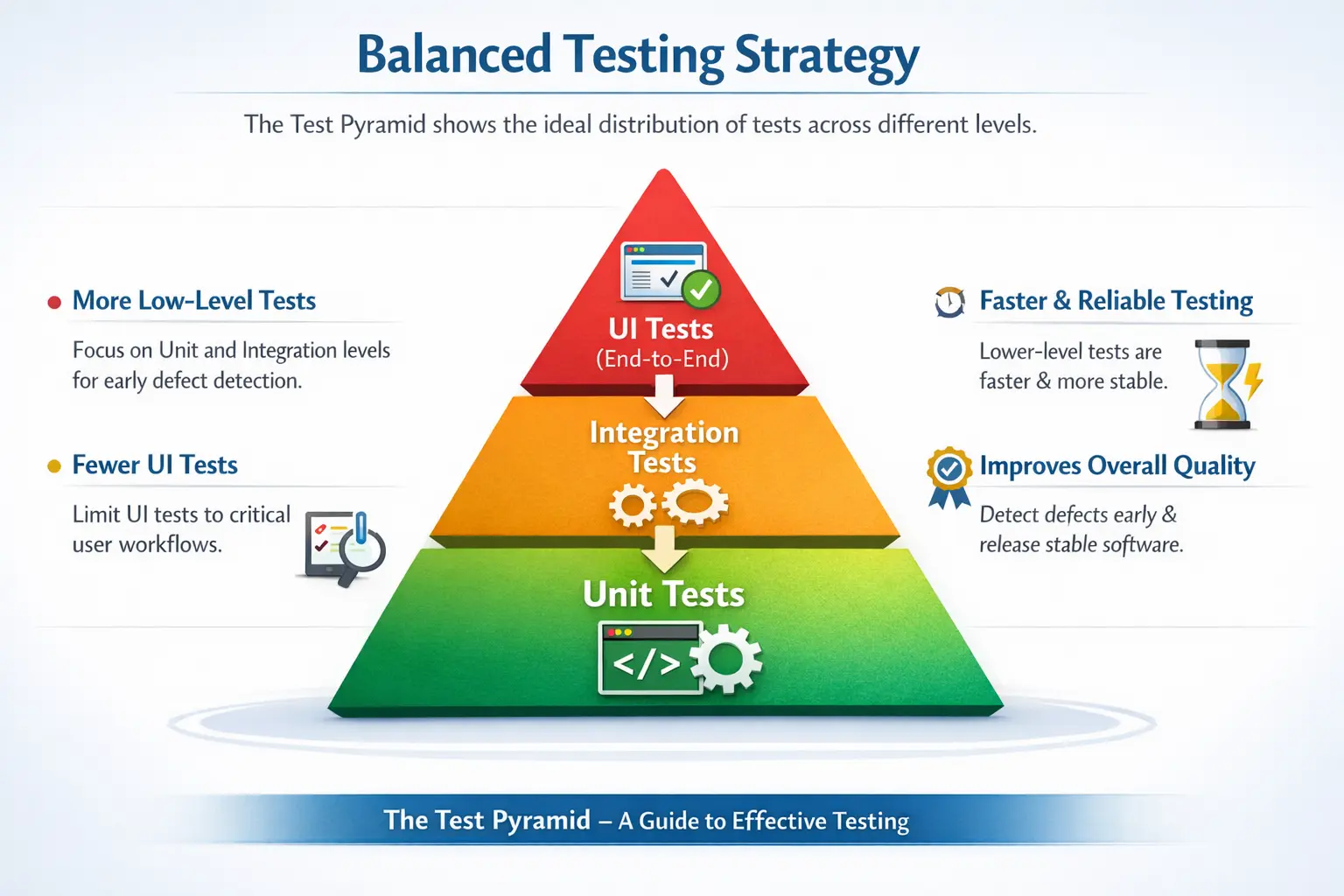
Definition of Test Pyramid
The Test Pyramid is a conceptual model that illustrates the ideal distribution of tests across different levels of a software system. It suggests that most tests should be performed at the lower levels of the system, while fewer tests should be performed at higher levels.
The pyramid shape represents the recommended proportion of testing activities. The base of the pyramid contains the largest number of tests, and the top contains the smallest number of tests.
Lower-level tests focus on individual components and logic. Higher-level tests focus on complete user workflows.
As testing moves from bottom to top, tests generally become slower, more complex, and more expensive to maintain. Lower-level tests tend to be faster and more reliable, while higher-level tests often depend on multiple components working together.
The Test Pyramid provides guidance for building a balanced testing strategy that delivers efficient feedback and strong product quality.
Structure of the Test Pyramid
The Test Pyramid is typically divided into three conceptual layers. These layers represent different testing levels and testing scopes.
The lowest layer represents unit testing. Unit tests focus on individual components and functions. These tests verify small pieces of code independently and provide rapid feedback about correctness.
The middle layer represents integration testing. Integration tests verify interactions between components and ensure that different modules work together correctly.
The top layer represents UI or end-to-end testing. These tests simulate real user workflows and validate that the entire system works correctly from the user perspective.
The number of tests typically decreases as the testing level moves upward. The majority of testing effort occurs at lower levels where tests are faster and easier to maintain.
Higher-level tests provide important validation but should be limited to critical workflows.
Conceptual Interpretation for Manual Testers
Manual testers often associate the Test Pyramid with automation, but the model applies equally to manual testing strategy.
The Test Pyramid should be understood as a quality approach rather than a programming rule. It helps testers decide where to focus their effort and how to collaborate with developers.
Manual testers should avoid relying entirely on UI testing. UI-only testing delays defect detection and increases testing effort.
Manual testers should encourage early validation by participating in requirement discussions and design reviews.
Manual testers should help identify edge cases before development begins.
Manual testers should validate key business workflows end-to-end to ensure correct behavior from the user perspective.
The Test Pyramid helps manual testers test smarter by emphasizing prevention and early detection instead of late discovery.
Unit Level Testing and Manual Testers
The unit level forms the foundation of the Test Pyramid. Unit tests typically validate individual functions, classes, or modules independently.
Unit testing is usually performed by developers, but manual testers still play an important supporting role.
Manual testers help ensure that requirements are testable and well defined before development begins.
Manual testers identify edge cases that developers may overlook.
Manual testers help clarify expected behavior during requirement discussions.
Manual testers contribute to defect prevention by reviewing designs and identifying risks early.
Although manual testers rarely execute unit tests themselves, their early involvement helps ensure that unit tests cover important scenarios.
Strong collaboration between testers and developers improves the effectiveness of unit testing.
Integration Level Testing and Manual Testers
Integration testing validates interactions between different components of the system. This level ensures that modules communicate correctly and data flows properly between systems.
Integration testing often includes interactions between services, databases, APIs, and external systems.
Manual testers frequently participate in integration testing activities.
Manual testers verify data consistency between modules.
Manual testers validate communication between system components.
Manual testers check error handling and failure scenarios.
Manual testers identify integration gaps that may not be covered by automated tests.
Integration testing is critical because many defects occur when systems interact rather than within individual modules.
Manual testers help ensure that system components work correctly together.
UI and End-to-End Testing
The top of the Test Pyramid represents UI and end-to-end testing. These tests simulate real user interactions and validate complete workflows.
UI testing verifies that the application behaves correctly from the user perspective.
Manual testers typically focus heavily on this level because it reflects real user behavior.
Manual testers perform functional testing to validate business requirements.
Manual testers perform exploratory testing to discover unexpected issues.
Manual testers perform regression testing to verify that existing features continue working.
Manual testers perform usability testing to evaluate user experience.
Manual testers perform acceptance testing to validate business expectations.
UI testing is essential because it verifies that the entire system works together.
However, relying only on UI testing is inefficient and risky.
Why the Test Pyramid Matters
The Test Pyramid provides important guidance for building effective testing strategies.
UI tests tend to be slow and fragile because they depend on many components working correctly.
Integration tests are faster and more reliable than UI tests but still involve multiple components.
Unit tests provide the fastest feedback because they test small pieces of code independently.
Defects discovered late in the testing cycle are more expensive to fix.
Early validation reduces defect costs and improves development efficiency.
The Test Pyramid encourages teams to detect defects earlier rather than later.
The Test Pyramid also promotes collaboration between developers and testers.
Quality becomes a shared responsibility rather than a testing-only activity.
Test Pyramid and Defect Prevention
One of the key goals of the Test Pyramid is defect prevention.
Defects introduced during requirements or design phases can often be prevented through early validation.
Manual testers contribute to defect prevention by reviewing user stories and acceptance criteria.
Manual testers identify missing scenarios before development begins.
Manual testers participate in backlog refinement and sprint planning discussions.
Defect prevention reduces rework and improves productivity.
The Test Pyramid supports a proactive testing approach instead of a reactive one.
Testing becomes a continuous activity rather than a final phase.
Test Pyramid Anti-Patterns
Many teams unintentionally follow inefficient testing patterns that contradict the Test Pyramid.
One common anti-pattern is the Ice-Cream Cone model. In this model, most testing occurs at the UI level, while very little testing occurs at lower levels.
UI-heavy testing results in slow feedback cycles.
UI tests are more likely to fail due to environment issues rather than real defects.
UI-heavy testing increases maintenance costs.
UI-heavy testing delays defect detection.
The Ice-Cream Cone model often results in unstable releases and long testing cycles.
Balanced testing strategies reduce these risks.
Benefits of Following the Test Pyramid
Following the Test Pyramid concept provides several important benefits.
Feedback cycles become faster because lower-level tests detect issues quickly.
Defect leakage decreases because defects are detected earlier.
Testing costs decrease because early fixes require less effort.
Testing becomes more efficient because effort is distributed properly.
Product quality improves because defects are prevented and detected earlier.
Release stability improves because testing is more reliable.
Team productivity improves because fewer defects reach later stages.
Balanced testing strategies produce consistent results.
Manual Tester’s Strategic Role
Manual testers play a strategic role in applying the Test Pyramid.
Manual testers advocate early involvement in development activities.
Manual testers promote clear requirements through Definition of Ready practices.
Manual testers design effective test scenarios that detect defects early.
Manual testers identify risk areas and critical workflows.
Manual testers focus manual effort on high-value user journeys.
Manual testers support collaboration between developers and business stakeholders.
Manual testers help ensure balanced testing strategies.
Manual testers ensure that UI testing focuses on critical workflows rather than unnecessary scenarios.
The Test Pyramid helps manual testers prioritize their work effectively.
Test Pyramid in Agile Projects
The Test Pyramid aligns naturally with Agile development practices.
Agile teams deliver software incrementally and require fast feedback.
Lower-level testing supports continuous integration and rapid development.
Integration testing validates system behavior as features are added.
UI testing validates completed increments.
The Test Pyramid supports continuous testing throughout the sprint.
Manual testers collaborate with developers and Product Owners to ensure quality.
Agile teams benefit from balanced testing strategies.
The Test Pyramid helps Agile teams maintain speed without sacrificing quality.
Test Pyramid as a Testing Strategy
The Test Pyramid should be understood as a testing strategy, not only as a diagram. Its real purpose is to help teams decide which kinds of checks belong at which level of the system. A team that understands the pyramid does not ask only whether something can be tested. It asks where that behavior can be tested most efficiently, reliably, and meaningfully.
Some behavior is best validated close to the code. Calculation rules, validation logic, data transformations, and small decision branches are often better checked at lower levels because the tests are fast and precise. If a tax calculation is wrong, a low-level test can identify the issue quickly without needing a browser, login flow, test account, and complete checkout process.
Other behavior requires integration-level validation. A feature may work in isolation but fail when it communicates with another component, service, database, or third-party system. Integration tests confirm that data moves correctly between parts of the system. They are slower than unit tests but faster and more focused than full UI workflows.
Complete business journeys still need end-to-end validation. A customer should be able to register, log in, add items to a cart, complete payment, receive confirmation, and view the order. These workflows prove that the product works from the user’s perspective. However, because end-to-end tests are expensive and fragile, they should be used for critical journeys rather than every small condition.
A strong testing strategy uses all these levels together. The pyramid does not say that UI testing is bad. It says that UI testing should not carry the entire quality burden. When each level does the work it is best suited for, the team gets faster feedback, clearer defect isolation, and more stable releases.
Manual Testing and the Pyramid Mindset
Manual testers may not write unit tests, but they still benefit from the pyramid mindset. The model helps manual testers understand where quality risks should be caught and how to collaborate with the team earlier. A manual tester who thinks only at the UI level may find defects late. A manual tester who thinks across the pyramid helps prevent defects before the UI is ready.
During requirement refinement, manual testers can identify conditions that should be covered by lower-level tests. For example, if a story includes discount calculation rules, the tester can ask whether those rules will be unit tested. If a story depends on an external API, the tester can ask how integration behavior and failure cases will be verified. These questions improve the team’s overall test coverage.
Manual testers also help decide what should remain manual. Exploratory testing, usability checks, visual review, business workflow validation, and stakeholder acceptance often benefit from human judgment. The pyramid does not eliminate manual testing. It helps manual testers focus on high-value areas where human observation is useful.
A pyramid-minded tester avoids spending excessive manual effort on repetitive checks that could be validated earlier or automated reliably. Instead, the tester uses time for scenario analysis, risk exploration, end-to-end confidence, and user experience evaluation. This makes manual testing more strategic and less repetitive.
The best manual testers use the pyramid as a conversation tool. They discuss coverage with developers, Product Owners, and automation engineers. They ask where defects are most likely to occur and which level can detect them fastest. This turns testing into a shared team responsibility instead of a final gate.
Unit Tests at the Base of the Pyramid
Unit tests form the base of the Test Pyramid because they are fast, focused, and inexpensive to run. They usually validate individual functions, methods, classes, or small pieces of business logic. Since they do not require the full application to run, they provide quick feedback to developers and help catch defects soon after code is written.
A strong unit test suite improves confidence during change. When a developer modifies logic, unit tests can quickly reveal whether existing behavior has been broken. This is especially useful in Agile projects where code changes frequently. Fast feedback supports continuous integration and reduces the cost of fixing defects.
Manual testers support unit-level quality indirectly. They may not execute these tests, but they can help developers understand important business rules and edge cases. For example, a tester reviewing a loan eligibility story may identify age boundaries, income limits, credit score thresholds, and combinations of conditions. Developers can use those inputs to create meaningful unit tests.
Unit tests are not enough by themselves. They can confirm that small logic units work correctly, but they do not prove that components communicate correctly or that the full user journey works. A calculator function can pass all unit tests while the UI sends the wrong input or the API maps the wrong field. That is why the pyramid needs multiple layers.
The base of the pyramid is powerful because it prevents many simple defects from reaching higher testing levels. When low-level logic is verified early, manual testers and integration tests can focus on broader behavior rather than repeatedly finding basic coding mistakes.
Integration and API Layer Importance
The middle layer of the Test Pyramid is often where many real-world defects appear. Modern applications depend on APIs, databases, microservices, queues, authentication services, payment gateways, notification systems, and third-party integrations. Even when individual components work correctly, defects can occur when those components interact.
Integration tests verify whether data is passed correctly, responses are handled properly, and failures are managed gracefully. For example, an order service may create an order correctly, but the payment service may reject the transaction, or the notification service may fail to send confirmation. Integration testing helps detect these issues before complete UI flows are tested.
API testing is especially valuable because it can validate business logic without relying on the browser. API tests are usually faster and more stable than UI tests. They can check response codes, payloads, authentication behavior, data persistence, error handling, and service contracts. This makes them a strong middle layer in many applications.
Manual testers can participate in integration and API testing even if they are not automation specialists. They can use tools, review API responses, validate data flow, and design scenarios that cover success, failure, timeout, invalid input, and authorization conditions. This expands manual testing beyond only screens and buttons.
A strong integration layer reduces pressure on end-to-end tests. If service behavior is already validated at the API level, UI tests do not need to repeat every variation. The UI can focus on critical user journeys while integration tests cover many system interactions more efficiently.
End-to-End Tests at the Top
End-to-end tests sit at the top of the pyramid because they validate complete workflows across the full system. They are valuable because they reflect real user journeys and confirm that the product works as a connected whole. They are also expensive because they depend on many parts of the system being available and stable at the same time.
A good end-to-end test validates a meaningful business flow. For example, in an e-commerce system, an end-to-end test may cover login, product search, cart update, checkout, payment, order confirmation, and order history. This test gives strong confidence that the business process works. But it should not be used to test every coupon variation, every field-level validation, or every small calculation.
End-to-end tests are more fragile because many things can cause failure. The test may fail due to UI change, test data issue, environment outage, network delay, third-party service problem, or real product defect. When failures occur, investigation takes longer because the test covers many components. This is why teams should keep E2E suites focused and valuable.
Manual testers are often strongest at this level because they understand workflows, business expectations, and user behavior. They can evaluate whether the entire flow feels correct, whether messages make sense, whether navigation is intuitive, and whether the user can complete the goal without confusion. These human observations are difficult to replace completely with automation.
The top of the pyramid is necessary, but it should be selective. Critical business flows, release smoke scenarios, and high-risk workflows deserve end-to-end coverage. Low-risk variations should usually be covered lower in the pyramid where possible.
Risk-Based Testing and the Pyramid
The Test Pyramid works best when combined with risk-based testing. Not every feature needs the same depth of testing at every level. A minor text update may need only a quick verification. A payment feature, security feature, or financial calculation may require unit checks, integration validation, end-to-end testing, regression testing, and exploratory testing.
Risk helps the team decide where to invest testing effort. High-impact features should have strong coverage across multiple layers. Frequently used workflows should receive more attention than rarely used settings. Areas with a history of defects should be tested more carefully than stable, low-risk areas.
Manual testers contribute by identifying risk from a user and business perspective. They ask which workflows affect revenue, compliance, customer trust, data integrity, or operational continuity. They also consider complexity, recent change, integration points, and defect history. These factors guide test selection.
Risk-based thinking prevents teams from applying the pyramid mechanically. The pyramid recommends a general distribution, but risk determines exact coverage. Some features may need more end-to-end validation because the business risk is high. Others may be safely validated mostly through lower-level checks.
A balanced strategy is not equal testing everywhere. It is intentional testing at the right level based on value, risk, cost, and confidence.
Test Pyramid and Regression Strategy
Regression testing becomes more manageable when teams follow the Test Pyramid. If most regression confidence depends on manual UI checks, every release becomes slow and stressful. A pyramid-based regression strategy spreads checks across levels so that many defects are caught quickly before manual regression begins.
Unit tests protect low-level logic during change. Integration tests protect service behavior and data flow. API tests protect contracts and business rules. End-to-end tests protect critical user journeys. Manual regression can then focus on high-risk areas, recent changes, user experience, and exploratory coverage instead of repeating every basic validation.
This approach reduces regression overload. Manual testers often face pressure to validate too much in too little time. When lower-level tests provide reliable coverage, manual testers can prioritize better. They can spend time where human judgment is needed rather than repeatedly checking stable low-level behavior.
The pyramid also improves regression failure analysis. If a unit test fails, the issue is usually close to the changed logic. If an integration test fails, the issue is likely in component interaction. If an end-to-end test fails, the investigation may be broader. Having failures at the right level helps the team diagnose defects faster.
A mature regression strategy does not eliminate manual testing. It uses automated and lower-level checks to support manual testers so they can focus on meaningful validation and risk discovery.
The Ice-Cream Cone Problem
The Ice-Cream Cone is the opposite of the Test Pyramid. In this pattern, a team has very few unit tests, limited integration tests, many UI tests, and often a large amount of manual regression on top. It looks like an upside-down pyramid with a heavy upper layer. Many organizations fall into this pattern when testing begins late or automation is focused only on the UI.
The Ice-Cream Cone creates slow feedback. Defects are discovered after the full application is built and deployed to a test environment. By then, fixing the issue may require more rework. Developers may need to revisit old code, testers may need to retest large workflows, and releases may be delayed.
UI-heavy testing is also fragile. A small locator change, layout update, test data issue, or environment delay can break many UI tests. When test failures are noisy, teams start losing trust in the test suite. They spend time maintaining tests rather than improving coverage.
Manual testers suffer under the Ice-Cream Cone because they become the final safety net for too many risks. Instead of validating high-value workflows and exploring product behavior, they repeatedly find issues that could have been caught earlier. This creates pressure, fatigue, and late-cycle defect discovery.
Moving from an Ice-Cream Cone toward a Test Pyramid requires collaboration. Developers strengthen unit and integration coverage. Testers improve scenario design and risk analysis. Automation specialists move suitable checks below the UI where possible. Product Owners support earlier clarification of requirements.
Real Project Example
Consider a banking application where the team is building a fund transfer feature. If the team tests only through the UI, every scenario requires logging in, selecting accounts, entering transfer details, confirming the transfer, and checking balances. This is slow, and it becomes harder when many combinations must be tested.
A pyramid-based approach distributes the testing. Unit tests validate transfer amount rules, balance calculations, daily limits, and fee logic. Integration tests validate communication between account service, transfer service, notification service, and transaction history. API tests validate successful transfer, insufficient balance, invalid account, and authorization behavior.
End-to-end tests then focus on critical user journeys: successful transfer, failed transfer due to insufficient balance, and confirmation displayed in transaction history. Manual testers validate usability, error messages, edge workflows, and exploratory scenarios. They also verify that the user experience is understandable and trustworthy.
This strategy provides broader confidence with less waste. Low-level rules are checked quickly. Service interactions are validated before UI testing. End-to-end testing proves the business flow. Manual testing focuses on risk, behavior, and user experience. The team gets faster feedback and fewer late surprises.
Best Practices for Applying the Test Pyramid
Start by understanding current test distribution. Many teams assume they have balanced coverage until they map their tests. If most validation happens manually through the UI, the team likely has an Ice-Cream Cone. Mapping tests by level helps identify gaps and improvement opportunities.
Move suitable checks lower in the pyramid. Field validation, calculation rules, API response behavior, authorization rules, and data transformations often do not require UI-level testing for every variation. Testing them lower improves speed and reliability. UI tests should focus on workflows that truly require the full interface.
Keep end-to-end tests focused on critical business journeys. A small, stable E2E suite is more valuable than a large fragile one. If an end-to-end test does not protect meaningful business risk, consider whether the behavior can be checked better at another level.
Use manual testing where human judgment matters. Exploratory testing, usability testing, visual assessment, workflow sense-checking, and business acceptance often benefit from human observation. The goal is not to replace manual testers but to use their skill where it creates the most value.
Review the pyramid regularly. As the product grows, test distribution can drift. New features, quick fixes, and release pressure may push teams back toward UI-heavy testing. Periodic review helps keep the strategy balanced and sustainable.
Interview Perspective
The Test Pyramid is a common interview topic for manual testers and automation testers.
Interviewers expect candidates to understand the structure and purpose of the model.
A short answer usually defines the Test Pyramid as a model with more low-level tests and fewer high-level tests.
A detailed answer explains how the pyramid improves efficiency and quality.
Strong answers also explain the role of manual testers.
Understanding the Test Pyramid demonstrates knowledge of modern testing practices.
Interviewers often expect testers to understand how early validation improves quality.
Key Takeaway
The Test Pyramid provides a strategic approach for distributing testing effort across different levels of a system.
It emphasizes having more low-level validation and fewer high-level tests in order to achieve faster feedback, lower costs, and improved reliability.
For manual testers, the Test Pyramid represents a quality mindset that encourages early involvement, defect prevention, and efficient testing.
The Test Pyramid is not only an automation strategy but a complete testing philosophy that helps teams test earlier, test smarter, and deliver higher-quality software.