Shift-Left Testing
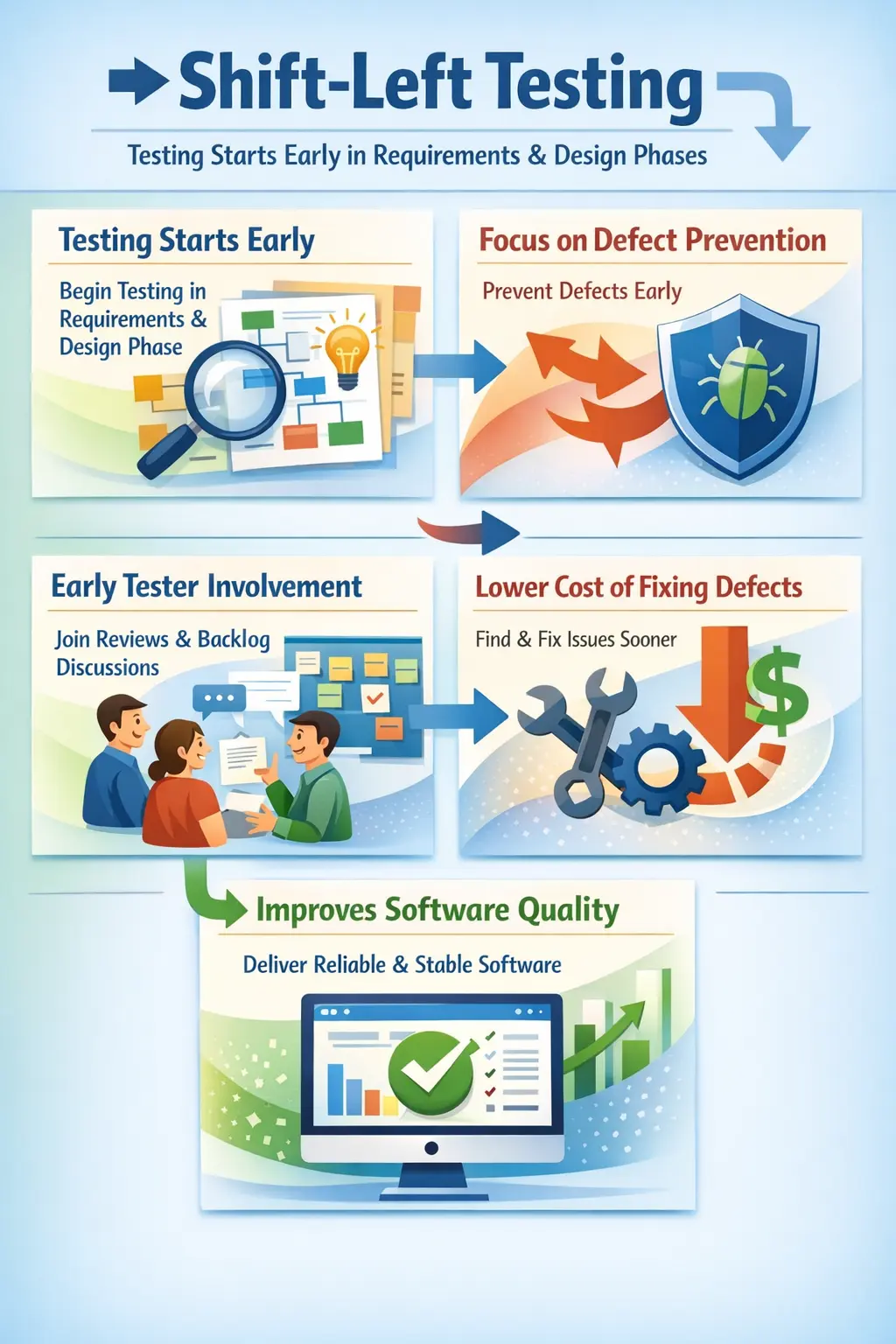
Shift-Left Testing is a modern testing approach that emphasizes performing testing activities as early as possible in the software development lifecycle. Instead of waiting until development is completed, testing begins during requirement analysis, design, and planning phases. The primary goal of Shift-Left Testing is to prevent defects rather than detect them late in the process.
Shift-Left Testing answers a fundamental quality question: “How can we find and prevent defects as early as possible?” By identifying issues early, teams can reduce rework, lower development costs, and improve overall software quality.
Traditional testing models often treat testing as a separate phase that begins after development is complete. This approach leads to late defect discovery, increased costs, and delayed releases. Shift-Left Testing changes this mindset by integrating testing activities throughout the development lifecycle.
In modern Agile and DevOps environments, Shift-Left Testing has become essential because teams deliver software rapidly and require continuous feedback. Manual testers play a critical role in Shift-Left practices by participating in requirement discussions, reviewing user stories, designing tests early, and collaborating closely with developers and business stakeholders.
Shift-Left Testing transforms testers from defect finders into quality enablers who help build quality into the product from the beginning.
Definition of Shift-Left Testing
Shift-Left Testing is a testing approach that moves testing activities earlier in the software development lifecycle, focusing on defect prevention rather than defect detection.
The term “Shift-Left” refers to shifting testing activities toward the left side of the development timeline, where requirements and design activities take place. Instead of performing testing only after coding is complete, testing becomes an ongoing activity starting from the earliest project stages.
Shift-Left Testing emphasizes early validation of requirements, designs, and assumptions. When issues are discovered early, they can be corrected quickly and with minimal effort.
Shift-Left Testing promotes a proactive approach to quality where defects are prevented instead of fixed later.
Core Idea of Shift-Left Testing
The core idea of Shift-Left Testing is simple: testing should start as early as possible and continue throughout development.
Testing activities should begin before coding starts. Requirements should be reviewed from a testing perspective to identify ambiguities and missing scenarios. Acceptance criteria should be defined clearly so that both developers and testers understand expected behavior.
Early feedback is essential for successful development. When testers participate early, misunderstandings can be resolved before implementation begins.
One of the most important principles behind Shift-Left Testing is that defects are cheaper to fix earlier. A defect discovered during requirement analysis may take minutes to fix, while the same defect discovered during system testing may require significant rework.
Shift-Left Testing promotes the idea that quality should be built into the product rather than inspected at the end.
Understanding What “Left” Means in SDLC
In a typical software development lifecycle, activities occur in a sequence that moves from requirements to design, development, testing, and release.
The left side of the lifecycle represents early phases such as requirement gathering and system design. The right side represents later phases such as system testing and production release.
Shift-Left Testing moves testing activities toward the early phases of the lifecycle.
This includes:
- Requirement analysis
- Design discussions
- Planning activities
By involving testers early in these phases, teams can detect potential problems before development begins.
This approach improves clarity and reduces rework.
Requirement Review Activities
Requirement review is one of the most important Shift-Left activities for manual testers.
Testers analyze requirements from a validation perspective and identify areas that may cause confusion or defects.
Manual testers identify ambiguous statements that may lead to inconsistent implementations.
Manual testers ask clarifying questions to ensure that business rules are clearly understood.
Manual testers identify missing scenarios that may not have been considered during requirement writing.
Manual testers apply test design thinking early by considering positive scenarios, negative scenarios, and edge cases.
Requirement reviews reduce misunderstandings and improve requirement quality.
Clear requirements lead to better development and better testing.
Backlog Refinement Participation
Backlog refinement is a key opportunity for Shift-Left Testing in Agile projects.
During refinement sessions, user stories are reviewed and prepared for future sprints.
Manual testers ensure that stories meet Definition of Ready criteria.
Manual testers verify that acceptance criteria are complete and testable.
Manual testers identify potential risks and edge cases.
Manual testers raise concerns about missing business rules.
Manual testers ensure that stories are small enough to be completed within a sprint.
Participation in backlog refinement prevents poorly defined stories from entering sprints.
Well-prepared stories improve development efficiency and reduce testing challenges.
Test Design Before Development
Shift-Left Testing encourages testers to design test scenarios before development begins.
Early test design helps testers understand requirements more deeply.
Writing test scenarios early often reveals missing requirements and unclear behavior.
Testers identify required test data before development begins.
Testers identify environment needs early.
Testers identify integration dependencies in advance.
Early test design reduces delays during test execution.
Test preparation improves sprint efficiency and predictability.
Collaboration and Communication
Shift-Left Testing depends heavily on collaboration between team members.
Testers collaborate continuously with developers, Product Owners, and business analysts.
Regular communication ensures that everyone shares the same understanding of requirements.
Testers provide early feedback on potential risks.
Developers provide technical insights that help testers design effective tests.
Product Owners clarify business expectations.
Strong communication reduces misunderstandings.
Collaboration ensures that quality becomes a shared responsibility.
Shift-Left Testing cannot succeed without strong teamwork.
Shift-Left Testing vs Traditional Testing
Traditional testing approaches treat testing as a phase that begins after development is completed.
Testers receive completed builds and begin testing at the end of the development cycle.
Defects are often discovered late in the process.
Late defect discovery increases development costs and delays releases.
Shift-Left Testing integrates testing into every stage of development.
Testers participate in requirement discussions.
Testers design tests before development.
Testers collaborate continuously with developers.
Shift-Left Testing focuses on prevention rather than detection.
Traditional testing focuses primarily on defect discovery.
Shift-Left Testing improves efficiency and reduces risk.
Benefits of Shift-Left Testing
Shift-Left Testing provides several important benefits for software teams.
Defect leakage is reduced because issues are detected early.
Development cycles become faster because less rework is required.
The cost of fixing defects decreases because early fixes are simpler.
Requirements become clearer because testers ask detailed questions.
Test preparation becomes more efficient.
Product quality improves because defects are prevented rather than corrected later.
Teams gain better visibility into risks early in the project.
Release confidence increases because fewer surprises occur late in the cycle.
Shift-Left Testing improves both quality and productivity.
Common Shift-Left Techniques
Several practical techniques support Shift-Left Testing.
Requirement reviews help ensure that requirements are clear and complete.
Acceptance criteria definition ensures that stories are testable.
Early test scenario design helps identify missing scenarios.
Pairing with developers helps testers understand implementation details.
Exploratory thinking during design helps identify potential risks.
Risk-based analysis helps prioritize testing efforts early.
Checklist-based reviews help ensure consistency.
These techniques help teams detect issues before development begins.
Manual Tester’s Role in Shift-Left Testing
Manual testers play a central role in Shift-Left Testing.
Testers analyze requirements from a quality perspective.
Testers identify missing scenarios early.
Testers clarify acceptance criteria.
Testers design tests early.
Testers identify risks and dependencies.
Testers prepare test data in advance.
Testers collaborate with developers continuously.
Testers provide feedback during design discussions.
Testers support Definition of Ready practices.
Shift-Left Testing expands the tester's role from execution to prevention.
Manual testers become active contributors to product quality.
Challenges in Shift-Left Adoption
Despite its benefits, Shift-Left Testing can be challenging to implement.
Some teams resist early tester involvement because they are used to traditional processes.
Requirements may be incomplete or evolving, making early testing difficult.
Time constraints may limit early analysis.
Teams may underestimate the value of requirement reviews.
Testers may lack experience in early-phase activities.
Mindset changes are often required for successful adoption.
Shift-Left Testing requires strong collaboration and communication.
Training and process improvements may be necessary.
Organizations must support early tester involvement.
Real-Time Example of Shift-Left Testing
Consider a login feature with a password validation requirement.
Without Shift-Left Testing, testers may discover during system testing that password rules are unclear.
Developers may have implemented incorrect validation logic.
Fixing the issue may require code changes and retesting.
With Shift-Left Testing, testers review requirements early and identify unclear password rules.
The Product Owner clarifies the rules before development begins.
Developers implement correct validation logic.
Testing proceeds smoothly without rework.
Early detection saves time and reduces costs.
Shift-Left Testing in Agile Projects
Shift-Left Testing fits naturally into Agile development.
Agile emphasizes continuous feedback and iterative delivery.
Testers participate in backlog refinement sessions.
Testers participate in sprint planning.
Testers design test scenarios early.
Testers execute tests continuously during the sprint.
Testers collaborate with developers daily.
Agile teams benefit greatly from Shift-Left practices.
Early involvement improves sprint success rates.
Shift-Left Testing supports continuous improvement.
Shift-Left Testing as a Quality Mindset
Shift-Left Testing is more than an activity schedule. It is a quality mindset that changes how teams think about defects. In a traditional approach, testing is often treated as the place where defects are found after development. In a shift-left approach, the team asks how those defects can be prevented before code is written, before a design is finalized, and before a story enters a sprint.
This mindset is important because many defects do not begin in code. They begin as unclear requirements, incomplete business rules, missed edge cases, misunderstood user expectations, or design assumptions that nobody questioned. If these problems are discovered only during system testing, the team must rework code, retest features, and sometimes revise the user experience. Shift-Left Testing tries to catch these problems at the source.
For manual testers, this mindset expands the value of testing. A tester is not valuable only because they can execute test cases. A tester is valuable because they think critically about behavior, risk, users, data, and failure conditions. When testers bring that thinking into early conversations, they help shape better requirements and better implementation decisions.
Shift-left quality also makes testing a team responsibility. Developers, Product Owners, business analysts, designers, testers, and operations teams all contribute to quality. The tester may guide test thinking, but the entire team participates in preventing defects. This reduces the harmful idea that quality belongs only to the QA team at the end of the sprint.
A successful shift-left culture does not remove the need for later testing. System testing, regression testing, exploratory testing, and acceptance testing still matter. The difference is that late testing becomes confirmation and deeper exploration rather than the first moment when the team discovers basic requirement problems.
Shift-Left During Requirement Analysis
Requirement analysis is one of the most powerful places to apply Shift-Left Testing. At this stage, the cost of correction is low because no code has been written yet. A tester can ask questions, challenge assumptions, and identify missing scenarios before the team invests development effort.
During requirement analysis, testers should look for ambiguous words such as fast, proper, valid, user-friendly, secure, or normal. These words may sound understandable, but they are often not testable. For example, “the page should load fast” is unclear unless the expected response time is defined. “The system should show proper error” is unclear unless the condition and message are specified.
Testers should also look for missing negative behavior. Requirements often describe what should happen when everything goes correctly. Real users, however, enter invalid data, lose sessions, use expired links, lack permissions, submit duplicate requests, and abandon workflows midway. Identifying these scenarios early improves both requirements and design.
Business rule clarity is another key area. If a rule has thresholds, limits, eligibility conditions, or exceptions, testers should ask for examples. Examples make rules testable. Instead of saying “discount applies for eligible customers,” the requirement should clarify who is eligible, when the discount applies, what happens when criteria are not met, and whether multiple discounts can combine.
By reviewing requirements early, testers prevent defects before they become code defects. This is one of the highest-value contributions manual testers can make in an Agile team.
Shift-Left During Design and Architecture
Shift-Left Testing also applies during design and architecture discussions. Testers do not need to be architects, but they should understand how design decisions affect testability, reliability, and risk. When testers join design conversations, they can identify validation concerns before implementation begins.
For example, if a feature depends on an external payment gateway, testers can ask how failures will be handled, how timeout behavior will appear to users, what test environment will be available, and how failed payment data will be verified. These questions may influence design decisions and prevent gaps in error handling.
If a feature involves asynchronous processing, such as sending emails, generating reports, or updating background jobs, testers can ask how completion will be observed. Will the UI show status? Will logs be available? Will there be a retry mechanism? If these questions are ignored until testing, validation may become difficult or incomplete.
Design discussions also help testers understand integration points. A feature may look simple in the UI but involve several services behind the scenes. Knowing these integrations helps testers plan API checks, data validation, and regression scope. It also helps them identify where defects are most likely to occur.
Shift-left design participation improves testability. A system that is hard to observe, hard to configure, or hard to control is harder to test. Testers can help teams design features with better logs, clearer statuses, controlled test data, and predictable error handling.
Shift-Left and Acceptance Criteria
Acceptance criteria are one of the most practical tools for Shift-Left Testing. A User Story may describe the user need, but acceptance criteria define the specific behavior that must be validated. When acceptance criteria are weak, testing becomes unclear and development becomes assumption-driven.
Shift-left testers review acceptance criteria before development starts. They check whether each criterion is clear, measurable, and testable. They also check whether criteria cover successful behavior, failure behavior, boundary conditions, and important business rules. If criteria are missing, testers raise questions during refinement.
Good acceptance criteria reduce rework. A developer who knows exactly how invalid input should behave can implement validation correctly the first time. A tester who knows expected error behavior can design tests before the build is ready. A Product Owner who reviews criteria early can confirm business expectations before the sprint begins.
Acceptance criteria should remain business-focused. They should describe what the user or system should experience, not unnecessary implementation details. For example, “the user should see a message that the reset link has expired” is better than “the database expiry flag should be false.” Technical checks may still exist, but the criteria should express business behavior.
When acceptance criteria are strong, Shift-Left Testing becomes easier because everyone shares the same target. The team can build, test, and accept the story with less confusion.
Early Test Design as a Discovery Tool
Designing tests before development is not only preparation; it is discovery. When testers write scenarios early, they often uncover missing requirements that were not visible during normal discussion. This happens because test design forces the tester to think through actual inputs, actions, outputs, exceptions, and user paths.
For example, a story may say that users can upload documents. While designing tests, the tester may ask about supported file types, maximum file size, duplicate file names, upload progress, virus scanning, network interruption, preview behavior, and deletion rules. These questions can reveal significant requirement gaps before coding begins.
Early test design also helps identify test data and environment needs. If a scenario requires a user with a specific role, a product in a certain status, an expired token, or a failed API response, the tester can prepare earlier. This prevents delays during execution when the build is ready but the data is not.
Test design before development also supports better estimation. If a story produces many scenarios, the team may realize it is larger than expected. The story can be split or reprioritized before sprint commitment. This improves sprint predictability and prevents overloaded testing at the end.
Early test design should be lightweight enough to support agility. The goal is not to write every detailed step upfront. The goal is to identify key scenarios, risks, data needs, and validation questions early enough to influence the work.
Shift-Left and Definition of Ready
Definition of Ready is closely connected to Shift-Left Testing. DoR defines the conditions a story must meet before it enters a sprint. Shift-left testers help ensure that readiness includes testability, clear acceptance criteria, known dependencies, and identifiable test data needs.
If a story is unclear, too large, missing acceptance criteria, blocked by dependencies, or impossible to test in the sprint environment, it is not ready. Pulling such a story into a sprint creates predictable problems. Developers spend time asking questions, testers wait for clarification, and the team risks missing the sprint goal.
Testers strengthen DoR by asking readiness questions. Can test scenarios be derived from the story? Are negative cases known? Is test data available? Are integrations accessible? Are user roles defined? Are designs or API contracts available where needed? These questions improve story quality before sprint planning.
Shift-left testing is most effective when readiness is treated as a team responsibility. Product Owners clarify value and business rules. Developers identify technical feasibility and dependencies. Testers identify validation needs. Together, the team decides whether the story is ready to start.
When DoR is used well, testing begins before execution. The tester is already thinking about validation while the story is being shaped. This reduces mid-sprint surprises and makes delivery smoother.
Shift-Left in DevOps and CI/CD
In DevOps and CI/CD environments, Shift-Left Testing becomes even more important because changes move quickly from development to deployment pipelines. Fast delivery requires fast feedback. If quality checks happen too late, the pipeline becomes unstable and releases become risky.
Shift-left practices in CI/CD often include static analysis, unit tests, API tests, security scans, build verification checks, and automated regression suites running early in the pipeline. These checks help teams identify problems before changes reach later environments. Manual testers may not build every pipeline check, but they help define meaningful scenarios and quality risks.
Manual testers also contribute by identifying which workflows should be part of smoke validation and which areas require exploratory testing before release. Automation can catch repeated known risks, but human testers are still needed to investigate new behavior, usability, business logic gaps, and unexpected combinations.
DevOps also requires strong collaboration between testing, development, operations, and business teams. If an issue appears in production-like environments, testers can help analyze whether it came from requirements, configuration, data, integration, or deployment. Shift-left thinking encourages teams to prevent similar issues earlier next time.
In fast delivery models, quality cannot wait for a final testing phase. Shift-Left Testing supports continuous quality checks throughout the pipeline while keeping manual testing focused on the areas where human judgment matters most.
Shift-Left and Risk-Based Testing
Shift-Left Testing becomes stronger when combined with risk-based testing. Not every requirement needs the same depth of early analysis. High-risk areas such as payments, authentication, authorization, data migration, compliance, and financial calculations deserve deeper early review than low-risk cosmetic changes.
Risk-based shift-left testing asks where defects would hurt the most and where misunderstandings are most likely. A tester may focus early attention on complex business rules, frequently used workflows, integration-heavy stories, areas with past defects, or features that affect sensitive data. This helps the team spend early analysis effort wisely.
For example, a login page color change may need limited early review. A new multi-factor authentication flow needs detailed review of user roles, fallback behavior, expired codes, retry limits, session handling, device trust, and error messages. Risk determines how much shift-left effort is appropriate.
Risk-based thinking also helps testers communicate better. Instead of saying “we need more testing,” the tester can explain the specific risk: “This story affects payment failure handling, so we should clarify timeout behavior and retry rules before development starts.” This makes the quality concern concrete and actionable.
Shift-left testing is not about analyzing everything endlessly. It is about identifying the most important risks early enough to prevent expensive defects later.
Common Misunderstandings About Shift-Left
One misunderstanding is that Shift-Left Testing means testers must do all testing before development. That is not correct. Shift-left means testing activities begin earlier, not that later testing disappears. Execution, system testing, regression testing, and exploratory testing still matter. The difference is that they are supported by earlier validation and preparation.
Another misunderstanding is that Shift-Left Testing belongs only to automation. Automation helps shift left by running fast checks early, but shift-left is broader than automation. Requirement review, acceptance criteria analysis, test design, risk identification, and design feedback are all shift-left activities that manual testers can perform effectively.
Some teams think shift-left means developers replace testers. In reality, shift-left encourages closer collaboration. Developers may write more automated checks, but testers bring scenario thinking, business validation, risk analysis, and user perspective. The tester’s role changes, but it does not disappear.
Another misunderstanding is that shift-left slows the team down. Poorly implemented shift-left can become heavy, but practical shift-left saves time by preventing rework. A few minutes spent clarifying a rule during refinement can prevent hours or days of coding, defect fixing, and retesting.
Shift-left is most useful when it is lightweight, collaborative, and focused on meaningful risk. It should improve flow, not create unnecessary process overhead.
Real Project Application
Consider an e-commerce team building a coupon feature. In a traditional approach, the Product Owner writes a short story, developers implement the coupon field, and testers later discover that expired coupons, minimum cart value, duplicate coupons, and cart updates were not handled correctly. Several defects are logged, and the team must rework logic near the end of the sprint.
With Shift-Left Testing, testers join refinement and ask about coupon rules before development begins. The team clarifies valid coupon behavior, expired coupons, invalid codes, minimum order value, one-coupon limit, discount recalculation when items are removed, and final order confirmation. Acceptance criteria are updated before sprint planning.
Testers then design scenarios early and identify required test data. Developers implement the logic with clearer expectations. Some rules may be covered by unit tests, API checks may validate coupon service behavior, and manual testers can focus on checkout workflow and user experience. Testing becomes smoother because major rules were clarified upfront.
The result is not only fewer defects. The team also builds confidence earlier. Developers understand what to build, testers know what to validate, and the Product Owner can accept the story based on agreed criteria. This is the practical value of Shift-Left Testing.
Best Practices for Shift-Left Testing
Start by involving testers in backlog refinement. This is one of the easiest and most valuable shift-left practices. Testers should review stories before sprint planning and raise questions about clarity, acceptance criteria, data, dependencies, and risks.
Use examples to clarify requirements. Examples are often more powerful than abstract statements. Instead of saying “discount applies for eligible users,” define examples of eligible and non-eligible users. Examples improve shared understanding and make testing easier.
Design key test scenarios early. The goal is not always to write full detailed test cases before development, but the tester should identify main flows, negative paths, edge cases, and data needs early enough to influence the story.
Collaborate continuously with developers. Short conversations during implementation can prevent misunderstandings. If a developer is unsure about expected behavior, testers and Product Owners should clarify quickly rather than waiting for a defect report later.
Review shift-left effectiveness during retrospectives. If defects were found late, ask whether earlier review could have prevented them. If requirements were unclear, improve refinement practices. If test data blocked execution, add data readiness to Definition of Ready. Shift-left improves when teams learn from real delivery problems.
Interview Perspective
Shift-Left Testing is a common interview topic for manual testers and automation testers.
Interviewers often expect candidates to understand the concept and benefits.
A short answer usually defines Shift-Left Testing as early testing in the development lifecycle.
A detailed answer explains how testers participate in requirement analysis and design.
Strong answers also explain defect prevention.
Understanding Shift-Left Testing demonstrates knowledge of modern testing practices.
Interviewers often expect testers to explain their role in Shift-Left activities.
Knowledge of Shift-Left Testing shows professional maturity.
Key Takeaway
Shift-Left Testing is a proactive testing approach that moves testing activities earlier in the development lifecycle to prevent defects rather than detect them late.
It emphasizes early tester involvement, strong collaboration, and continuous feedback.
Shift-Left Testing reduces defect costs, improves requirement clarity, and increases development efficiency.
For manual testers, Shift-Left Testing transforms testing from a late-phase activity into a continuous quality practice.
Shift-Left Testing turns testers into quality enablers who help build reliable software from the beginning rather than finding problems at the end.