Purpose of Software Testing: Ensuring Quality, Confidence, and Business Value
Understanding the Purpose of Software Testing
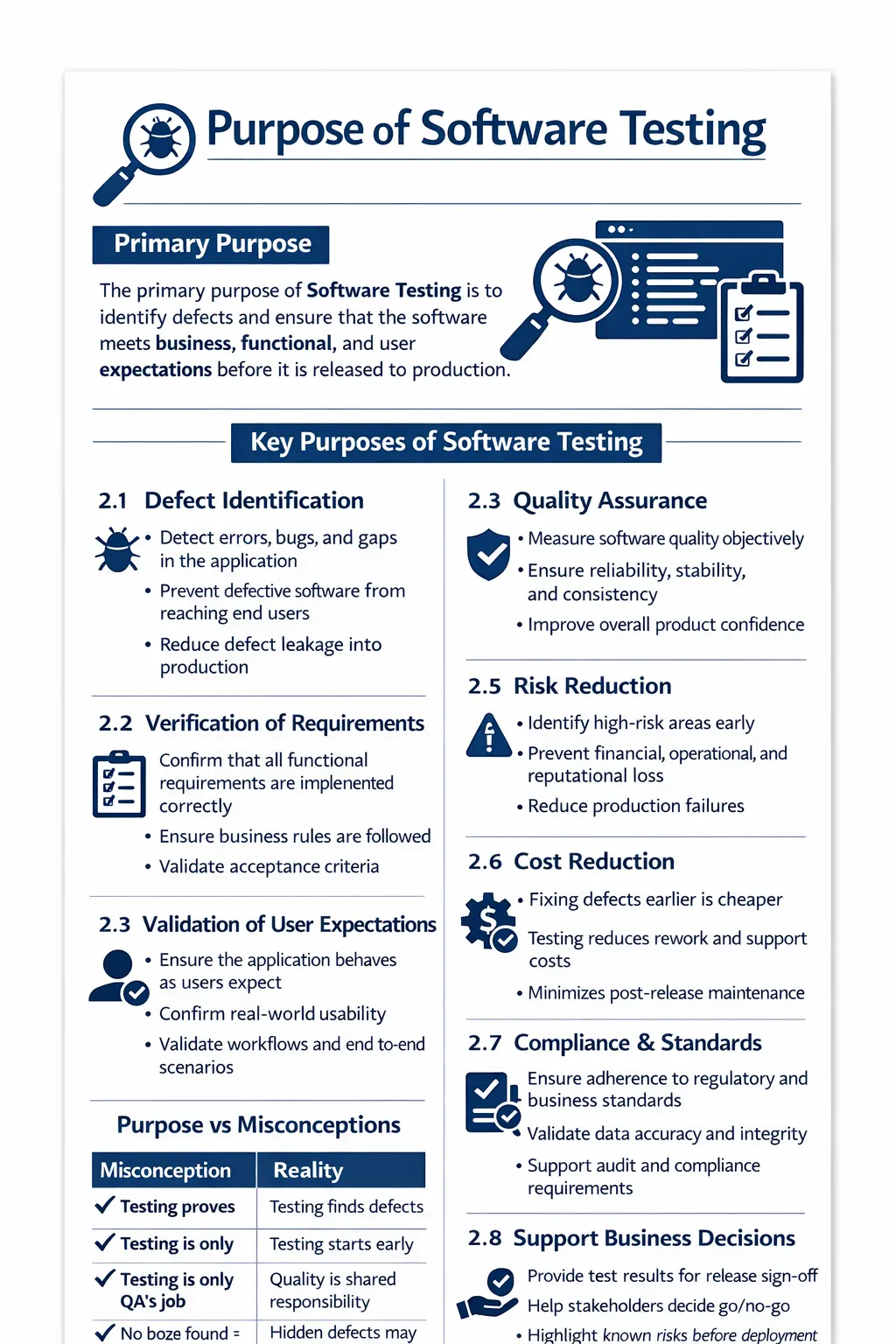
The primary purpose of software testing is to identify defects and to ensure that a software product meets business needs, functional requirements, and user expectations before it is released to production. Testing acts as a safeguard that evaluates whether the application is ready for real-world use. Rather than being a formality at the end of development, testing is a quality-focused discipline that helps teams deliver reliable and trustworthy software.
At its heart, testing is about prevention as much as detection. It aims to prevent poor-quality software from reaching users and to ensure that what is delivered truly solves the intended problem.
Software Testing as a Safeguard for Real Users
The purpose of software testing becomes clearer when we think about the real people who depend on software. Users do not care how many lines of code were written, how many frameworks were used, or how complex the architecture is. They care whether the application helps them complete their work safely, accurately, and without unnecessary frustration. Testing exists to protect that experience. It checks whether the system behaves correctly when real users enter data, follow workflows, make mistakes, use different devices, and depend on the application for important tasks.
A software product can appear complete from a development perspective but still fail from a user perspective. A button may exist, but it may not save data. A report may open, but it may show incorrect totals. A payment flow may work for one card type but fail for another. A login screen may accept valid credentials but expose poor error handling for invalid attempts. Testing helps reveal these gaps before users are affected. This is why testing is not merely a technical checkpoint. It is a user protection activity.
When testing is done well, it reduces uncertainty. The team gains evidence that important workflows have been checked, business rules have been validated, known risks have been explored, and critical defects have been addressed. This evidence does not mean the software is perfect. No responsible tester can promise that. But it does mean the release decision is based on observation and analysis rather than hope.
Testing as Prevention, Not Only Detection
Many people describe testing as the process of finding bugs. That is true, but it is incomplete. One of the deeper purposes of testing is prevention. When testers review requirements, ask questions, identify missing acceptance criteria, and challenge unclear assumptions, they help prevent defects before code is written. A defect avoided during requirement discussion is far cheaper than a defect found after production release.
For example, suppose a requirement says that a user should be able to reset a password. A tester may ask what should happen if the reset link expires, if the email address is not registered, if the password is too weak, if the same reset link is used twice, or if the account is locked. These questions may reveal missing rules. If the team clarifies them early, developers can implement the correct behavior the first time. Testing has already added value before execution begins.
This preventive role is one of the reasons modern teams involve testers early. Testing does not have to wait for a completed build. Test thinking can be applied to user stories, designs, API contracts, database changes, wireframes, and acceptance criteria. The earlier quality questions are asked, the easier it is to correct direction. Late testing finds problems; early testing helps avoid them.
Purpose in Requirement Verification
One important purpose of software testing is to verify that documented requirements are implemented correctly. Requirements are the agreed description of what the software should do. Testing compares the application against those requirements and checks whether the expected behavior has been delivered. This includes functional flows, validation rules, permissions, calculations, notifications, data storage, reports, and integration behavior.
Requirement verification protects the team from delivering software that only appears complete. A feature may be present in the user interface, but it may not follow the required business rule. For example, a discount field may accept a coupon code, but the calculation may be wrong. A leave request page may submit requests, but it may not enforce available leave balance. A banking form may transfer funds, but it may not apply transaction limits correctly. Testing checks these details.
Verification also helps uncover requirement ambiguity. If a tester cannot determine the expected result for a scenario, that usually means the requirement needs clarification. This is not a testing failure. It is useful information. Ambiguity is a risk, and testing helps make that risk visible. Clear requirements lead to better development, better testing, and fewer disputes during release.
Purpose in Business Rule Validation
Business rules are often where important defects hide. A screen may look correct and a workflow may appear to run, but the business logic may still be wrong. Testing validates whether the system follows the rules that matter to the organization. These rules may involve eligibility, pricing, taxes, discounts, approvals, limits, roles, statuses, deadlines, calculations, and exception handling.
For example, an e-commerce application may allow free shipping only above a certain order value. A payroll system may calculate overtime differently for different employee categories. A healthcare application may restrict access to patient records based on role. A finance system may apply different approval levels based on transaction amount. Testing confirms that these rules are not only coded but coded correctly.
This is where domain understanding becomes valuable. A tester who understands the business can design better scenarios than someone who only checks the user interface. The purpose of testing is not only to interact with screens; it is to evaluate whether the system supports the business correctly. Strong business-rule testing protects revenue, compliance, user trust, and operational stability.
Purpose in User Experience Validation
Software can meet written requirements and still fail users. A workflow may technically work but require too many steps. Error messages may be unclear. Navigation may be confusing. Important information may be hidden. A form may reset after validation failure, causing users to re-enter data. These are quality problems even if the main function works. Testing helps identify such issues by evaluating the application from a user perspective.
User experience validation is especially important because users judge software by practical use, not by internal design. If the application slows them down, confuses them, or causes repeated mistakes, they may lose trust in it. Manual testers bring human observation into this process. They notice awkward flows, inconsistent labels, missing feedback, unclear messages, and behavior that may frustrate users.
This purpose is sometimes underestimated because usability issues may not look as severe as functional failures. But poor user experience can reduce adoption, increase support calls, and damage product reputation. Testing helps teams see whether the product is not only functional but usable.
Purpose in Risk Reduction
Every release carries risk. The purpose of testing is to reduce that risk to an acceptable level by identifying problems, validating critical flows, and giving stakeholders visibility into remaining uncertainty. Testing cannot remove all risk, but it can make risk visible and manageable. This is why testing is closely connected to decision-making.
Risk can come from many sources. A new feature may be complex. A module may have changed recently. An integration may depend on another system. A payment workflow may affect revenue. A security rule may protect sensitive data. A regulatory requirement may carry legal consequences. Testing helps teams prioritize these areas and focus effort where failure would matter most.
Risk-based testing is practical because time is limited. No team can test every possible combination. Instead, testers ask which areas are most critical, most used, most changed, most complex, or most likely to fail. This prioritization supports better coverage where it matters most. The purpose of testing is not to execute the maximum number of cases; it is to provide the most useful quality information within the available time.
Purpose in Cost Control
Testing helps reduce cost by finding problems earlier. The later a defect is found, the more expensive it usually becomes. A requirement issue found during discussion may require only a conversation and an update to the story. The same issue found after development may require code changes, retesting, and schedule impact. If found after production release, it may require emergency fixes, customer communication, support effort, data correction, and reputation repair.
Early testing reduces rework. It also reduces the cost of uncertainty. When teams test continuously, they avoid discovering large quality gaps at the end of a project. This supports smoother delivery and better planning. Testing may appear to add effort, but poor testing often costs more through defects, delays, support tickets, customer dissatisfaction, and production incidents.
Cost control is not only about finding defects. It is also about preventing unnecessary development. If testing questions reveal that a requirement is misunderstood or not needed, the team can avoid building the wrong thing. In this way, testing supports efficiency as well as quality.
Purpose in Compliance and Accountability
Some industries require strong evidence that systems have been tested. Finance, healthcare, insurance, education, government, and safety-related systems may need to follow regulatory or organizational standards. Testing supports compliance by verifying rules, documenting execution, maintaining evidence, and showing that required behavior was evaluated.
Compliance testing may involve data accuracy, privacy, access control, audit trails, approval workflows, retention rules, consent handling, reporting accuracy, and security requirements. Failure in these areas can have serious consequences. It may lead to legal penalties, failed audits, operational disruption, or loss of public trust.
Testing deliverables such as test cases, execution results, defect reports, screenshots, logs, and summary reports provide accountability. They show what was tested, when it was tested, who tested it, what passed, what failed, and what risks remain. This evidence is important not only for audits but also for responsible project management.
Purpose in Release Readiness
One of the most practical purposes of testing is to support release readiness decisions. Before a product or feature is released, stakeholders need to know whether it is stable enough for users. Testing provides the information needed for that decision. It reports the status of critical scenarios, defect severity, unresolved issues, regression results, and known limitations.
Testing does not make the release decision alone. Product owners, business leaders, technical leads, and stakeholders may consider many factors, including timelines, customer commitments, market needs, risk acceptance, and operational readiness. But without testing information, the decision is based on assumptions. Testing turns the conversation into an evidence-based discussion.
A mature test summary does not simply say that testing is complete. It explains what was covered, what was not covered, what defects remain open, which risks are accepted, and what areas need monitoring after release. This transparency is one of the key business values of software testing.
Purpose in Regression Protection
Software changes constantly. New features are added, bugs are fixed, integrations are updated, dependencies change, and configurations are modified. Every change can accidentally break existing behavior. One purpose of testing is to protect the product from regression, which means existing functionality failing after a change.
Regression testing is important because users expect old features to continue working while new features are added. A bug fix in the checkout flow should not break login. A report update should not damage export functionality. A database change should not corrupt existing data. Testing checks that the system remains stable as it evolves.
Automation is especially useful for regression protection because repeated checks can be executed quickly across builds. Manual testing still plays a role when changes are complex, when exploratory thinking is needed, or when user experience must be evaluated. Together, manual and automated regression testing help maintain confidence over time.
Purpose in Building Stakeholder Confidence
Confidence is one of the most important outcomes of testing. Stakeholders need confidence that the product works, that important risks are known, and that the release is responsible. This confidence should not come from optimism alone. It should come from evidence. Test execution, defect trends, coverage reports, retest results, and regression outcomes all contribute to confidence.
Confidence does not mean certainty. Testing cannot guarantee that no defects exist. Instead, it gives a reasoned view of product quality. It helps answer questions such as: have the critical workflows been checked? Are severe defects resolved? Are known issues acceptable? Has regression testing passed? Is the product aligned with requirements? Are users likely to complete key tasks successfully?
When testing is weak, teams may release with false confidence. When testing is strong, teams may still release with some risk, but that risk is understood. This difference matters. Testing helps organizations act responsibly rather than blindly.
Purpose in Continuous Improvement
Testing also supports continuous improvement. Defects found during testing reveal patterns. If many issues appear in one module, that module may need better design, code review, or refactoring. If many defects come from misunderstood requirements, the team may need stronger refinement sessions. If many escaped defects come from missing regression coverage, the test strategy may need improvement.
Test results are feedback, not just pass-fail records. They show where the development process is strong and where it needs attention. A team that studies testing feedback can improve requirements, design, coding practices, automation, deployment, and monitoring. In this way, testing contributes to better future delivery, not only current release quality.
Continuous improvement is especially important in Agile and DevOps environments. Fast delivery without quality feedback creates fast failure. Testing provides the feedback loop that helps teams move quickly without losing control. The purpose of testing is therefore connected to sustainable delivery.
How Testers Communicate the Purpose of Testing
A tester also fulfills the purpose of testing through communication. Finding a defect is valuable, but explaining it clearly is equally important. A good defect report helps developers understand the problem quickly. It includes the steps to reproduce, test data, expected result, actual result, environment, screenshots, logs, and severity. This clarity reduces wasted time and helps the team correct issues faster.
Testing communication also helps stakeholders understand product readiness. A test summary should not only say how many test cases passed or failed. It should explain which areas were tested, which areas were not tested, what risks remain, which defects are still open, and whether the product is ready from a quality perspective. This transforms testing from a silent execution activity into a decision-support activity.
Good testers communicate without exaggeration and without hiding risk. If an issue is serious, they explain the impact. If a defect is minor, they do not overstate it. If testing coverage is incomplete, they say so clearly. This honesty builds trust. The purpose of testing is not to block releases unnecessarily or approve them blindly. It is to provide accurate information so the organization can make responsible choices.
Purpose of Testing for Different Stakeholders
The purpose of software testing is viewed differently by different stakeholders. For users, testing means fewer failures, clearer workflows, better performance, and a more dependable product. Users may never see the test cases, but they experience the result of good testing when the application behaves reliably.
For developers, testing provides feedback. It shows where implementation does not match expectation and where hidden assumptions created problems. Good testing helps developers improve code quality and avoid repeated mistakes. For product owners, testing confirms whether business rules and acceptance criteria are working. For managers, testing provides visibility into risk, schedule impact, and release readiness.
For the business, testing protects reputation, revenue, customer trust, and operational stability. A serious production failure can affect support teams, sales teams, legal teams, customers, and leadership. Testing reduces the likelihood of such failures and helps the organization deliver value with confidence.
Practical Example of Testing Purpose
Consider a simple online payment feature. The visible purpose of testing is to check whether payment succeeds. But the real purpose is much broader. Testing must verify that valid cards are accepted, invalid cards are rejected, duplicate payments are prevented, transaction amounts are correct, failed payments show clear messages, order status is updated accurately, and sensitive payment data is protected.
If testing checks only the happy path, the feature may look ready but still fail in real life. A user may be charged twice. An order may remain pending after successful payment. A failed payment may still reduce inventory. A timeout may leave the user uncertain. Testing protects against these business and user risks by exploring realistic and negative conditions.
This example shows why the purpose of testing cannot be reduced to clicking through a feature. Testing connects requirement validation, risk reduction, business rule checking, user experience, compliance, and release confidence. Every meaningful test should provide information that helps the team understand product quality better.
Defect Identification as a Core Purpose
One of the most visible purposes of testing is defect identification. During development, errors and gaps can appear in logic, design, or implementation. Testing uncovers these issues so they can be corrected before release. By catching problems early, testing reduces the chance that defective software will reach end users. This directly lowers defect leakage into production and protects the user experience.
Defect identification is not about blaming developers; it is about strengthening the product. Every defect found during testing is a failure avoided in production.
Verifying Requirements and Business Rules
Testing also exists to confirm that requirements are implemented correctly. Software is built based on documented needs, business rules, and acceptance criteria. Testing checks whether these are translated accurately into the application. When this verification is done thoroughly, it ensures that the system behaves according to agreed expectations and supports the intended business processes.
Without this level of checking, teams risk delivering software that works technically but fails functionally from a business perspective.
Validating User Expectations
Beyond requirements, software must satisfy user expectations. Testing evaluates how the system behaves in realistic scenarios, whether workflows make sense, and whether the application is usable in day-to-day situations. This validation ensures that the product is not only correct on paper but also practical and intuitive in real life.
A system that meets specifications but frustrates users cannot be considered successful. Testing bridges that gap between specification and experience.
Quality Assurance and Product Confidence
Testing contributes to broader quality assurance by providing objective information about reliability, stability, and consistency. It gives stakeholders confidence that the product performs as intended. When test results demonstrate stability across scenarios, teams gain trust in the system’s readiness.
Quality is not assumed; it is demonstrated through evidence gathered during testing.
Reducing Risk and Protecting the Business
Every software release carries risk. Failures in production can lead to financial impact, operational disruption, and reputational damage. Testing helps identify high-risk areas early so they can be addressed. By reducing the likelihood of failures, testing protects the organization and its customers.
In this sense, testing is a risk management activity as much as a technical one.
Lowering Costs Through Early Detection
The cost of fixing defects grows as a project progresses. Issues discovered after release are far more expensive to resolve than those found during requirements or development. Testing helps detect problems sooner, which reduces rework, support costs, and long-term maintenance. Investing in testing early ultimately saves money and effort later.
Ensuring Compliance and Standards
Many systems must follow regulatory or industry standards. Testing checks whether the software adheres to these obligations, including data accuracy, integrity, and process compliance. This is especially critical in domains such as finance, healthcare, and government systems, where non-compliance can have serious consequences.
Supporting Business Decisions
Testing provides the evidence needed for release decisions. Test outcomes inform stakeholders about system readiness, known risks, and remaining limitations. This transparency allows leaders to make informed go or no-go decisions. Testing does not decide releases on its own, but it provides the data that makes decisions responsible and informed.
Clarifying Common Misconceptions
There are misunderstandings about the purpose of testing. Testing does not prove that software works perfectly; it reveals where problems exist. Testing is not something that starts only after development; it begins as soon as requirements are discussed. Testing is also not the sole responsibility of a QA team, because quality is a shared responsibility across roles. Even when no defects are found, it does not guarantee perfect quality, as some issues may remain hidden.
Recognizing these realities helps teams use testing more effectively.
Purpose of Testing in Real Projects
In real-world projects, testing ensures that critical features operate under realistic conditions, that new changes do not break existing functionality, and that business-critical flows remain stable. It builds user trust by demonstrating that the system has been evaluated carefully. Over time, consistent testing practices contribute to a product’s reputation for reliability.
Purpose Across the Software Development Lifecycle
The purpose of testing appears in every phase of the lifecycle. During requirements, it prevents misunderstandings. During design, it exposes gaps. During development, it catches defects early. During system testing, it validates the integrated product. Even after release, testing feedback helps minimize failures and improve future versions.
Testing is not a single phase; it is a continuous influence on quality.
Conclusion: The Real Purpose of Software Testing
The true purpose of software testing is to protect the business, the user, and the product’s reputation. It ensures that software is dependable, aligned with needs, and ready for real use. Testing is not about finding faults for their own sake; it is about preventing failure and enabling success.
When viewed this way, software testing becomes a value-driven activity that supports both technical excellence and business confidence.