Negative Testing: Validating System Behavior Under Invalid Conditions
Introduction to Negative Testing
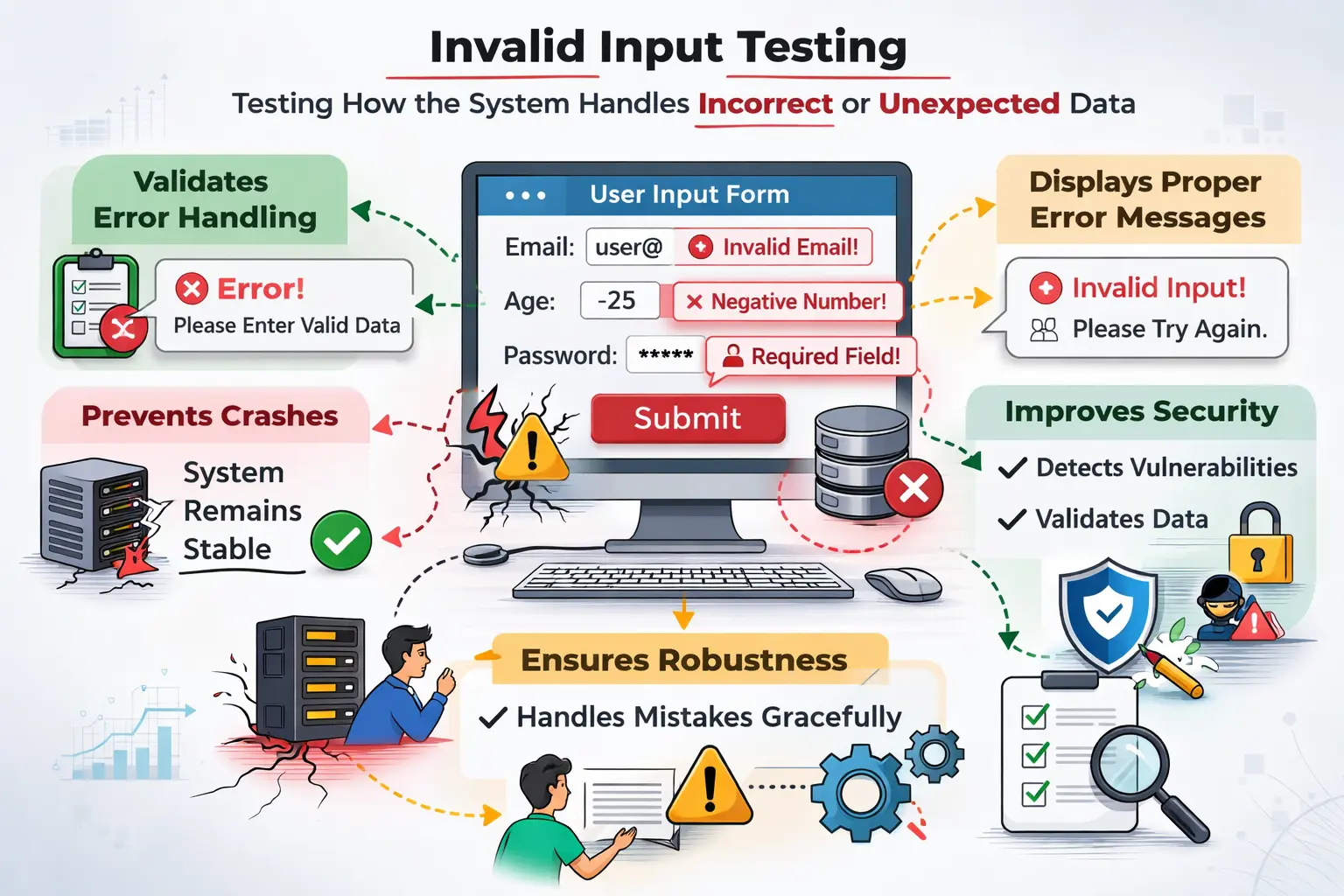
Negative Testing is the process of validating how an application behaves when invalid, unexpected, or incorrect inputs are provided. Its objective is to ensure that the system fails gracefully, securely, and predictably without crashing or corrupting data.
Negative testing answers a critical question: how does the system behave when things go wrong?
Purpose of Negative Testing
The primary goal of negative testing is to identify weaknesses in validation, error handling, and system stability. Real users make mistakes, and systems must handle those mistakes properly. A user may forget a required field, enter an incorrect password, paste a long value, use an unsupported file, submit a form twice, or attempt an action without permission. Negative testing verifies whether the application responds safely and clearly in those situations.
Negative testing helps prevent crashes, security vulnerabilities, and data corruption. A system that accepts invalid data can damage reports, business workflows, downstream integrations, and user trust. A system that crashes during invalid input creates instability. A system that exposes sensitive information in an error message creates security risk. Negative testing helps catch these problems before release.
It also confirms that validation rules are enforced consistently. If a field is mandatory, the system should reject blank input every time. If a user is not authorized, the system should prevent access reliably. If a file type is unsupported, the system should reject it with a clear explanation.
It strengthens application robustness and improves user trust. Users are more confident when an application handles mistakes gracefully, explains what went wrong, and allows them to recover without losing data or seeing technical failures.
Scope of Negative Testing
Negative testing includes validating invalid inputs, missing mandatory fields, incorrect data formats, boundary violations, unauthorized actions, duplicate submissions, expired sessions, unsupported files, and unexpected user actions. It challenges the system by providing data or actions outside expected norms.
The scope includes field-level validation, form-level validation, workflow validation, role-based validation, data integrity checks, and error handling. For example, a tester may check whether an email field rejects invalid formats, whether a date field rejects impossible dates, whether a payment flow rejects insufficient balance, and whether a restricted page blocks unauthorized users.
Negative testing also includes boundary violations. If a field allows a maximum of fifty characters, the tester checks what happens with fifty-one. If an amount must be greater than zero, the tester checks zero and negative numbers. If a session expires after a fixed time, the tester checks behavior after expiry.
This approach ensures that the system enforces validation rules and responds appropriately under abnormal conditions. The goal is not to make the system fail badly; the goal is to verify that it rejects invalid behavior safely and predictably.
Role of the Manual Tester
The manual tester must think critically and anticipate how users might misuse the system. This includes entering invalid values, skipping required fields, manipulating workflows, testing edge cases, attempting unauthorized actions, and interrupting normal flows. Negative testing requires the tester to think beyond the ideal user path.
The tester verifies that proper error messages are displayed, the system remains stable, and no sensitive data is exposed. The objective is controlled failure, not system breakdown. A failed negative test does not mean the user was rejected; rejection is often expected. A failed negative test means the system rejected incorrectly, accepted invalid data, crashed, exposed information, or failed to guide the user.
Manual testers also verify recovery. After an invalid action, the user should know what to correct and should be able to continue without unnecessary frustration. If a form rejects invalid input but deletes all previously entered valid data, the experience is poor. Negative testing checks these recovery details.
Clear defect reporting is especially important. The tester should describe the invalid condition, expected rejection, actual behavior, error message, data used, and whether the system remained stable. This helps developers understand whether the problem is validation, error handling, security, workflow, or data persistence.
Negative Testing Compared to Positive Testing
Positive testing validates expected behavior with valid inputs, while negative testing validates error handling with invalid inputs. In positive testing, success is expected. In negative testing, controlled rejection or proper validation is expected. Both approaches are needed because software must work correctly when used properly and remain stable when used incorrectly.
Positive testing asks whether a valid user can log in, whether a valid payment can be processed, or whether a valid form can be submitted. Negative testing asks whether invalid credentials are rejected, whether an expired card is blocked, or whether a blank mandatory form is prevented from submission.
Positive testing establishes the functional baseline. Negative testing strengthens the system by checking its protective behavior. A product that passes only positive tests may still fail badly in production because users rarely behave perfectly all the time.
Both approaches are necessary for comprehensive quality assurance. Positive testing confirms expected success; negative testing confirms safe failure.
Real-Time Example
Consider a login feature. Negative testing involves entering an invalid username, incorrect password, leaving fields empty, entering only spaces, using an inactive account, trying a locked account, attempting too many failed logins, or attempting malicious inputs such as SQL injection patterns. The expected outcome is a clear error message without system crash or data exposure.
The tester verifies that invalid login attempts do not authenticate the user, do not expose whether the username exists if the requirement forbids it, and do not reveal sensitive system details. The tester also checks whether failed attempts are counted correctly and whether account lockout rules work if they exist.
Another example is file upload. Negative testing may include unsupported file types, oversized files, empty files, files with special characters in the name, duplicate uploads, and interrupted uploads. The system should reject unsupported conditions clearly and should not corrupt data or crash.
In a payment feature, negative testing may include insufficient balance, expired card, invalid CVV, wrong billing address, duplicate submission, and network interruption during payment. The application must reject invalid attempts while maintaining security and stability.
Entry and Exit Criteria
Negative testing begins when validation rules and functional requirements are defined. The tester must know which inputs are invalid, which fields are mandatory, which formats are allowed, which limits apply, which roles are restricted, and what error behavior is expected. Without clear rules, negative testing can become guesswork.
Good entry preparation also includes test data. Negative testing may require invalid users, locked accounts, expired records, unsupported files, duplicate data, restricted roles, and boundary values. The tester should prepare this data before execution where possible.
Negative testing concludes when all planned invalid scenarios are handled properly, appropriate error messages are displayed, invalid data is not saved, unauthorized actions are blocked, and no system instability occurs. Critical validation and security-related defects should not remain open without explicit risk acceptance.
The system should remain secure and consistent under all tested invalid conditions. Successful negative testing means the system fails in a controlled, meaningful, and recoverable way.
Common Defects Identified
Negative testing often uncovers application crashes, unclear or misleading error messages, missing validation rules, security vulnerabilities, and potential data corruption issues. These defects can have serious impact if released to production.
Missing validation rules are common. A system may accept blank mandatory fields, invalid email formats, negative amounts, future birth dates, unsupported file types, or values outside allowed limits. These defects can pollute data and break downstream processes.
Error message defects are also frequent. The application may show a vague message, technical stack trace, or misleading instruction. A good error message should explain the problem and help the user correct it without exposing sensitive technical details.
Stability defects may appear when invalid input causes the application to crash, freeze, or become unresponsive. A robust system should reject invalid input without losing control of the user session or corrupting data.
Security-related defects may appear when the system exposes internal information, allows unauthorized actions, fails to sanitize input, or responds differently in ways that reveal sensitive data. Negative testing often overlaps with basic security awareness.
Common Mistakes
One common mistake is treating negative testing as optional. Another is focusing only on functionality without validating error messages or security implications. Failing to test boundary conditions thoroughly can also leave critical gaps in validation coverage.
Another mistake is testing invalid input randomly without understanding the rule. Negative testing should be based on validation rules, business constraints, and realistic misuse patterns. Random invalid values may find some issues, but structured invalid scenarios provide better coverage.
Some testers check only whether an error appears, but not whether the error is correct. The error message should be clear, displayed in the right place, and should not expose sensitive information. It should also allow the user to recover.
Another mistake is ignoring data state after rejection. If an invalid order is rejected, no order should be created. If an invalid payment fails, money should not be deducted. If an invalid profile update is blocked, old profile data should remain unchanged.
Negative testing requires structured thinking and attention to detail. It is not only about entering wrong values; it is about confirming safe and correct system behavior under invalid conditions.
Best Practices for Negative Testing
The first best practice is to derive negative scenarios from clear rules. If a field has a format, length, range, role, or dependency rule, the tester should create invalid cases around that rule. This keeps negative testing systematic instead of random.
The second best practice is to verify the complete rejection behavior. A test should confirm that the system rejects the invalid action, displays the correct message, preserves valid data where appropriate, avoids saving invalid data, and remains stable.
The third best practice is to include boundary-related invalid values. If the maximum allowed quantity is ten, testing eleven is a negative case. If the minimum age is eighteen, testing seventeen is a negative case. Boundary-related negatives are often high value.
The fourth best practice is to consider security and privacy. Error messages should not reveal database details, stack traces, server paths, valid usernames, or sensitive internal logic. Invalid input should not bypass authorization or expose protected data.
The fifth best practice is to combine negative testing with positive testing. After confirming that invalid input is rejected, testers should also confirm that valid input still works. This prevents overly strict validation from blocking legitimate users.
Designing Negative Test Cases
Designing negative test cases begins by identifying what the system should not accept. The tester reviews requirements, validation rules, business rules, security expectations, and user workflows. Each invalid condition should have a clear expected response.
A good negative test case includes invalid preconditions or input, execution steps, expected rejection, expected error message, and expected data state after the action. For example, if a user attempts to submit a blank mandatory email field, the expected result is not only that submission fails, but also that a clear email-required message appears and no incomplete account is created.
Negative test cases should avoid combining too many invalid conditions at once. If username, password, and email are all invalid in the same test, it may be hard to know which validation rule is being checked. One invalid condition per test is often clearer, followed by a few combination tests where business risk requires them.
Testers should also include workflow-based negative cases, not only field-level cases. Examples include submitting the same form twice, using browser back after logout, accessing a page without permission, or attempting payment after session expiry.
Negative Testing in Agile Projects
In Agile projects, negative testing should be considered during refinement, not only during execution. Testers should ask what should happen when required data is missing, when the user lacks permission, when limits are exceeded, and when dependent services fail. These questions improve acceptance criteria.
During sprint testing, negative scenarios help confirm that the story is robust, not just functional. A story that works only for valid input may not be ready if it crashes or saves bad data when invalid input is used.
Negative cases can also become automation candidates when they protect important rules. For example, mandatory field validation, unauthorized access rejection, and invalid payment handling may be useful automated regression checks if they are stable and high risk.
Security and Data Integrity in Negative Testing
Negative testing often supports basic security and data integrity validation. Invalid inputs should be rejected safely. Unauthorized actions should be blocked. Error messages should be controlled. Sensitive data should not appear in responses, logs visible to users, or browser messages.
Data integrity is equally important. If invalid data is rejected, the system should not partially save it. If a transaction fails, balances and statuses should remain correct. If a file upload is rejected, the file should not remain in an inconsistent state.
These checks are important because negative behavior often reveals system weakness. A product's quality is not proven only by how it succeeds; it is also proven by how safely it handles invalid conditions.
Common Negative Testing Scenarios
Common negative testing scenarios include blank mandatory fields, invalid email formats, wrong passwords, expired sessions, unsupported file uploads, duplicate submissions, insufficient balance, unauthorized page access, invalid date ranges, and values outside allowed limits. These scenarios are common because they reflect realistic user mistakes and misuse patterns.
Form-based applications require strong negative coverage. Testers should check empty required fields, invalid formats, very long input, special characters, leading and trailing spaces, duplicate values, and copy-pasted data. These checks help prevent poor-quality data from entering the system.
Workflow-based applications need negative testing around sequence and state. A user may try to approve a request twice, cancel an already completed order, access a page after logout, refresh during payment, or return to a previous step after submission. The system should handle these actions safely.
Role-based systems need negative testing for permissions. A regular user should not access admin functions. A viewer should not edit records. A user from one organization should not see another organization's data. These checks protect business rules and privacy.
File and data processing systems need negative testing for unsupported file types, corrupt files, empty files, oversized files, invalid encodings, and unexpected data columns. The system should reject bad input clearly and avoid partial processing that corrupts records.
Limitations of Negative Testing
Negative testing is powerful, but it cannot cover every possible invalid condition. The number of wrong inputs and abnormal workflows can be extremely large. Testers must prioritize based on risk, business impact, security concerns, and historical defect patterns.
Another limitation is that negative testing depends on clear rules. If requirements do not define what is invalid or how the system should respond, testers may need clarification before they can design meaningful cases. Otherwise, expected results become subjective.
Negative testing also needs balance. Too much focus on rare invalid scenarios can consume time while core business paths remain under-tested. A strong test strategy starts with positive coverage, then expands into high-value negative and boundary cases.
Interview Perspective
In interviews, negative testing is typically described as validating system behavior with invalid or unexpected inputs. A strong answer emphasizes that it ensures graceful failure, proper validation, and system security under abnormal conditions.
A stronger interview answer explains that negative testing verifies rejection behavior, error messages, stability, security, and data protection. It should mention invalid inputs, missing mandatory fields, boundary violations, unauthorized actions, and unexpected workflows.
If asked for an example, login is effective. The tester can explain invalid username, wrong password, blank fields, locked account, too many failed attempts, and SQL injection-like input. The expected behavior is controlled rejection without crash or data exposure.
If asked how it differs from positive testing, the answer should say that positive testing validates success with valid inputs, while negative testing validates controlled failure with invalid inputs. Both are required for complete validation.
Key Takeaway
Negative Testing ensures that an application remains stable, secure, and user-friendly even when used incorrectly. It transforms potential system failures into controlled and meaningful responses, strengthening overall software quality.
The practical value of negative testing is resilience. It proves that the application can protect itself, protect data, guide users, and maintain stability when invalid or unexpected actions occur.
Good negative testing is structured, rule-based, and risk-aware. It checks invalid inputs, incorrect workflows, boundary violations, authorization failures, error messages, and data state. When combined with positive testing, it gives a much stronger picture of software quality.