Manual Testing Best Practices
Manual testing remains one of the most important disciplines in software quality because it brings human judgment, business understanding, observation, and critical thinking into the testing process. Automation can execute repeated checks quickly, but it cannot fully replace a tester who understands user behavior, notices unusual patterns, questions unclear requirements, and recognizes whether the product truly solves the business problem. Manual testing best practices are the proven habits and techniques that help testers work with clarity, detect meaningful defects, and support confident releases.
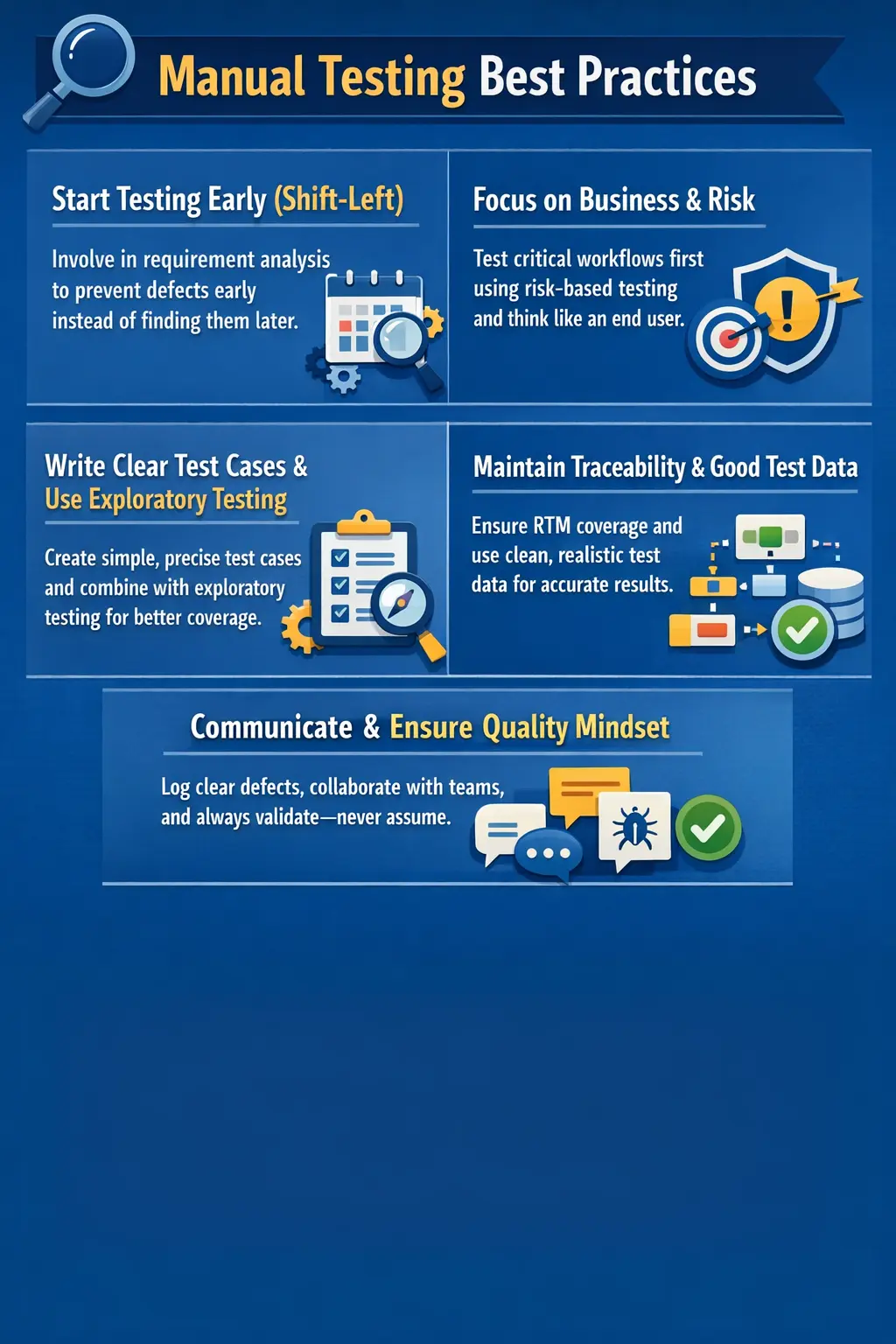
Effective manual testing is not just about following a test case document from top to bottom. It involves understanding requirements, identifying risks, preparing useful test data, validating business workflows, exploring beyond scripted cases, reporting defects clearly, and communicating quality status to stakeholders. In real projects, timelines are often tight, requirements change, environments may be unstable, and builds may arrive late. Best practices help testers stay organized and make better decisions even when the project is under pressure.
These practices are especially important in Agile teams, where testing is expected to happen continuously rather than only at the end of development. A skilled manual tester contributes from the beginning of the sprint by reviewing user stories, clarifying acceptance criteria, preparing test scenarios early, executing focused tests, and giving fast feedback. When applied consistently, manual testing best practices reduce defect leakage, improve collaboration, and strengthen overall product quality.
Start Testing Early with a Shift-Left Mindset
One of the strongest manual testing best practices is to start testing activities as early as possible. In older project models, testers often became involved only after development was complete. By that time, requirement misunderstandings, design mistakes, and missing validations had already moved into the code. Finding defects late usually increases rework because developers must revisit completed work, testers must retest, and release timelines may be affected.
Shift-left testing changes this pattern by involving testers during requirement analysis, design discussions, backlog refinement, and acceptance criteria review. A tester can ask practical questions before coding begins. What should happen when mandatory data is missing? What is the maximum allowed value? Which roles can access this feature? What should the user see when an integration fails? These questions help expose hidden assumptions early.
Early testing does not always mean executing the application. It also includes reviewing requirements, identifying ambiguities, suggesting test scenarios, and checking whether expected behavior is measurable. When testers participate early, they help prevent defects instead of only detecting them later. This saves time, improves requirement clarity, and allows the team to build the product correctly from the beginning.
Understand the Business Domain
Manual testing becomes much stronger when the tester understands the business domain. A tester who only checks whether buttons work may miss important business defects. A tester who understands how users actually perform their work can identify workflow gaps, incorrect rules, confusing messages, and risky behavior that may not be obvious from the screen alone. Domain knowledge turns testing from mechanical execution into meaningful quality analysis.
For example, in an e-commerce application, a tester should understand product search, cart behavior, discounts, tax calculation, payment, order confirmation, cancellation, returns, and notifications. In a banking application, the tester should understand authentication, beneficiary management, transfer limits, balance validation, transaction history, statements, and role-based access. Without domain understanding, a tester may pass a feature that technically works but fails to support real business usage.
Domain knowledge also improves test design. It helps testers choose realistic scenarios, prepare meaningful test data, and prioritize flows that matter most to users. Testers should regularly learn from business analysts, product owners, support teams, production issues, customer feedback, and existing application behavior. The better a tester understands the domain, the better they can detect defects that have real user impact.
Write Clear and Testable Test Cases
Clear test cases are the foundation of consistent manual testing. A good test case should explain the preconditions, test steps, test data, and expected result in a way that another tester can execute without confusion. If a test case is vague, different testers may interpret it differently, which leads to inconsistent results and missed defects.
Each test case should focus on a specific validation. Overloaded test cases that try to cover many behaviors at once become difficult to execute and difficult to debug when they fail. For example, a test case for successful login should not also validate password reset, profile update, and logout. Those should be separate scenarios. A focused test case produces clearer results and makes defect reporting easier.
Test cases should also be objectively testable. The expected result should not say only "system should work correctly." It should describe the exact expected behavior, such as "the user should be redirected to the dashboard and the account summary should be displayed." Clear expected results reduce ambiguity and help testers identify actual deviations from requirements.
Maintain Strong Requirement Traceability
Requirement traceability ensures that every approved requirement is covered by one or more test cases. In structured projects, this is often maintained through a Requirement Traceability Matrix, commonly called RTM. Traceability helps testers answer an important question: have we tested everything that was agreed in the requirements?
RTM is useful during test design, execution, change management, and release sign-off. During test design, it reveals whether any requirement lacks test coverage. During execution, it shows which requirements have passed, failed, or remain blocked. When a requirement changes, traceability helps identify which test cases need updates. During release discussions, RTM provides evidence of coverage.
Strong traceability is especially valuable in regulated or business-critical domains such as banking, insurance, healthcare, and finance. It reduces the risk of missing requirements and supports audits, reporting, and stakeholder confidence. Even when a formal RTM is not required, testers should still maintain some mapping between requirements and tests.
Apply Risk-Based Testing
In real projects, testers rarely have unlimited time. Because of this, it is not practical to test every feature with equal depth. Risk-based testing helps testers focus effort where failure would cause the greatest impact. Risk usually combines two factors: how likely a failure is and how serious the impact would be if it happened.
High-risk areas usually include payment flows, login and authentication, user permissions, business-critical transactions, integrations, reports used for decisions, recently changed modules, and areas with a history of defects. These areas should be tested earlier and more thoroughly. Low-risk or rarely used areas may receive lighter coverage when time is limited, but the decision should be visible to the team.
Risk-based testing does not mean ignoring low-priority features. It means making intelligent choices when time, people, or environment availability is limited. A tester should communicate what was tested, what was deferred, and what risk remains. This allows stakeholders to make informed decisions rather than assuming everything received equal coverage.
Balance Scripted Testing with Exploratory Testing
Scripted test cases provide structure, repeatability, and coverage, but they are not enough by themselves. Many important defects are found when testers explore the application beyond predefined steps. Exploratory testing allows testers to learn, design, and execute tests at the same time. It uses experience, curiosity, and domain understanding to investigate how the system behaves.
Exploratory testing is useful for new features, complex workflows, unclear requirements, and areas where users may behave unpredictably. A tester may vary inputs, change navigation order, interrupt workflows, try unusual combinations, or validate how the application behaves under unexpected conditions. These actions often reveal defects that scripted cases do not cover.
The best practice is to combine both approaches. Test cases ensure planned coverage, while exploratory testing adds depth and flexibility. Exploratory testing should still be thoughtful, not random. Testers can use charters, notes, session goals, and defect evidence to keep it useful and accountable.
Keep Test Data Clean and Controlled
Test data has a direct impact on test reliability. Poor test data can create false failures, hide real defects, or make test results difficult to reproduce. For example, a login test may fail not because the application is broken, but because the test account is locked. A report test may fail because old data was modified by another tester. These issues waste time and reduce confidence in testing.
Good test data should be realistic, controlled, documented, and aligned with the scenario being tested. Testers should prepare valid data, invalid data, boundary values, role-based data, and data for special business conditions. If data is shared across testers, the team should define naming conventions, reset rules, and ownership to avoid accidental conflicts.
Clean data also improves defect reporting. When a defect includes exact test data, developers can reproduce the issue faster. When test data is uncontrolled, teams may spend more time investigating whether the problem is in the application or in the data. Strong test data management makes manual testing more accurate and repeatable.
Understand the Test Environment
A tester should always know which environment is being used and what limitations exist in that environment. QA, UAT, staging, and production environments may have different builds, configurations, integrations, user roles, data sets, and feature flags. Many failures are caused by environment issues rather than application defects, so testers must understand the environment before drawing conclusions.
Before execution begins, testers should verify environment readiness. Is the correct build deployed? Are required services available? Are user accounts active? Is test data prepared? Are integrations connected or mocked? Are there known environment limitations? These checks prevent wasted effort and false defect reporting.
Strong test environment understanding also helps during defect analysis. If a feature works in QA but fails in UAT, the tester can compare configuration, endpoints, roles, and data. This practical awareness improves communication with developers, DevOps, and environment support teams.
Log High-Quality Defects
Defect reporting is one of the most visible responsibilities of a manual tester. A high-quality defect report helps developers understand the issue quickly and fix it correctly. A poor defect report creates confusion, delays resolution, and may lead to rejection because the issue cannot be reproduced.
A good defect report should include a clear title, module, environment, build version, preconditions, test data, steps to reproduce, expected result, actual result, severity, priority suggestion, and evidence such as screenshots, videos, logs, or downloaded files. The report should be factual and neutral. It should describe behavior, not blame people.
Testers should assign severity based on impact and priority based on urgency or business need. If a defect blocks a critical workflow, the report should explain the business impact. If the issue is intermittent, the report should mention frequency and conditions. High-quality defects improve teamwork and speed up the defect lifecycle.
Communicate Clearly and Professionally
Manual testing is a communication-heavy role. Testers communicate requirement questions, test progress, blockers, defects, risks, environment issues, and release concerns. Clear communication prevents surprises and helps the team act early. Poor communication can make even good testing work less useful because stakeholders may not understand the risk.
Professional communication should be evidence-based. Instead of saying "the feature is bad," a tester should say "the transfer confirmation page does not display the transaction reference number, although the acceptance criteria states that the reference number should be shown after successful transfer." This style is specific, objective, and easier to act on.
Testers should collaborate closely with developers, BAs, product owners, scrum masters, support teams, and business users. Quality is a shared responsibility. A tester who communicates early and respectfully helps defects get resolved faster and builds trust across the team.
Perform Effective Regression Testing
Regression testing ensures that new changes do not break existing functionality. It is essential because even a small code change can affect shared components, validations, data flows, reports, or integrations. Without regression testing, the product may slowly become unstable as changes accumulate.
Effective regression testing begins with impact analysis. Testers should understand what changed, which modules are connected, which business flows are critical, and which areas have defect history. Based on this, they can select the right regression scope. Full regression may be needed before major releases, while selective regression may be enough for smaller changes.
Regression should be optimized. Running every test case every time may be wasteful, but testing only the changed feature may be risky. A good tester balances coverage and time by focusing on impacted areas, high-risk workflows, and critical user journeys. After defect fixes, testers should first perform re-testing and then regression around related functionality.
Track and Use Metrics Wisely
Testing metrics provide useful visibility into progress and quality, but they must be interpreted carefully. Common test metrics include test cases planned, executed, passed, failed, blocked, defect count, defect severity distribution, defect reopening rate, requirement coverage, and test execution progress. These numbers help stakeholders understand where testing stands.
However, metrics can be misleading if viewed without context. A high pass rate does not always mean high quality if the tests are shallow. A low defect count does not always mean the product is stable if testing coverage is incomplete. A large number of defects may indicate poor quality, but it may also indicate strong testing in a risky area. Metrics should guide decisions, not replace judgment.
Best practice is to combine quantitative metrics with qualitative analysis. Along with numbers, testers should explain risks, blockers, defect patterns, unstable modules, and untested areas. This gives stakeholders a more accurate picture of product readiness.
Document Lessons Learned
Continuous improvement is an important part of professional manual testing. After each sprint, release, or major testing cycle, the team should review what worked well and what needs improvement. Lessons learned may include recurring defects, unclear requirements, environment instability, test data problems, late changes, weak regression coverage, or communication gaps.
Documenting lessons learned helps the team avoid repeating the same mistakes. If many defects were caused by ambiguous requirements, the team can improve refinement and acceptance criteria review. If regression defects escaped, the regression suite can be updated. If environment issues caused delays, environment readiness checks can be improved.
This practice also helps individual testers grow. Good testers learn from every release. They improve their test design, update checklists, strengthen domain knowledge, and share useful findings with the team. Over time, this makes testing more efficient and more effective.
Never Assume, Always Validate
Assumption is one of the biggest risks in testing. Testers should not assume that requirements are complete, fixes are correct, test data is valid, or existing functionality still works. Every important behavior must be validated through observation, execution, review, or evidence. A single unchecked assumption can become a production defect.
For example, if a developer says a defect is fixed, the tester should still perform re-testing. If a requirement says a field is mandatory, the tester should verify what happens when it is blank. If a feature works for one user role, the tester should check whether role-based differences exist. Validation is the core mindset of testing.
This does not mean testers should distrust the team. It means testers should rely on evidence. A professional tester asks questions, confirms behavior, and documents results. This habit improves quality and reduces surprises late in the release cycle.
Maintain a Strong Quality Mindset
A strong quality mindset is what separates good testers from simple test executors. Quality-minded testers do not only ask whether a test case passed. They ask whether the feature is useful, understandable, reliable, secure, consistent, and aligned with user expectations. They think about what can go wrong and how users may behave in real life.
This mindset helps testers identify risks beyond the obvious. They may notice unclear error messages, confusing workflows, missing validations, inconsistent data, slow responses, accessibility gaps, or security concerns. These issues may not always appear in basic test cases, but they affect user experience and business trust.
A quality mindset also includes ownership. Testers should not think, "My job is only to execute assigned cases." They should contribute to requirement clarity, test coverage, defect prevention, release readiness, and continuous improvement. This broader thinking makes manual testing valuable in modern software teams.
Interview-Ready Closing Statement
In interviews, manual testing best practices are often used to judge whether a candidate has real project awareness. A strong answer can be: "I follow best practices such as early involvement in requirement analysis, understanding the business domain, writing clear test cases, maintaining traceability, applying risk-based testing, using exploratory testing, preparing reliable test data, logging clear defects, communicating risks early, and continuously improving testing based on lessons learned."
This answer works because it connects process, quality, and business value. It does not sound like a memorized list. It shows that the tester understands how manual testing fits into real delivery. If the interviewer asks for examples, you can explain how unclear requirements were clarified early, how risk-based testing helped during a tight release, or how regression testing prevented side effects after a defect fix.
Key Takeaway
Manual testing best practices help testers deliver reliable results in real-world projects. They bring structure to test design, discipline to execution, clarity to defect reporting, and intelligence to risk-based decisions. Without these practices, manual testing can become random and inconsistent. With them, it becomes a powerful quality activity that supports better products and safer releases.
The most effective manual testers combine process knowledge with curiosity, domain understanding, communication, and judgment. They start early, validate carefully, report clearly, and keep improving. That is why manual testing remains essential even in teams that use automation, CI/CD, and modern Agile delivery practices.