Exploratory Session-Based Testing (SBT)
Exploratory Session-Based Testing, often shortened to SBT, is a structured way of performing exploratory testing without losing visibility, discipline, or accountability. In traditional testing, testers usually execute predefined test cases that contain documented steps and expected results. That style is useful for repeatability, regression, and traceability, but it does not always give testers enough freedom to investigate the product deeply. Modern applications change quickly, requirements evolve, and many defects appear in areas that were not predicted during test case design. Session-based testing gives testers a practical method to explore those areas intelligently.
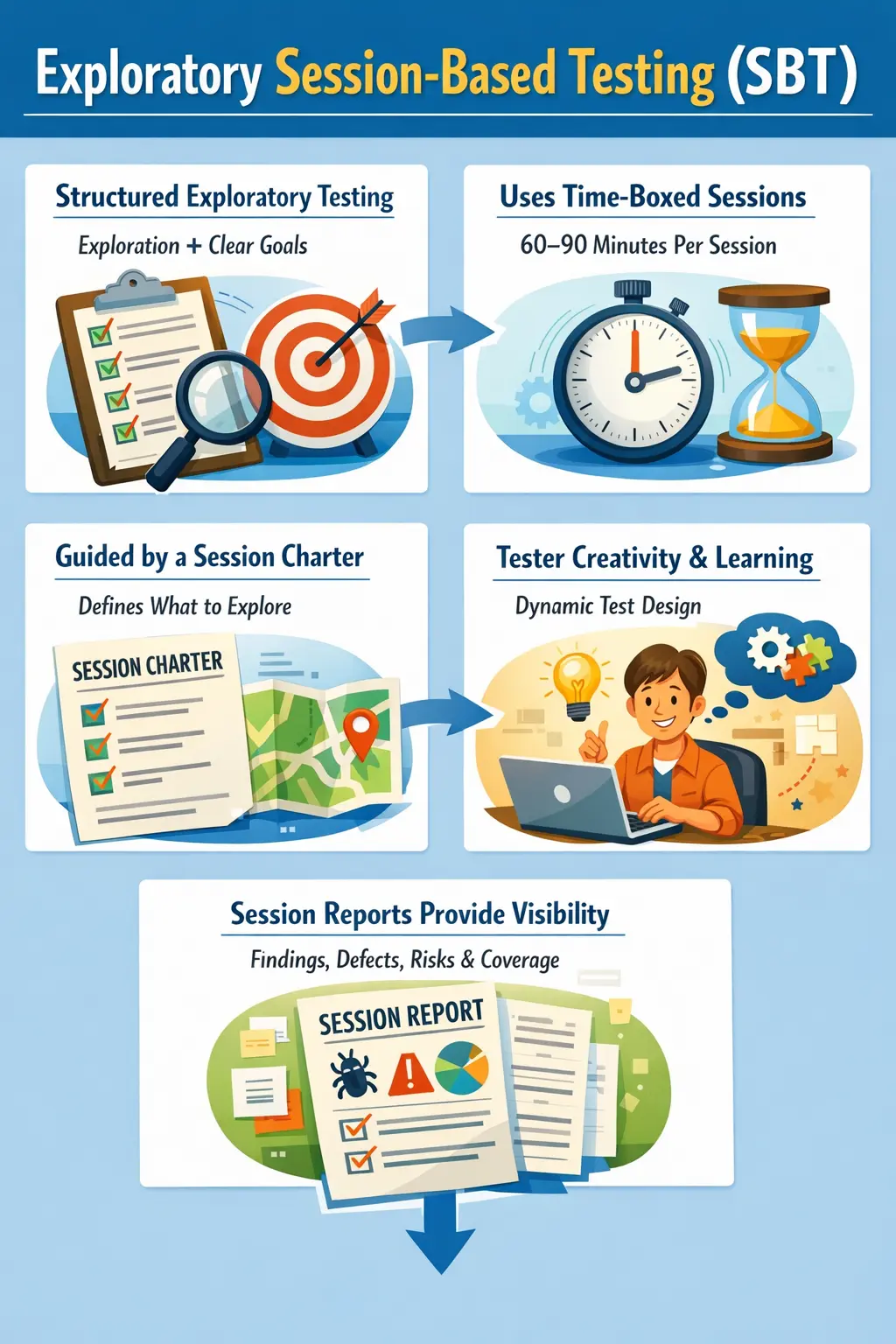
The idea behind session-based testing is simple but powerful. A tester is given a focused mission, called a charter, and a fixed amount of time, called a session. During that session, the tester explores the application, designs test ideas while learning, executes those ideas immediately, observes the results, records notes, and reports findings. Unlike random ad-hoc testing, the session has a clear objective. Unlike rigid scripted testing, the tester is free to follow useful clues and investigate unexpected behavior. This balance is what makes SBT valuable in real projects.
Session-based testing answers an important question: how can testers explore the application systematically without depending only on rigid test cases? The answer is to organize exploration into focused, time-boxed, reportable work units. A session gives exploratory testing enough structure for planning and reporting, while still preserving the tester’s judgment, creativity, domain understanding, and curiosity. This makes SBT especially useful in Agile, fast-changing, high-risk, or poorly documented areas of a product.
In many teams, exploratory testing is misunderstood as informal clicking or unplanned testing. That misunderstanding reduces its value. True exploratory testing is not careless activity. It is simultaneous learning, test design, test execution, and interpretation. Session-based testing strengthens this approach by adding a charter, time-boxing, note-taking, and debriefing. As a result, the team can see what was tested, why it was tested, what was found, and what needs further attention.
Understanding Exploratory Session-Based Testing
To understand session-based testing, it helps to first understand exploratory testing. In exploratory testing, the tester does not simply follow a script. The tester learns about the application while testing it. Each observation can influence the next test idea. If a field behaves unexpectedly, the tester may investigate boundary values. If an error message is unclear, the tester may check related validation rules. If a workflow behaves differently for different user roles, the tester may explore permissions and state changes. The testing path evolves based on what the tester discovers.
This adaptive nature is the strength of exploratory testing. Software systems are complex, and not every important scenario can be predicted in advance. A scripted test case may check the expected flow, but exploratory testing can reveal awkward interactions, hidden assumptions, usability gaps, missing validations, data inconsistencies, and unusual state transitions. It allows testers to think like real users, attackers, business users, support teams, and maintainers rather than only following predefined instructions.
However, pure exploratory testing can be difficult to manage if it is not documented. A test lead may ask what was covered, how much time was spent, which risks were investigated, and what evidence supports the findings. If testers cannot answer clearly, exploratory testing may look uncontrolled. Session-based testing solves this by creating a lightweight structure around exploration. It does not turn exploration into scripted testing; it makes exploration visible and reviewable.
In SBT, every session has a purpose. The tester enters the session with a charter, explores within a time-box, records useful notes, reports defects, and shares outcomes. The session becomes a measurable unit of exploratory work. Multiple sessions can be planned across features, risks, roles, workflows, integrations, or data conditions. This allows teams to manage exploratory testing as part of a professional testing strategy.
Why Session-Based Testing Is Needed
Traditional scripted testing and exploratory testing solve different problems. Scripted testing is strong when the expected behavior is clear, stable, and repeatable. It is useful for regression testing, compliance evidence, and routine validation. But scripted testing can become weak when requirements are incomplete, features are new, workflows are complex, or the product changes faster than documentation. In those situations, testers need room to investigate.
Exploratory testing provides that room, but without structure it may be difficult to plan or defend. A manager may not know whether one hour of exploratory testing produced meaningful coverage. A stakeholder may not know whether the tester focused on important risks or simply tried random actions. A developer may not understand the path that led to a defect. Session-based testing bridges the gap by preserving exploration while adding enough discipline for collaboration.
SBT is also needed because many defects appear outside obvious happy paths. Users may combine actions in unexpected ways, switch roles, refresh pages, repeat submissions, enter unusual data, abandon workflows, return later, or use features under different states. Scripted test cases may not cover all of these possibilities. A skilled tester in a focused exploratory session can follow these behavioral clues and discover issues that scripted testing might miss.
Another reason SBT is useful is stakeholder visibility. A session report can show the charter, duration, areas explored, test ideas, defects, risks, questions, and follow-up recommendations. This gives test leads and managers a clear view of effort and findings. Instead of saying that exploratory testing was done, the tester can show what was explored and what was learned.
Core Concepts of Session-Based Testing
Session-based testing is built around a few important concepts: the session, the charter, the tester, notes, defects, and debriefing. These concepts work together to make exploratory testing focused and accountable. The session defines the work unit. The charter defines the mission. The tester performs the investigation. Notes capture observations. Defects capture confirmed problems. Debriefing turns individual findings into shared team learning.
A session is a fixed period of uninterrupted testing focused on a specific objective. Many teams use sessions of 60 to 120 minutes, though shorter sessions may be useful for small features or quick risk checks. The time-box matters because it keeps the tester focused and prevents exploration from becoming endless. It also helps the test lead plan effort. If a feature needs deeper investigation, the lead can assign multiple sessions with different charters.
A charter is the mission statement of the session. It tells the tester what to explore and why. A charter should be specific enough to guide the session but broad enough to allow judgment. For example, a weak charter might say, “Test checkout.” A stronger charter might say, “Explore the checkout workflow for discount handling, payment validation, and error recovery using registered and guest users.” The second charter gives direction while still allowing the tester to decide which paths to follow.
The tester is central to the success of SBT. In scripted testing, the quality of the test case carries much of the structure. In session-based testing, the tester’s thinking carries much of the value. The tester must observe carefully, ask questions, vary data, challenge assumptions, identify risk, and document findings clearly. A strong exploratory tester is not just clicking through screens; they are continuously forming and testing hypotheses about system behavior.
The Role of Session Charters
The charter is one of the most important parts of session-based testing because it prevents exploration from becoming unfocused. A good charter gives the tester a clear target. It may focus on a feature, a risk, a user role, a workflow, a data condition, a platform, or a business rule. The charter helps the tester decide what matters during the session and what can be left for another session.
A charter usually includes the area to explore, the purpose of the exploration, and any specific risks or constraints. For example, a login charter may focus on invalid credentials, account lockout, session timeout, and error messages. A reporting charter may focus on filter combinations, date ranges, export behavior, and data accuracy. A mobile charter may focus on orientation changes, offline behavior, and interrupted network conditions.
Good charters are written in practical language. They do not need to contain step-by-step instructions. In fact, too much detail can reduce exploratory value. The charter should guide the tester without forcing a fixed path. It should encourage investigation rather than merely repeat scripted testing. When written well, a charter creates purposeful freedom.
Charters also support coverage planning. A test lead can create a set of charters for a feature: one for happy path workflows, one for negative validations, one for role permissions, one for integration behavior, one for usability, and one for edge cases. Together, these charters create a structured exploratory plan. This makes SBT easier to explain to stakeholders and easier to review after execution.
Session Time-Boxing
Time-boxing is the practice of limiting each exploratory session to a fixed duration. This is important because exploration can easily expand in many directions. A tester may find one issue, then another related issue, then a broader design question. Without time limits, the session may lose focus or become difficult to report. Time-boxing keeps the session manageable.
A common session length is 60 to 90 minutes. This is long enough for meaningful exploration but short enough to maintain concentration. Very long sessions can lead to fatigue and weaker observation. Shorter sessions may work well for targeted checks, such as validating a specific bug fix, exploring a small user story, or investigating a narrow risk. The right length depends on feature complexity and team practice.
Time-boxing also helps planning. If a release has several high-risk areas, the test lead can schedule a set of sessions and estimate exploratory effort more realistically. For example, a payment module may receive four sessions, a profile module may receive two, and a low-risk static page may receive one. This approach gives structure without needing detailed test cases for every possible path.
During a session, the tester should try to minimize interruptions. Context switching weakens exploration because the tester is continuously learning and forming ideas. If possible, the tester should have access to the necessary environment, data, accounts, tools, and requirement notes before starting. Preparation helps the time-box remain productive.
Activities During a Session
A session usually begins with the tester reading the charter and understanding the mission. The tester may quickly review related requirements, user stories, acceptance criteria, known defects, recent changes, or risk notes. This preparation helps the tester enter the session with context. Once testing begins, the tester interacts with the application and observes behavior carefully.
The tester designs tests dynamically. If the session focuses on a search feature, the tester may start with normal search terms, then try partial matches, special characters, long text, empty input, repeated searches, filters, sorting, pagination, browser refresh, and role-based access. Each result influences the next test idea. This adaptive testing is the heart of exploratory work.
While exploring, the tester records notes. Notes may include paths tested, data used, observations, questions, risks, suspected defects, confirmed defects, screenshots, logs, and follow-up ideas. The notes do not need to be as formal as scripted test cases, but they must be clear enough for the tester and team to understand what happened. Good notes turn exploration into evidence.
If a defect is found, the tester may pause to investigate whether it is reproducible. The tester should capture enough information to report it properly: steps, test data, environment, actual result, expected result, screenshots, and any logs if available. If a behavior is suspicious but not confirmed, it can be recorded as an observation or question for follow-up. Not every finding becomes a defect immediately, but every important finding should be captured.
Session Reports
A session report is the output of the session. It summarizes what was tested, what was found, and what should happen next. The report makes exploratory testing transparent. Without a report, the work may depend only on the tester’s memory. With a report, the team can review the session, understand coverage, and plan follow-up work.
A useful session report usually includes the session title or ID, charter, tester name, date, duration, environment, build version, test data, areas explored, notes, defects found, questions raised, risks identified, and suggested next sessions. The level of detail depends on project needs. A regulated project may require more documentation, while an Agile team may use lighter notes in a test management tool or shared document.
Session reports also help test leads assess coverage. If several sessions reveal many defects in the same module, that area may need more testing. If a session raises many unanswered questions, requirements may need clarification. If a session completes without major findings in a low-risk area, the team may decide that enough exploration has been performed. Reports convert individual testing activity into team-level knowledge.
Good session reports are factual and readable. They should not be overloaded with unnecessary detail, but they should contain enough information to support decisions. A report that says “tested checkout and found bugs” is too vague. A better report explains which checkout paths were explored, what data was used, which issues were found, and which risks remain.
Manual Tester’s Role in SBT
Manual testers play a central role in session-based testing because the technique depends heavily on human judgment. A tester must be able to understand business context, recognize risk, design test ideas, notice inconsistencies, and communicate findings. These skills are not replaced by tools or scripts. SBT highlights the analytical value of manual testing.
One responsibility of the tester is to understand the charter before starting. If the charter is unclear, the tester should ask questions. A vague mission can lead to weak exploration. The tester may also suggest better charters based on product knowledge. Experienced testers often know which areas are risky because they understand defect history, user behavior, integrations, and business rules.
During the session, the tester must remain observant. Many important defects are not obvious failures. They may appear as confusing messages, inconsistent data, slow responses, unexpected state changes, missing confirmations, broken transitions, or unclear permissions. A strong exploratory tester notices these small signals and follows them intelligently.
After the session, the tester must report clearly. This includes logging confirmed defects, summarizing observations, sharing risks, and participating in debriefs. The tester’s job is not finished when the session time ends. The value of the session becomes real when the findings are communicated in a way that helps the team act.
SBT vs Traditional Test Case Execution
Traditional test case execution and session-based testing are not enemies. They serve different purposes and work best when used together. Traditional test cases are useful when behavior is stable, expected results are clear, and repeatability is important. They are especially valuable for regression testing, compliance checks, and routine validation of critical flows.
Session-based testing is more useful when the team needs discovery, learning, and investigation. It works well for new features, unclear requirements, complex workflows, user experience concerns, integrations, and high-risk areas where scripted coverage may be incomplete. A tester can use exploration to discover what should later become formal regression coverage.
The difference is also visible in documentation. A traditional test case tells the tester what to do and what to expect. A session charter tells the tester what mission to pursue. A traditional test result usually says pass or fail. A session report describes learning, observations, risks, defects, and follow-up ideas. SBT captures richer information because exploration is not limited to a single expected result.
In mature teams, scripted testing provides baseline confidence, while session-based testing provides discovery. Scripted tests confirm known expectations. Exploratory sessions investigate unknown risks. Together, they create stronger test coverage than either approach alone.
When to Use Session-Based Testing
Session-based testing is valuable when detailed test cases are not available or when the product is changing quickly. In Agile teams, user stories may be developed and tested within short sprints. Writing detailed scripts for every path before testing may not be practical. A charter-based session allows testers to begin meaningful testing quickly while still documenting what was explored.
SBT is also useful for complex workflows. Some defects appear only when multiple features interact. For example, a user may update profile information, change permissions, perform a transaction, receive a notification, and then generate a report. A scripted test may validate each feature separately, but an exploratory session can investigate how the whole experience behaves under realistic conditions.
Risk-based testing also benefits from SBT. If a module has a history of defects, recent code changes, complex business rules, or high customer impact, focused exploratory sessions can provide deeper insight. A charter can direct the tester toward the risky area without limiting their investigation to predetermined steps.
SBT is useful near release as well. Even when formal regression passes, teams may schedule exploratory sessions around critical flows to look for hidden issues. These sessions can act as a final human review of usability, workflow continuity, and unexpected behavior. They do not replace regression testing, but they strengthen release confidence.
Common Defects Found Through SBT
Session-based testing often reveals defects that are missed by scripted testing because testers are free to investigate beyond expected paths. Workflow gaps are common. A feature may work in isolation but fail when combined with another feature. For example, a discount may apply correctly in the cart but disappear after address changes. A report may display correct data until filters are changed in a specific order. These issues are often discovered through exploration.
Usability issues are also commonly found. A scripted test may confirm that a form can be submitted, but an exploratory session may reveal that the error message is confusing, required fields are unclear, navigation is awkward, or users receive no confirmation after an important action. These issues may not always be functional failures, but they affect user experience and business quality.
Missing validations and weak error handling are frequent findings. Testers may try unexpected data combinations, repeated clicks, expired sessions, direct URL access, invalid file uploads, interrupted workflows, or unusual timing conditions. These actions can reveal system behavior that was not considered in formal test cases.
Data consistency problems may also appear. An action may update one screen but not another. A status may change in the database but not in the UI. A notification may show outdated information. Exploratory sessions are good at finding these issues because testers can follow the flow of data through the application instead of checking only one isolated expected result.
Common Mistakes in Session-Based Testing
One common mistake is starting sessions without clear charters. Without a mission, exploration may become unfocused. The tester may touch many areas but investigate none deeply. A clear charter gives direction and makes the session easier to review. It also helps the tester decide which observations are relevant to the session goal.
Another mistake is making sessions too long. Long sessions can reduce concentration and make notes harder to organize. Time-boxing helps keep the tester focused and makes reporting easier. If an area needs more investigation, it is better to create another session with a refined charter rather than stretch one session indefinitely.
Poor documentation is another major issue. If the tester finds valuable information but does not record it clearly, the team loses much of the benefit. Notes do not need to be overly formal, but they should explain what was explored, what was observed, and what should happen next. A defect without clear reproduction steps may waste developer time and weaken trust in the testing process.
Some teams also treat SBT as a replacement for all test cases. That is not the right approach. Session-based testing complements scripted testing. Critical regression scenarios, compliance checks, and stable workflows may still need documented test cases. SBT is strongest as a discovery and risk investigation technique, not as the only testing method.
Best Practices for Effective SBT
Effective session-based testing begins with good charters. Charters should be specific, risk-focused, and aligned with business value. Instead of writing “Explore user management,” a stronger charter might say, “Explore user role changes with focus on permission updates, session behavior, and restricted page access.” This gives the tester a sharper mission.
Preparation also matters. Before starting a session, the tester should confirm that the environment, build, accounts, permissions, and test data are ready. Losing half the session to access issues reduces value. If setup is complex, it may be worth documenting prerequisites in the charter or session plan.
Notes should be captured during the session, not reconstructed from memory afterward. Useful notes include test ideas tried, data used, important observations, suspected issues, confirmed defects, screenshots, and questions. The notes should be lightweight but meaningful. They are the evidence behind the session.
Debriefing is another strong practice. After the session, the tester can discuss findings with the test lead, developer, business analyst, or product owner. A debrief helps clarify whether observations are defects, expected behavior, requirement gaps, or future improvements. It also helps decide whether additional sessions are needed.
Interview-Ready Explanation
In interviews, session-based testing can be explained as a structured form of exploratory testing where testers explore the application in time-boxed sessions guided by charters and document their findings in session reports. This explanation shows that SBT is not random testing. It is exploratory, but it has planning, focus, and reporting.
A stronger answer should mention the main elements: session, charter, time-box, tester notes, defects, and session report. The candidate can explain that the charter defines the mission, the time-box keeps the session focused, and the report provides visibility into what was tested and what was found. Mentioning these elements shows practical understanding.
A concise interview answer could be: Exploratory Session-Based Testing is a disciplined approach to exploratory testing where testers test a feature within a fixed time-box using a defined charter. During the session, the tester learns, designs tests, executes them, records observations, and reports defects. It is useful for new features, Agile projects, complex workflows, and risk-based testing because it combines creativity with accountability.
Key Takeaway
Exploratory Session-Based Testing gives teams a practical way to explore software deeply while still maintaining structure and transparency. It keeps the creativity of exploratory testing but adds charters, time-boxing, notes, reports, and debriefs so the work can be planned, reviewed, and improved.
SBT is especially valuable when requirements are changing, features are new, workflows are complex, or risks are not fully understood. It helps testers discover hidden defects, improve product understanding, and provide richer feedback than scripted testing alone. When used with traditional test cases, it creates a balanced testing strategy that validates both known expectations and unknown risks.
Ultimately, session-based testing turns exploration into a disciplined testing practice. It allows testers to think, investigate, learn, and adapt while still producing evidence that stakeholders can trust.