End-to-End (E2E) Testing: Validating Complete Business Workflows
Introduction to End-to-End Testing
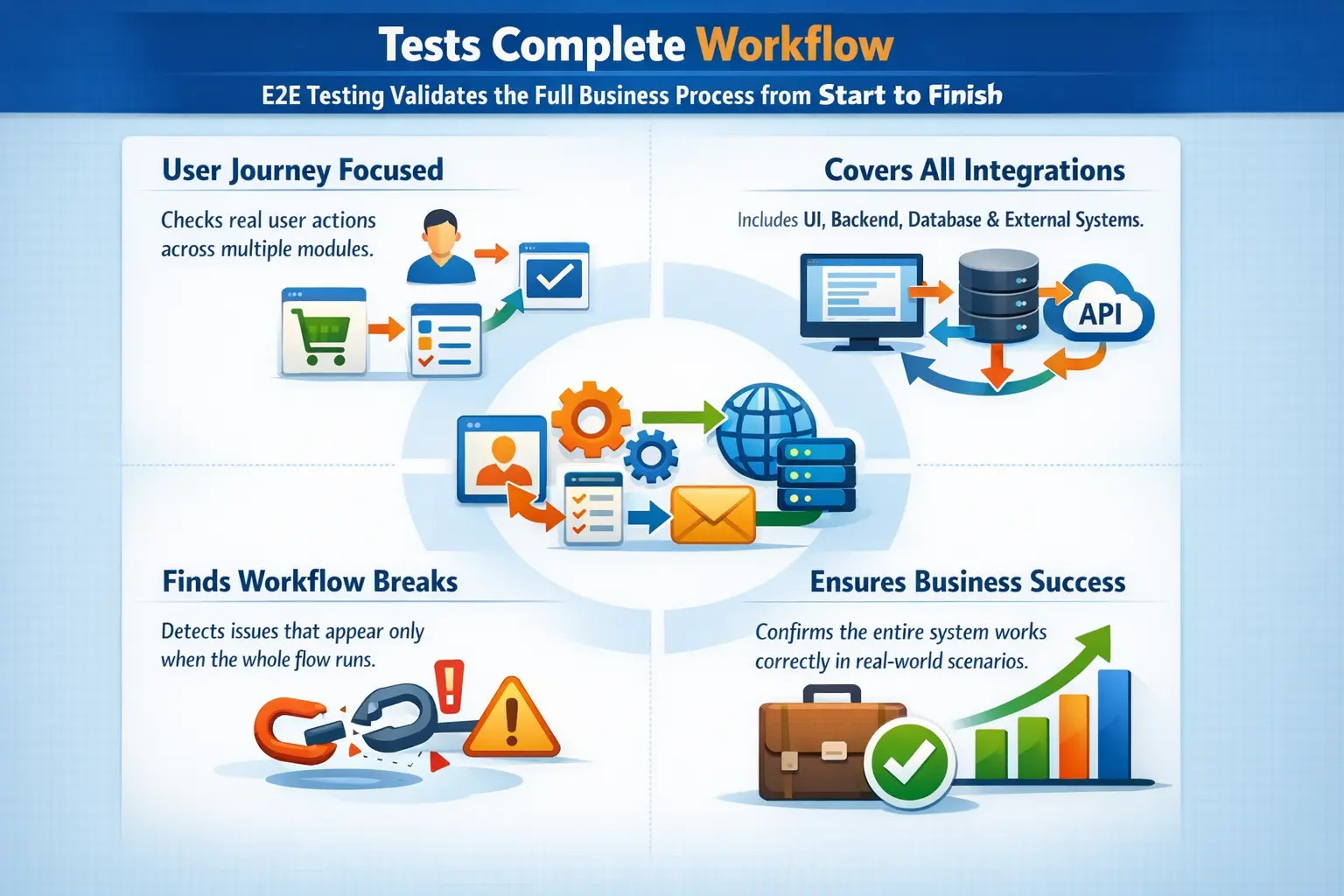
End-to-End (E2E) Testing is a level of testing that validates complete business workflows from start to finish. It ensures that all integrated components of the system—across multiple modules and systems—work together correctly in real-world scenarios. E2E testing answers a critical business question: does the entire business process work from beginning to end?
Unlike lower testing levels that focus on isolated components, E2E testing views the system from the perspective of the user and the business.
Why End-to-End Testing Matters in Real Projects
End-to-End testing matters because business value is delivered through complete workflows, not isolated screens or individual services. A user does not care that the login module works separately, the payment service works separately, and the notification service works separately if the complete checkout journey fails. From the user's perspective, the product works only when the entire process works from beginning to end. E2E testing validates that complete process.
Modern applications are often distributed across multiple systems. A single business transaction may involve a web interface, mobile app, backend APIs, databases, authentication service, payment gateway, email provider, reporting system, and third-party integrations. Each component may pass its own tests, but the business flow can still fail because of sequencing issues, missing data, configuration mismatch, delayed processing, or integration failure. E2E testing exposes these cross-system risks.
E2E testing is especially important for workflows that affect revenue, compliance, customer experience, or operational continuity. If users cannot complete a purchase, submit a claim, book a ticket, transfer funds, approve a request, or receive confirmation, the business suffers. E2E testing gives teams confidence that critical journeys work as complete business processes rather than as disconnected features.
The Business View of E2E Testing
The strongest way to understand E2E testing is to view it from the business perspective. Lower testing levels often focus on components, interfaces, or application features. E2E testing focuses on business success. It asks whether the workflow that matters to users and stakeholders can be completed successfully under realistic conditions. This makes it business-centric rather than purely application-centric.
For example, system testing may verify that registration works, login works, product search works, cart works, payment works, order creation works, and email notification works. E2E testing connects these into a single business journey: a new customer registers, logs in, searches for a product, adds it to the cart, pays, receives an order confirmation, and later views the order history. The focus is the continuity of the business flow.
This business view helps teams prioritize E2E coverage. Not every feature requires a large E2E test. The most valuable E2E scenarios are usually the workflows that represent core business outcomes. These are the flows where failure would cause customer impact, revenue loss, compliance problems, or operational disruption.
Purpose of End-to-End Testing
The primary purpose of E2E testing is to validate complete user journeys. It confirms that different modules, services, data stores, integrations, and external systems collaborate correctly. E2E testing does not stop at checking whether a button works or whether an API returns a response. It checks whether the complete outcome is achieved and whether all related system effects happen as expected.
Another purpose is to detect defects that appear only when multiple systems interact. A payment may be processed successfully, but the order status may not update. An order may be created, but the confirmation email may not be sent. A user may submit a request, but the approval dashboard may not show it. These defects require complete workflow execution to surface. They may not appear in unit, integration, or even feature-level system testing.
E2E testing also validates operational readiness. A workflow may involve logs, audit records, reports, notifications, background jobs, and downstream systems. If these supporting pieces fail, the business may not be able to operate smoothly. E2E testing confirms that the main transaction and its related outcomes are complete.
Scope of End-to-End Testing
The scope of E2E testing typically spans the entire application landscape. It may include user interface interactions, backend processing, database updates, external API calls, third-party services, reports, notifications, file generation, audit trails, and downstream system updates. This wide scope is what makes E2E testing powerful, but it also makes it more complex than lower-level testing.
A good E2E scenario should follow a meaningful business path. It should not simply combine many unrelated features into one long test. The flow should represent a real process that users or operations teams care about. For example, "customer completes checkout and receives order confirmation" is a meaningful E2E flow. "login, update profile, search product, download report, and logout" may be long but not necessarily one coherent business process.
Because E2E scope crosses technical boundaries, it often exposes configuration and dependency problems. Environment variables, credentials, service endpoints, data mappings, message queues, scheduled jobs, permissions, and network access must all align. A small configuration issue can break the complete flow even when individual components work.
Manual Tester Role in E2E Testing
Manual testers play a strategic role in E2E testing. They help identify the business workflows that deserve end-to-end validation. These workflows are usually selected based on business impact, frequency of use, integration complexity, revenue impact, compliance importance, and historical defect patterns. Good testers know that E2E testing is expensive, so they focus it where it provides meaningful risk reduction.
Testers design realistic scenarios that simulate how users and systems interact from start to finish. They prepare test data, confirm environment readiness, coordinate with teams responsible for connected systems, execute the workflow, observe outputs at each stage, and record defects with full context. In E2E testing, context is essential because failures may occur at any point in the chain.
A strong E2E defect report should clearly identify where the journey failed. Did the UI fail to submit data? Did the backend reject the request? Did the database update incorrectly? Did the notification not trigger? Did a downstream system fail to receive the transaction? Clear defect reporting helps teams diagnose broad workflow failures faster.
E2E Testing Compared to System Testing
System testing and E2E testing are related but not identical. System testing validates the complete application against requirements and focuses on feature correctness. E2E testing validates complete business workflow correctness across modules, systems, and integrations. System testing may be application-centric, while E2E testing is business-process-centric.
For example, system testing may confirm that the payment feature works and that the email feature works. E2E testing confirms that after payment is completed, the order is created, payment status is updated, inventory is adjusted, confirmation email is sent, and the order appears in the user's history. The focus is not just whether each feature works, but whether the combined workflow delivers business value.
In practice, some organizations use the terms broadly and overlap them. The important distinction is scope and intent. If the test validates a full business journey across connected components and systems, it is functioning as E2E testing regardless of the label used by the team.
Entry Criteria for E2E Testing
E2E testing should begin only when the system is stable enough for complete workflow validation. Common entry criteria include completed system testing for major features, active integrations, stable environment, available test data, user access, configured external services, and clear E2E scenarios. If these conditions are not ready, E2E testing may produce false failures or be blocked repeatedly.
Integration readiness is especially important. If payment gateway, email service, reporting service, authentication provider, or downstream system is unavailable, a full workflow cannot be validated. Teams should confirm dependency availability before starting E2E execution. Otherwise, testers may spend time chasing environment issues rather than product defects.
Test data readiness is also critical. E2E flows often require data in several systems. A customer account, product inventory, payment configuration, shipping address, tax rule, and notification template may all be needed for one scenario. Poor data preparation can make E2E testing unreliable.
Exit Criteria for E2E Testing
E2E testing can be considered complete when critical business workflows have been executed successfully, blocking defects have been resolved, retesting is complete, known issues are documented, and stakeholders have reviewed remaining risk. Because E2E testing focuses on high-value workflows, unresolved failures in these tests often carry significant release risk.
Exit criteria should be realistic and risk-based. Not every possible user journey can be tested end to end before every release. The team should identify the most critical workflows and define completion criteria for them. For example, checkout, payment, order confirmation, and notification may be mandatory for an e-commerce release, while a rarely used optional report may have lower priority.
If E2E testing reveals serious issues, release decisions should be revisited. A failed E2E flow often means the business process is broken, not just a minor feature defect. Teams should treat such failures with appropriate seriousness.
A Practical E-Commerce E2E Example
An e-commerce E2E test may begin with user registration, continue through login, product search, adding items to the cart, applying valid shipping details, completing payment, generating an order, updating inventory, sending a confirmation email, and showing the order in order history. This flow crosses UI, backend, database, payment service, inventory logic, email service, and user account modules.
Each step may work alone, but the complete journey can still fail. Payment may succeed but order creation may fail. Order creation may succeed but inventory may not update. Inventory may update but confirmation email may not be sent. Email may be sent but order history may not show the record. E2E testing validates the continuity of the entire journey.
This example also shows why E2E testing protects customer experience. A customer does not evaluate the system module by module. The customer expects the purchase to complete. If any part of the chain breaks, the business outcome fails.
Common Defects Found in E2E Testing
E2E testing often uncovers broken integrations, incorrect data transfer, missing notifications, failed downstream updates, interrupted workflows, transaction failures, inconsistent statuses, and sequencing issues. These defects require complete workflow execution to detect. They are often invisible in isolated tests.
Data consistency defects are especially common. A status may update in one system but not another. A customer may see one order state while the admin system shows another. A report may use stale data. A transaction may be stored but not communicated downstream. These are serious because they affect business operations and trust.
Notification defects also appear frequently. Emails, SMS messages, alerts, reports, and audit events may fail even though the main workflow appears successful. E2E testing checks these supporting outputs because they are often part of the complete business process.
Common Pitfalls in E2E Testing
One common pitfall is testing only the happy path. Happy path E2E testing is important, but real workflows also include failures, retries, partial completion, invalid data, unavailable services, and user interruptions. Ignoring these situations reduces the value of E2E testing. Critical business flows should include selected negative and alternate paths based on risk.
Another pitfall is creating too many long E2E tests. E2E tests are usually slower, more fragile, and more expensive to maintain than lower-level tests. If every small rule is tested only through E2E flows, the test suite becomes heavy and unreliable. Teams should use a balanced test strategy, keeping E2E coverage focused on critical workflows and using lower-level tests for detailed combinations.
Poor test data management is also a major problem. E2E scenarios often depend on data across several systems. If data is reused carelessly, corrupted by previous tests, or unavailable in one system, failures may be false or difficult to debug. Reliable E2E testing needs planned data setup and cleanup.
Automation Strategy for E2E Testing
E2E automation is valuable when applied carefully. Critical business workflows should often be automated so they can be checked regularly. However, E2E automation should not try to cover every possible validation. Because E2E tests cross many systems, they are more vulnerable to environment issues, data problems, and timing dependencies. A small, stable E2E suite is usually better than a large, flaky one.
Good E2E automation should focus on high-value flows, use reliable test data, avoid unnecessary dependency on unrelated features, include clear failure reporting, and run at appropriate times. Some E2E tests may run on every build, while others may run nightly or before release. The schedule should match execution cost and business risk.
Teams should also keep detailed checks at lower levels where possible. Unit tests, API tests, integration tests, and component tests can validate many rules faster and more reliably. E2E tests should confirm that the complete workflow works, not carry the entire burden of quality.
Interview-Ready Understanding of E2E Testing
In interviews, E2E testing should be explained as testing complete business workflows from start to finish across the full system. A strong answer should mention user journeys, multiple modules, integrations, backend processing, database updates, notifications, and business outcomes. The focus is ensuring that all connected parts work together to deliver value.
A practical example strengthens the answer. You can describe an e-commerce flow where a user registers, logs in, searches for a product, adds it to the cart, pays, receives confirmation, and sees the order in history. This shows that E2E testing validates the entire process, not just individual features.
A concise interview answer could be: End-to-End testing validates complete business workflows across the entire system to ensure that all integrated components, services, data flows, and outputs work together from start to finish.
Final Practical Guidance
E2E testing should be used thoughtfully. It is one of the strongest ways to validate business success, but it is also one of the more complex and expensive testing approaches. Teams should focus E2E testing on the workflows that matter most to users, revenue, compliance, and operations. Detailed rule combinations should be covered at lower levels where possible.
When E2E testing is done well, it protects the business from broken journeys. It confirms that the product does not merely contain working parts, but delivers complete value. That is why E2E testing is essential for release confidence in modern integrated systems.
Purpose of End-to-End Testing
The primary purpose of E2E testing is to validate full user journeys. It confirms that various integrations, modules, and services collaborate seamlessly. Even when system testing confirms individual features work, E2E testing verifies that complete workflows function without interruption.
It is particularly effective at detecting defects that only appear when multiple systems interact under realistic conditions.
Scope of End-to-End Testing
E2E testing typically spans across the entire application landscape. It includes validating user interface interactions, backend processing, database updates, external system integrations, and even triggered notifications such as emails or reports.
Because it crosses technical boundaries, E2E testing often exposes issues related to configuration, sequencing, and cross-system dependencies.
Manual Tester’s Role in E2E Testing
Manual testers play a strategic role in E2E testing. They identify critical business flows that directly impact revenue, compliance, or user experience. They design realistic scenarios that simulate how users interact with the system from start to finish.
During execution, testers validate outputs at each stage of the process and log defects with complete contextual information. Since E2E testing covers broad workflows, defect descriptions must clearly indicate where the failure occurred within the journey.
End-to-End Testing Compared to System Testing
System testing validates the entire application against requirements, focusing on feature correctness. End-to-End testing goes further by validating business workflow correctness across multiple systems.
System testing is application-centric, whereas E2E testing is business-centric. While system testing ensures individual features work, E2E testing ensures those features collectively deliver business value.
Entry and Exit Considerations
E2E testing typically begins after system testing is completed and a stable environment is available. All major integrations must be active, and required data should be prepared.
E2E testing concludes when critical business workflows are validated successfully, no blocking defects remain, and business approval is obtained if required. These checkpoints ensure that high-risk flows are thoroughly verified before release.
A Practical Example
Consider an e-commerce application. An E2E test might include user registration, login, product search, adding items to a cart, completing payment, generating an order, and sending a confirmation email. Even if each module works independently, a failure in payment confirmation or email notification can break the business flow.
E2E testing ensures that nothing fails across the entire journey.
Common Defects Identified
E2E testing often uncovers broken integrations, incorrect data transfer between systems, interrupted workflows, missing notifications, and transaction failures. These issues may not appear in unit, integration, or system testing because they require complete process execution to surface.
Common Pitfalls
Testing only the happy path is a common mistake. Real users may enter unexpected inputs or encounter network interruptions. Ignoring negative scenarios reduces effectiveness. Poor test data management can also cause false failures or missed defects. Infrequent E2E execution increases the risk of late discovery of workflow defects.
Interview Perspective
In interviews, E2E testing is typically described as validating complete business workflows across the entire system. A strong answer emphasizes that it ensures all integrated components work together correctly to support real user journeys.
Key Takeaway
End-to-End testing validates business success rather than just technical correctness. It confirms that the application delivers value from start to finish. By verifying real-world workflows across systems, E2E testing protects both operational continuity and customer experience.