Bug Triage
Bug triage is a structured process used in software testing to review reported defects, evaluate their impact, and decide how they should be handled. During any testing cycle, testers may discover many issues across different modules, environments, browsers, user roles, and business flows. It is rarely practical or even necessary to fix every reported issue immediately. Bug triage gives the team a disciplined way to decide which defects should be fixed first, which defects can wait, which reports need more investigation, and which issues are not valid defects.
Bug triage answers a key project management question: which bugs should we fix first, and who will fix them? This question sounds simple, but in real projects it involves many competing concerns. A defect may be technically serious, but it may affect a feature that is not part of the current release. Another defect may look small, but it may appear on a public page, affect a paying customer, or block a business-critical workflow. Triage helps the team make these decisions with evidence instead of guesswork.
In real software projects, bug triage is essential for balancing product quality with release schedules and resource constraints. Without triage, development teams may spend time fixing less important issues while critical defects remain unresolved. Testers may keep reporting bugs, developers may become overloaded, product owners may lose visibility, and release managers may struggle to understand actual risk. Bug triage creates a shared decision point where quality, business value, technical effort, and release timing are discussed together.
Bug triage is not only a meeting; it is a decision-making discipline. It ensures that defect resolution is collaborative, transparent, and aligned with project goals. A well-run triage process prevents confusion about defect priority, reduces duplicate work, improves release planning, and helps teams focus on the problems that matter most to users and the business.
Bug triage is used in both Agile and traditional development processes. In Agile teams, triage may happen frequently because builds change often and defects must be assessed quickly. In traditional projects, triage may happen at specific testing milestones or before release gates. Regardless of the development model, the purpose remains the same: review defects, make informed decisions, assign ownership, and keep the product moving toward release with controlled risk.
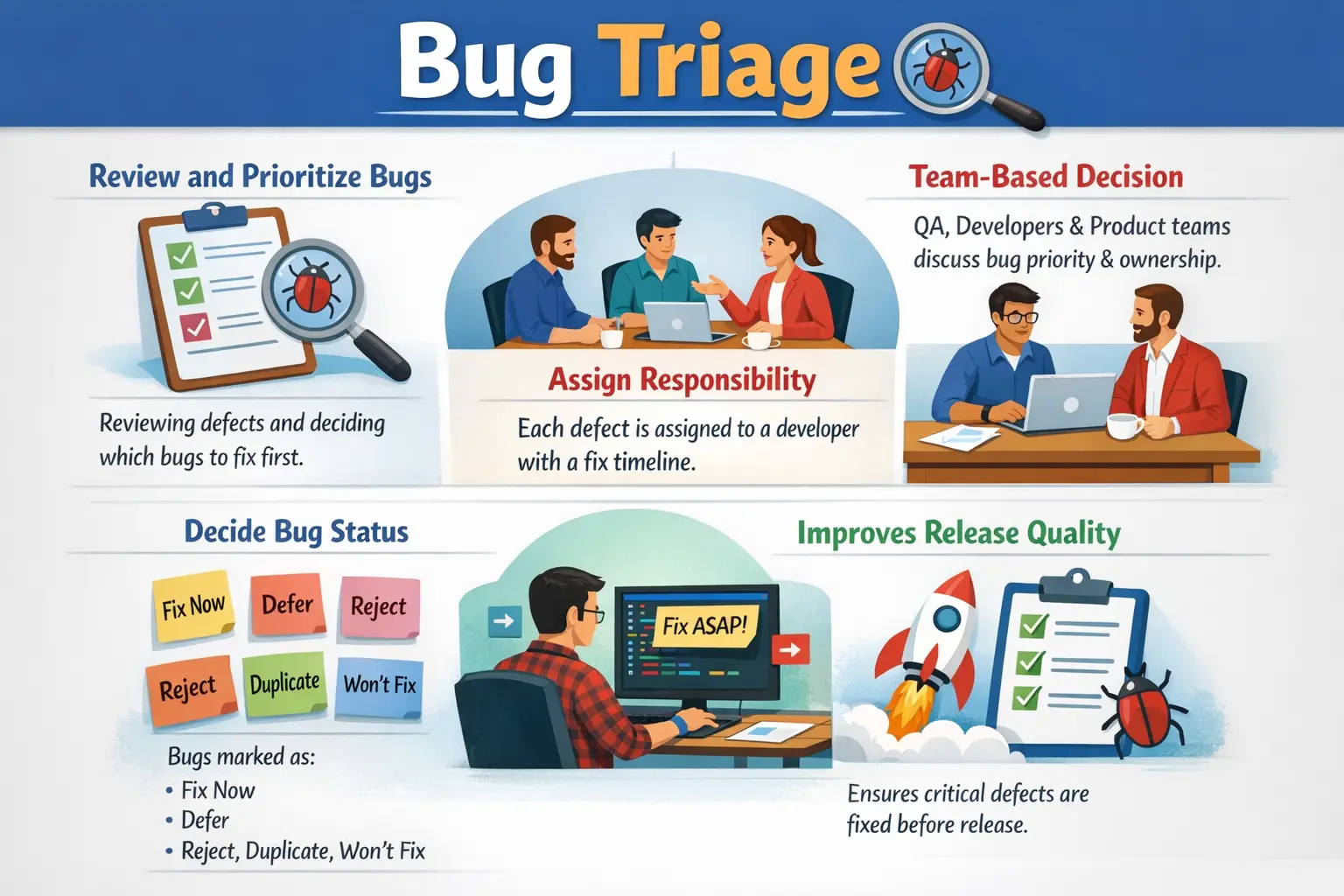
Understanding Bug Triage
Bug triage is a decision-making process in which reported defects are reviewed and evaluated by key stakeholders. The goal is to determine the right action for each defect and assign responsibility for that action. A reported bug does not automatically mean the development team will fix it immediately. It must first be understood, validated, classified, prioritized, and planned.
During triage, teams analyze defect reports to verify that issues are valid, reproducible, and correctly classified. A good triage process checks whether the defect description is clear, whether the steps to reproduce are complete, whether the expected result is aligned with requirements, and whether the actual result truly represents a failure. If information is missing, the defect may be sent back for clarification instead of being assigned directly to development.
The team also reviews severity and priority. Severity describes how badly the defect affects the application from a functional or technical viewpoint. Priority describes how urgently the defect should be fixed from a business viewpoint. Triage brings both dimensions together so that teams avoid fixing defects based only on emotion, reporting order, or technical curiosity.
Bug triage involves both technical and business perspectives. Technical teams evaluate root cause possibilities, affected modules, regression risk, dependencies, and fix complexity. Business stakeholders evaluate customer impact, release scope, revenue risk, contractual obligations, and user visibility. A defect decision is strongest when both perspectives are considered together.
Bug triage is not just about deciding what to fix. It is also about deciding what not to fix right now. Some defects must be fixed immediately. Some can be postponed safely. Some are duplicates of existing defects. Some are not defects because the system behaves according to approved requirements. Some are valid observations but should be treated as enhancements rather than bugs. Triage gives the team a formal place to make these distinctions.
This structured decision-making process improves efficiency and ensures that defect resolution aligns with project goals. Instead of allowing the defect backlog to grow without direction, triage turns the backlog into an organized set of decisions, owners, target releases, and next steps.
Purpose of Bug Triage
Bug triage serves several important purposes in software development and testing. Its first purpose is prioritization. Since development resources are limited, teams must focus on the most important issues first. Bug triage ensures that defects affecting critical features, customer workflows, revenue, compliance, or release readiness receive attention before low-impact issues.
A second purpose is validation. Not every reported issue is automatically a valid defect. A report may be based on misunderstood requirements, incorrect test data, an unsupported configuration, an already known issue, or a duplicate of another defect. Triage helps the team separate valid defects from invalid or incomplete reports before developer effort is spent.
A third purpose is deciding the appropriate action for each defect. Some defects are marked for immediate fixing. Others are deferred to a future release. Some are rejected, duplicated, reopened, moved to a different component, or converted into enhancement requests. These decisions prevent defects from sitting idle without direction.
Bug triage also assigns ownership. Every actionable defect needs a responsible developer, team, or component owner. Without ownership, defects can remain open for weeks because everyone assumes someone else is handling them. Triage creates accountability by making ownership visible.
Another purpose is timeline planning. By reviewing defects collectively, teams can estimate fix effort, plan retesting, identify regression impact, and decide whether fixes can fit into the current sprint or release. This helps project managers and product owners make realistic commitments instead of assuming that all defects can be fixed immediately.
Bug triage also helps balance product quality with release schedules. In many projects, deadlines are fixed, and teams must decide which defects are essential to fix before release. Triage provides the evidence and discussion needed to make those decisions responsibly. It allows stakeholders to accept some risks knowingly while still protecting critical quality.
Participants in Bug Triage
Bug triage is a collaborative process involving multiple roles. Each participant brings a different perspective, and the quality of triage improves when those perspectives are balanced. If only testers attend, the meeting may lack business and technical planning. If only developers attend, user impact may be underestimated. If only managers attend, technical risk may be missed.
The Test Lead or QA Lead usually coordinates bug triage meetings. This role ensures that defects are properly reviewed, testing concerns are represented, and the team understands the quality impact of open issues. The QA lead may explain test coverage, blocked testing areas, regression risk, and the seriousness of defects discovered during execution.
Manual testers provide the ground-level evidence behind each defect. They explain how the defect was found, how it can be reproduced, what data was used, which environment was affected, and how the defect impacts the user. If a defect is difficult to understand, the tester may demonstrate it during the meeting.
Developers or technical leads evaluate the technical aspects of defects. They may identify possible root causes, affected components, dependency risks, estimated effort, and side effects of potential fixes. Their input is important because a small visible issue may require a large change, while a serious-looking issue may have a simple fix.
The Product Owner or Business Representative plays a major role in determining priority. Priority depends on business impact, so product stakeholders help decide which defects must be fixed before release, which can be deferred, and which risks are acceptable. They also clarify expected behavior when requirements are unclear.
The Project Manager or Scrum Master may participate to coordinate timelines, remove blockers, and ensure that defect decisions align with sprint goals or release milestones. In some organizations, support teams, operations teams, security representatives, or customer success teams may also join when defects affect production users or important customers.
The collaboration between these roles ensures that defect decisions consider both technical feasibility and business needs. Good triage is not about one person winning an argument; it is about the team making the most responsible decision with the information available.
When Bug Triage Happens
Bug triage can occur at different times depending on the development process, release model, and project risk. In Agile projects, bug triage may happen frequently, sometimes daily, because new builds, user stories, and defects move quickly. Frequent triage helps the team respond to newly discovered defects before they pile up.
Triage may also occur once per build or test cycle. After a build is deployed and testers execute planned scenarios, the team reviews defects found during that cycle. This approach works well in structured test phases where defects are collected and reviewed at regular checkpoints.
Bug triage is especially important before release milestones. Before releasing software, teams must review all open defects and decide whether the product is ready. This release triage focuses on open high-priority defects, unresolved blockers, customer-facing issues, known workarounds, deferred defects, and risks that require business sign-off.
Triage also happens when production defects are reported. Production issues often need faster handling because real users are affected. In this situation, triage may decide whether the issue requires an emergency hotfix, a planned patch, a rollback, a workaround, or monitoring until the next scheduled release.
Regular triage meetings ensure that defects are managed proactively rather than reactively. Without regular review, defect backlogs become outdated. Priorities may no longer match business needs, duplicate defects may increase, and important issues may remain hidden among low-value reports.
Key Activities in Bug Triage
Bug triage involves several important activities that help ensure effective defect management. One of the first activities is reviewing defect descriptions and supporting evidence. The team checks whether the report contains a clear summary, environment details, steps to reproduce, expected result, actual result, screenshots, logs, and relevant test data.
Reproducibility is another critical activity. A defect that can be reproduced consistently is easier to analyze and fix. If a defect is intermittent, the team may ask for additional evidence, more testing, log analysis, environment checks, or monitoring. If the defect cannot be reproduced at all, it may be kept open for investigation, marked as cannot reproduce, or returned to the reporter for more details depending on the project process.
Severity and priority levels are reviewed during triage. Severity may be adjusted if the team discovers that the defect affects more or fewer workflows than originally thought. Priority may change if the product owner confirms that the affected feature is business-critical or out of scope for the current release.
Triage also involves checking for duplicates. In large projects, multiple testers or users may report the same issue in different ways. Duplicate defects should be linked to the original defect report so that the team avoids duplicate analysis and fixes. Linking duplicates also helps show how widely the issue is observed.
Another activity is deciding the defect path. The team may choose to fix the defect immediately, defer it, reject it, reopen it, move it to another team, convert it into a change request, or mark it as a known issue. The decision should be recorded clearly in the defect tracking tool.
Finally, triage assigns ownership and timelines. An actionable defect should have an owner, a target build or sprint, and clear next steps. If the defect is deferred, the reason for deferral should be documented. If it is rejected, the reason should be explained so the tester and stakeholders understand the decision.
Inputs for Bug Triage
Bug triage decisions are only as good as the information used to make them. The primary input is the defect report. A strong defect report gives the triage team enough information to understand the failure quickly. It includes a concise title, clear reproduction steps, environment details, expected and actual results, severity suggestion, screenshots or logs, and affected test cases.
Severity and priority information also play an important role. These attributes help teams understand both technical impact and business urgency. However, they should be treated as reviewable inputs, not fixed truth. Triage may confirm them or adjust them based on discussion.
Reproducibility status is another key input. If a defect is easy to reproduce, the team can move quickly toward analysis and fixing. If reproduction is inconsistent, the team may need more data, environment comparison, browser/device details, user role information, or logs before assigning it for development.
Business impact is often the most important input. Defects affecting critical functionality, high-value customers, revenue, compliance, security, accessibility, or customer experience usually receive higher attention. A defect with limited technical impact may still become urgent if it affects public visibility or business commitments.
Release timelines strongly influence triage decisions. A defect found early in development may be planned normally. The same defect found hours before release may require immediate risk review. Late-cycle defects are not automatically fixed; the team must consider fix risk, retesting effort, and release impact.
Historical data can also help. If a module has a history of production defects, defects in that module may deserve closer attention. Support tickets, customer complaints, analytics, monitoring alerts, and previous regression failures can all influence triage decisions.
Possible Triage Decisions
Bug triage results in specific decisions regarding how defects will be handled. The most direct decision is Fix Now. This means the defect must be resolved before the current release or as soon as possible. Fix Now defects usually affect critical functionality, major business processes, customer access, data integrity, revenue, or compliance.
Another common decision is Deferred. A deferred defect is valid, but the team decides not to fix it in the current release. Deferral may happen because the impact is low, the affected feature is not in scope, the fix is risky, a workaround exists, or higher-priority defects require attention. Deferral should always include a reason and preferably a target release or backlog location.
A defect may be Rejected if it is not a valid issue. Rejection may happen when the software behaves according to approved requirements, when the reported behavior is expected, when the issue is caused by incorrect test data, or when the scenario is outside supported scope. A rejected defect should include a clear explanation to avoid confusion and repeated reporting.
A defect may be marked Duplicate if the same issue has already been reported. Duplicate defects should be linked to the original report. This keeps the backlog clean while preserving useful evidence from multiple observations.
Some defects may be classified as Cannot Reproduce. This does not always mean the defect is false. It may mean that the team lacks enough information to reproduce it. In such cases, the defect may be monitored, returned for more details, or reopened if new evidence appears.
A defect may also be marked Won't Fix when the team accepts the issue but decides not to fix it. This may happen when the fix effort is too high, the affected feature is being retired, the issue is extremely rare, or the change would introduce unacceptable risk. This decision should be used carefully and documented clearly.
Manual Tester’s Role in Bug Triage
Manual testers play a major role in bug triage because they provide the practical evidence behind reported defects. A tester must be able to explain what failed, how it failed, why it matters, and how the team can reproduce it. A defect that is technically valid but poorly explained may be delayed in triage because stakeholders cannot understand its impact.
Testers must clearly explain user impact. It is not enough to say that a button does not work. The report should explain whether the broken button prevents checkout, blocks account creation, stops data submission, or affects only a secondary action. Business stakeholders need this context to assign priority correctly.
Testers must justify severity with evidence. Screenshots, screen recordings, logs, database references, browser details, device details, and test data can all help. The goal is not to make the defect report long; the goal is to make it useful. Good evidence reduces debate and speeds up triage.
Testers often demonstrate defects during triage meetings. A live demonstration can quickly clarify confusion, especially for UI issues, workflow failures, intermittent behavior, or complex business rules. Demonstration also helps developers see the exact path that leads to the issue.
Testers must also accept business decisions professionally. Sometimes a valid defect is deferred or rejected because it is out of scope, low risk, or not aligned with release goals. The tester's role is to provide accurate evidence and risk information, not to force every reported defect into the current release.
After triage, testers update defect status, add notes, retest fixed items, verify reopened issues, and track deferred defects. Effective tester participation improves triage accuracy and keeps the defect lifecycle clean.
Real-Time Bug Triage Example
Consider a testing cycle for an online shopping application. During regression testing, the QA team reports several defects: payment fails for credit card orders, product images are misaligned on one category page, the discount code field accepts lowercase codes incorrectly, and a tester reports that a search filter behaves differently than expected.
During triage, the payment failure is classified as Fix Now because it affects revenue and blocks a core customer journey. The team assigns it high severity and high priority, gives ownership to the payment module developer, and plans immediate retesting after the fix.
The product image alignment issue is reviewed next. It is visible but does not block purchasing. Because the release deadline is close and there are more serious issues open, the team classifies it as Deferred. The defect remains valid, but it is moved to the next release or UI cleanup backlog.
The discount code issue is discussed with the product owner. If business rules require codes to be case-sensitive, the defect may be fixed in the current release. If the business decides that accepting lowercase is acceptable, the issue may be rejected or converted into a requirement clarification.
The search filter report is found to be based on a misunderstanding of requirements. The system is behaving as designed, so the defect is rejected with an explanation. The tester may update test cases or requirement notes to prevent the same misunderstanding in future cycles.
This example shows that triage is not a mechanical process. Each defect receives a decision based on business impact, correctness, urgency, scope, and evidence.
Benefits of Bug Triage
Bug triage provides many benefits for software projects. The most important benefit is focus. It ensures that critical defects are resolved first and that development effort is not consumed by low-impact issues while major risks remain open.
Bug triage improves communication between testing, development, and business teams. Everyone sees the same defect list, hears the same impact explanation, and understands the decision made for each issue. This reduces blame, confusion, and hidden assumptions.
Triage reduces confusion about defect priorities. Instead of relying on individual opinions, the team agrees on priority through discussion. This helps developers know what to fix first and helps testers know what to retest first.
Bug triage improves release planning. Open defects can be reviewed against release scope, exit criteria, customer commitments, and known risks. Stakeholders can decide whether to delay release, fix specific defects, accept risks, or document known issues.
Triage also supports efficient use of development resources. Developers can focus on the right defects, avoid duplicate work, and receive clearer ownership. Testers can focus retesting and regression effort around prioritized fixes.
Another benefit is transparency. Defect decisions are visible to all stakeholders. If a defect is deferred, everyone can see why. If a defect is rejected, the reason is recorded. This creates accountability and reduces repeated debates later.
Common Mistakes in Bug Triage
Poor defect descriptions often lead to confusion during triage. If a report lacks clear steps, environment details, expected results, or evidence, the team may spend more time understanding the defect than deciding what to do with it. Testers should write reports with triage in mind.
Emotional arguments instead of evidence can disrupt triage discussions. A defect should not be marked high priority simply because someone is frustrated. Decisions should be based on facts such as affected users, blocked workflows, business impact, severity, reproducibility, and release risk.
Skipping triage under time pressure is another common mistake. When deadlines are tight, teams may think triage is unnecessary. In reality, tight deadlines make triage more important because the team must choose carefully where to spend limited time.
Changing priorities without team agreement can create confusion. If priorities are adjusted privately or inconsistently, developers and testers may work from different assumptions. Priority changes should be visible and documented.
Inconsistent triage decisions reduce process effectiveness. If similar defects receive different decisions without clear reasoning, the team loses trust in the process. Clear guidelines for severity, priority, duplicate handling, rejection, and deferral help avoid inconsistency.
Another mistake is allowing triage meetings to become too long and unfocused. Triage should be structured. The team should review necessary defects, make decisions, assign owners, and move forward. Deep root-cause analysis can be taken offline when needed.
Bug Triage in Agile Development
Bug triage is especially important in Agile environments because Agile teams release software frequently and work in short iterations. Defects must be evaluated quickly so that teams can decide whether they belong in the current sprint, the product backlog, a hotfix, or a future release.
Agile triage meetings are usually short and focused. The team reviews newly reported defects, checks blockers, confirms priority, assigns ownership, and decides whether defects affect sprint goals. This keeps the defect backlog from growing silently.
In Agile, bug triage is closely connected to backlog refinement. Some defects may be converted into backlog items, especially when they require larger changes or represent improvements rather than failures. Product owners help decide where defects fit among user stories and technical tasks.
Triage also supports sprint planning. If a defect is urgent, it may be pulled into the current sprint. If it is lower priority, it may be scheduled later. This prevents the team from treating every bug as an interruption while still protecting quality.
Continuous triage supports continuous improvement. Agile teams can use triage outcomes to identify weak areas in requirements, development, testing, or review. If many defects come from unclear acceptance criteria, the team can improve story refinement. If many defects come from one module, the team can plan technical improvement.
Bug Triage and Release Readiness
Bug triage becomes especially important near release. At this stage, the question is no longer only whether defects exist. Every real product has some open defects. The more important question is whether the remaining defects are acceptable for release.
Release triage focuses on open high-priority defects, unresolved blockers, defects without owners, defects affecting core workflows, and issues that require business sign-off. The team reviews whether each defect must be fixed, deferred, documented as a known issue, or accepted as a risk.
A release should not move forward simply because the calendar says so. It should move forward because stakeholders understand the remaining risks and accept them. Bug triage provides the information needed for that decision. It turns open defects into visible release risks rather than hidden surprises.
Triage also helps define retesting and regression needs before release. When high-priority defects are fixed late, testers must validate the fix and check related areas. The triage team should consider not only fix effort but also verification effort and regression impact.
In mature teams, release triage produces a clear view of product quality: fixed defects, open defects, deferred defects, known issues, release blockers, and accepted risks. This visibility supports confident go-or-no-go decisions.
Interview Perspective
Bug triage is a common interview topic for manual testers because it reflects real project experience. A simple answer defines bug triage as the process of reviewing reported defects, validating them, assigning severity and priority, deciding next actions, and assigning ownership.
A stronger answer explains why triage is needed. During testing, many defects may be reported, and teams cannot fix all of them immediately. Triage helps decide which defects should be fixed first, which can be deferred, which are duplicates, and which are invalid. It supports release planning and ensures that development effort is focused on the most important issues.
Interviewers may also ask who participates in bug triage. A good answer mentions the QA lead, testers, developers, technical leads, product owner, business analyst, and project manager. The answer should explain that testers provide evidence, developers assess technical feasibility, and business stakeholders determine priority based on business impact.
Another common interview angle is the tester's role. Testers should write clear defect reports, provide evidence, explain impact, demonstrate defects when needed, suggest severity, support priority discussions, update defect status after triage, and retest fixed defects. This shows that the tester understands defect management beyond simply finding bugs.
An interview-ready summary is: bug triage is a structured review process used to validate, prioritize, assign, defer, reject, or duplicate defects so that the team fixes the right issues at the right time. It balances quality, business impact, technical feasibility, and release timelines.
Key Takeaway
Bug triage is a structured process used to review, prioritize, and assign defects so that teams can resolve issues efficiently. It ensures that defect decisions are based on evidence, business impact, technical feasibility, and release goals rather than random order or personal opinion.
A strong bug triage process keeps the defect backlog clean, improves communication, prevents duplicate work, supports release planning, and ensures that critical issues receive attention first. It also helps teams make responsible decisions about defects that can be deferred, rejected, or converted into future improvements.
Most importantly, bug triage ensures that the right bugs are fixed at the right time by the right people. It helps teams balance product quality with project deadlines and gives stakeholders a clear, transparent view of software readiness.