Ambiguous Requirements
Ambiguous requirements are one of the most common and dangerous sources of defects in software projects. A requirement may appear correct at first glance, but if it can be interpreted in more than one way, it becomes a source of confusion for developers, testers, and business stakeholders. Ambiguity leads to incorrect implementation, inconsistent testing, and costly rework.
Ambiguous requirements arise when requirements are unclear, incomplete, or written in a way that allows multiple interpretations. They create uncertainty about what the system should actually do and make it difficult to determine whether the implemented functionality is correct.
Ambiguous requirements answer the critical question: “What does this actually mean?”
For manual testers, identifying ambiguous requirements early is one of the most important responsibilities during requirement analysis. Detecting ambiguity early prevents defects, reduces rework, and improves overall product quality.
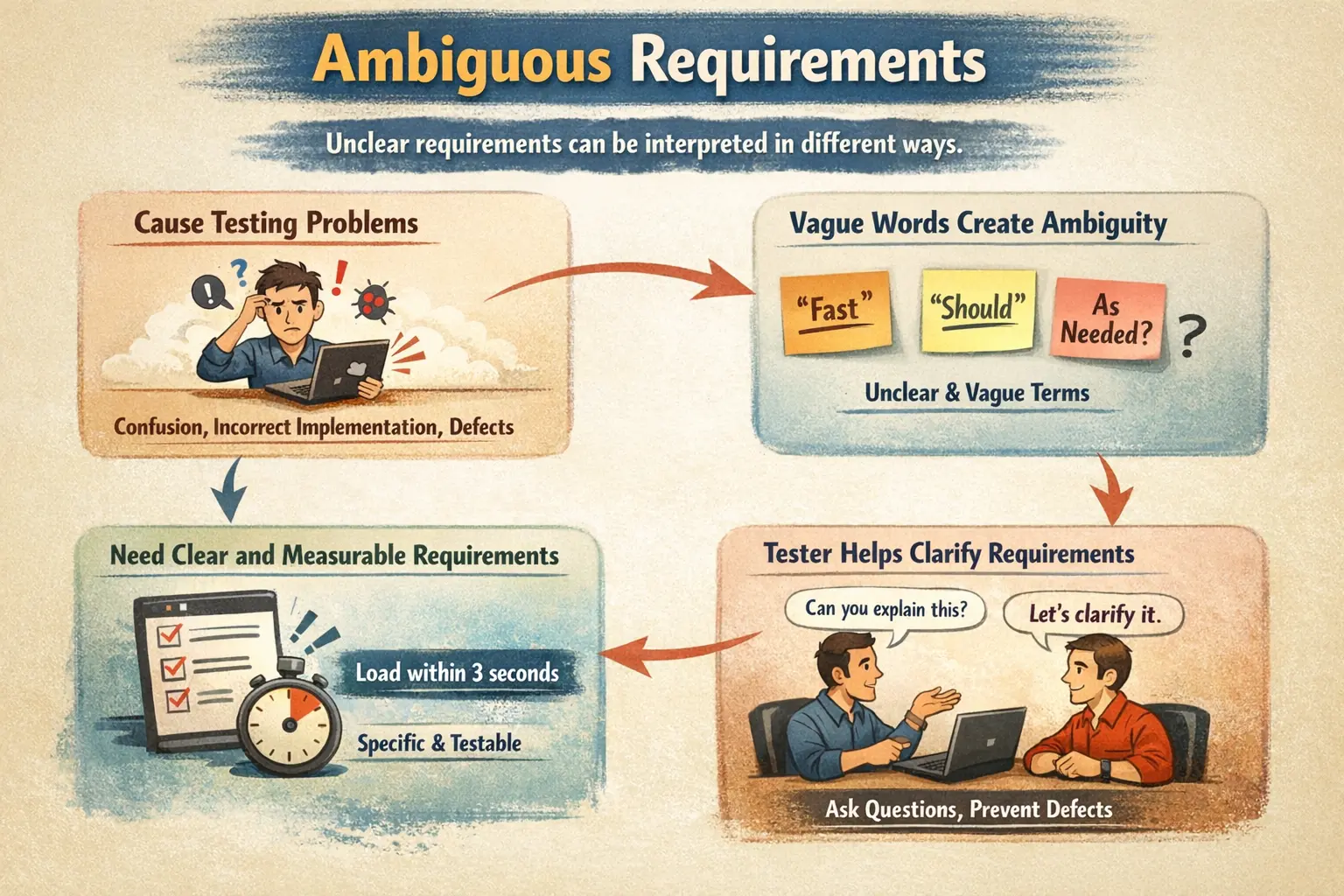
Definition of Ambiguous Requirements
Ambiguous requirements are requirements that are unclear, vague, incomplete, or open to multiple interpretations. These requirements do not provide enough information to allow consistent implementation and testing.
When a requirement is ambiguous, different team members may interpret it differently. Developers may implement one interpretation while testers validate another interpretation. This mismatch results in defects and delays.
Ambiguous requirements often lack measurable criteria, clear boundaries, or defined business rules. Without clear expectations, it becomes difficult to determine whether the system behaves correctly.
Ambiguous requirements create uncertainty in development and testing. They increase the risk of defects and misunderstandings between teams.
Clear and precise requirements reduce ambiguity and improve project outcomes.
Why Ambiguous Requirements Are Dangerous
Ambiguous requirements are a major cause of software defects. When requirements are unclear, developers may implement incorrect functionality because they must rely on assumptions.
Incorrect implementation leads to mismatched expectations between business stakeholders and development teams. The product may technically work but fail to meet business needs.
Ambiguous requirements increase defects and rework. Defects discovered late in the development lifecycle are more expensive to fix. Clarifying requirements early reduces this cost significantly.
Testing is also delayed when requirements are unclear. Testers cannot design effective test cases until requirements are understood clearly. Ambiguity slows test design and execution.
Ambiguous requirements often lead to conflicts between teams. Developers may argue that the system works as designed, while testers may argue that the requirement was interpreted differently.
Clear requirements prevent misunderstandings and improve collaboration.
Common Causes of Ambiguous Requirements
Ambiguous requirements are often caused by vague wording. Words such as "fast," "user-friendly," and "secure" do not define measurable expectations. These words mean different things to different people.
Missing acceptance criteria also create ambiguity. A user story without acceptance criteria leaves testers and developers guessing about expected behavior.
Another common cause is the lack of examples or edge cases. Requirements that describe only normal scenarios often leave boundary conditions undefined.
Inconsistent terminology is another source of ambiguity. If different documents use different terms for the same concept, confusion occurs. For example, using both "customer" and "user" without clarification can cause misunderstandings.
Undocumented assumptions create hidden ambiguity. When business rules exist only in conversations rather than documents, teams rely on memory and interpretation.
Ambiguous requirements usually result from incomplete communication rather than intentional mistakes.
Examples of Ambiguous and Clear Requirements
Understanding the difference between ambiguous and clear requirements is essential for effective testing.
An ambiguous requirement might state that the system should load quickly. The term "quickly" is subjective and does not define measurable expectations. One team member might consider five seconds acceptable, while another might expect one second.
A clear requirement specifies that the system shall load the dashboard within three seconds for most users. This requirement defines measurable performance criteria and removes interpretation differences.
Another ambiguous requirement might state that users can upload files. Without additional information, testers do not know what file types are supported or what size limits apply.
A clear requirement specifies that users can upload PDF and JPG files up to five megabytes in size. This requirement defines supported formats and limits clearly.
Clear requirements eliminate uncertainty and improve testability.
Manual Tester’s Role in Handling Ambiguous Requirements
Manual testers play a critical role in identifying ambiguous requirements during requirement analysis.
Testers review requirements with a testing mindset. They focus on identifying gaps, unclear statements, and missing details that could affect testing.
Testers ask clarifying questions early. Early clarification prevents incorrect assumptions and reduces rework later.
Testers request measurable acceptance criteria whenever possible. Measurable criteria allow objective validation of system behavior.
Testers document assumptions and clarifications. Written clarifications ensure that all team members share the same understanding.
Testers also help enforce the Definition of Ready. Stories with ambiguous requirements should not enter a sprint until they are clarified.
Manual testers act as quality advocates by preventing ambiguous requirements from progressing into development.
Detecting Ambiguous Requirements
Testers must learn to recognize ambiguous requirements during requirement analysis.
A requirement is likely ambiguous if it allows multiple interpretations. If two testers interpret the same requirement differently, the requirement is unclear.
Missing boundary values indicate ambiguity. Requirements that define ranges without specifying limits create uncertainty.
Undefined error handling also indicates ambiguity. Requirements should specify what happens when invalid input or system errors occur.
Unclear non-functional expectations create ambiguity. Requirements that mention performance or security without measurable targets are difficult to validate.
Ambiguous requirements often appear simple but lack critical details needed for testing.
Recognizing ambiguity early improves requirement quality.
Techniques to Resolve Ambiguity
Several techniques help clarify ambiguous requirements and improve understanding.
Requirement walkthroughs allow stakeholders to review requirements together. Discussions help identify unclear areas and resolve misunderstandings.
Acceptance criteria written in structured formats improve clarity. The Given–When–Then format helps define preconditions, actions, and expected outcomes clearly.
Decision tables help clarify complex business rules. They define conditions and outcomes systematically, reducing interpretation differences.
Examples and scenarios help illustrate expected behavior. Concrete examples reduce ambiguity more effectively than abstract descriptions.
Prototypes and mockups help clarify user interface requirements. Visual representations reduce misunderstandings and improve communication.
These techniques help transform ambiguous requirements into clear and testable specifications.
Impact of Ambiguous Requirements on Testing
Ambiguous requirements have significant impact on testing activities.
Test design becomes difficult when requirements are unclear. Testers cannot determine which scenarios to cover or what results to expect.
Test execution often requires frequent rework. Test cases must be updated repeatedly as requirements are clarified.
Ambiguous requirements increase defect rejection rates. Developers may reject defects by claiming that the system works according to their interpretation.
Release schedules are affected because ambiguous requirements delay development and testing.
Ambiguity increases project risk by introducing uncertainty into testing and validation.
Clear requirements improve testing efficiency and reduce delays.
Real-World Example of Ambiguous Requirements
Consider a requirement that states that an account locks after multiple failed login attempts.
This requirement appears straightforward but contains several ambiguities.
The requirement does not specify how many attempts trigger the lock. Different implementations may choose different numbers.
The requirement does not specify whether attempts are counted consecutively or over a time period.
The requirement does not specify how long the account remains locked.
The requirement does not specify how users unlock their accounts.
A tester reviewing this requirement would ask clarifying questions to resolve these ambiguities.
Clarified requirements might specify that the account locks after five consecutive failed attempts within ten minutes and unlocks automatically after thirty minutes.
Clear requirements allow consistent implementation and testing.
Relationship Between Ambiguity and Defects
Ambiguous requirements are a major source of defects in software projects.
Defects caused by ambiguous requirements often appear as functional issues. The system may behave differently from business expectations because requirements were unclear.
These defects are difficult to resolve because teams may disagree about expected behavior.
Ambiguous requirements also increase defect leakage into production. Late discovery of requirement misunderstandings leads to production issues.
Reducing ambiguity reduces defect rates significantly.
Early clarification prevents requirement-related defects.
Common Mistakes When Handling Ambiguous Requirements
One common mistake is assuming the meaning of a requirement instead of asking questions. Assumptions often lead to incorrect implementation and testing.
Another mistake is waiting until test execution to raise concerns. Late clarification increases rework and delays.
Failing to document clarifications is another common mistake. Verbal discussions without documentation lead to repeated misunderstandings.
Ignoring non-functional aspects also creates ambiguity. Requirements should define both functionality and quality expectations.
Testers must actively identify and resolve ambiguity to prevent defects.
Types of Ambiguity in Requirements
Ambiguity can appear in several forms, and testers should learn to recognize each type. The most obvious type is language ambiguity, where the words used in the requirement are vague or subjective. Words such as quickly, properly, regularly, normal, secure, and user-friendly sound meaningful but do not define exact behavior. Different people can interpret them differently.
Another type is scope ambiguity. This occurs when a requirement does not clearly define what is included and what is excluded. A requirement such as “admin can manage users” may include creating users, editing users, deleting users, resetting passwords, assigning roles, locking accounts, and viewing audit history. If the scope is not clarified, implementation and testing will be inconsistent.
Data ambiguity occurs when the requirement does not define valid values, invalid values, limits, formats, or mandatory fields. For example, a requirement may say that the user can enter an amount, but it may not define minimum amount, maximum amount, decimal precision, currency rules, or behavior for negative values. These missing details create test gaps.
Workflow ambiguity occurs when the sequence of actions is unclear. A requirement may describe a result but not the steps, preconditions, or alternate paths. If the user cancels halfway through a process, refreshes the page, loses connection, or changes previous selections, the expected behavior may be unknown.
Non-functional ambiguity occurs when quality expectations are unclear. If the requirement says the system should be fast, secure, reliable, or accessible without measurable criteria, testers cannot verify the expectation objectively. These quality ambiguities often become production complaints because they are ignored during functional testing.
Ambiguous Words Testers Should Watch For
Certain words often signal ambiguity. Testers should be alert when requirements use terms that sound reasonable but lack measurable meaning. The word fast is one example. A business user may expect a page to load in one second, while a developer may consider five seconds acceptable. Without a measurable target, both interpretations are possible.
The word proper is another common problem. A requirement such as “show proper error message” does not explain what message should appear, when it should appear, where it should appear, or what the user should do next. A testable requirement should describe the condition and expected message behavior clearly.
Words such as normal and standard also require clarification. What is normal usage? What is a standard report? What is a regular customer? These terms may depend on business context. If the requirement does not define them, the team may make assumptions.
The phrase as required is especially dangerous because it hides responsibility. Required by whom? Under what condition? According to which business rule? If a requirement says a notification should be sent as required, testers should ask when it is required, who receives it, what it contains, and what happens if delivery fails.
Testers should not simply reject vague words. They should turn them into clarification questions. The goal is to replace subjective language with observable behavior, measurable limits, and concrete examples.
How Ambiguity Affects Developers
Ambiguous requirements do not affect only testers. Developers are also forced to make assumptions when requirements are unclear. If a business rule is missing, a developer may choose a reasonable implementation based on technical judgment. The problem is that reasonable technical judgment may not match business expectation.
For example, if a requirement says that accounts should lock after multiple failed login attempts, a developer may implement locking after three attempts. Another developer might choose five attempts. A business stakeholder may expect five attempts within ten minutes. Without clarification, the implementation can be technically clean but functionally wrong.
Ambiguity also makes estimation unreliable. Developers cannot estimate accurately when scope, rules, integrations, and edge cases are unclear. A story may appear small during planning but become large during implementation as missing details emerge. This disrupts sprint planning and delivery predictability.
Developers may also face rework when testers or stakeholders later identify a different interpretation. Rework is frustrating because the developer may have implemented exactly what they believed the requirement meant. Clear requirements protect developers from wasted effort and late changes.
This is why ambiguity should be treated as a team issue, not a tester complaint. Developers, testers, Product Owners, and business analysts all benefit when requirements are clarified before implementation begins.
How Ambiguity Affects Test Design
Test design depends on expected behavior. If the expected behavior is unclear, test cases become unreliable. A tester cannot define accurate steps, expected results, test data, or pass/fail criteria without understanding what the system should do.
Ambiguity often leads to incomplete test coverage. If a requirement does not define boundary values, testers may miss important edge cases. If error handling is undefined, testers may not validate failure scenarios correctly. If user roles are unclear, authorization testing may be incomplete.
Ambiguous requirements also cause test case rework. Testers may write tests based on one interpretation, then later update them when the Product Owner clarifies a different expectation. This wastes time and can delay execution. In large projects, repeated test rework becomes a major productivity issue.
Ambiguity can also create disagreement during defect reporting. A tester may report a defect because the system behaves differently from their interpretation. A developer may reject it because their interpretation differs. Without documented clarification, defect discussion becomes opinion-based instead of requirement-based.
Clear requirements make test design faster and more reliable. They allow testers to focus on meaningful validation rather than guessing what the requirement might mean.
Clarifying Questions for Ambiguous Requirements
Clarifying questions are one of the tester’s strongest tools for resolving ambiguity. A good question should be specific, practical, and connected to system behavior. Instead of saying “this requirement is unclear,” the tester should ask what condition, rule, limit, or outcome needs clarification.
For user actions, testers can ask who can perform the action, what preconditions must exist, what data is required, what result should appear, and what should happen if the action fails. These questions help define the main workflow and alternate paths.
For input fields, testers can ask whether the field is mandatory, what formats are allowed, what the minimum and maximum values are, whether special characters are permitted, whether duplicate values are allowed, and what message appears for invalid input.
For business rules, testers can ask for examples. What should happen for an eligible user? What should happen for a non-eligible user? What happens at the boundary? What happens when two rules conflict? Examples make abstract rules easier to understand and validate.
For non-functional expectations, testers can ask how fast, how secure, how available, how accessible, or how compatible the system must be. These questions turn broad quality statements into measurable requirements.
Using Acceptance Criteria to Remove Ambiguity
Acceptance criteria are one of the most effective ways to reduce ambiguity in Agile projects. A user story may be short and intentionally simple, but acceptance criteria define the conditions that must be satisfied for the story to be accepted. They turn broad user needs into testable expectations.
Good acceptance criteria describe specific behavior. They define what should happen under known conditions. For example, instead of saying “user can reset password,” acceptance criteria can define valid email behavior, invalid email behavior, reset link expiry, password rules, and successful login after reset.
The Given-When-Then format can help clarify behavior because it separates context, action, and outcome. Given the user has an active account, when the user requests a password reset, then the system sends a reset link to the registered email. This structure reduces interpretation gaps.
Acceptance criteria should include negative and edge conditions where relevant. If only the happy path is defined, ambiguity remains around failure behavior. A requirement is not fully clear until the team understands both what should happen and what should not happen.
Testers should review acceptance criteria during backlog refinement. If criteria are vague, missing, or not testable, the story should be clarified before it enters the sprint. This supports Definition of Ready and prevents ambiguity from becoming sprint risk.
Ambiguity in Non-Functional Requirements
Non-functional requirements are especially prone to ambiguity because they often use broad quality words. Requirements such as “the application should be fast,” “the system should be secure,” or “the interface should be user-friendly” are common but not testable unless measurable expectations are defined.
A clear performance requirement should define response time, load condition, transaction type, and measurement target. For example, the dashboard should load within three seconds for ninety-five percent of requests under expected business load. This gives testers and performance engineers something concrete to verify.
A clear security requirement should define authentication, authorization, session management, data protection, or audit expectations. Instead of saying the system should be secure, the requirement should specify that inactive sessions expire after fifteen minutes, sensitive values are masked, or unauthorized users cannot access restricted pages.
A clear usability requirement should define observable behavior. Instead of saying the form should be easy to use, the requirement can state that mandatory fields are clearly marked, validation messages identify the field and correction needed, and the user can complete submission without re-entering valid data after an error.
Testers should challenge vague non-functional requirements early because these issues are often expensive to fix late. Performance, security, accessibility, and usability concerns may require design changes, not just small code fixes.
Ambiguity in Agile User Stories
Agile user stories are intentionally short, so they can easily become ambiguous if the team treats the story sentence as the full requirement. A story such as “As a customer, I want to manage my profile so that my information stays updated” is a useful starting point, but it does not define exactly what manage means.
The team must clarify which fields can be updated, which fields are read-only, what validation rules apply, whether email changes require verification, whether phone numbers need formatting, and what happens if duplicate data is entered. Without this clarification, developers and testers may interpret the story differently.
Ambiguity in user stories should be addressed during backlog refinement. Testers should ask questions, Product Owners should clarify business expectations, and developers should identify technical dependencies. The result should be a story that is small, clear, valuable, and testable.
Acceptance criteria, examples, and conversation are all necessary. The user story card alone is rarely enough. The Three C’s of user stories, card, conversation, and confirmation, help teams remember that the written story must be supported by discussion and validation rules.
When Agile teams handle ambiguity early, sprint execution becomes smoother. Stories enter the sprint with better shared understanding, and testers can design scenarios without waiting for mid-sprint clarification.
Documenting Clarifications
Clarifying a requirement verbally is useful, but it is not enough. If the clarification is not documented, the team may forget it, new team members may miss it, and future testing may rely on old assumptions. Documentation turns conversation into shared reference.
Clarifications can be documented in user stories, acceptance criteria, requirement notes, decision logs, comments in backlog tools, or test documentation. The format depends on the team’s process, but the clarification should be easy to find and connected to the requirement.
When a tester asks a question and receives an answer, that answer should become part of the requirement if it affects behavior. For example, if the Product Owner clarifies that reset links expire after thirty minutes, that detail should be added to acceptance criteria, not left in a chat message.
Documentation also helps defect resolution. If a defect is reported later, the team can refer to the documented clarification instead of debating memory. This reduces conflict and makes validation more objective.
Good documentation does not mean excessive paperwork. It means important decisions are captured where the team can use them. Lightweight documentation is enough when it preserves shared understanding.
Detailed Example: File Upload Requirement
Consider an ambiguous requirement: “User should be able to upload documents.” This statement gives a general idea, but it leaves many unanswered questions. A developer may implement one interpretation, while testers and business users may expect another.
The tester should ask which document types are supported. Are PDF, JPG, PNG, DOCX, and XLSX allowed? Are executable files blocked? The tester should also ask about maximum file size, filename restrictions, number of files allowed, duplicate file behavior, and whether users can remove uploaded files.
The tester should ask what happens when upload fails. Is there a retry option? Does the system preserve other form data? Does the user receive a clear error message? Are partial uploads cleaned up? These questions define failure behavior.
The tester should also ask about security and accessibility. Are uploaded files scanned? Can unauthorized users view uploaded documents? Is upload progress visible? Can the upload control be used with keyboard navigation? These questions reveal non-functional requirements connected to the feature.
After clarification, the requirement becomes testable: users can upload PDF and JPG files up to five megabytes, unsupported files are rejected with a clear message, duplicate filenames are renamed or blocked according to rule, and failed uploads allow retry without losing form data. This clarity supports consistent implementation and testing.
Best Practices for Managing Ambiguity
The first best practice is to review requirements early. Ambiguity becomes more expensive as the project moves forward. A question asked during requirement analysis may take minutes to answer, while the same question during system testing may require code changes and retesting.
The second best practice is to use examples. Examples are often clearer than abstract rules. If a business rule is complex, ask for approved, rejected, boundary, and exception examples. These examples help developers understand behavior and help testers design scenarios.
The third best practice is to make requirements measurable. Replace vague quality words with specific targets. Replace broad functional statements with observable outcomes. If a result cannot be measured or observed, it cannot be tested reliably.
The fourth best practice is to keep terminology consistent. If customer, client, user, member, and account holder mean different things, define them. If they mean the same thing, use one term. Consistent language prevents misunderstanding across documents and discussions.
The final best practice is to treat ambiguity as a project risk, not a minor wording issue. Ambiguity affects cost, quality, timelines, and stakeholder trust. Managing it carefully is a professional testing responsibility.
Interview Perspective
Ambiguous requirements are frequently discussed in testing interviews because they demonstrate requirement analysis skills.
Interviewers often ask how testers handle unclear requirements.
A short answer typically defines ambiguous requirements as requirements that can be interpreted in multiple ways.
A detailed answer explains how testers identify ambiguity, ask questions, and request clarification.
Providing examples demonstrates practical understanding.
Understanding ambiguous requirements is essential for manual testing roles.
Preventing Ambiguous Requirements
Preventing ambiguity requires collaboration between business analysts, developers, and testers.
Requirements should be reviewed early by the entire team. Early reviews identify unclear statements before development begins.
Acceptance criteria should define measurable conditions. Measurable conditions reduce interpretation differences.
Examples and scenarios should accompany complex requirements. Examples improve understanding significantly.
Consistent terminology should be used across documents. Standard terminology reduces confusion.
Documentation should capture all clarifications and decisions.
Preventing ambiguity improves development and testing efficiency.
Key Takeaway
Ambiguous Requirements are unclear requirements that can be interpreted in multiple ways, making them difficult to implement and test accurately.
They lead to incorrect implementation, increased defects, testing delays, and team conflicts.
Manual testers play a critical role in identifying and resolving ambiguity during requirement analysis.
Clear and measurable requirements reduce risk and improve product quality.
Ambiguous Requirements are essentially defects waiting to happen, and early clarification is the most effective way to prevent them.