Agile Manifesto
The Agile Manifesto is the foundational document that defines the philosophy and guiding principles of Agile software development. It establishes the core values that shape how Agile teams plan, build, test, and deliver software. The manifesto emphasizes flexibility, collaboration, rapid feedback, and continuous delivery of value to customers.
The Agile Manifesto answers an essential question in modern software development: “What do we value most while building software?”
Before Agile methods became popular, software development was dominated by structured, sequential models such as Waterfall. These models focused heavily on detailed planning, documentation, and strict process control. Although these approaches worked for stable requirements, they often struggled when requirements changed or when faster delivery was needed.
The Agile Manifesto introduced a new way of thinking about software development. Instead of focusing on rigid processes and documentation, Agile emphasizes people, collaboration, and working software. Today, the Agile Manifesto serves as the philosophical foundation for Agile frameworks such as Scrum, Kanban, and Extreme Programming.
For software testers, especially manual testers, understanding the Agile Manifesto is essential because it explains why testing in Agile environments is continuous, collaborative, and adaptive.
The manifesto is not a testing document in the narrow sense, but it deeply influences testing practice. It explains why testers are involved early, why acceptance criteria matter, why feedback must be fast, why documentation should be useful rather than excessive, and why teams must adapt test coverage when business needs change. A tester who understands the manifesto can understand the purpose behind Agile ceremonies and testing activities instead of treating them as mechanical process steps.
In practical terms, the Agile Manifesto reminds teams that software development is uncertain. Requirements may evolve, users may provide new feedback, market conditions may shift, and technical discoveries may change the best solution. Agile does not remove discipline; it changes the kind of discipline required. Teams must communicate frequently, deliver working increments, inspect results, and improve continuously.
Origin of the Agile Manifesto
The Agile Manifesto was created in 2001 by a group of experienced software developers who wanted to improve software development practices. They met to discuss better ways to develop software that could adapt to change and deliver value quickly.
At that time, many software projects failed due to rigid processes, excessive documentation, and slow feedback cycles. Development teams spent months writing specifications and documentation before writing any code. Testing occurred only after development was complete, often revealing major defects late in the project.
The creators of the Agile Manifesto believed that software development should focus on delivering working software and responding quickly to changing requirements.
The result of this collaboration was the Agile Manifesto, which introduced four core values and twelve guiding principles that continue to influence modern software development.
The manifesto emerged from practical frustration, not theory alone. The people involved had seen projects struggle because teams followed plans even when the plan no longer matched reality. They had seen documentation become more important than usable software, and contracts become more important than customer outcomes. The manifesto captured a shared belief that software teams needed a more adaptive, human-centered way of working.
Since 2001, the manifesto has influenced many methods and frameworks. Scrum, Kanban, Extreme Programming, Lean software development, and modern DevOps practices all reflect parts of its thinking. These approaches may differ in process, but they share the same broad direction: deliver value frequently, collaborate closely, learn quickly, and improve continuously.
Definition of Agile Manifesto
The Agile Manifesto is a formal statement that defines the values and principles guiding Agile software development. It emphasizes delivering valuable software through collaboration, adaptability, and continuous improvement.
The manifesto defines what Agile teams prioritize when building software and explains how development and testing should be performed in dynamic environments.
Rather than prescribing specific processes, the Agile Manifesto provides a philosophical framework that allows teams to choose practices that work best for their projects.
This distinction is important. The Agile Manifesto does not say every team must use the same board, the same meeting format, the same tool, or the same sprint length. It gives values and principles that guide decision-making. A team may use Scrum ceremonies, Kanban flow, automated testing, exploratory testing, user story mapping, or lightweight documentation, but those practices should support the values of collaboration, feedback, working software, and adaptability.
For testers, the manifesto provides a reason for changing the traditional testing role. Testers are not limited to executing test cases after coding. They become quality collaborators who help define testable requirements, validate increments, identify risks, and improve the team’s development process.
The Four Core Values of the Agile Manifesto
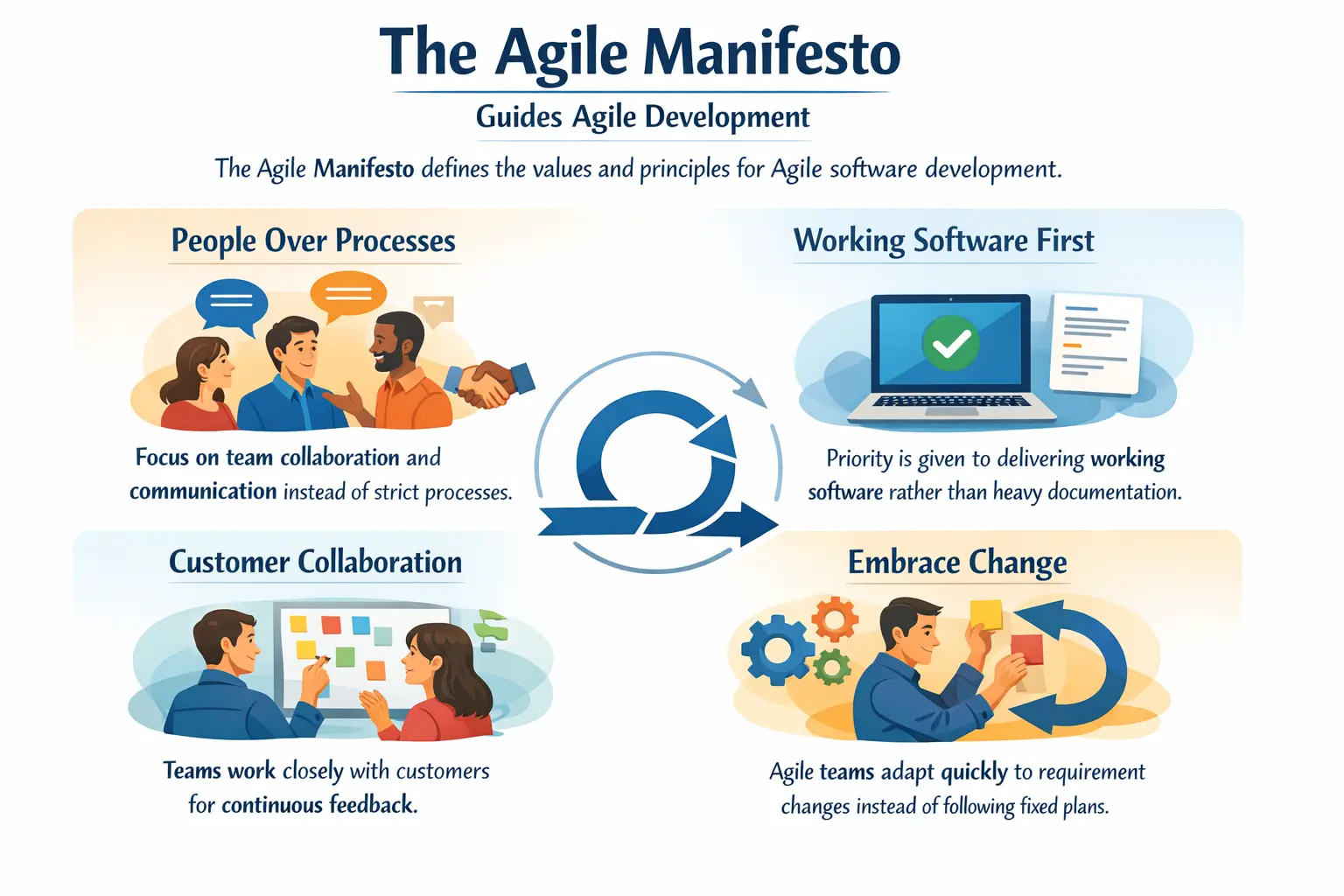
The Agile Manifesto defines four core values that guide Agile development and testing practices. These values represent priorities rather than strict rules. Agile teams still use processes and documentation, but they value people and working software more highly.
The phrase "over" is important in each value. It does not mean the item on the right has no value. Processes, tools, documentation, contracts, and plans can all be useful. The manifesto says that when there is tension, Agile teams should give greater importance to the item on the left. People matter more than process, working software matters more than large documentation, collaboration matters more than contract protection, and adapting to change matters more than blindly following an outdated plan.
Individuals and Interactions Over Processes and Tools
The first Agile value emphasizes the importance of people and communication. Successful software development depends more on collaboration between team members than on rigid processes or sophisticated tools.
Traditional development approaches often rely heavily on predefined processes and specialized tools. However, even the best processes cannot replace effective communication among team members.
In Agile environments, testers collaborate closely with developers, product owners, and business stakeholders. Frequent discussions help clarify requirements and reduce misunderstandings.
For manual testers, this value means participating actively in requirement discussions, sprint planning sessions, and daily meetings. Direct communication often prevents defects that might otherwise occur due to misunderstood requirements.
Strong collaboration allows teams to solve problems quickly and maintain consistent product quality.
This value is especially important in testing because many defects come from communication gaps. A developer may misunderstand a requirement. A tester may interpret an acceptance criterion differently from the product owner. A business stakeholder may assume a rule is obvious even though it was never written. Direct conversation helps expose these gaps before they become defects.
Tools are still useful in Agile teams. Defect trackers, test management tools, automation tools, boards, and chat systems can improve visibility. But tools cannot replace trust, clarity, and collaboration. A team with strong communication can often work effectively even with simple tools, while a team with poor communication may fail even with advanced tools.
Working Software Over Comprehensive Documentation
The second Agile value emphasizes the importance of delivering functional software rather than producing extensive documentation.
Traditional development approaches often require large volumes of documentation before development begins. While documentation is useful, excessive documentation can delay development and testing.
Agile teams focus on delivering working features as early as possible. Instead of waiting for complete specifications, testers validate features as soon as they are implemented.
Working software provides real feedback. Stakeholders can evaluate functionality directly instead of relying on written descriptions.
For testers, this value encourages early validation of features. Instead of waiting for finalized documents, testers verify actual system behavior.
This approach improves quality by identifying defects earlier and reducing misunderstandings between teams.
Agile does not eliminate documentation, but it promotes creating only the documentation that provides real value.
For manual testers, this value changes how test documentation is created. Instead of writing large test documents that are rarely updated, testers focus on practical artifacts such as acceptance criteria, test scenarios, checklists, exploratory notes, and regression coverage. The goal is to support testing and future learning, not to produce documents for their own sake.
Working software also gives testers the strongest evidence. A requirement document may say the feature works a certain way, but the actual application shows how users will experience it. Agile testing therefore emphasizes validating real behavior early and often. This helps teams discover misunderstandings while changes are still easier to make.
Customer Collaboration Over Contract Negotiation
The third Agile value emphasizes continuous collaboration with customers or business stakeholders.
Traditional development often relies on detailed contracts and requirement documents. Once requirements are defined, changes become difficult and expensive.
Agile encourages ongoing collaboration with customers throughout the development lifecycle. Regular feedback ensures that the product meets real user needs.
For testers, customer collaboration is particularly important when defining acceptance criteria. Acceptance criteria describe expected system behavior and guide testing activities.
Testers often participate in discussions with product owners to clarify requirements and identify potential risks.
Continuous collaboration reduces misunderstandings and ensures that the final product delivers real business value.
For testers, customer collaboration improves acceptance testing. When testers understand what the customer actually needs, they can write better scenarios, ask stronger questions, and identify risks that matter to business users. Testing becomes more than checking whether the software matches a document; it becomes checking whether the software solves the intended problem.
This value also explains why Agile teams use frequent demonstrations, sprint reviews, and feedback sessions. Stakeholders do not wait until the end of a long project to see the product. They review working software regularly and provide feedback that shapes the next iteration. Testers help by ensuring that what is demonstrated is stable enough to generate useful feedback.
Responding to Change Over Following a Plan
The fourth Agile value emphasizes flexibility and adaptability. Software projects often face changing requirements, new business priorities, and evolving market conditions.
Traditional approaches rely heavily on fixed plans created early in the project. When requirements change, updating these plans can be difficult and costly.
Agile encourages teams to adapt quickly to changing requirements. Instead of resisting change, Agile teams incorporate changes into future iterations.
For testers, this value means adapting test scenarios and test cases as requirements evolve. Testers must be flexible and prepared to update their testing approach frequently.
Exploratory testing becomes particularly valuable in Agile environments because it allows testers to adapt quickly to new features.
Responding effectively to change ensures that the product remains relevant and useful.
For manual testers, responding to change requires flexible test design. Test cases, scenarios, and regression coverage may need updates when business priorities change. This does not mean abandoning discipline. It means keeping testing aligned with the current product direction instead of continuing to validate outdated assumptions.
This value also encourages risk-based thinking. When a requirement changes, testers should ask what existing behavior may be affected, what regression areas need attention, what acceptance criteria must be updated, and what new edge cases appear. Agile change is not uncontrolled change; it is managed adaptation.
The Twelve Agile Principles
The Agile Manifesto is supported by twelve principles that expand on the core values and provide practical guidance.
The first principle emphasizes early and continuous delivery of valuable software. Frequent delivery allows stakeholders to provide feedback and ensures that development stays aligned with business goals.
The second principle encourages welcoming changing requirements, even late in development. Agile teams view change as an opportunity to improve the product rather than a disruption.
The third principle promotes frequent delivery of working software. Short development cycles ensure regular feedback and faster defect detection.
The fourth principle emphasizes daily collaboration between business stakeholders and development teams. Continuous communication ensures shared understanding.
The fifth principle focuses on building projects around motivated individuals. Agile teams rely on trust and autonomy rather than strict control.
The sixth principle highlights the importance of direct communication. Face-to-face discussions are considered the most effective way to share information.
The seventh principle states that working software is the primary measure of progress. Progress is evaluated based on delivered functionality rather than completed documentation.
The eighth principle promotes sustainable development. Teams should maintain a consistent pace that can be sustained long term.
The ninth principle emphasizes technical excellence and good design. High-quality code improves maintainability and reduces defects.
The tenth principle promotes simplicity. Avoiding unnecessary work improves efficiency.
The eleventh principle encourages self-organizing teams. Teams determine the best way to accomplish their work.
The twelfth principle promotes continuous improvement. Teams regularly evaluate their processes and identify improvement opportunities.
Together, these principles guide Agile teams toward consistent quality and continuous improvement.
These principles also explain why testing must be continuous. Early and frequent delivery requires early and frequent validation. Welcoming change requires testers to update coverage quickly. Daily collaboration requires testers to communicate risks openly. Technical excellence requires testing to support maintainable quality, not only last-minute defect detection.
The principles are practical when applied to real team behavior. A tester can use them to decide whether to ask questions during refinement, whether to raise a risk in the daily meeting, whether to recommend exploratory testing, whether to update regression coverage, or whether to suggest a process improvement in the retrospective.
How the Twelve Principles Affect Testing
The first principle, early and continuous delivery, means testers must think about quality from the beginning of a user story. If the team wants to deliver value frequently, testing cannot wait until the end. Testers must help define acceptance criteria early and prepare validation approaches before development is finished.
The principle of welcoming change means testers must be comfortable updating test scenarios. A changed requirement should not be treated only as a disturbance. It may be an opportunity to improve the product. The tester’s job is to understand the change, assess impact, and adjust coverage so the product remains reliable.
The principle that working software is the primary measure of progress affects reporting. A team may complete documents, designs, and meetings, but progress is limited if the software does not work. Testers help confirm whether the delivered increment is actually usable, testable, and aligned with expectations.
The principles around motivated individuals, direct communication, and self-organizing teams affect team culture. Testers are not passive recipients of completed code. They are active contributors who can raise risks, suggest better coverage, clarify behavior, and help the team improve the way it works.
The principle of sustainable development also matters for testing. If testers are constantly forced to test everything at the end of the sprint, the process is not sustainable. Agile quality requires a steady flow of work, early builds, clear stories, and shared responsibility for finishing work properly.
Importance of Agile Manifesto for Manual Testers
The Agile Manifesto has a significant impact on the role of manual testers.
Testing is no longer a separate phase that occurs after development. Instead, testing is integrated into every stage of development.
Manual testers collaborate closely with developers and business stakeholders. Early involvement helps identify potential defects before development begins.
Quality becomes a shared responsibility. Developers write better code, and testers validate functionality continuously.
Feedback loops become shorter. Testers provide immediate feedback to developers, allowing quick corrections.
Testing activities must adapt to changing requirements. Manual testers update test scenarios and test cases as new features are introduced.
Exploratory testing becomes more important because it supports flexibility and rapid adaptation.
Understanding the Agile Manifesto helps testers succeed in modern Agile environments.
The manifesto changes the tester’s identity from final gatekeeper to continuous quality partner. In older models, testers often received a completed build and tried to find defects before release. In Agile, testers help shape the feature before it is built, validate it while it is being built, and improve the process after the sprint ends.
This requires stronger communication skills. Manual testers must ask clear questions, explain risks, discuss defects constructively, and work closely with developers and product owners. A tester who understands the manifesto knows that collaboration is not optional in Agile; it is one of the foundations of quality.
It also requires adaptability. Testers must be ready to update test cases, use exploratory testing, prioritize critical flows, and balance speed with coverage. Agile testers must understand business value, not only functional correctness.
Agile Manifesto vs Traditional Mindset
The Agile Manifesto represents a major shift from traditional development approaches.
Traditional models emphasize detailed planning and strict processes. Agile emphasizes flexibility and collaboration.
Traditional testing occurs after development is complete. Agile testing occurs continuously throughout development.
Traditional approaches resist requirement changes. Agile approaches welcome change and adapt quickly.
Traditional progress measurement focuses on documentation and milestones. Agile measures progress through working software.
These differences make Agile better suited for modern software development environments where requirements change frequently.
The traditional mindset often treats change as a problem to control. The Agile mindset treats change as information to learn from. This is not the same as accepting every change without analysis. Agile teams still discuss impact, effort, and priority. The difference is that they expect change and build their process to respond to it.
For testers, this means the test approach must be living and flexible. A fixed test plan written at the beginning of a project may become outdated quickly. Agile testers continuously refine their tests based on new stories, defects, feedback, and product direction.
Real-Time Agile Example
Consider a project where a new feature is being developed for an online shopping application.
During development, business stakeholders decide to modify the checkout process. The new process requires additional validation steps.
In a traditional model, such changes might require extensive documentation updates and approval processes.
In an Agile environment, testers and developers collaborate to update acceptance criteria and test scenarios quickly.
Testing continues without major delays, and the updated feature is delivered in the next sprint.
This flexibility ensures that the product meets evolving business needs.
Consider the same example from a testing perspective. The tester does not wait for a large change request document. Instead, the tester discusses the new checkout validation with the product owner, updates acceptance criteria, identifies affected regression flows, prepares new positive and negative scenarios, and validates the change as soon as the updated build is ready.
This approach gives the business faster feedback. If the new validation creates friction for customers, stakeholders can see it in the sprint review and adjust the next iteration. The product improves through short feedback cycles rather than long delays.
Common Misunderstandings About Agile Manifesto
Many teams misunderstand the Agile Manifesto.
One common misconception is that Agile eliminates documentation. In reality, Agile promotes useful documentation rather than excessive documentation.
Another misunderstanding is that Agile eliminates planning. Agile involves continuous planning rather than one-time planning.
Some people believe Agile ignores quality. In reality, Agile emphasizes continuous testing and early defect detection.
Another misconception is that Agile removes discipline. Agile teams follow structured processes, but these processes are flexible and adaptable.
Understanding these misconceptions helps teams apply Agile principles correctly.
Another misunderstanding is that Agile means moving fast without structure. In reality, strong Agile teams are highly disciplined. They use clear definitions of ready and done, regular planning, frequent reviews, defect triage, retrospectives, automation where useful, and continuous testing. The difference is that the structure supports adaptability instead of preventing it.
Some teams also believe Agile means testers are less important because developers and automation handle quality. This is incorrect. Agile increases the importance of testers because quality feedback is needed continuously. Testers provide risk awareness, exploratory thinking, business validation, usability observation, and process improvement insight.
Applying the Agile Manifesto in Testing Practice
Applying the Agile Manifesto in testing begins with early involvement. Testers should participate in backlog refinement, story discussions, and acceptance criteria review. Their questions help clarify expected behavior and expose missing scenarios before development starts.
The manifesto also encourages testers to focus on value. Instead of testing only because a document says so, testers ask which user workflow matters most, which risk is highest, and which validation will give the team useful feedback. This keeps testing aligned with business goals.
Collaboration is another practical application. Testers work directly with developers to reproduce defects, confirm fixes, and understand technical constraints. They work with product owners to clarify outcomes and with business stakeholders to validate real-world usefulness.
Responding to change means testers continuously maintain test coverage. When stories change, regression suites, checklists, exploratory charters, and acceptance scenarios may need updates. A stale test suite can create false confidence, so Agile testers keep testing assets aligned with current product behavior.
Continuous improvement is also part of applying the manifesto. In retrospectives, testers should discuss quality patterns, recurring defects, late testing bottlenecks, unstable environments, unclear stories, and opportunities to improve. Agile testing improves when the whole team learns from each sprint.
Why the Agile Manifesto Still Matters Today
The Agile Manifesto still matters because software teams continue to face uncertainty. Requirements change, users give new feedback, competitors move quickly, technology changes, and business priorities shift. A rigid approach can struggle in this environment because it assumes that the team can know everything at the beginning. Agile thinking accepts that learning happens throughout the project.
Modern teams may use cloud platforms, DevOps pipelines, automation frameworks, CI/CD tools, and advanced collaboration systems, but the basic challenges remain human and product-focused. Teams still need clear communication, useful feedback, working software, customer involvement, and adaptability. The manifesto remains relevant because it addresses these fundamentals.
For testers, the manifesto remains especially useful because it protects the purpose of testing. Testing is not just about executing scripts or closing tickets. It is about helping the team understand whether the product is valuable, usable, reliable, and aligned with customer expectations. That purpose is directly connected to the Agile values.
The manifesto also helps teams avoid fake Agile. A team may use sprints, standups, and boards but still behave in a rigid, siloed, late-testing way. The values remind the team that Agile is not only a set of ceremonies. It is a way of thinking about collaboration, feedback, delivery, and improvement.
Interview Perspective
The Agile Manifesto is a common topic in software testing interviews.
Interviewers often ask testers to explain Agile values and principles.
A short answer typically describes the Agile Manifesto as a document that defines the core values and principles of Agile development.
A detailed answer explains the four values and twelve principles and their impact on development and testing.
Understanding the Agile Manifesto demonstrates readiness for Agile environments.
A strong interview answer should mention that the Agile Manifesto has four values and twelve principles. It values individuals and interactions, working software, customer collaboration, and responding to change. It does not reject processes, tools, documentation, contracts, or plans; it simply values the left-side items more when there is a tradeoff.
For testing interviews, it is useful to connect the manifesto to tester responsibilities. Because Agile values collaboration, testers join discussions early. Because Agile values working software, testers validate real behavior continuously. Because Agile values customer collaboration, testers focus on acceptance criteria and business value. Because Agile values responding to change, testers update test scenarios as requirements evolve.
Key Takeaway
The Agile Manifesto provides the philosophical foundation for Agile development and testing. It emphasizes collaboration, flexibility, and continuous delivery of value.
By focusing on individuals, working software, customer collaboration, and responsiveness to change, Agile teams can deliver high-quality software efficiently.
For manual testers, the Agile Manifesto explains why testing is continuous, collaborative, and adaptive.
The Agile Manifesto ensures that software development remains flexible and customer-focused while maintaining strong quality standards.
For testers, the most important lesson is that quality is not a final phase. It is built through continuous communication, early feedback, practical validation, and willingness to improve. The Agile Manifesto remains important because it keeps teams focused on delivering useful software to real users, not simply completing process steps.