Evolution of SQL (SEQUEL → ANSI SQL → Modern SQL)
Introduction
SQL is one of the most influential and enduring technologies in the history of computing. While programming languages, frameworks, and software platforms often rise and fall within a few years, SQL has remained a cornerstone of data management for more than five decades. From small desktop applications to global banking systems, e-commerce platforms, social media networks, cloud services, and big data analytics platforms, SQL continues to play a vital role in storing, retrieving, and managing information.
The story of SQL is more than just the evolution of a database language. It is the story of how the software industry moved from complex data storage models to a simple, standardized, and powerful way of working with data. What began as a research project inside IBM eventually became the universal language of relational databases and one of the most widely used technologies in the world. Understanding how SQL evolved helps developers, testers, database administrators, and software architects appreciate why modern databases work the way they do and why different database products share common syntax while still offering unique features.
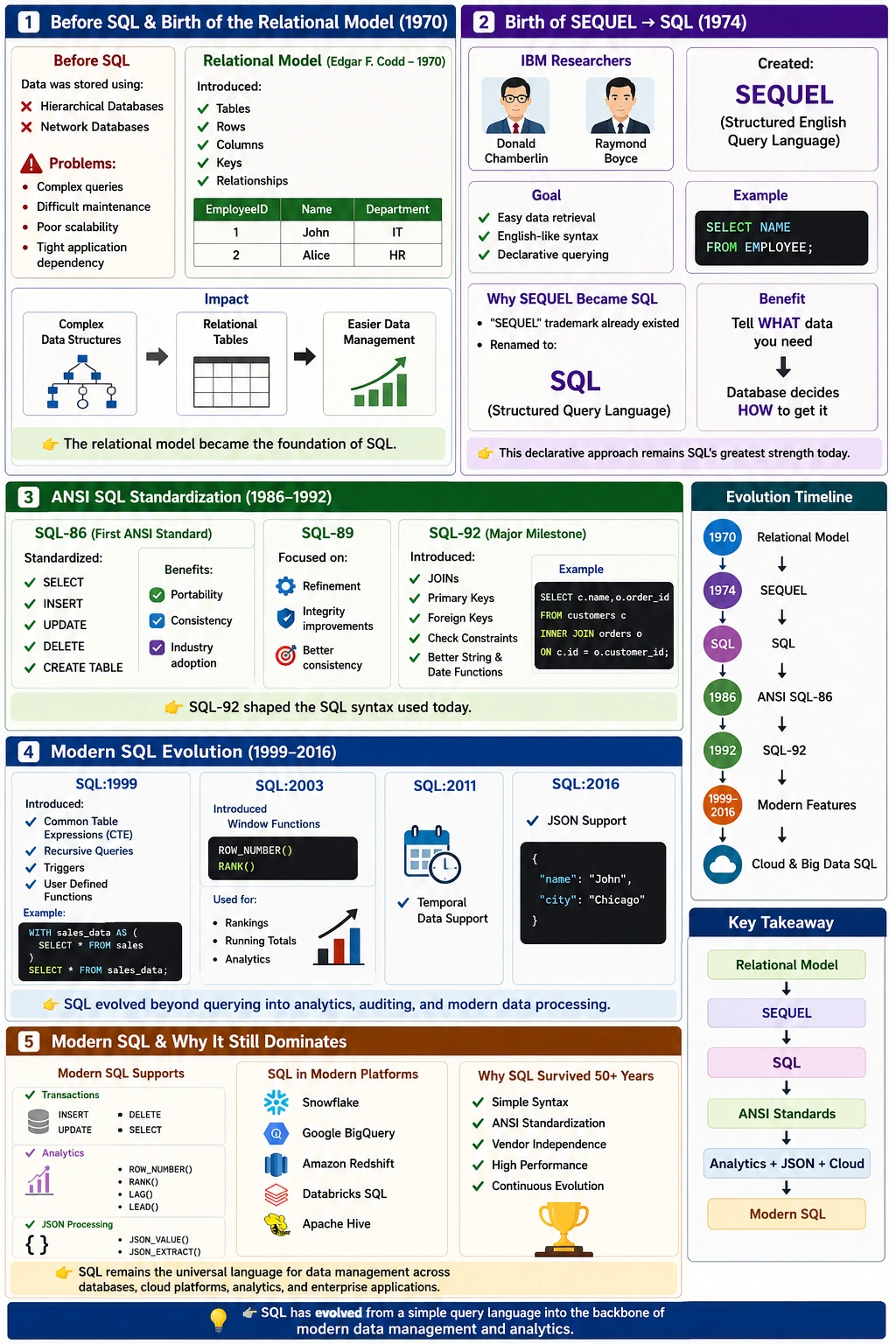
The Data Management World Before SQL
To understand why SQL was created, it is important to understand the state of data management before relational databases existed.
During the 1960s, organizations stored data primarily using hierarchical and network database systems. These systems organized information using tree-like or graph-like structures. While they were powerful for specific use cases, they were difficult to design, maintain, and query.
In a hierarchical database, data relationships were rigid. Retrieving information often required developers to know the exact path through the data structure. Network databases improved flexibility but introduced even greater complexity.
These systems had several limitations:
- Complex query logic
- High maintenance costs
- Tight coupling between applications and data structures
- Poor flexibility when business requirements changed
- Difficult scalability
As organizations began collecting larger amounts of data, a better solution became necessary. The industry needed a simpler and more flexible way to store and access information.
The Relational Model Revolution (1970)
The foundation of SQL can be traced back to 1970 when IBM researcher Dr. Edgar F. Codd published a groundbreaking research paper titled:
"A Relational Model of Data for Large Shared Data Banks."
This paper introduced the concept of the relational model.
Instead of storing information in complex hierarchical structures, Codd proposed storing data in tables called relations. Each table would consist of rows and columns, and relationships between tables could be established using common values.
This idea was revolutionary because it separated the logical view of data from its physical storage implementation.
For example:
| EmployeeID | Name | Department |
|---|---|---|
| 1 | John | IT |
| 2 | Alice | HR |
This tabular approach made data easier to understand, query, and maintain.
Many of the concepts introduced by Codd remain fundamental to relational databases today, including:
- Tables
- Rows
- Columns
- Keys
- Relationships
- Data integrity
The relational model laid the theoretical foundation upon which SQL would later be built.
The Birth of SEQUEL (1974)
Building on Codd's relational model, IBM researchers Donald Chamberlin and Raymond Boyce began developing a language that would allow users to interact with relational databases more easily.
In 1974, they introduced:
SEQUEL (Structured English Query Language)
The goal of SEQUEL was ambitious yet straightforward:
- Make database querying easier
- Allow users to describe what data they wanted
- Eliminate the need to specify how data should be retrieved
- Create a language that resembled English
Consider a simple query:
SELECT NAME
FROM EMPLOYEE;
This was dramatically simpler than navigating hierarchical or network database structures.
SEQUEL represented a major shift in thinking. Instead of instructing the database on every step required to locate data, users could simply describe the desired result.
This declarative approach became one of SQL's greatest strengths and remains central to the language today.
Why SEQUEL Became SQL
Although the language was originally called SEQUEL, IBM later discovered that the name was already trademarked by another company.
As a result, the language was renamed:
SQL (Structured Query Language)
Interestingly, many professionals continued to pronounce it as "SEQUEL" even after the name change. Others adopted the pronunciation "S-Q-L."
Today, both pronunciations are widely accepted throughout the software industry.
The name changed, but the vision remained the same: provide a simple and powerful language for relational databases.
IBM System R and the Validation of SQL
Between 1974 and 1979, IBM launched an ambitious research initiative known as System R.
The objective of System R was to prove that the relational model and SQL could be implemented effectively in real-world systems.
System R became one of the most important projects in database history.
Major innovations introduced by System R included:
- SQL query processing
- Relational storage architecture
- Cost-based query optimization
- Execution planning
- Transaction management
One of the most significant achievements was the development of the query optimizer.
Instead of requiring users to determine the most efficient way to retrieve data, the database engine could automatically generate an optimal execution plan.
This concept remains at the heart of modern database systems such as Oracle, SQL Server, PostgreSQL, and MySQL.
Many of today's database optimization techniques can trace their origins directly to the System R project.
The Commercial Success of SQL
Research alone was not enough. SQL needed commercial adoption to become successful.
In 1979, Oracle released the first commercially available SQL-based database system.
Although the product was marketed as Oracle Version 2, it was actually the company's first public release.
Oracle's success demonstrated that relational databases could solve real business problems.
Soon other vendors entered the market:
- IBM SQL/DS
- IBM DB2
- Sybase
- Informix
The rapid growth of relational databases created a new challenge.
Each vendor implemented SQL differently.
Applications developed for one database often required significant modifications before they could run on another.
This lack of consistency created a need for standardization.
ANSI SQL-86: The First Official Standard
In 1986, the American National Standards Institute (ANSI) introduced the first official SQL standard.
This standard became known as:
SQL-86
Its goals included:
- Standardizing SQL syntax
- Improving portability
- Reducing vendor-specific differences
- Encouraging industry adoption
Core commands standardized during this period included:
SELECT
INSERT
UPDATE
DELETE
CREATE TABLE
For the first time, organizations could build applications with greater confidence that SQL skills and code would transfer across platforms.
SQL-86 marked the beginning of SQL's transformation from a vendor-specific technology into an industry-wide standard.
SQL-89: Refinement and Improvement
Three years later, ANSI released SQL-89.
Unlike SQL-86, SQL-89 did not introduce dramatic new functionality.
Instead, it focused on:
- Clarifying existing standards
- Improving integrity constraints
- Refining syntax definitions
- Enhancing consistency
While SQL-89 is often overshadowed by later versions, it helped strengthen the foundation of standardized SQL.
SQL-92: The Defining Milestone
SQL-92 is widely regarded as one of the most important milestones in SQL history.
Many of the SQL features developers use today were standardized during this release.
Major enhancements included:
JOIN Operations
SELECT c.name, o.order_id
FROM customers c
INNER JOIN orders o
ON c.id = o.customer_id;
Improved Constraints
- Primary Keys
- Foreign Keys
- Check Constraints
Better String Handling
Enhanced Date Functions
More Powerful Query Capabilities
SQL-92 dramatically improved SQL's expressiveness and practicality.
Even today, much of modern SQL syntax closely resembles the standards established by SQL-92.
For many professionals, SQL-92 represents the point at which SQL became the mature language we recognize today.
SQL:1999 and the Object-Relational Era
The next major leap occurred with SQL:1999.
By the late 1990s, applications were becoming more complex, and SQL needed additional capabilities.
SQL:1999 introduced several powerful features.
Common Table Expressions (CTEs)
WITH sales_data AS (
    SELECT * FROM sales
)
SELECT * FROM sales_data;
CTEs improved readability and maintainability for complex queries.
Recursive Queries
Recursive queries enabled SQL to process hierarchical structures such as:
- Organization charts
- Folder systems
- Product categories
Triggers
Triggers allowed automatic execution of logic when database events occurred.
Examples:
- AFTER INSERT
- AFTER UPDATE
- AFTER DELETE
User-Defined Functions (UDFs)
Developers could create reusable custom functions.
These additions transformed SQL from a query language into a more complete data processing platform.
SQL:2003 and the Analytics Revolution
One of the most significant advancements in SQL history arrived with SQL:2003.
This version introduced:
Window Functions
SELECT
name,
salary,
ROW_NUMBER() OVER (
ORDER BY salary DESC
)
FROM employees;
Window functions made advanced analytics possible directly within SQL.
New capabilities included:
- Ranking
- Running totals
- Moving averages
- Percentiles
- Trend analysis
Before window functions, many analytical operations required procedural programming.
After SQL:2003, databases became significantly more powerful analytical engines.
This development helped SQL expand beyond transactional systems into business intelligence and data analytics.
SQL:2006 and XML Integration
During the early 2000s, XML became a popular format for data exchange.
To support enterprise integration requirements, SQL:2006 introduced XML capabilities.
Features included:
- XML storage
- XML querying
- XML generation
- XML integration functions
Organizations could now manage structured XML documents directly within relational databases.
This improved interoperability between databases and enterprise applications.
SQL:2008 and Query Improvements
SQL:2008 focused on refining the language and improving usability.
One notable addition was standardized row limiting:
FETCH FIRST 10 ROWS ONLY;Other improvements included:
- Enhanced query capabilities
- Better portability
- Improved standards compliance
Although less revolutionary than SQL:1999 or SQL:2003, SQL:2008 helped modernize the language.
SQL:2011 and Temporal Data Management
Organizations increasingly needed to track historical changes.
SQL:2011 addressed this requirement through temporal database features.
Examples included:
- Employee salary history
- Product price history
- Audit records
- Regulatory compliance tracking
Temporal support allowed databases to manage both current and historical versions of data more effectively.
This was especially valuable in finance, healthcare, and government systems where auditability is critical.
SQL:2016 and JSON Support
As web applications and APIs became dominant, JSON emerged as the preferred data exchange format.
A typical JSON document looks like:
{
  "name": "John",
  "city": "Chicago"
}
To bridge the gap between relational databases and modern application architectures, SQL:2016 introduced JSON support.
New capabilities included:
- JSON querying
- JSON extraction
- JSON manipulation
- JSON validation
This development allowed relational databases to handle semi-structured data more effectively.
As a result, SQL remained relevant even as NoSQL databases gained popularity.
The Modern SQL Era
Today's SQL is far more powerful than the original SEQUEL language created in the 1970s.
Modern SQL supports:
Transaction Processing
INSERT
UPDATE
DELETE
SELECT
Advanced Analytics
ROW_NUMBER()
RANK()
LAG()
LEAD()
JSON Processing
JSON_VALUE()
JSON_EXTRACT()
Big Data Platforms
SQL now powers:
- Snowflake
- Google BigQuery
- Amazon Redshift
- Databricks SQL
- Apache Hive
Cloud Databases
Examples include:
- Amazon RDS
- Azure SQL Database
- Google Cloud SQL
SQL has successfully adapted to cloud computing, analytics, machine learning pipelines, and large-scale distributed systems.
Why SQL Has Survived for More Than 50 Years
Few technologies remain dominant for half a century.
SQL's longevity can be attributed to several factors:
Simplicity
Its English-like syntax makes it relatively easy to learn.
Standardization
ANSI and ISO standards ensure consistency across platforms.
Flexibility
SQL supports both transactional and analytical workloads.
Performance
Modern database engines optimize SQL queries efficiently.
Vendor Independence
Core SQL skills transfer across multiple database products.
Continuous Evolution
SQL has consistently adapted to new technological trends, including:
- Cloud computing
- Big data
- Analytics
- JSON processing
- AI-driven platforms
Its ability to evolve without abandoning its core principles has been a major reason for its continued success.
How SQL Evolution Changed Application Development
The evolution of SQL directly changed how applications are designed and built. Early database systems forced developers to understand physical data paths and storage structures. Application code often became tightly connected to the way data was physically stored. When business requirements changed, changing the data structure could also require major application changes. SQL and the relational model reduced this coupling by allowing developers to think in terms of tables, relationships, and desired results.
As SQL matured, application development became more data-driven. Developers could create tables for business entities, define relationships between them, and write queries to retrieve exactly the information needed by the application. Instead of writing complex navigation logic, developers could use SELECT, JOIN, WHERE, GROUP BY, and ORDER BY to express data requirements clearly. This made backend systems easier to build and maintain.
The later evolution of SQL also helped applications become more sophisticated. Transaction support allowed banking, payment, ticketing, and order systems to handle critical operations reliably. Constraint support helped protect data integrity. Query optimization improved performance without requiring every developer to manually control low-level access paths. JSON support helped relational databases work better with modern APIs and web applications. Window functions made analytical features easier to build directly in the database layer.
How SQL Evolution Changed Testing and Quality Engineering
SQL evolution also changed software testing. In early systems, validating data often required knowledge of complicated storage structures. With relational databases and SQL, testers could verify backend data using readable queries. This made database testing, API validation, report testing, migration testing, and audit verification more practical.
For example, if an API creates a customer record, a tester can use SQL to check whether the customer row exists with the correct values. If an order workflow updates multiple tables, SQL can validate whether order, payment, inventory, and invoice records are consistent. If a report shows monthly revenue, SQL can be used to compare the displayed number against grouped and aggregated database records. These practices are common in enterprise testing and SDET roles.
Modern SQL features expanded testing capabilities further. Window functions help validate rankings, running totals, and trend-based reports. Temporal features help test audit and history requirements. JSON support helps validate semi-structured payloads stored in relational systems. Standardized SQL knowledge also helps testers move between MySQL, PostgreSQL, Oracle, SQL Server, and cloud databases with less friction.
SQL Standards and Vendor Extensions
One important part of SQL history is the balance between standards and vendor-specific extensions. ANSI and ISO standards helped make SQL portable across database systems, but each major database vendor also introduced features to solve practical problems or improve developer productivity. Oracle introduced PL/SQL, Microsoft SQL Server introduced T-SQL, PostgreSQL added powerful extensions and data types, and MySQL developed its own behavior around storage engines, functions, and syntax details.
This means SQL is both standard and product-specific. A basic SELECT query works similarly across most relational databases, but advanced features may differ. Date functions, string functions, pagination syntax, JSON functions, procedural extensions, identity columns, and indexing options can vary between products. Developers and testers should understand core SQL first, then learn the specific database used in their project.
This balance is one reason SQL skills remain valuable. Core concepts such as tables, rows, columns, keys, joins, filtering, grouping, aggregation, constraints, and transactions transfer across systems. Vendor-specific knowledge adds depth, but the foundation remains shared. The standards made SQL a common professional language, while extensions allowed database products to innovate.
SQL in the Cloud and Big Data Era
The cloud era did not reduce SQL's importance. Instead, it expanded where SQL is used. Managed relational database services such as Amazon RDS, Azure SQL Database, Google Cloud SQL, and cloud-hosted PostgreSQL or MySQL allow teams to use SQL databases without manually managing every infrastructure detail. Cloud providers handle backups, replication, monitoring, failover, and scaling options, while applications continue to use SQL for structured data access.
Big data platforms also adopted SQL-like interfaces because analysts and engineers already understood SQL. Tools such as BigQuery, Snowflake, Redshift, Hive, Spark SQL, and Databricks SQL allow large-scale analytics using familiar query concepts. The datasets may be huge and the execution engines may be distributed, but the query language remains close to SQL. This shows how powerful the SQL model is: even new data platforms often choose SQL-style access because it is expressive and widely understood.
Modern organizations often combine transactional SQL databases with analytical SQL platforms. A production application may store orders in PostgreSQL or SQL Server, then stream or replicate data into a warehouse such as Snowflake or BigQuery for reporting. SQL is used in both places, but for different workloads. Transactional SQL supports day-to-day application correctness, while analytical SQL supports business insight.
SQL and Modern API-Based Applications
Modern applications often expose functionality through APIs. A web page, mobile app, partner system, or microservice sends a request to an API, and the backend service often uses SQL to read or write data. Even when users never see SQL directly, SQL may be responsible for fetching profiles, validating permissions, creating orders, updating balances, saving preferences, and generating reports.
JSON support became especially important because APIs commonly exchange JSON payloads. Earlier relational systems were designed mainly around tables and rows. Modern SQL databases can now store, query, and extract JSON data when the application needs semi-structured values. This does not remove the value of relational design, but it gives developers more flexibility when working with API-style data.
The evolution from SEQUEL to modern SQL therefore reflects the evolution of applications themselves. Early SQL focused mainly on relational querying. Modern SQL supports transactional applications, reporting systems, API payloads, cloud workloads, analytics, and integration scenarios. It continues to adapt while preserving the familiar declarative style that made it successful.
SQL in Microservices Architecture
Microservices changed application architecture, but SQL still plays a major role. In a microservices system, each service may own its own database or schema. A user service may store users and roles, an order service may store orders and order items, and a payment service may store payment records. These databases may be relational, NoSQL, or mixed depending on the service requirement, but SQL databases remain common for structured transactional data.
In this architecture, SQL is usually used inside service boundaries. Other services should not directly query a service's private database because that creates tight coupling. Instead, services communicate through APIs or events. The service that owns the database uses SQL internally to manage its data. This pattern preserves service independence while still benefiting from relational storage where appropriate.
SQL evolution matters here because modern services need more than simple storage. They need transactions, indexes, constraints, auditing, reporting, and sometimes JSON handling. Mature SQL databases provide these capabilities. This is why even distributed architectures often continue to rely on SQL for important business data.
Why Learning SQL History Helps Beginners
Learning SQL history helps beginners understand why SQL looks the way it does. The language was designed to be declarative and closer to English so users could ask for data without specifying physical retrieval steps. This explains why SELECT queries describe the desired columns and conditions rather than a step-by-step file navigation process. It also explains why relational tables, keys, joins, and constraints are central to SQL learning.
History also helps learners understand why standards matter. SQL is used across many databases because ANSI and ISO standards created a common foundation. At the same time, vendor-specific extensions explain why the exact syntax may differ between Oracle, SQL Server, PostgreSQL, MySQL, and SQLite. A learner should not be confused when one database uses one function and another uses a different function. Core SQL is shared, but products extend it.
For interviews, SQL history provides useful context. Instead of memorizing that SQL came from SEQUEL, a strong candidate can explain that SQL grew from the relational model, became commercially successful through relational database products, was standardized by ANSI, and evolved to support joins, constraints, analytics, XML, JSON, cloud systems, and big data platforms. This answer sounds much more mature than a simple date list.
Interview Perspective on SQL Evolution
Interviewers may ask why SQL is still relevant when many newer technologies exist. A strong answer should mention that SQL is standardized, readable, declarative, powerful for structured data, supported by mature database engines, and useful for both transactional and analytical workloads. It has survived because it keeps adapting without losing its core design.
If asked about SEQUEL, explain that it was the original IBM language created to query relational databases using an English-like style. It was later renamed SQL because of trademark issues. If asked about ANSI SQL, explain that ANSI standardization helped make SQL portable across vendors and reduced fragmentation. If asked about modern SQL, explain that modern SQL supports advanced analytics, JSON, cloud databases, big data systems, and enterprise workloads.
A concise interview answer can be: SQL evolved from IBM's SEQUEL project, which was based on Edgar Codd's relational model. It became commercially successful through relational database products, standardized through ANSI and ISO, and later expanded with features such as joins, constraints, CTEs, window functions, temporal data, XML, JSON, and cloud-scale analytics. Its declarative style and continuous evolution are the reasons it remains important today.
Conclusion
The evolution of SQL represents one of the most remarkable success stories in software engineering. Beginning with Edgar Codd's relational model in 1970, progressing through IBM's SEQUEL project in 1974, and eventually becoming the standardized SQL language used worldwide, SQL has continuously adapted to changing technological demands. From SQL-86 and SQL-92 to modern standards supporting analytics, XML, JSON, cloud computing, and big data processing, each stage of its evolution expanded its capabilities while preserving its fundamental goal: making data accessible through a simple, declarative language.
Today, SQL is far more than a database query language. It powers enterprise applications, financial systems, e-commerce platforms, reporting solutions, cloud services, analytics engines, and data warehouses. Despite the emergence of numerous alternative technologies, SQL remains the universal language of data management. Its journey from SEQUEL to modern SQL demonstrates how a well-designed technology can remain relevant across generations of computing, making it one of the most valuable and enduring skills in the software industry.