Writing Maintainable Tests in Selenium
Writing Maintainable Tests in Selenium means designing automation tests so they remain easy to read, update, debug, reuse, and extend as the application changes. A maintainable test suite does not collapse when a locator changes, a browser version changes, a new environment is added, or a business workflow is slightly modified. Instead, the framework absorbs those changes through clear layers such as page objects, configuration readers, reusable utilities, driver factories, waits, reports, and well-named test methods.
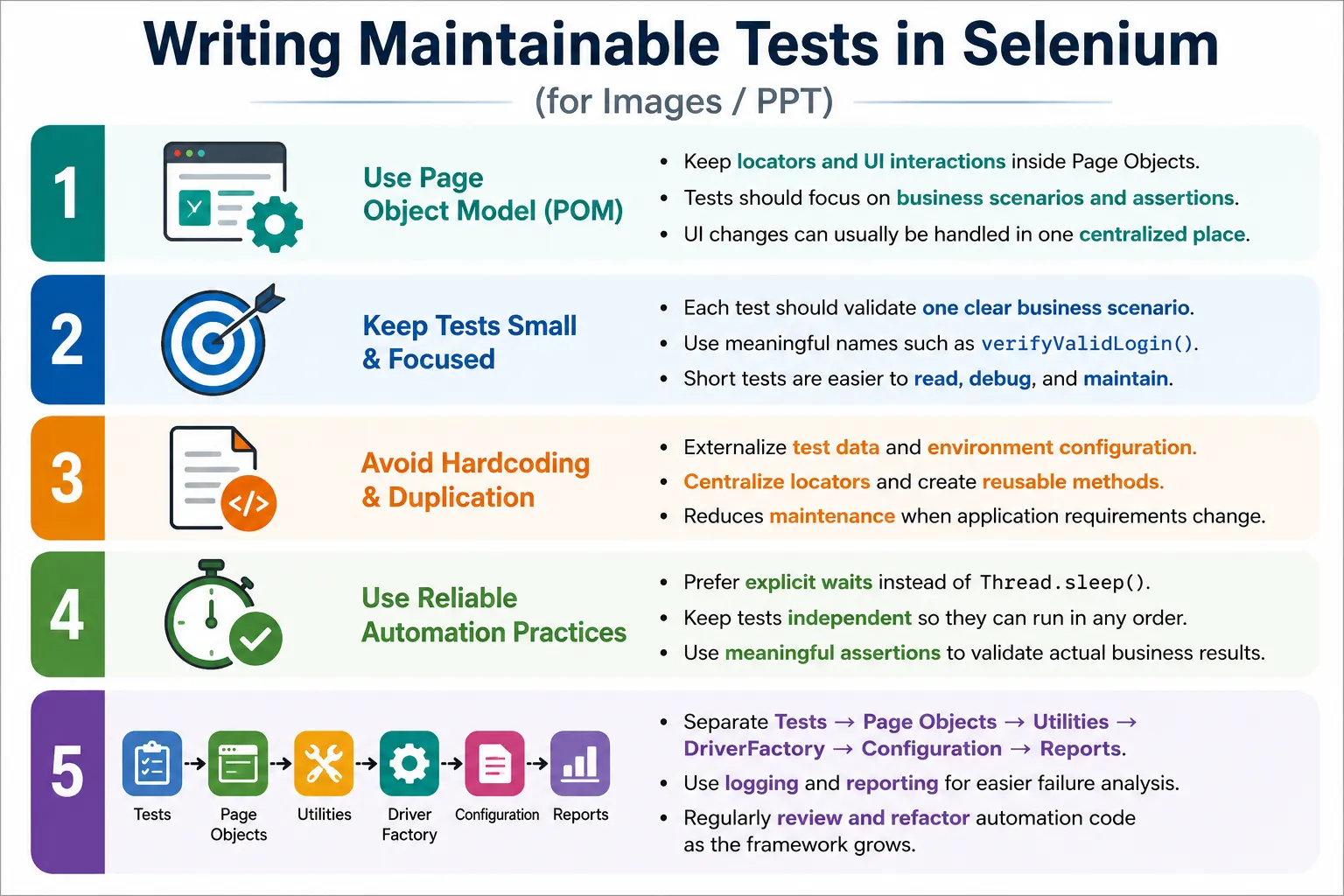
In enterprise Selenium projects, maintainability is not optional. Applications evolve continuously. New fields are added, UI layouts are adjusted, validation rules change, user roles expand, and workflows are refined across releases. If automation tests are written as long scripts full of duplicated locators and hardcoded values, every small application change becomes a maintenance project. Well-designed tests reduce that cost because the change is usually made in one focused place instead of dozens or hundreds of test methods.
1. What Maintainable Tests Mean
Maintainable tests are automation scripts that can be understood and modified with minimal effort. A new team member should be able to open a test and quickly understand the business scenario being verified. The test should not force the reader to decode long chains of WebDriver calls, scattered waits, repeated data values, and unclear method names. The intent should be visible from the structure.
Instead of hardcoded values, duplicate code, complex test methods, and mixed responsibilities, maintainable tests use reusable methods, readable naming, modular design, external configuration, and clear separation between test logic and page interaction logic. A maintainable test does not try to do everything inside one method. It delegates browser interactions to page objects, configuration to configuration utilities, data handling to data providers or readers, and reporting to listeners or reporting helpers.
Non-Maintainable Test
  Hardcoded Values
  Duplicate Locators
  Long Methods
  Mixed Responsibilities

Maintainable Test
  Readable Scenario
  Page Objects
  Reusable Utilities
  External Configuration
2. Why Maintainability Matters
Imagine an application with 1,500 Selenium tests and weekly UI changes. If the login button locator appears directly in 300 test classes, one locator change can create hundreds of failures. The product may not be broken, but the automation suite becomes noisy. The team then spends time fixing scripts instead of testing product risk. This is how poorly designed automation loses credibility.
With maintainable tests, the same UI change affects a page object method or locator declaration. The team updates one place, runs the suite again, and most tests continue to work. This is the central promise of maintainable automation: when the application changes, automation updates should be focused, predictable, and limited in scope.
Small UI Change
  Poor Design
    Hundreds of Test Failures
      Days of Maintenance

Small UI Change
  Good Design
    Update One Page Object
      Suite Continues Working
3. Problems with Poorly Written Tests
Poorly written Selenium tests usually have similar symptoms. They contain duplicate code, hardcoded URLs, hardcoded usernames, unclear method names, direct locators inside test methods, excessive Thread.sleep(), no reporting, no logging, and large test methods that validate too many things at once. They may pass initially, but they become expensive as the project grows.
Another problem is tight coupling. A test that knows every locator, every click, every wait, every data value, and every navigation detail is tightly coupled to the UI implementation. When the UI changes, the test breaks even if the business behavior is still correct. Maintainable automation reduces coupling by hiding UI details behind page object methods and business-oriented actions.
4. Core Design Idea
The core idea is simple: tests should describe what business scenario is being validated, while framework layers handle how the browser performs the steps. A test method should read like a scenario, not like a raw browser script. It should say that a user logs in, searches for a product, adds it to the cart, or verifies a dashboard. It should not expose every locator and low-level click unless there is a specific reason.
Business Requirement
  Test Class
    Page Object
      Reusable Utility
        DriverFactory
          Browser
This design creates a clean separation of responsibilities. Test classes focus on scenarios and assertions. Page objects focus on UI behavior. Utilities handle reusable technical tasks. DriverFactory manages browser creation. Configuration readers provide environment values. Reporting and logging capture evidence. Each layer has a reason to exist.
5. Characteristics of Maintainable Tests
A maintainable test should be readable, reusable, independent, modular, reliable, scalable, easy to debug, and easy to modify. Readability helps humans understand the test. Reusability prevents duplication. Independence allows tests to run in any order. Modularity allows changes to stay localized. Reliability reduces false failures. Scalability allows the framework to grow without becoming chaotic.
Maintainable tests also have clear failure points. When a test fails, the report should show what business step failed, what was expected, what actually happened, and what evidence was captured. A failure should not require the tester to manually rerun the full suite just to understand what happened.
6. Use Page Object Model
The Page Object Model is one of the most important practices for maintainable Selenium tests. A page object represents a page or component in the application. It stores locators and exposes meaningful methods for actions and validations. Test classes call these methods instead of directly using driver.findElement() everywhere.
driver.findElement(By.id("username")).sendKeys("admin");
driver.findElement(By.id("password")).sendKeys("admin123");
driver.findElement(By.id("login")).click();
The direct WebDriver version works, but it is not maintainable when repeated across many tests. A better test calls page object methods that express intent.
loginPage.enterUsername("admin");
loginPage.enterPassword("admin123");
loginPage.clickLogin();
An even cleaner page object may expose a single business action when the steps naturally belong together.
loginPage.login("admin", "admin123");This keeps UI details inside the page object. If the username field locator changes, the test method does not change. Only the page object changes.
7. Separate Test Logic from Page Logic
Test logic and page logic should not be mixed. Test logic decides the scenario, data, and expected result. Page logic knows how to interact with the screen. When test classes directly manage locators, waits, clicks, text entry, scrolling, and validation details, they become hard to read and harder to maintain.
@Test
public void verifyValidLogin() {
    loginPage.login(username, password);
    Assert.assertTrue(dashboardPage.isDisplayed());
}
This test clearly says what is being verified. The details of entering credentials, clicking login, and locating dashboard elements are hidden in page objects. That is exactly what a maintainable test should do.
8. Use Meaningful Test Names
Names matter because tests are read more often than they are written. A method named test1(), sample(), or login() does not explain the scenario. A method named verifyValidLogin(), verifyInvalidPasswordMessage(), or verifyProductSearchReturnsMatchingResults() communicates intent immediately.
Good test names also improve reports. When a Jenkins report shows a failure in test1(), the reader learns almost nothing. When it shows a failure in verifyPaymentFailsForExpiredCard(), the reader understands the business area and likely risk without opening the code.
9. Keep Tests Short and Focused
A maintainable test should usually validate one business scenario. A single test that logs in, searches, adds to cart, checks out, pays, downloads an invoice, logs out, and verifies account history may look useful, but it is hard to debug. If it fails, the failure could come from many unrelated areas. Long tests also create dependencies between features.
Short focused tests are easier to maintain. A login test verifies login. A search test verifies search. A checkout test verifies checkout. End-to-end tests are still useful, especially for critical journeys, but they should be intentional and limited. Most test suites are easier to maintain when they contain a mix of focused feature tests and a smaller number of high-value end-to-end flows.
10. Follow Arrange, Act, Assert
The Arrange, Act, Assert pattern improves test readability. Arrange prepares preconditions and data. Act performs the user action. Assert verifies the expected result. This structure helps readers understand the purpose of the test quickly.
@Test
public void verifyValidLogin() {
    // Arrange
    loginPage.open();

    // Act
    loginPage.login("admin", "admin123");

    // Assert
    Assert.assertTrue(dashboardPage.isDisplayed());
}
Comments are not always required, but the structure should be visible. When a test becomes too hard to organize into these three parts, it may be doing too much.
11. Avoid Hardcoded Test Data
Hardcoded test data makes tests harder to maintain. If a username, password, URL, product name, or account number is repeated in many test classes, changes become painful. Test data should be centralized or externalized depending on the need.
loginPage.login(
        ConfigReader.get("username"),
        ConfigReader.get("password")
);
Configuration values such as URLs, browser names, timeouts, usernames, and environment names can come from properties files, JSON files, environment variables, Jenkins parameters, or Maven system properties. Test data for multiple scenarios can come from Excel, CSV, JSON, databases, or TestNG DataProvider.
12. Externalize Test Data
Externalized test data makes a framework flexible. When valid login data, invalid login data, registration values, product details, and payment test data are outside the test method, the same test logic can run with different data sets. This is useful for data-driven testing and enterprise regression suites.
However, externalization should be practical. Not every value needs to live in a spreadsheet. Constants that truly belong to the test may remain in code, but environment-specific and frequently changing values should be configurable. The goal is not to move all values outside code blindly. The goal is to reduce maintenance effort and improve clarity.
13. Use Reusable Methods
Reusable methods reduce duplication. If the same click, wait, scroll, dropdown selection, screenshot capture, file upload, or JavaScript action appears repeatedly, it belongs in a reusable helper or page object method. Duplication increases maintenance cost because the same fix must be made in multiple places.
Reusable methods should be meaningful and not overly generic. A method named clickLoginButton() in a page object is clear. A utility method named clickElement() can be useful when it wraps waiting and logging consistently. But a huge generic method that tries to handle every possible action can become harder to maintain than duplicated code. Reuse should simplify the framework, not hide complexity.
14. Centralize Locators
Locators should be centralized in page objects or component objects. If By.id("username") appears in many test classes, the framework is fragile. A locator change will require multiple updates and may cause inconsistent fixes. Centralizing locators makes UI changes easier to handle.
Stable locator strategy is also part of maintainability. Prefer reliable IDs, names, accessible labels, semantic attributes, or test-specific attributes such as data-testid when available. Avoid brittle XPath expressions that depend heavily on visual layout or index positions unless there is no better option.
15. Avoid Thread.sleep
Thread.sleep() pauses execution for a fixed time regardless of application state. It can make tests slow and unreliable. If the application responds faster, time is wasted. If it responds slower, the test still fails. Maintainable Selenium tests use explicit waits that wait for a real condition.
WebDriverWait wait =
        new WebDriverWait(driver, Duration.ofSeconds(10));
Explicit waits should be placed in page objects or reusable wait utilities. Tests should not scatter waits everywhere. A good page object waits for elements before interacting with them and exposes stable behavior to the test layer.
16. Write Independent Tests
Independent tests can run alone, in any order, and in parallel where appropriate. A test should not depend on another test to create data, log in, or leave the application in a specific state. Dependent tests are difficult to debug because one failure can cause many follow-up failures.
Independence requires setup and cleanup discipline. Each test should prepare what it needs or use safe reusable data. If a test creates data, it should clean up when practical. If cleanup is not possible, data should be unique enough to avoid conflicts with future runs. This becomes especially important in Jenkins and parallel execution.
17. Use Assertions Properly
Printing a message is not validation. A maintainable test must assert expected behavior. Assertions should be clear, business-relevant, and placed at meaningful points. A test that performs actions without assertions may pass even when the application is wrong.
Assert.assertEquals(
        dashboardPage.getTitle(),
        "Dashboard"
);
Assertions should not be vague. Instead of only asserting that an element exists, verify the actual message, status, URL, table value, confirmation number, or business result when possible. Strong assertions make tests more valuable.
18. Use Configuration Management
Configuration management keeps environment-specific values outside test logic. URLs, browser names, timeout values, Grid URLs, headless mode, usernames, report paths, and API endpoints should be configurable. This allows the same framework to run against QA, staging, UAT, or production-like environments without code changes.
driver.get(ConfigReader.get("url"));Configuration values can come from properties files, JSON files, Maven properties, environment variables, or Jenkins parameters. The framework should define one consistent way to resolve configuration so that values do not become scattered across files and code.
19. Use DriverFactory
Driver creation should be centralized. If every test class creates its own ChromeDriver, the framework becomes difficult to scale. A DriverFactory can handle browser selection, headless mode, window size, remote execution, Selenium Grid, timeouts, and browser options in one place.
WebDriver driver =
        DriverFactory.getDriver(browser);
Centralized driver creation also supports cross-browser testing. When a team adds Firefox, Edge, or remote Grid execution, tests do not need to change. DriverFactory absorbs the browser-specific setup.
20. Handle Exceptions Gracefully
Exception handling should preserve evidence. When a Selenium test fails, the framework should capture screenshots, log meaningful messages, record exceptions in reports, and close browser sessions properly. Abrupt failures without evidence make debugging slow.
At the same time, tests should not catch every exception and hide failures. If the application is broken, the test should fail clearly. Graceful handling means adding context and cleanup, not pretending the failure did not happen. TestNG listeners, base classes, and report utilities are common places to handle failure evidence.
21. Logging for Maintainability
Logs help maintainers understand what happened before a failure. Weak logs such as Clicked button are less useful than business-oriented logs such as User submitted valid login credentials or Checkout confirmation message was displayed. Logs should describe user intent and important system states.
Good logging helps during Jenkins execution because the browser may not be visible. When a headless build fails, logs, screenshots, and reports become the main evidence. Logs should include browser, environment, URL, test name, key steps, and failure details where appropriate.
22. Reporting for Maintainability
Reports are not only for managers. They are maintenance tools. A good report shows passed tests, failed tests, skipped tests, exception messages, screenshots, logs, environment details, browser details, execution time, and sometimes categories or groups. Extent Reports are commonly used in Selenium frameworks for this purpose.
Reports should help the maintainer answer important questions quickly. Which scenario failed? What was the expected result? What exception occurred? What screenshot was captured? Which browser and environment were used? If a report does not answer these questions, debugging becomes slower.
23. Folder Structure
A clear folder structure improves maintainability because files have predictable locations. A typical Selenium framework may contain base classes, configuration utilities, driver management, page objects, test classes, reusable utilities, reports, screenshots, test data, and listeners.
AutomationFramework
  base
  config
  driver
  pages
  tests
  utilities
  reports
  screenshots
  testdata
The exact structure can vary by project, but the principle is the same. Related responsibilities should be grouped clearly. Test classes should not be mixed with utilities, and page objects should not be mixed with configuration code.
24. Naming Conventions
Consistent naming makes the framework easier to navigate. Page classes can use names such as LoginPage, DashboardPage, and CheckoutPage. Test classes can use names such as LoginTest or CheckoutTest. Utility classes can use names such as ConfigReader, WaitUtils, and ScreenshotUtils.
Method names should describe actions or validations. Good examples include login(), searchProduct(), placeOrder(), isErrorMessageDisplayed(), and getConfirmationNumber(). Variable names should also be meaningful: username, password, searchText, and orderId are clearer than a, b, or value1.
25. Keep Framework Layers Separate
Maintainable frameworks have clear layers. Tests call page objects. Page objects call WebDriver and reusable utilities. Utilities perform common technical tasks. DriverFactory creates browsers. Configuration readers provide values. Reports and listeners capture results. Each layer has a single responsibility.
Tests
  Page Objects
    Utilities
      Driver
        Configuration
          Reports
When layers are mixed, the framework becomes difficult to maintain. For example, if a page object reads Excel data, creates browsers, and writes reports, it is doing too much. Keeping responsibilities separate makes future changes easier.
26. Advantages of Maintainable Tests
Maintainable tests are easier to update, easier to debug, easier to review, easier to onboard, and easier to scale. They reduce duplication, improve reliability, support parallel execution, and make CI/CD execution more trustworthy. They also reduce dependency on one person because the framework is easier for the whole team to understand.
Another advantage is better long-term return on investment. Automation requires upfront effort, but maintainable automation continues to provide value across releases. Poorly maintained automation becomes a cost center. Maintainable automation becomes a reliable quality asset.
27. Limitations and Discipline Required
Maintainable tests require initial design effort. It takes time to build page objects, utilities, configuration handling, reporting, and driver management. It also requires team discipline. If some team members follow standards and others write direct WebDriver scripts inside tests, the framework will become inconsistent.
Refactoring is also necessary. A framework that starts clean can become messy as new features are added quickly. Regular code reviews, cleanup, naming improvements, and duplicate removal are part of maintaining maintainability. Good design is not a one-time activity.
28. Maintainable vs Non-Maintainable Tests
Non-maintainable tests rely on hardcoded values, duplicate code, mixed UI and test logic, long methods, poor naming, and manual updates everywhere. Maintainable tests use external configuration, reusable methods, Page Object Model, small focused methods, descriptive names, and centralized changes.
Non-Maintainable
  Hardcoded Values
  Duplicate Code
  Mixed Responsibilities
  Long Methods
  Poor Naming

Maintainable
  External Configuration
  Reusable Methods
  Page Object Model
  Focused Tests
  Descriptive Naming
29. Common Beginner Mistakes
A common beginner mistake is writing all code in test classes. This creates scripts that work initially but become painful to update. Another mistake is repeating locators across tests. Locators belong in page objects. Beginners also often use Thread.sleep() because it appears simple, but it creates slow and unstable tests.
Hardcoding test data is another frequent mistake. Tests become tied to one environment and one data set. Dependent tests are also risky because they fail in chains. Finally, skipping code reviews allows inconsistent patterns to spread. Maintainability improves when teams review automation code with the same seriousness as application code.
30. Enterprise Best Practices
Enterprise Selenium frameworks should follow Page Object Model, separate test logic from page logic, keep tests independent, use meaningful names, externalize configuration and test data, create reusable utilities, use explicit waits, implement logging and reporting, follow consistent coding standards, and refactor regularly.
They should also support command-line execution through Maven, CI/CD execution through Jenkins, cross-browser execution through DriverFactory or Grid, and environment selection through configuration. Maintainability is strongest when the framework works consistently across local machines and build servers.
31. Real Enterprise Architecture
A real enterprise Selenium architecture usually starts with business requirements and test scenarios. Test classes express those scenarios. Page objects model application pages. Utilities handle reusable operations. DriverFactory creates browser sessions. Configuration controls environment behavior. Reports provide execution evidence. Jenkins or another CI system runs everything automatically.
Automation Tests
  Page Objects
    Utilities
      DriverFactory
        Configuration
          Reports
            Jenkins
This architecture helps the team manage growth. As new features are automated, the framework remains organized because each new piece has a clear place.
32. Code Review for Maintainability
Code review is one of the best ways to protect maintainability. Reviewers should check whether tests are readable, whether methods are named clearly, whether locators are centralized, whether waits are appropriate, whether data is hardcoded, whether assertions are meaningful, and whether duplication has been avoided.
Automation code should not be treated as disposable. If test code is poorly reviewed, the suite becomes unreliable and expensive. A code review may take a few minutes, but it can prevent weeks of maintenance problems later.
33. Refactoring Selenium Tests
Refactoring means improving test code structure without changing test behavior. In Selenium frameworks, refactoring may include moving locators into page objects, extracting repeated waits into utilities, renaming unclear methods, splitting long tests, externalizing data, or simplifying duplicated assertions.
Refactoring should be done continuously. Waiting until the framework becomes unmanageable makes cleanup risky and expensive. Small regular improvements keep the codebase healthy. When a tester touches a page object or test class, it is often a good opportunity to improve nearby code carefully.
34. Maintainability in CI/CD
Maintainability becomes more visible in CI/CD. Jenkins exposes slow tests, flaky tests, poor reporting, missing cleanup, environment dependency, and test data conflicts. A suite that passes manually may fail in CI because it was not designed for repeatable execution.
CI-friendly tests should run from Maven, accept runtime configuration, avoid local machine dependencies, produce reports, capture screenshots, clean up resources, and run independently. These qualities are closely connected to maintainability. A test that cannot run reliably in Jenkins is usually not maintainable enough for enterprise use.
35. Interview Perspective
A short interview answer is: writing maintainable tests means designing Selenium automation so tests are easy to read, update, reuse, and debug. This is achieved through Page Object Model, reusable utilities, externalized configuration, meaningful naming, explicit waits, independent tests, logging, reporting, and clean framework layers.
A stronger real-time answer is: in my Selenium hybrid framework, I focus on maintainability by separating test logic from page logic using Page Object Model. Browser creation is centralized in DriverFactory, URLs and browser settings are managed through configuration files or Maven properties, and test data is externalized using JSON, Excel, CSV, or properties files. I avoid duplicate locators and hardcoded values by using page objects and reusable utilities. Each test validates one business scenario, uses explicit waits for synchronization, and generates detailed reports with screenshots. This makes the framework easier to maintain when the application changes.
36. Maintainable Test Workflow
The maintainable test workflow starts with a business requirement. A test class represents the scenario. A page object performs UI actions. Utilities support repeated technical operations. DriverFactory creates the browser. Selenium interacts with the application. Reports capture results.
Business Requirement
  Test Class
    Page Object
      Utilities
        DriverFactory
          Selenium
            Reports
This workflow keeps the test readable while still allowing the framework to manage technical complexity behind the scenes.
37. Practical Checklist
Before adding a Selenium test to the framework, ask whether the test has a clear name, validates one scenario, uses page objects, avoids hardcoded environment values, uses explicit waits, has meaningful assertions, logs important steps, captures evidence on failure, and can run independently. If the answer is no, the test may work today but become costly tomorrow.
Also check whether any code is duplicated. If a locator, wait, action, or data setup appears repeatedly, consider extracting it into the correct layer. Maintainability is often improved by small decisions made every day.
38. Key Takeaway
Maintainable Selenium tests are built on readability, modularity, reusability, independence, explicit waits, external configuration, meaningful assertions, logging, reporting, and clean framework architecture. They reduce maintenance effort and make automation more reliable as the application grows.
Maintainable Tests
  Page Object Model
  Reusable Methods
  External Configuration
  Independent Tests
  Explicit Waits
  Logging
  Reporting
  Clean Architecture
    Reliable and Scalable Framework
The most important practices are to keep tests small and focused, separate test logic from UI interaction logic, use Page Object Model and reusable utilities, externalize configuration and test data, prefer explicit waits over Thread.sleep(), use meaningful names, generate useful reports, and refactor regularly. Writing maintainable tests is the foundation of a successful Selenium automation framework because it allows the suite to stay useful even when applications, teams, environments, and requirements change over time.