Types of Selenium Automation Frameworks
An automation framework is a structured collection of guidelines, reusable components, libraries, utilities, design patterns, reporting mechanisms, configuration rules, and coding standards used to build automated tests efficiently. In Selenium, a framework prevents test code from becoming a collection of random scripts. It gives the automation suite a consistent architecture that can be maintained by a team over time.
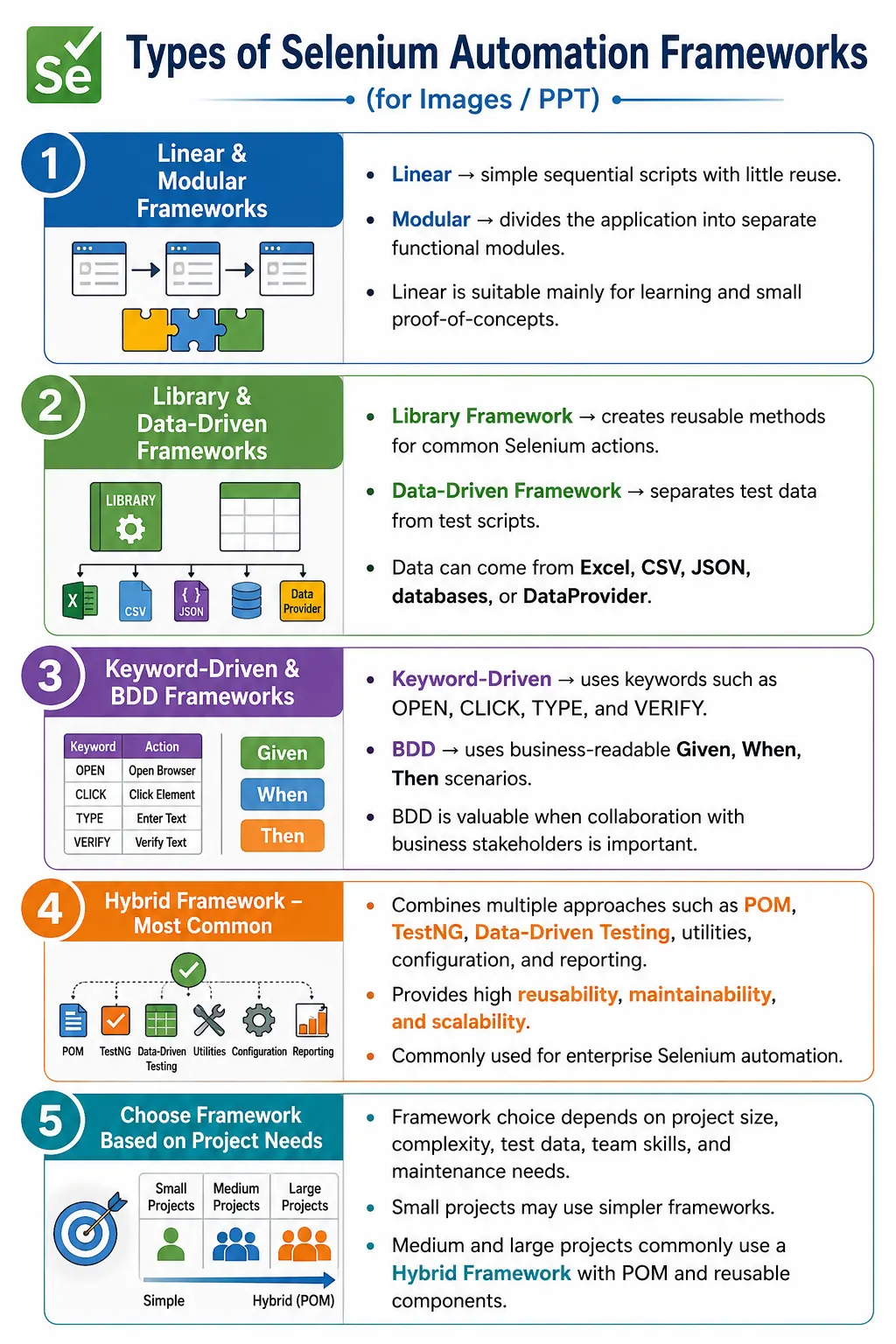
There is no single framework type that fits every project. A small proof of concept may need only a simple linear script. A medium project may need modular pages and utility methods. A large enterprise project usually needs a hybrid framework with Page Object Model, TestNG, Maven, data-driven testing, reusable utilities, configuration management, logging, reporting, and CI/CD integration. Understanding the major framework types helps you choose the right design for the project and answer Selenium interview questions with practical clarity.
1. What Is an Automation Framework?
An automation framework is a standardized architecture for developing and maintaining automated test scripts. It defines where tests live, where page objects live, how drivers are created, how test data is supplied, how configuration is managed, how reports are generated, and how reusable actions are shared.
- Folder structure.
- Coding standards.
- Reusable libraries.
- Test execution mechanism.
- Reporting and logging.
- Data management.
- Configuration management.
- Driver setup and cleanup.
Without a framework, engineers may write scripts in different styles. Locators may be duplicated. Browser setup may be repeated. Test data may be hardcoded. Reporting may be inconsistent. A framework solves these problems by creating a shared structure.
2. Why Do We Need an Automation Framework?
Without a framework, Selenium scripts often grow in an uncontrolled way. One test may open the browser directly. Another may use a helper method. One test may hardcode data. Another may read Excel. One engineer may use implicit waits, another may use sleeps, and another may use explicit waits. This inconsistency makes maintenance difficult.
Random Selenium Scripts
  Duplicate Code
    Poor Maintenance
      Difficult Debugging
        Hard to Scale
With a framework, the team follows a consistent structure. Browser setup is centralized. Page actions are reusable. Test data is separated. Reports are standardized. New tests are easier to add because the foundation already exists.
Standardized Structure
  Reusable Components
    Easy Maintenance
      Scalable Automation
        Better Collaboration
3. Major Types of Selenium Frameworks
The major Selenium automation framework types are Linear Framework, Modular Framework, Library Architecture Framework, Data-Driven Framework, Keyword-Driven Framework, Hybrid Framework, and BDD Framework. These are not always completely separate in real projects. Most enterprise frameworks combine multiple types.
- Linear Framework.
- Modular Framework.
- Library Architecture Framework.
- Data-Driven Framework.
- Keyword-Driven Framework.
- Hybrid Framework.
- Behavior Driven Development Framework.
4. Linear Framework
The Linear Framework is the simplest automation framework. Scripts are written sequentially from start to finish without much reuse. It is often similar to record-and-playback style automation or beginner-level manual scripting. The test opens the browser, performs steps, validates behavior, and closes the browser in one flow.
Open Browser
  Login
    Search Product
      Logout
        Close Browser
driver.get(url);
driver.findElement(By.id("username"))
.sendKeys("admin");
driver.findElement(By.id("password"))
.sendKeys("admin123");
driver.findElement(By.id("login"))
.click();The advantage is simplicity. It is easy to learn, quick to create, and useful for proof of concept work. The disadvantage is poor maintainability. There is little reuse, lots of duplication, and a high cost when the application changes. Linear frameworks are not suitable for large applications.
5. Modular Framework
The Modular Framework divides the application into independent modules. Each module has its own automation scripts or classes. For example, a shopping application may have Login Module, Search Module, Cart Module, Checkout Module, Payment Module, and Reports Module.
Application
  Login Module
  Search Module
  Cart Module
  Checkout Module
  Payment Module
This framework type is better organized than a linear framework. If the login module changes, login-related code can be updated in one area. It improves maintainability and reusability at the module level. However, data may still be hardcoded, utilities may be limited, and the framework still requires careful design to scale.
6. Library Architecture Framework
The Library Architecture Framework focuses on reusable methods and common operations. Instead of writing raw Selenium actions everywhere, common functions are placed in utility methods or reusable libraries. Examples include click, type, select dropdown, wait for element, scroll, take screenshot, switch window, and handle alert.
click(loginButton);
type(usernameField, "admin");
waitForVisible(successMessage);
takeScreenshot("login-success");
This framework type reduces duplication significantly. If the click behavior needs an explicit wait before clicking, it can be updated in one reusable method. The downside is that it requires good design. Poorly designed libraries can become dumping grounds for unrelated methods. The best libraries are focused, reusable, and easy to understand.
7. Data-Driven Framework
A Data-Driven Framework separates test data from test scripts. The same test can run multiple times with different input data from sources such as Excel, CSV, JSON, databases, or TestNG DataProvider. This is one of the most common framework patterns in Selenium projects.
Login Test
  Excel or CSV or JSON
    Admin User
    Standard User
    Guest User
    Invalid User
The main advantage is reusability. One test method can validate many data combinations. Adding a new scenario may require adding a data row instead of writing a new test method. The challenge is data management. Poor-quality data, duplicate rows, sensitive values, and unclear expected results can make data-driven frameworks unreliable.
8. Keyword-Driven Framework
A Keyword-Driven Framework represents test steps using action keywords. Instead of writing Java code for every step, a data file may contain rows such as OPEN, TYPE, CLICK, SELECT, and VERIFY. The framework reads the keyword and performs the matching action.
| Keyword | Locator | Value |
|---|---|---|
| OPEN | Browser | |
| TYPE | username | admin |
| TYPE | password | admin123 |
| CLICK | login | |
| VERIFY | title | Dashboard |
The advantage is that non-programmers can define flows with keywords. The disadvantage is complexity. The framework must interpret keywords, maintain action libraries, handle errors, support data, and provide debugging. Large keyword frameworks can become hard to maintain if not designed carefully.
9. Hybrid Framework
A Hybrid Framework combines multiple framework types. Most enterprise Selenium projects use hybrid frameworks because real projects need more than one pattern. A typical hybrid framework may combine Page Object Model, TestNG, Maven, DataProvider, Excel, JSON, properties files, DriverFactory, reusable utilities, logging, reporting, and CI/CD integration.
Page Object Model
  Data Driven Testing
    Utility Libraries
      Configuration Management
        Reports and Logs
          DriverFactory
            CI/CD Integration
The hybrid approach is scalable and maintainable when designed well. It supports reusable page objects, externalized data, flexible configuration, rich reporting, and team collaboration. The cost is higher initial setup and the need for experienced framework design.
10. BDD Framework
BDD, or Behavior Driven Development, focuses on business-readable scenarios. Tools such as Cucumber allow test scenarios to be written in Gherkin syntax using Given, When, Then, And, and But. BDD is useful when business stakeholders, testers, developers, and automation engineers need a shared language for behavior.
Feature: Login

Scenario: Valid Login
  Given User opens login page
  When User enters username and password
  Then User should see dashboard
Feature File
Step Definitions
Page Objects
Selenium WebDriverBDD improves collaboration and documentation. Feature files can act as living documentation. The downside is additional maintenance. BDD adds feature files, step definitions, hooks, runners, and mapping layers. It should be used when business-readable scenarios provide value, not just because it is popular.
11. Framework Comparison
| Framework | Reusability | Maintenance | Complexity | Enterprise Usage |
|---|---|---|---|---|
| Linear | Low | Low | Very Low | Rare |
| Modular | Medium | Medium | Low | Limited |
| Library | High | High | Medium | Common |
| Data-Driven | High | High | Medium | Very Common |
| Keyword-Driven | High | High | High | Moderate |
| Hybrid | Very High | Very High | High | Most Common |
| BDD | High | High | High | Very Common |
12. Evolution of Frameworks
Selenium frameworks usually evolve toward greater modularity and maintainability. A beginner may start with linear scripts. As duplication appears, modules are created. As common actions repeat, libraries are added. As multiple data combinations are needed, data-driven design appears. As the suite grows, hybrid architecture becomes necessary.
Linear
  Modular
    Library
      Data Driven
        Keyword Driven
          Hybrid
            BDD + Hybrid
This evolution is natural. A framework should grow based on real project needs. Over-engineering too early can create unnecessary complexity. Waiting too long can create maintenance problems.
13. Which Framework Is Used in Real Projects?
Most enterprise projects use a Hybrid Framework. The exact design differs by company, but the common pattern includes TestNG or JUnit, Page Object Model, data-driven testing, reusable utilities, properties-based configuration, reporting, logging, and CI/CD support. BDD may be added when business-readable scenarios are valuable.
TestNG
  Page Object Model
    DataProvider
      Excel or JSON or CSV
        Utilities
          DriverFactory
            Reports
              Logs
                Selenium WebDriver
A real framework is usually not labeled as only one type. It is a practical combination of several patterns that solve different problems.
14. Choosing the Right Framework
Framework choice depends on project size, team skill, release frequency, application complexity, and automation goals. A small proof of concept does not need a full hybrid framework with every tool. A large enterprise suite should not rely on linear scripts. The right framework is the one that supports maintainability without unnecessary complexity.
If the project has many data combinations, data-driven design is important. If the application has many pages, Page Object Model is important. If business stakeholders want readable scenarios, BDD may help. If non-programmers must author steps, keyword-driven design may be considered, but it should be implemented carefully.
15. Role of Page Object Model
Page Object Model is often part of hybrid frameworks, even though it is not always listed as a separate framework type in older interview answers. POM organizes page locators and page actions into page classes. It prevents test classes from being filled with raw Selenium calls. POM works well with data-driven, modular, BDD, and hybrid frameworks.
In modern Selenium projects, POM is almost a baseline design pattern. A framework without page abstraction usually becomes difficult to maintain as the application grows.
16. Linear Framework in Real Projects
Linear frameworks are rarely used as final enterprise solutions, but they still have a place. They are useful for learning Selenium basics, proving that an application can be automated, or creating a quick proof of concept before investing in a larger framework. A beginner can understand browser launch, locating elements, clicking, typing, and assertion flow without first learning framework architecture.
The problem starts when linear scripts are allowed to grow. Ten linear scripts may still be manageable. Hundreds of linear scripts become expensive. Every test may repeat login, navigation, waits, and cleanup. A locator change can require edits in many files. The suite becomes fragile because there is no abstraction layer. The right approach is to treat linear scripts as a starting point, not as the final design for a serious project.
17. Modular Framework in Real Projects
Modular frameworks are useful when an application has clear functional areas. In a banking application, modules may include login, account summary, fund transfer, bill payment, statements, and profile management. In an e-commerce application, modules may include catalog, product details, cart, checkout, payment, and order history. Dividing automation by module gives ownership and reduces confusion.
However, modular design alone is not enough. If every module still hardcodes test data and duplicates utility methods, maintenance problems remain. Modular architecture should usually be combined with reusable libraries, POM, and data-driven testing. The module boundary tells you where a feature belongs, while other framework layers handle reuse, data, and execution.
18. Library Framework in Real Projects
A library architecture is often the first step toward professional automation. Reusable methods such as click, type, select, wait, scroll, screenshot, alert handling, frame switching, and window switching reduce duplication. When these methods are implemented consistently, test scripts become shorter and more reliable.
The risk is creating one large utility class with every possible method. A better design separates utilities by responsibility. WaitUtil handles waits. ScreenshotUtil handles screenshots. JavaScriptUtil handles JavaScript actions. FileUtil handles files. Focused utilities are easier to maintain than one generic class with hundreds of unrelated methods.
19. Data-Driven Framework in Real Projects
Data-driven design is essential when the same scenario must be tested with many data combinations. Login with multiple users, search with multiple keywords, registration with many validation cases, checkout with different cards, and API payload validation are common examples. Instead of writing separate tests for every dataset, the framework runs the same test with different rows.
Good data-driven frameworks do more than read files. They manage data quality, expected results, negative cases, environment-specific data, sensitive values, and reporting. A weak data-driven framework can become unreliable if the data source is messy. A strong one treats test data as a managed part of the automation architecture.
20. Keyword-Driven Framework in Real Projects
Keyword-driven frameworks can be attractive when non-programmers need to define test steps. A spreadsheet or file can list actions such as OPEN, CLICK, TYPE, SELECT, and VERIFY. The framework engine reads the keyword and executes the matching method. This can make tests look simple from the outside.
The hidden cost is engine complexity. The framework must map keywords to actions, handle locators, manage data, produce useful errors, and support debugging. If a keyword fails, the error must be understandable. If the keyword library grows too large, maintaining it becomes difficult. Keyword-driven frameworks are useful in some contexts, but they should not be chosen just to avoid writing code. Poor keyword frameworks can be harder to maintain than normal Java tests.
21. Hybrid Framework in Real Projects
Hybrid frameworks are popular because real automation problems are mixed. A project needs page abstraction, data variation, reusable utilities, browser configuration, logging, reporting, CI support, and sometimes BDD. A hybrid framework combines the useful parts rather than forcing the project into one framework style.
A practical hybrid framework may use Page Object Model for UI pages, TestNG for execution, DataProvider for data-driven tests, Excel or JSON for test data, properties files for configuration, DriverFactory for browser creation, utilities for common actions, listeners for screenshots, reports for visibility, and CI pipeline integration for scheduled execution.
The risk of hybrid frameworks is over-engineering. A hybrid framework should solve real project problems. It should not include every possible tool just because those tools exist. Keep the architecture purposeful and understandable.
22. BDD Framework in Real Projects
BDD frameworks are useful when collaboration matters. If product owners, business analysts, testers, and developers review scenarios together, Gherkin feature files can provide shared language. BDD can also serve as living documentation when scenarios are written clearly and maintained well.
BDD is not automatically better than TestNG tests. If feature files are written only by automation engineers and never reviewed by business stakeholders, BDD may add overhead without much value. Step definitions can become duplicated or too generic. Feature files can become verbose. Use BDD when readable behavior specifications help the team, not only because it is a common interview term.
23. Framework Selection Criteria
Choosing a framework type should be based on project needs. Consider application size, number of test cases, data complexity, team skill, stakeholder involvement, release frequency, CI/CD expectations, and maintenance budget. A small application with limited automation may not need a complex hybrid framework. A large enterprise application almost certainly does.
The first selection question should be about maintenance, not tool popularity. If the application changes every sprint, the framework must make locator updates and page flow changes easy. If the application has stable screens but many data rules, the data layer becomes more important. If the test suite is executed by many engineers, naming conventions, folder structure, and reporting become critical. If the suite is executed only by one person from an IDE, those design needs may be lighter, but that is usually a temporary stage.
The second selection question should be about team skill. A keyword-driven framework may look attractive to a team with less programming experience, but the engine behind the keywords still needs strong design. A BDD framework may look readable, but badly written step definitions can become harder to maintain than normal TestNG tests. A hybrid framework gives flexibility, but only if the team understands the responsibility of each layer. Framework selection is not only a technical decision; it is also a team maturity decision.
- Use Linear for learning and proof of concept.
- Use Modular when application features have clear boundaries.
- Use Library Architecture when repeated actions need reuse.
- Use Data-Driven when the same workflow needs many datasets.
- Use Keyword-Driven when non-programmer step definition is a real requirement.
- Use Hybrid for scalable enterprise automation.
- Use BDD when business-readable scenarios add collaboration value.
24. Framework Migration
Many automation suites start simple and later need migration. A team may begin with linear scripts, then extract common methods, then introduce page objects, then add data-driven testing, then add reporting and CI. This is normal. Frameworks should evolve as test coverage grows.
Migration should be incremental. Do not rewrite an entire automation suite at once unless the old framework is unusable. Start with the most painful flows. Move repeated login code into a page object. Create common wait utilities. Externalize configuration. Replace hardcoded data with DataProvider. Add reports. Each improvement should reduce maintenance pain.
A good migration plan protects existing test value while improving structure. First identify repeated code, flaky waits, unstable locators, hardcoded values, and unclear reports. Then migrate one business flow end to end using the new pattern. Once that pattern is proven, the team can move the remaining tests gradually. This approach avoids a long rewrite where automation gives no value for weeks or months. It also lets the team learn the new framework style through real conversion rather than theory alone.
Migration also needs discipline around old and new patterns. If half the suite follows page objects and the other half still uses raw Selenium calls, maintenance becomes confusing. During migration, teams should document the target structure and stop adding new tests in the old style. Otherwise the framework keeps moving in two directions at the same time.
25. Framework Layers
Enterprise frameworks usually have layers. The test layer contains test scenarios and assertions. The page layer contains page objects. The utility layer contains common technical helpers. The data layer provides test data. The configuration layer controls environment settings. The driver layer creates browsers. The reporting layer provides visibility.
Test Layer
  Page Layer
    Utility Layer
      Data Layer
        Configuration Layer
          Driver Layer
            Reporting Layer
Layer separation prevents one class from doing everything. It also helps teams maintain the framework because each type of code has a clear home.
26. Framework and CI/CD
Modern automation frameworks should be CI/CD-ready. This means tests can run from Maven or Gradle commands, accept environment and browser parameters, generate reports, capture screenshots, and exit with correct build status. A framework that only works from one engineer's IDE is not enterprise-ready.
Hybrid frameworks are well suited for CI/CD because they support configuration, data management, parallel execution, reporting, and repeatable setup. CI integration should be considered part of framework design, not an afterthought.
CI/CD also changes how the framework handles failures. A local test run can be debugged immediately by the engineer who launched it. A pipeline failure may be reviewed later by another person. Because of that, the framework must capture enough evidence at the time of failure. Screenshots, browser name, environment, test data reference, exception message, logs, and report links all become important. A failed test should tell a clear story without requiring the reader to rerun the entire suite first.
Parallel execution is another CI concern. When tests run in parallel, the framework must avoid shared mutable state. Driver instances should be isolated. Test data should not collide. Reports should not overwrite each other. File downloads and screenshots should use unique names. A framework that passes sequentially but fails in parallel is not truly scalable.
27. Framework and Reporting
Reporting is a major part of framework usefulness. A good framework tells the team what passed, what failed, where it failed, which browser was used, which environment was tested, what screenshot was captured, and what error occurred. Without reporting, automation results are difficult to trust.
Reporting can be implemented through TestNG reports, Extent Reports, Allure, custom HTML reports, CI reports, or combinations. The report design should support debugging and stakeholder visibility. Logging should complement reporting by giving technical execution details.
28. Framework and Maintainability
Maintainability is the main reason frameworks exist. A test suite that is hard to update will eventually be ignored. Good frameworks reduce locator duplication, separate data, centralize waits, support configuration, and make tests readable. Maintainability matters more than clever architecture.
Every framework decision should be judged by a practical question: will this make the suite easier to build, debug, scale, and maintain? If the answer is no, the design may be unnecessary.
Maintainability is visible during small changes. If a button locator changes and the team updates one page object, the framework is helping. If the same locator is copied across twenty tests, the framework is weak. If a new browser is added by changing one configuration value, the design is healthy. If every test class must be edited, the design is too tightly coupled. Good framework architecture reduces the number of places that must change when the application or execution environment changes.
Readable tests are also part of maintainability. A test method should explain the business scenario, while page objects and utilities handle technical interaction. When test classes contain long chains of low-level Selenium commands, the intent becomes hidden. When page methods are named around business actions, such as login, add product to cart, submit payment, or create user, the test becomes easier to review and debug. This is one reason hybrid frameworks often combine Page Object Model with data-driven execution and reusable utilities.
29. Common Beginner Mistakes
- Choosing a Linear Framework for a large application.
- Mixing framework responsibilities.
- Hardcoding test data.
- Not creating reusable utilities.
- Ignoring configuration management.
- Ignoring logging and reporting.
- Building an overly complex framework for a small project.
- Using BDD without real business collaboration.
- Creating keyword frameworks that are harder to debug than code.
- Not separating page logic from test logic.
30. Enterprise Best Practices
Use Page Object Model for page abstraction. Separate test data from test scripts. Use reusable utility classes for common technical actions. Keep configuration in properties files. Use DriverFactory for browser creation. Implement logging and reporting. Integrate the framework with CI/CD. Use data-driven testing where input combinations matter. Use BDD only when business collaboration requires it.
For medium and large projects, hybrid architecture is usually the most practical. It combines the strengths of multiple framework types while avoiding dependence on one rigid style.
31. Real Project Hybrid Architecture
Tests
  TestNG
    Page Objects
      Utilities
        DriverFactory
          Configuration
            Test Data
              Reports and Logs
                Selenium WebDriver
                  Browser
This architecture gives each layer a clear responsibility. Tests describe scenarios. Page objects model UI pages. Utilities handle reusable technical operations. DriverFactory creates browsers. Configuration controls execution. Test data drives variations. Reports and logs provide visibility.
32. Interview Perspective
A short interview answer is: the major Selenium automation frameworks are Linear, Modular, Library Architecture, Data-Driven, Keyword-Driven, Hybrid, and BDD frameworks. Among these, the Hybrid Framework is the most commonly used in enterprise automation because it combines the strengths of multiple framework types.
A stronger real-time answer is: in my Selenium automation framework, I use a hybrid approach that combines Page Object Model, TestNG, Maven, data-driven testing using Excel and JSON, configuration through properties files, reusable utility classes, DriverFactory, logging, reporting, and CI/CD integration. This architecture keeps the framework modular, scalable, maintainable, and suitable for real project execution. When business stakeholders need readable scenarios, the framework can also integrate Cucumber for BDD.
In interviews, it is useful to explain why one framework type is not enough for a real project. For example, data-driven testing solves input variation but does not automatically solve page maintenance. Page Object Model solves UI abstraction but does not automatically solve reporting. BDD improves readability but does not automatically make automation stable. Hybrid architecture is common because it combines these separate strengths into one maintainable structure.
A practical answer should also mention trade-offs. Linear frameworks are simple but not scalable. Keyword-driven frameworks can help non-programmers but can create a complex execution engine. BDD can improve collaboration but can become overhead if feature files are not reviewed by stakeholders. Hybrid frameworks are powerful but must be kept clean. This balanced explanation shows that the engineer understands real automation design, not just definitions.
33. Key Takeaway
Modern Selenium automation rarely relies on only one framework type. Linear frameworks are simple but not scalable. Modular and library frameworks improve reuse. Data-driven frameworks separate data from code. Keyword-driven frameworks externalize actions but add complexity. BDD frameworks improve business readability. Hybrid frameworks combine the most useful parts and are the most common in enterprise projects.
The best framework is not the most complicated one. The best framework is the one that fits the application, team, and maintenance needs. For most medium and large Selenium projects, a hybrid framework using POM, data-driven testing, reusable utilities, configuration management, reporting, logging, and CI/CD integration gives the best balance of scalability and maintainability.