Separating Test and Page Logic in Selenium POM
Separating test logic and page logic is the core principle of the Page Object Model in Selenium automation. It means test classes should describe what scenario is being verified, while page classes should describe how to interact with the application page. A clean Selenium framework keeps locators, Selenium actions, waits, and page-specific operations inside page objects, while keeping assertions, expected results, data selection, and scenario flow inside test classes.
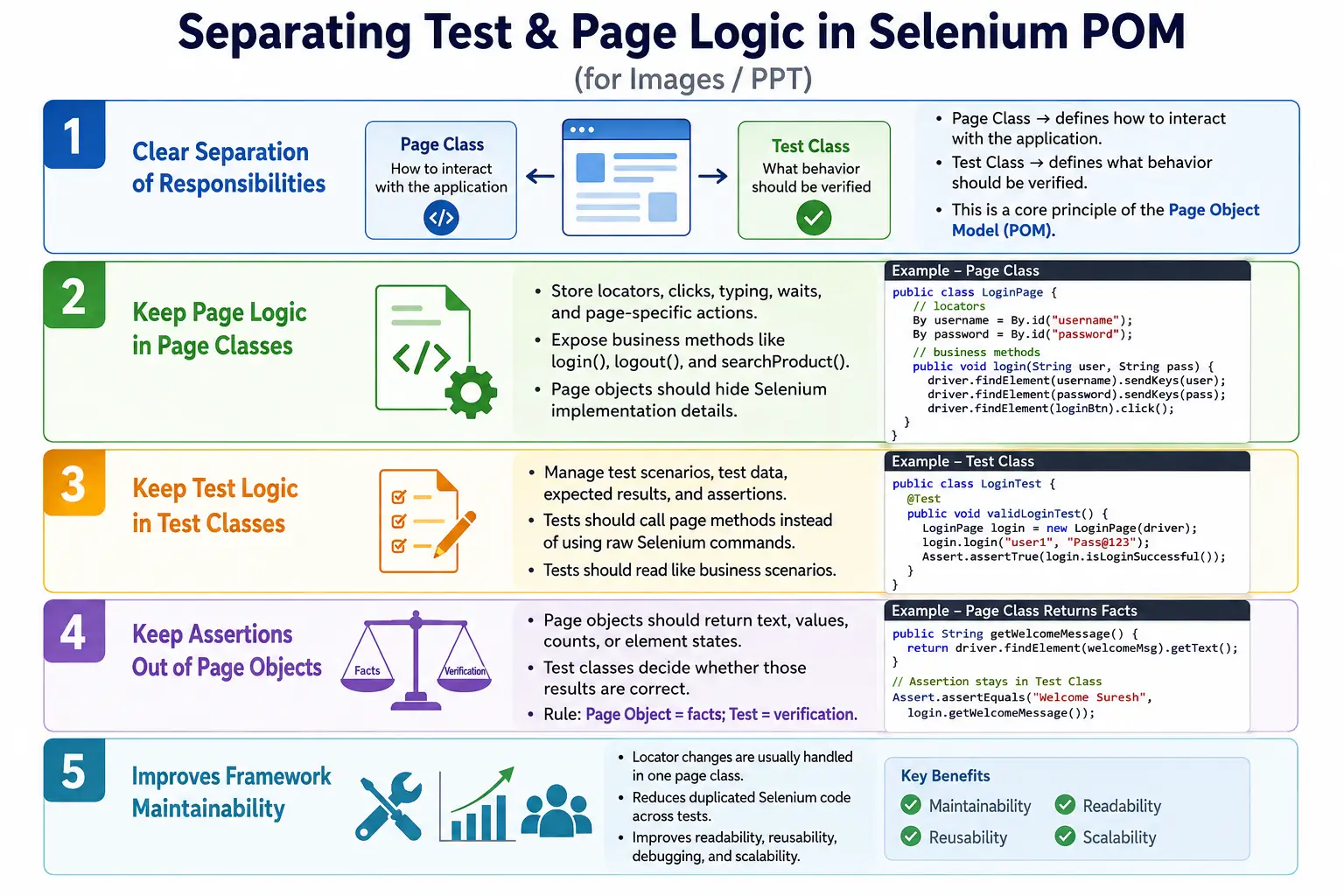
This separation is not just a code style preference. It is what turns fragile Selenium scripts into a maintainable automation framework. When tests contain raw locators and page objects contain assertions, responsibilities become mixed. The suite becomes harder to read, harder to debug, and harder to update when the application changes. A clean boundary makes the framework easier to scale across more pages, more tests, more contributors, and more execution environments.
1. The Core Idea
The Page Object Model works because it divides responsibility clearly. The page class answers how to interact with a page. The test class answers what behavior should be verified. This division is simple, but it has a major effect on framework quality.
Page Class:
How to interact with the page

Test Class:
What to verify from the user scenario
For example, a login page knows how to type a username, type a password, click the login button, and read an error message. A login test knows that valid credentials should open the dashboard and invalid credentials should show an error message. Those are different responsibilities and should live in different classes.
2. What Is Test Logic?
Test logic is the scenario and validation layer. It defines the expected behavior of the application. It decides which data to use, which workflow to execute, and what result should be asserted. Test logic is connected to requirements, acceptance criteria, business rules, and expected outcomes.
- Verify successful login.
- Verify invalid login error message.
- Assert dashboard title.
- Assert product is added to cart.
- Assert order confirmation is displayed.
- Assert validation message for required fields.
Assert.assertEquals(
        homePage.getPageTitle(),
        "Dashboard"
);
This assertion belongs in the test because the test knows the expected result. The page object can provide the actual page title, but it should not decide whether that title is correct for a specific scenario.
3. What Is Page Logic?
Page logic is the interaction layer. It defines how to work with a specific page or component. It includes locators, typing, clicking, selecting, reading visible text, checking element state, waiting for page conditions, and returning the next page object after navigation.
- Enter username.
- Enter password.
- Click login button.
- Get login error message.
- Search for product.
- Click checkout.
- Read cart total.
public void enterUsername(String user) {
    driver.findElement(username).sendKeys(user);
}
This belongs in the page class because it describes how the page is operated. The test should not need to know the username locator or how text is entered.
4. Bad Example: Mixed Logic
The following test mixes scenario, locators, browser actions, and assertion in one method. It may pass, but it is not a maintainable design.
@Test
public void verifyLogin() {
    driver.findElement(By.id("username")).sendKeys("admin");
    driver.findElement(By.id("password")).sendKeys("admin123");
    driver.findElement(By.id("login")).click();

    Assert.assertEquals(driver.getTitle(), "Dashboard");
}
This test has several problems. Locators are inside the test class. Selenium actions are inside the test class. If the login locator changes, this test must be edited. If many tests repeat the same login steps, the maintenance cost multiplies. The test also has low readability because it mixes implementation details with business validation.
5. Good Example: Page Logic in Page Class
The login page should own its locators and page interactions. A page object hides the details and exposes a method that represents the user action.
public class LoginPage {

    private WebDriver driver;

    private By username = By.id("username");
    private By password = By.id("password");
    private By loginButton = By.id("login");

    public LoginPage(WebDriver driver) {
        this.driver = driver;
    }

    public HomePage login(String user, String pass) {
        driver.findElement(username).sendKeys(user);
        driver.findElement(password).sendKeys(pass);
        driver.findElement(loginButton).click();

        return new HomePage(driver);
    }
}
The page class now controls how login is performed. If the username locator changes, the page class is updated. Tests that call login() do not need to change.
6. Good Example: Test Logic in Test Class
The test class should call page methods and assert expected results. It should read like a business scenario.
@Test
public void verifyLogin() {
    LoginPage loginPage = new LoginPage(driver);

    HomePage homePage =
            loginPage.login("admin", "admin123");

    Assert.assertEquals(
            homePage.getPageTitle(),
            "Dashboard"
    );
}
This is cleaner. The test tells the reader that a user logs in and the dashboard title is verified. It does not expose the username locator, password locator, or login button locator.
7. What Page Classes Should Contain
Page classes should contain the details needed to interact with a page. They are the owners of page structure and page-specific operations.
- Locators for elements on that page.
- Page actions such as click, type, select, and submit.
- Business methods such as
login(),logout(), andsearchProduct(). - Getter methods for visible text, title, state, and count.
- Explicit waits for page-specific readiness.
- Navigation methods that return the next page object.
public String getErrorMessage() {
    return driver.findElement(errorMessage).getText();
}
This method belongs in the page class because it knows where the error message is located. The test decides what the expected message should be.
8. What Test Classes Should Contain
Test classes should contain scenario flow, test data usage, expected results, and assertions. They should coordinate page objects, not implement page mechanics.
- Test scenario steps at a business level.
- Test data from constants, factories, fixtures, or DataProviders.
- Assertions based on expected behavior.
- High-level flow across multiple pages.
- References to requirements, groups, priorities, or categories.
Assert.assertEquals(
        loginPage.getErrorMessage(),
        "Invalid username or password"
);
The test owns the expected value because expected behavior belongs to the test scenario.
9. What Page Classes Should Not Contain
Page classes should not contain test assertions. They should not decide whether the application is correct for a business scenario. They should also avoid loading test data, controlling TestNG groups, creating browsers, or writing reports.
// Avoid this inside a page object
public void verifyLoginError() {
    Assert.assertEquals(
            driver.findElement(errorMessage).getText(),
            "Invalid username or password"
    );
}
A better page object method returns the visible text:
public String getLoginErrorMessage() {
    return driver.findElement(errorMessage).getText();
}
The test then performs the assertion. This keeps the page object reusable for multiple scenarios with different expected messages.
10. Why Assertions Should Stay in Tests
Assertions define expected behavior. Expected behavior belongs to tests because tests are written from requirements and acceptance criteria. A page object can answer what is displayed, whether an element is visible, or what value appears in a field. The test decides whether that result is correct.
Page object:
What is displayed?

Test class:
Is it correct?
This separation makes page methods reusable. A method such as getErrorMessage() can support invalid login, locked account, expired password, and empty password scenarios. Each test can assert a different expected message.
11. Real Project Structure
src/test/java
  pages
    LoginPage.java
    HomePage.java
    CartPage.java
  tests
    LoginTest.java
    SearchTest.java
    CheckoutTest.java
  base
    BaseTest.java
    BasePage.java
  utilities
    WaitUtil.java
    ScreenshotUtil.java
This structure helps the team know where code belongs. Page classes are under pages. Test classes are under tests. Browser setup is in base. Reusable technical helpers are in utilities.
12. Example Flow
LoginTest
  LoginPage.login()
    HomePage.getPageTitle()
      Assert in LoginTest
The test coordinates the flow. The page objects perform interactions and return page state. The assertion happens in the test.
13. BasePage Role
BasePage can contain reusable UI interaction helpers such as click, type, get text, wait for visibility, wait for clickability, and scroll. Page classes extend BasePage and use these helpers.
public class BasePage {

    protected WebDriver driver;

    public BasePage(WebDriver driver) {
        this.driver = driver;
    }

    protected void click(By locator) {
        driver.findElement(locator).click();
    }

    protected void type(By locator, String value) {
        WebElement element = driver.findElement(locator);
        element.clear();
        element.sendKeys(value);
    }
}
BasePage should support page interaction. It should not contain test assertions or scenario-specific business validations.
14. Page Class Using BasePage
public class LoginPage extends BasePage {

    private By username = By.id("username");
    private By password = By.id("password");
    private By loginButton = By.id("loginBtn");

    public LoginPage(WebDriver driver) {
        super(driver);
    }

    public DashboardPage login(String user, String pass) {
        type(username, user);
        type(password, pass);
        click(loginButton);

        return new DashboardPage(driver);
    }
}
This page object is clean. It owns its locators, uses reusable base methods, exposes a business method, and returns the next page object.
15. Test Class Using Page Objects
public class LoginTest extends BaseTest {

    @Test
    public void validLoginTest() {
        LoginPage loginPage = new LoginPage(driver);

        DashboardPage dashboard =
                loginPage.login("admin", "admin123");

        Assert.assertTrue(
                dashboard.isDashboardDisplayed()
        );
    }
}
The test extends BaseTest for setup and uses page objects for application actions. The assertion remains in the test class.
16. Returning the Next Page Object
When a page action causes navigation, returning the next page object keeps the flow clear. A login action can return dashboard. A checkout action can return payment. A payment action can return confirmation.
public DashboardPage login(String user, String pass) {
    type(username, user);
    type(password, pass);
    click(loginButton);

    return new DashboardPage(driver);
}
This models the application flow in code and reduces manual page object creation in tests.
17. Boolean Page State Methods
Page classes can return boolean state. For example, a dashboard page can say whether the dashboard is displayed. The test decides whether that should be true.
public boolean isDashboardDisplayed() {
    return driver.findElement(dashboardHeader).isDisplayed();
}
Assert.assertTrue(
dashboardPage.isDashboardDisplayed()
);The page object provides the state. The test performs validation.
18. Business-Friendly Page Methods
Page methods should describe user behavior, not only technical actions. Methods such as login(), searchProduct(), addToCart(), applyCoupon(), and checkout() are clearer than exposing every click and type operation to tests.
This makes tests easier to review. A stakeholder or new team member can read the test and understand the flow without inspecting every locator.
19. Avoid Exposing WebElements
Do not expose WebElements publicly from page classes. If tests directly call loginPage.loginButton.click(), the test is again depending on page implementation. This breaks encapsulation.
Expose methods instead. The page object should decide how a login button is clicked, including waits, scrolling, or fallback handling if needed.
20. Explicit Waits Belong Near Page Interaction
Explicit waits usually belong inside page methods or reusable page helpers because they are tied to page readiness. A test should not need to know that a login button becomes clickable after a spinner disappears. The page object can handle that detail.
Keeping waits close to page interaction improves consistency and reduces duplicated timing logic across tests.
21. Test Data Is Not Page Logic
Page objects should accept data but not own test data. A login page can accept username and password as method parameters. It should not decide which username belongs to smoke testing or read usernames from Excel directly. Data selection belongs to tests, DataProviders, or data utilities.
loginPage.login(username, password);This keeps the page object reusable across positive, negative, boundary, and role-based scenarios.
22. Component Objects
Some UI areas are reusable but not full pages. Header, footer, navigation menu, profile menu, product card, filter panel, and modal dialog can be represented as component objects. Component objects follow the same separation rule: they own component interaction, not test assertions.
For example, a header component can expose logout(). A test can assert that logout returns the user to the login page.
23. Common Design Mistakes
- Putting locators directly inside test classes.
- Putting assertions inside page objects.
- Making WebElements public.
- Creating one large page object for many unrelated pages.
- Putting test data reading inside page classes.
- Putting report logging and screenshot logic inside page methods.
- Using page objects as end-to-end workflow classes.
- Duplicating the same locator in multiple tests.
24. Why Separation Improves Maintenance
When the UI changes, page logic changes. When the requirement changes, test logic changes. Separating these layers makes maintenance easier because the type of change points to the correct file. A changed locator should usually affect the page class. A changed expected message should usually affect the test.
This reduces blast radius. A single locator update should not require editing many tests. A new assertion should not require changing the page interaction layer.
25. Why Separation Improves Readability
A clean test reads like a business scenario. It does not contain long selectors, repeated waits, or browser command details. The test communicates intent. Page objects hide implementation.
DashboardPage dashboard =
        loginPage.login("admin", "admin123");

dashboard.logout();

Assert.assertTrue(
        loginPage.isLoginPageDisplayed()
);
This is easier to understand than a test filled with raw element operations.
26. Where Workflow Classes Fit
Sometimes a business flow spans many pages and is reused often. For example, creating an order may require login, search, product selection, cart, checkout, and payment. If this flow is repeated in many tests, a separate workflow helper can coordinate page objects.
Even then, page objects should still contain page interaction, and tests should still contain assertions. A workflow class can reduce duplication for repeated multi-page setup, but it should not become a place where all assertions and page details are hidden.
27. Code Review Checklist
- Does the test class contain raw locators?
- Does the page class contain assertions?
- Are page methods named as business actions?
- Are WebElements private?
- Are waits handled in page methods or page helpers?
- Does navigation return the next page object where useful?
- Is test data selected outside page classes?
- Can page methods be reused across multiple tests?
28. Practical Rule of Thumb
Ask one question when deciding where code belongs: is this code about interacting with the page, or is it about verifying the scenario? If it is about interacting with the page, place it in the page object. If it is about verifying expected behavior, place it in the test.
This rule is simple enough to apply during development and code review. It prevents most common POM mistakes.
29. Positive and Negative Scenario Design
Separating test and page logic becomes especially important when the same page supports both positive and negative scenarios. A login page can be used for valid login, invalid login, locked account, empty password, expired password, and role-based login. The page interaction is similar, but the expected result changes by scenario.
The page object should provide reusable methods such as login(), getErrorMessage(), and isLoginPageDisplayed(). The test class should decide which data to use and what result to expect. This avoids creating separate page methods such as verifyInvalidLogin(), verifyLockedUser(), and verifyEmptyPassword() inside the page class.
When page objects contain scenario-specific verification, they become less reusable. A page method that returns page state is more flexible than a page method that performs one fixed assertion.
30. Data-Driven Tests
Data-driven tests also benefit from this separation. A DataProvider may supply many usernames, passwords, and expected outcomes. The login page still needs only one method to perform login and one method to read page state. The test loops through different rows and performs assertions based on each row's expected result.
@Test(dataProvider = "loginData")
public void loginTest(String user, String pass, String expected) {
    LoginPage loginPage = new LoginPage(driver);

    loginPage.login(user, pass);

    Assert.assertEquals(
            loginPage.getLoginResult(),
            expected
    );
}
The page object does not know where the data came from. It only knows how to interact with the page and return page information. This keeps the page layer reusable across hardcoded tests, DataProvider tests, Excel-driven tests, API-prepared data, and CI executions.
31. Reporting and Screenshots
Reporting and screenshots are often confused with page logic. A page method should not become responsible for writing report entries for every click. Reporting usually belongs in listeners, reporting utilities, or the test framework layer. Screenshots on failure are usually handled by a TestNG listener or teardown logic.
A page object may provide meaningful method names that make reports easier to understand, but it should not directly control the report lifecycle. For example, loginPage.login() is a good page method. The listener can record failure evidence if that method throws an exception. The page object does not need to know how the report is generated.
32. Error Handling Responsibility
Page objects can handle expected page-level conditions, but they should not hide serious failures. If a login button is not clickable, the page method can wait and then fail with a meaningful Selenium timeout. The test or framework can capture the failure. Swallowing exceptions inside page methods and returning false for everything makes debugging harder.
For expected application messages, return page state. For unexpected automation or application failures, allow the failure to surface clearly. Clean separation also means clean failure handling.
33. Page Logic and Business Logic
There is a difference between page logic and business logic. Page logic is how to operate the UI. Business logic is what the application should do according to requirements. Page objects may expose business-named actions, but they should not decide business correctness.
For example, applyCoupon("SAVE10") can be a page method because it performs a user action. But deciding that the cart total should reduce by 10 percent is test logic. The cart page can return the total before and after applying the coupon. The test validates the discount rule.
34. Service and API Setup
Some tests need data setup before UI execution. For example, a checkout test may need a product, a customer, or an order state. That setup should not be placed inside a page object. It belongs in test setup, API utilities, data builders, or service helpers.
Page objects should not create database records or call backend APIs as part of normal page actions. Mixing UI page logic with backend setup makes responsibilities unclear. A test can prepare data through an API helper, then use page objects to verify the UI behavior.
35. Parallel Execution Impact
Clear separation also helps parallel execution. Page objects should be created per test execution with the correct driver instance. Test classes should manage scenario flow and data. Shared static page objects, shared static WebElements, or shared mutable state can break parallel runs.
If each page object only contains instance locators and methods using its own driver, it is easier to run tests in parallel. If page objects also hold test data, assertions, report state, and workflow state, parallel safety becomes harder.
36. Refactoring Existing Tests
When refactoring an older Selenium suite, do not rewrite everything in one step. Start with the most duplicated flow, usually login. Move locators and actions into LoginPage. Keep the assertion in the test. Then move other repeated page interactions into their page objects.
A safe refactoring strategy preserves test intent. The test should still verify the same behavior before and after refactoring. Only the location of page interaction code changes. Run the test after each page extraction so mistakes are caught early.
37. Signs of Good Separation
- Test methods read like business scenarios.
- Test classes do not contain raw locators.
- Page classes do not contain business assertions.
- Page methods are reusable across multiple tests.
- Locator changes are usually fixed in one page class.
- Expected result changes are usually fixed in tests.
- Page objects can be reused with different test data.
- Failures are easier to trace to either page interaction or validation.
38. Signs of Poor Separation
- Tests contain many
driver.findElement()calls. - Page objects contain many
Assertstatements. - Page objects read Excel or JSON test data directly.
- Page objects create WebDriver instances.
- One page object contains actions for many unrelated pages.
- Tests access public WebElement fields.
- Changing one locator requires editing many tests.
- Test reports do not clearly show whether failure came from action or assertion.
39. Practical Code Organization
A practical framework can organize code by responsibility. BaseTest handles driver setup and teardown. BasePage handles reusable UI interactions. Page objects represent pages. Component objects represent reusable page sections. Test classes represent scenarios. Data utilities prepare data. Listeners and report utilities handle evidence.
This organization avoids overloaded classes. If a class has too many reasons to change, it probably owns too many responsibilities. Good separation follows the single responsibility principle in a testing framework context.
40. Naming Conventions
Naming helps enforce separation. Page object method names should describe user actions. Test method names should describe expected behavior. A method named login() belongs in LoginPage. A method named validUserShouldNavigateToDashboard() belongs in a test class.
Clear naming makes code review easier. Reviewers can quickly identify misplaced logic. If a page method starts with verify, it may be doing assertion work. If a test method contains By.id(), it may be doing page work.
41. Advanced Rule: Page Objects Return Facts
A useful way to think about page objects is that they return facts about the page. They can return text, titles, boolean visibility, counts, selected values, and current state. Tests interpret those facts against expected behavior.
String actualMessage =
        loginPage.getLoginErrorMessage();

Assert.assertEquals(
        actualMessage,
        "Invalid username or password"
);
This approach makes page objects reusable and tests expressive. The same page fact can support many different assertions.
42. Applying Separation During Debugging
Good separation also helps during debugging. When a test fails before an assertion, the problem is often in page interaction, synchronization, locator quality, browser state, or application availability. When a test reaches the assertion and the actual value differs from the expected value, the issue is often a product behavior difference, test data issue, or changed requirement.
This distinction makes failure analysis faster. If the failure happens inside loginPage.login(), start with the login page object, locator, wait, or page readiness. If the failure happens at Assert.assertEquals(), inspect the expected result, actual application behavior, and test data. Mixed logic makes this diagnosis harder because action and verification are tangled together.
43. Applying Separation During Code Review
During code review, separation gives reviewers a clear standard. A reviewer can reject a test class that contains raw By locators. A reviewer can question a page class that imports TestNG Assert. A reviewer can suggest moving data setup out of page objects and moving repeated page interaction into page methods.
This creates consistent framework quality. Without a clear separation rule, every tester writes automation in a personal style. Over time, the framework becomes inconsistent. With a clear rule, new tests follow the same structure and maintenance remains predictable.
44. Applying Separation During Onboarding
New automation engineers understand a framework faster when responsibilities are separated. They can open a test class to understand what scenario is being verified. They can open a page class to understand how a page is operated. They can open utilities to understand shared technical behavior.
If every class mixes setup, data, locators, waits, assertions, screenshots, and reports, onboarding becomes slow. Clear separation acts as documentation. The folder structure and class responsibilities teach the framework design.
45. Practical Example: Cart Validation
Consider a cart page. The page object can expose methods such as getCartItemCount(), getCartTotal(), removeItem(), and proceedToCheckout(). The test class can assert that the item count is one, the total matches the expected price, or checkout navigation occurs.
Assert.assertEquals(
        cartPage.getCartItemCount(),
        1
);

Assert.assertEquals(
        cartPage.getCartTotal(),
        "$120.00"
);
The cart page returns facts. The test verifies those facts against the scenario. This same cart page can support positive checkout tests, coupon tests, remove item tests, and tax calculation tests without embedding assertions inside the page object.
46. Practical Example: Search Validation
A search page can expose searchProduct(), getResultCount(), and getFirstResultName(). The test can decide whether zero results, one result, or multiple results are expected. This is much cleaner than creating page methods such as verifySearchHasResults() and verifySearchHasNoResults() for every scenario.
When page objects expose data and tests verify it, one page method can support many assertions. This keeps the automation suite smaller and easier to extend.
47. Keeping Test Flow High-Level
A well-written test should not describe every click. It should describe the important business flow. This does not mean hiding all details. It means hiding page mechanics that are not relevant to the purpose of the test.
DashboardPage dashboard =
        loginPage.login("admin", "admin123");

SearchResultsPage results =
        dashboard.searchProduct("Laptop");

CartPage cart =
        results.addFirstProductToCart();
This code communicates the workflow clearly. The page objects handle how each action is performed. The test continues by asserting the expected business result.
48. Final Best Practices
- Page classes should expose actions and page state.
- Test classes should expose intent and expected behavior.
- Do not optimize for fewer classes; optimize for clearer responsibility.
- Do not hide assertions inside page methods for convenience.
- Do not duplicate page mechanics in many tests.
- Use workflow helpers only when a repeated multi-page setup truly needs one.
- Keep the public interface of page objects stable and business-friendly.
49. Interview Perspective
A short interview answer is: separating test and page logic means keeping Selenium locators and page actions inside Page Object classes, while keeping assertions and test scenarios inside test classes.
A stronger real-time answer is: in my Selenium framework, page classes contain locators, waits, and page-specific actions such as login(), logout(), or searchProduct(). Test classes call those methods and perform assertions based on expected business behavior. This separation improves readability, reduces duplication, centralizes locator maintenance, and makes the framework easier to scale.
50. Key Takeaway
Page object classes answer how to interact with the application. Test classes answer what to verify. Keeping these responsibilities separate is the foundation of clean Selenium Page Object Model design.
A clean Selenium framework keeps page interaction logic inside page objects and validation logic inside test classes. This makes tests readable, page classes reusable, locators centralized, and maintenance more controlled when the application changes.